Tuesday, March 6, 2012

Alien Ingredient #19: Shungiku/Tung Ho


Shungiku (Japanese) or Tung Ho (Chinese) is an edible chrysanthemum leaf, Chrysanthemum coronarium. While I've read about it in my Asian cookbooks, I have never seen it in person before and honestly, wasn't too excited about trying it. My experiences with other members of the Chrysanthemum family have led me to conclude that I really don't like the smelly, Artemisia-like leaves at all.

To my pleasant surprise, the so-called Garland Chrysanthemum leaves taste just fine, sort of a cross between celery leaf and parsley leaf. Cooked, the flavor is milder, more at spinach. So I can gladly report that they taste just fine in salads, in stir fries, as well as in their traditional role in soups (nabemono).

In the western culinary lexicon, if you think of shungiku as a drop-in replacement for spinach, albeit with more flavor, you will understand its potential.

Vote: yep, just fine; another useful green to have in one's arsenal.

Saturday, March 3, 2012

Early March Tastings

Here are photos from a series of tastings we've done this week, playing games with what we have on hand.

Salmon Tartare. There's [sc]eviche, tartare, crudo, poke and all manner of other names for raw fish dishes. I'm calling this tartare and not seviche because the citrus juice goes on seconds before the dish hits the table so that there is no discoloration/firming of the flesh. Any time that we have a fatty fish belly, you can rest assured we're making a similar dish, whether or not it appears on the menu. It makes a great chef snack. This one contains red and yellow peppers, capers, green and red onions, Meyer lemon juice, and extra virgin olive oil. And as an accidental metaphor for the list of ingredients, note kitchen sink in background.

Mussels with Coconut-Yuzu Sauce. Finally, some good lighting in a kitchen picture! Sure I'd love to have a reflector behind this, but the quality of light on my cutting board versus on the main plating line is much nicer. Note to self. This is mussels steamed in coconut milk with yuzu juice and the sauce finished with a touch of fish sauce, lime leaves, and sugar. Grated lime zest and green onions over.

Grilled Shrimp. This all started early in the week when a customer inspired us to create a Provençale style pasta sauce. On the plate are two tiny wedges of a duck egg frittata made with roasted red peppers and goat cheese. These are the sops for a sauce of grilled peppers, sun-dried tomatoes, caperberries, black olives, fennel fronds, and orange zest. Propped up on all this is a grilled shrimp, marinated in black olive, garlic, and orange zest paste.

Duck Salad. This dish was really an exercise in how to use a new bottle of butternut seed oil. We're experimenting with it and naturally, it crossed our minds to make a dressing from it and Meyer lemon juice. The dressing is delicious. From there it's just a matter of building a salad around the dressing: local mesclun tied with Meyer lemon rind, duck confit, duck cracklings, duck fat croutons, orange segments, and toasted pumpkin seeds.

Rabbit Loin. Rabbit and fennel were made to go with each other: it's a magical combo. We've pounded out rabbit loin, dusted it with fennel pollen, and stuffed it with goat cheese mixed with fennel fronds and confit of fennel. Then it's rolled and wrapped in prosciutto, seared and finished in the oven. Purée of fennel and celery root down with a few cubes of fennel confit. We made the fennel confit in duck fat rather than olive oil.

Mushrooms and Bacon. We received a lot of brown beech, white beech, and pioppini mushrooms this week; you see them here featured with slab bacon on top of polenta. Nothing earth shattering or fancy about this, just plain old comfort food.

Teriyaki Royal Trumpet Mushrooms. In with the rest of our mushrooms this week were a few large royal trumpets, a mushroom that I like best when grilled and glazed with teriyaki sauce.

"Arancino." Here's a little play on food. When you hear arancino, you expect the deep-fried Sicilian risotto ball, perhaps stuffed with cheese or maybe even a ragù. But I doubt you expect our Northern Chinese Style pulled lamb stuffed into a fried rice ball. A little local bok choy to complete the dish.

Pork Belly. We were playing with the idea of Chinese steam buns stuffed with pork belly. But I'm not big on the texture of steamed dough, so I grilled it. There is something magical about tucking into a slab of pork belly with freshly cooked bread!

Here you see two different presentations. I'm not super happy with either presentation. The flavor was excellent, but the presentation is still lacking.

Jackfruit and Meyer Lemon Granita. This is a dish that had customers raving. The combination of the hyper-tropical flavors of the jackfruit with the lemon-orange tartness of the Meyer lemon yielded the best sorbet/granita I have ever tasted. Topped with a touch of amarena cherry mosto cotto and set on a piece of sinful coconut French toast.

Truffles. So every now and again, we make truffles. They're a fun way to end the evening. These are rolled in toasted coconut and in crushed candied walnuts. Plated with raspberry coulis and fried salted rice paper for a little texture.

Japanese Dinner

Here are the photos from a recent Japanese-themed dinner. The customer came to us with a menu in hand, so there wasn't a whole lot of wiggle room.

Salmon Sashimi with Pickled Daikon. Just a quick 24-hour pickle on the local daikon; thickened house-made ponzu on the plate. We let our ponzu brew for 48 hours before taking out the kombu and the hana-katsuo. We decided to use limes for the ponzu rather than bottled yuzu: fresh fruit tastes better, though limes taste different than yuzu.

Mushroom Mini Pizzas. The customer, having just returned from two weeks in Japan, says that mini pizzas are all the rage right now. We wouldn't know, but we do know how to make pizzas. You see hon-shimeji mushrooms (actually a mix of brown and white beech and pioppini) sautéed with a touch of garlic and ginger and finished with a splash of tamari. The sauce is soft tofu blended with ponzu. We thought it was a delicious touch bringing both creaminess and acid to the pizzette.

Yakitori. You see both chicken thighs and hearts skewered here, brushed with our house-made taré. We put the chicken in a soy- and ginger-based marinade for 48 hours. The taré sauce, based on chicken bones, took 48 hours to make and it has such a rich meaty sweetness. I couldn't find any cockscombs on such short notice; that would have been really cool as part of this dish. As it was, most of the guests didn't touch the hearts, which we happily snacked in the kitchen. The hearts are definitely the best part of this dish.

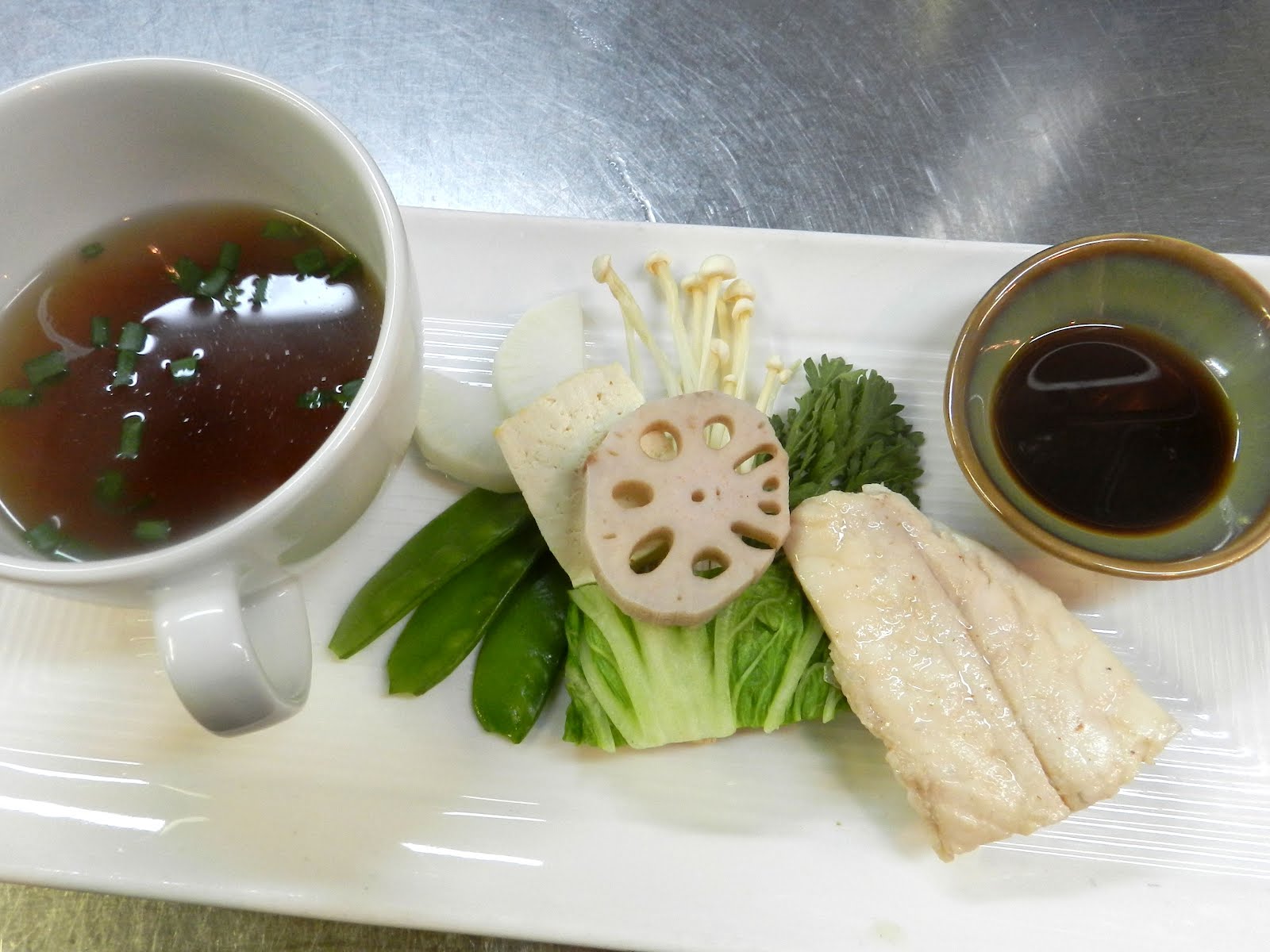
"Chirinabe". How do I tell a customer who is in love with a menu that we are not equipped to do a traditional nabe? I don't and I wing it, hence the quotation marks around chirinabe (fish hot pot). We just don't have the equipment to put communal hot pots on the tables (and the American customers would have freaked out at a communal pot anyway), so we blanched the vegetables and poached the black sea bass before plating them with a cup of boiling stock and small dish of ponzu for dipping. The garnishes, clockwise from the snow peas, are snow peas, daikon, enokitake, shungiku, sea bass, napa, tofu, and lotus root.

Purple Yam Custard. I wanted to finish with rice and then some fresh fruit. Customer wanted a dessert. So here is a pan-Asian dessert: a brûléed custard of Okinawa sweet potato, sesame seed brittle, and some fresh jackfruit in simple syrup. At least I managed to keep the dish non-sweet and sneak some fruit in too. The white flecks are sesame oil powder.

Friday, March 2, 2012

Alien Ingredient #18: Guava

I seem to be on a roll with the tropical fruit in the last few posts, though it's certainly not by design. It just happened that way. Last trip to the market, I spied some ripe baby yellow guavas, the first guavas I've ever seen. These are smaller than a lime, included in the photo for comparison, light yellow, a yellow the color of non-russeted Asian pears. The fruits are yielding in the sense that a peach or pear yields when it is ready to eat.

Now guava is not an unknown fruit to me. We regularly use pasta de guayaba (guava paste) and membrillo (quince paste) on our cheese plates. And I have somewhat fuzzy memories of last Easter Monday at a pool in St. Martin where our bartender Alain made us round after round of fabulous cocktails that he called Rendezvous, based on guava nectar.

I didn't know it was guava nectar at the time; I had to ask Alain because I could not place the haunting part passionfruit, part banana, part pear aroma coming from the cocktail. And this is the exact same aroma coming from these tiny little guavas, very tropical, very haunting, and very promising!

These particular guavas, in addition to being small and yellow, have white flesh. Many guavas have red or pink flesh. I cut one open to expose the round, very hard, blond seeds. The seeds in this particular guava are inedible and are encased in a pulp that reminds me of very, very ripe slippery, almost slimy, banana. This custardy pulp tastes mainly of banana and pear, with firm acidity and a slight starchiness that is unexpected. The shell of fruit surrounding the pulp is firmer with a texture and flavor of pear with banana overtones. Nowhere in the flesh could I find that haunting and elusive passionfruit that I smelled and that was so alluring.

Vote: This siren of a fruit lured me in with its aroma and then left me wanting. I won't try this particular kind of guava again, but I will try others as they cross my path.

Wednesday, February 29, 2012

Alien Ingredient #17: Jackfruit

These watermelon-sized fruits with the horned rinds (similar to Durians) are intimidating looking beasts, now that I see one in person. I've seen canned jackfruit in markets all my life, but when I try a fruit for the first time, I want to try the fresh version. And jackfruit has just become available at the local market.


The first thing that struck me about the fruit is the outstanding nose, perfumed with pineapple, mango, and banana. It is a simply beguiling smell. The flavor is—I don't know how to put it better—of straight up Juicy Fruit gum with a sweet banana finish. I can't explain Juicy Fruit to non-Americans because it's something you have to taste, but try to imagine a symphony of every tropical fruit you know.

So, how to attack one of these monsters, the largest tree fruits? I bought a quarter of one, about 5.5 lbs (2.5kg), already cut. Whole ones are easy enough to split and quarter with a sharp knife. When working with jackfruit, you definitely need to be mindful of the latex that the core oozes when cut. It can make a sticky mess, but I had no problem washing it off with hot water and soap.

I cut the core out of my quarter and this exposed the individual fruits (technically I think they're called arils, but really, who cares?). This is a fruit with training wheels: it is obvious how to disassemble it. The edible fruits are yellow and the stringy pithy white stuff surrounding them is not so good. Inside the fruit, you find a big seed that you discard. What's left is good, really good.


The texture of the fruit is unique in my experience; it compares to nothing in my vocabulary. The fruit is totally dry with no discernible juice. The texture is somewhat waxy and somewhat yieldingly crisp; it is not unpleasant though, but I just don't have any words to describe it.

Note: the next day, after we had pulled the fruit from the husk and refrigerated it overnight, the tropical complexities had dissipated and we were left with a fruit that tastes remarkably like cantaloupe with none of the sweet banana finish. Go figure.

Vote: Wow! We really like this fruit and the price is right!

Thursday, February 23, 2012

Winter Ingenuity


Jerusalem Artichoke Bisque, garnished with beet cream, white truffle oil, and toasted pumpkin seeds. What to make when there's not much in the cooler.

Alien Ingredient #16: Spondias/Mombin

I'm very weak on the subject of tropical fruits for the simple reasons that I run a local and seasonal restaurant in North America and I have never traveled much in the tropics, save the islands in the Caribbean, whose markets sell more or less the same fruits we do in our grocery stores here. So, I just don't have a clue about most tropical fruits. Grandilla? Sapodilla? Morinda? Safou? Yeah, heard of them, but never seen one live and in color. So I'm always on the lookout to increase my knowledge of such fruit.

With that in mind, I've had my eye on the jar of pickled makok—you know there's a joke in here somewhere—at the market for a while now and finally decided that it needed to come home with me, anticipating that it is similar pickled green mango or green papaya pickles. The fruits are lime-sized and are peeled before being pickled.

Before leaving the store, I googled makok to see what I was buying and found that makok is the Thai word for the fruit of Spondias dulcis. That reminded me that I had also previously seen other Spondias in the freezer case. These fruits are labeled jocote, both types of which are labeled as being S. purpurea or purple (or red) mombin. The red-purple type is called jocote indio and the green-yellow type is called jocote de corona.

In reading further on the subject, it appears that the green-yellow ones are color variants of purple mombins, and not yellow mombins, S. mombin, but our taste tests do not bear this out. The green ones taste and appear nothing like the red ones. Here they are side by side for comparison.


Each of these fruits appears to be a drupe, that is, it has fleshy fruit surrounding a central pit. The pits are more at mango pits than any of our domesticated drupes. The central pit is connected by masses of fibers to the flesh, a real clingstone if I ever saw one.

The pickled makok flesh is light green and mildly sweet, with sort of the texture of a mushy watermelon rind pickle. On chewing the pickle, the good parts disappear quickly and after a few moments, you're left chewing on a sort of flavorless, pasty, fibrous mass. To quote me during our tasting, "This is not a good pickle."

The red mombins on the other hand had a leathery skin yielding to a grapey, plummy red flesh. They are sweet and pretty tasty. I think we'll use the rest of these to flavor a flan or sorbet. By contrast, the yellow mombins had the same leathery skin yielding to a broken custard-looking baby puke flesh. The flavor was a touch medicinal and the skin quite astringent. These quickly went into the trash.

Vote: Pickled makok—not a good pickle. Red mombin—a delicious fruit, if quite low on the flesh to pit ratio. Yellow mombin—baby puke flesh says it all.