Friday, June 1, 2012

Alien Ingredient #30: Goose Eggs

Here at the restaurant, we use a lot of eggs as you might imagine. We are very fortunate to use duck eggs almost exclusively in our pastries and as a result, our pastries are killer rich and delicious. As an aside, all our recipes specify eggs by weight, so it is trivial for us to substitute an equivalent weight of duck eggs for chicken eggs. Doing things by weight, besides being how professional kitchens do things, has always been a necessity for us because we have never used standardized eggs. When our supplier's chickens were young, we would receive tiny pullet eggs and later on, as the Rhode Island Reds got to maturity, we'd get honking great eggs that were twice the size of pullet eggs and half again bigger than a store-bought extra large egg.

Goose, Extra Large Duck, Duck, Extra Large Chicken, Quail
We are super fortunate that our duck egg supplier has a goose or two that are laying eggs, so she brought us some goose eggs for grins. As you can see in the photo, goose eggs run about three times the size of an extra large egg. Besides being huge, the yolks are very different from chicken or duck eggs, almost custardy or pasty. When cooked, goose eggs are much more similar to duck eggs than chicken eggs in that they are intensely eggy and rich. We easily prefer duck or goose eggs to chicken eggs for scrambled eggs, and that is saying something because our fresh chicken eggs taste awesome.

Duck, Duck, Goose
Here you see one application of our goose eggs in a dish that we call Duck, Duck, Goose. On the plate is a slab of sourdough bread French toast made with a goose egg custard and fried in foie gras fat. On top of this is what we call duck bacon, breast tenders that we cure in salt, sugar, and pink salt and then smoke. The next layer is scrambled goose egg with chives, done in the classic French preparation oeufs brouillés, whisked over a water bath until creamy and custardy. On top are threads of duck confit that we have shredded and deep fried. Maple syrup completes this delicious and over the top decadent dish.

Vote: Goose eggs are awesome and we prefer them to chicken eggs. Duck eggs are equally awesome!

Wednesday, May 30, 2012

Alien Ingredient #29: Korean Melon

Korean Melon, Cell Phone for Reference
I spied this small oblong orange-yellow melon at the market the other day and decided to take it home. I chose it like any other melon: I smelled it for fragrance and felt it for a little give. This one was fragrant and had plenty of give.

On cutting it open, the fragrance is a cross between honeydew and cantaloupe and the flesh is nearly white with a slight yellow cast. The flesh tasted the same way, but despite showing all the signs of ripeness, it was too firm to spoon out of the shell.

Vote: nothing to write home about. Both ripe honeydew and ripe cantaloupe blow this guy out of the water and at $1.79 for a tiny melon, it's very expensive. I'll wait for July and August for our local melons, thanks.

Saturday, May 26, 2012

Alien Ingredient #28: Artichoke Stems

Out of the blue, one of our growers recently brought us a big bunch of artichoke leaves. I really don't know of any use for the gray-green leaves, but the central leaf ribs which you see in the picture below can be used like Swiss chard. Stripped down like this, they sort of resemble celery, chard, cardoon, or rhubarb stalks. We braised one of the artichoke stems in chicken stock with a touch of butter and lemon juice and our initial taste of the small end led us to believe that not only was the stalk edible, but that it tasted very much like artichokes, no surprise there.

I peeled the stalks down like celery or rhubarb, removing as many of the strings as I could and then braised them. We unleashed them on an unsuspecting table of guests at our Chef's Table. We served them stuffed with a classic Bolognese sauce made with some of our local rabbit. And the verdict, tasty but too stringy still. Darn! Back to the drawing board.

So we puréed them and served them as-is as a plate garnish, in a soup with asparagus, and as a sauce for some delicate John Dory filets. They worked admirably for these applications.

We're working on thinly slicing them across the grain to see how that works. I'm hoping that lets us use the stems in salad and side dish applications.

Vote: Delicious, but are probably best puréed and passed through a fine chinois. We'll take more any day.

Thursday, May 10, 2012

Alien Ingredient #27: Rambutan


This hairy relative of the lichee looks rather bizarre but is really a delicious fruit with notes of sweet melon, peach and jackfruit. The texture of the flesh surrounding the small pit is similar to a firm grape, but like jackfruit the flesh is not juicy. On some, when the flesh would peel away from the seed, it would pull some of the seed coating away attached to the flesh. This seed coating has an almond-like flavor.

I found it necessary to nick the husk with a knife to start opening it. I left a few on the counter overnight trying to see if I could get them to ripen more. Bad move. They shriveled. It seems best to store them covered.

Vote: Fun, tasty, not super sweet, and not cloying like lichees, but at $8/pound with at most 50% yield, probably not worth the price.

Saturday, April 21, 2012

"Spring"—A Chef's Tasting

We just did a Chef's Tasting on Thursday night with the theme of Spring. We decided to let the menu be informed by not only the ingredients that are available now in the spring but by the ideas and memories evoked by the season.

I am really pleased with this menu and think that it clearly states who I am as a chef right now and speaks to the food that appeals to me: simple, fresh, direct, highly flavorful, yet still a bit whimsical and playful, not too serious for its own good. I like this menu because the dishes are largely pared to their essence—not too many ingredients on the plate, but just enough. It is very difficult as a chef to pare dishes to their core: it forces excellence in the thought behind a dish, the ingredients themselves, and of course, in technique.

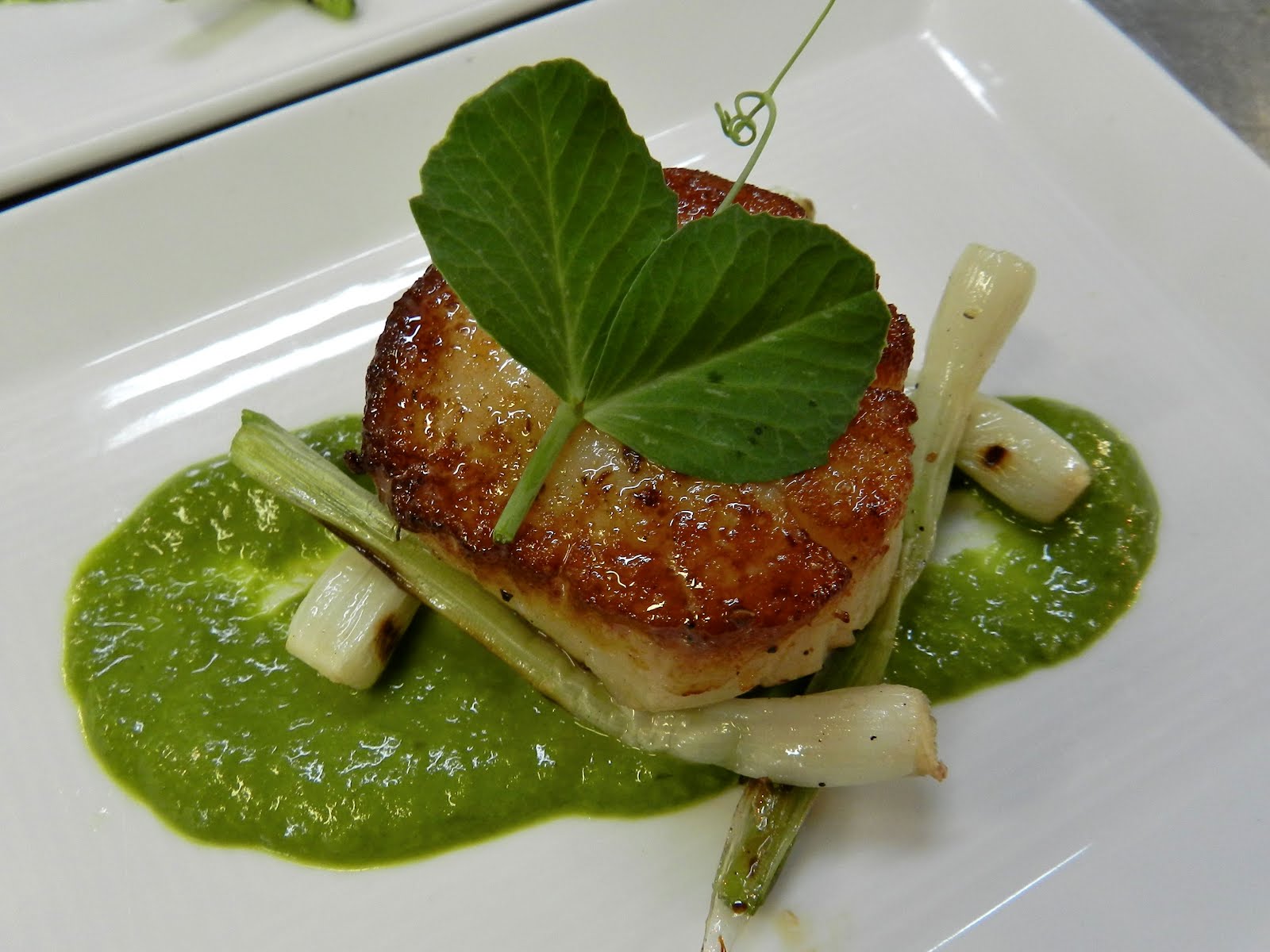
Sea Scallop. Spring always brings great scallops as new grounds are opened. I wanted to highlight our beautiful scallops against some of our local spring greens. The scallop is sitting on a purée of ramp greens and grilled baby spring onions and topped with a sugar snap tendril from my garden. The ramp bulbs have long since vanished into sopa de ajo.


Arctic Char. Spring always has me looking forward to salmon as it begins its spawning run up the rivers. It's just a little too early yet for salmon, but we do have two nice salmonids in house right now, arctic char and steelhead trout. Last week, we put up a batch of cured steelhead trout, so-called gravlax of steelhead trout, and we had a bunch of trimmings to work with.

On this plate, you see a mousse of roasted steelhead gravlax, fennel fronds from my garden, very lightly pickled hothouse cucumbers, seared arctic char, and a wonton containing gravlax, chives, and sour cream. The wonton came from wanting some crunchy element on the dish. And in the end, we decided to take the traditional bagel toppings and put them inside a crispy wonton as a somewhat cheesy (pun intended) nod to the God-awful crab rangoon served in ersatz Chinese restaurants. A little humor never hurt a dish as far I can tell.


Eggs, Bacon, and Toast. Now that spring has sprung and the days are getting longer, Sarah's ducks are cranking out far more eggs that we can possibly use to make our pastries. [Oh by the way, wondering why our pastries are so good? Blame the duck eggs!] So this dish was born of a need to consume duck eggs and of course also to showcase our awesome house-cured Berkshire pork belly.

Down on the plate, you see grilled and buttered focaccia topped with maple syrup-braised pork belly and a poached duck egg. We went through a dozen different plate presentations and finally in the spirit of consuming as many duck eggs as possible, decided to benedictify it with a lemon zest-augmented hollandaise. This sublime stack of wanton sinfulness is bejeweled with a crown of cilantro flowers from my garden.


Risotto. This dish didn't start as a risotto at all. For the longest time, it was just a list of ingredients: asparagus, morels, and duck confit. Our guests were very lucky that the first asparagus and the first morels of the year arrived in our kitchen simultaneously, lucky because they are ingredients that marry in the best kind of way. Morels, the king of mushrooms (you bolete fans are all wrong), deserve, no, they cry out for cured pork products. And what is better than cured pork? Our house-cured duck confit all poached in its unctuous duck fat bath!

So we had three awesome flavors that needed a neutral base to carry them and hence the risotto entered the picture, the rice marrying the ingredients and serving as a base for the garnishes: grilled asparagus, chive blossoms from my garden, and a morel dipped in cornstarch and crisped in hot oil. Ambrosial!


Picnic. I don't know what spring has on your mind, but a picnic is definitely on my mind. This dish is our homage to classic American picnic food: fried chicken, deviled eggs, and potato salad. Our fried chicken is an herb-marinated and grilled quail. Our deviled eggs are naturally quail eggs. And our potato salad, well, it is better than most potato salad you will ever eat, is instantly recognizable as potato salad, and yet, contains zero potatoes.

The potato salad is down on the plate letting us stand the boned-out quail up against it with the deviled egg halves nestled against it. Just under the quail and spilling out to the side of the eggs is an outstanding amarena cherry mosto cotto, cherry juice and grape must cooked down to almost a balsamic vinegar like syrup. To complete the cherry metaphor is a bit of dried cherry and celery salsa. Not only is it a great palate cleanser with the sweet-tart cherry working against the bitter crunchy celery, it is a reminder that cherries, that most delicious and first stone fruit of the new year, are just around the corner.

Oh, the potato salad. It's celery root, red onion, green onion, Surry sausage (our local Virginia smoked pork sausage), and parsley, all bound with mayonnaise.


Spring Lamb. No protein could be more spring in my mind than spring lamb and this one just arrived from the slaughterhouse. This lamb is so good that it really didn't need us to do much with it. I made a pesto from the tons of fresh mint growing in the boxes out in front of the restaurant and after boning out the lamb saddle, marinated the deboned loins in the pesto. In the vein of not doing very much with the lamb, I decided to serve it very classically, with pommes duchesse, mashed potatoes augmented with [duck] egg yolks and baked. Although you can't see it, the lamb is napped with a glace d'agneau, a highly concentrated lamb stock that we made from all the bones from the last lamb we received. It is so concentrated that it remains jellied at room temperature. We reheated it with a little white truffle juice.

The herbs I picked from my backyard in the morning. The lower herb in the photo is sheep sorrel which I included because lemony sorrel and lamb is a classic pairing, but also because I found it amusing to pair sheep with lamb! Corny, but true. The yellow blossom and the leaf above it is from a wild mustard plant. Lamb and mustard is a delicious combo. I often will drain the pan juices into a sauce pan after roasting a leg of lamb, add a little red wine, a little lamb glace, and then after straining it, will add Dijon mustard as a liaison to thicken the sauce. That, for me, is what the mustard greens on this plate evoke.


Rhubarb. Before there is any fruit in the spring, there is rhubarb, very much a vegetable, but one that we treat as a fruit. The only question here was how to provide a delicious foil for the sweet-tart rhubarb compote (rhubarb, cranberry juice, and sugar). Spring leads me to light desserts and light always leads me to Greek yogurt panna cotta, this one flavored with lemon zest and poppy seeds. For garnishes, you see a poppy seed tuile and lemon balm from my garden. The surprising element here is the black locust blossoms which had just opened for the very first time the morning of the dinner. I picked these from the backyard and just before serving them, tossed them in a dressing of honey, lemon juice, and lemon zest. The locust blossoms have a flavor at sweet pea crossed with honeysuckle nectar. They are delicious.

Saturday, April 14, 2012

Alien Ingredient #26: Khao Thong


On another quick trip to the market to grab a couple of things for the restaurant, I saw a new addition to the line up of Asian herbs. At first, I mistook this herb for sweet potato vines, which I have worked with many times in the past. But on closer inspection, it clearly wasn't sweet potatoes and it was labelled Kha Thong. Google didn't help, which led me to believe that there was a typo in the name somewhere.

It took me a few minutes of puzzling to figure that this was some kind of bastardized Thai name, but fortunately before I could spend too much time digging into the name or running it across the street to the Thai restaurant, a customer put me on the right track. [Tran Huong-Thu, thank you!]

I now see that I was looking for khao thong, or more properly, phak khao thong, aka Houttuynia cordata. English names are heartleaf and fishwort. It was described thus: "The shoots and young leaves of khao thong have a strong fish-like smell with a hint of lemon. They are eaten raw with jeo or laap, giving a slightly bitter flavour." And, "has an unusual taste that is often described as fishy (earning it the nickname "fish mint"), so it is not enjoyed as universally as basil, mint, or other more commonly used herbs."

Yeah, well Tony and I hadn't read this before we chowed down on a leaf and spit it out immediately. We have decided that there is a more fitting name for this plant: Ass Plant.

Vote: Ass Plant says it all. We have already been there and you have been warned. No need to go there yourself.

Alien Ingredient #25: Ngò om/Rice Paddy Herb


Here's another Vietnamese herb about which I have read much but never worked with before, the so-called rice paddy herb, a name that fittingly describes its preference for hot and wet growing conditions.

On tasting it, it presents a bright lemony, sweet, somewhat cumin-like flavor. In fact, it very much reminds me of shiso/perilla and I would use it in situations where I would use shiso. Which is a sneaky way of saying I wouldn't use it at all, not being a big fan of shiso. [When I say I'm not a fan, I'm not saying I won't eat it, because I will eat just about anything, but I am saying that there is no compelling reason for me to ever seek it out again.]

Vote: If you like shiso, you'll like ngò om. Me, I could do without shiso and I can do without rice paddy herb.