
I got to thinking about food stabilizers today. You know the backlash about unpronounceable words on the ingredients lists of certains food products. I got to thinking about this while reading the ingredients list of a certain brand of commercial ice cream that I really like. The list states that the ice cream contains guar gum and carob bean gum.
And this got me to thinking about the xanthan gum that I keep on hand in the kitchen for certain sauces. The tiniest amount of xanthan gum in a tomato sauce can bind the water in the sauce and keep it from bleeding all over the plate. So what role do the guar and carob bean gums play in ice cream?
It turns out that these stabilizers, including locust bean gum, sodium alginate, and carrageenan, do the same thing for ice cream that xanthan does for my tomato sauce. They bind the water and reduce water mobility, so that when the ice cream goes through temperature fluctuations, there are no big pockets of water to form the large ice crystals that we don't like in ice cream.
These stabilizers are all naturally derived from various plants. So I wonder sometimes what the fuss is all about. If we can make a better product using them than we can without them, why not? Food for thought.
Tuesday, December 8, 2009


Monday, December 7, 2009
PM Day
You'd think that things would be pretty slow at the restaurant on a Monday given that we're closed to the public on Mondays. But Mondays are when things happen around here: deep cleaning, remodeling, repairs, plumbing, web site maintenance, server and PC maintenance and upgrades, reprinting wine lists, and so forth and so on.
And today's a pretty busy Monday. It's PM Day as it is every six months, the day when we do preventative maintenance on all our refrigeration equipment. We have two freezers, three refrigerators, and an ice maker that need to be kept up.
And we're just a small restaurant. Imagine the constant maintenance and repair that a big restaurant has to contend with. Worse still, imagine you're at a restaurant that is open 24x7, like the local pancake house or full service hotel. When do you get time to pull equipment out of service and work on it?
The scene at the restaurant is a mess at this moment. The ice machine is in about 25 parts, many of them in the pot sink soaking in de-liming agent. Calcium build up is a huge problem here in the Shenandoah Valley where we're sitting right on top of limestone. Our water is a mess.
Our small reach-in refrigerators are all pulled apart too. Keeping the refrigeration coils clean is a nightmare: as the fans pull air through the coil, the air brings grease into the coil and that acts like glue for any dust that might be in the air.
This is all the non-glamorous stuff that you never hear about on TV or read about in books and which they never teach in culinary school. Non-glamorous, but really necessary. Next time you wonder why we're closed on Mondays, you have part of your answer.
And today's a pretty busy Monday. It's PM Day as it is every six months, the day when we do preventative maintenance on all our refrigeration equipment. We have two freezers, three refrigerators, and an ice maker that need to be kept up.
And we're just a small restaurant. Imagine the constant maintenance and repair that a big restaurant has to contend with. Worse still, imagine you're at a restaurant that is open 24x7, like the local pancake house or full service hotel. When do you get time to pull equipment out of service and work on it?
The scene at the restaurant is a mess at this moment. The ice machine is in about 25 parts, many of them in the pot sink soaking in de-liming agent. Calcium build up is a huge problem here in the Shenandoah Valley where we're sitting right on top of limestone. Our water is a mess.
Our small reach-in refrigerators are all pulled apart too. Keeping the refrigeration coils clean is a nightmare: as the fans pull air through the coil, the air brings grease into the coil and that acts like glue for any dust that might be in the air.
This is all the non-glamorous stuff that you never hear about on TV or read about in books and which they never teach in culinary school. Non-glamorous, but really necessary. Next time you wonder why we're closed on Mondays, you have part of your answer.
Saturday, December 5, 2009
Apple Arrivals
We're in the heart of Virginia apple country here in Winchester, known as the Apple Capital, which might explain why I play in the Apple Capital Hockey League. Virginia is in the top five or six apple growing states which combined produce over 85% of our domestic crop. Virginia's on par with California and Pennsylvania, but behind Washington, Michigan, and New York. So, it's an important industry for us.
It's really pretty sad that in the nearly 20 years that I have lived here, I have seen orchards succumb to subdivisions and to overseas competition. And because of our idiotic labor laws, I've seen fruit hanging in orchards because we can't get enough labor to pick the apples. The system for bringing in legal migrant labor (mostly from Haiti, it would seem) cannot adjust to real-time needs of a crop that can be unpredictable.
But I guess what irritates me most is that our friends and neighbors labor all year to grow and harvest wonderful local apples and yet our grocery stores stock nothing but apples imported from elsewhere. That, and far too many people are unwilling to seek out the local apples at farmers markets and farm stands.
Are you one of those people who would go to the Mega-Mart and buy a Chinese apple? I'm asking you to reconsider that and support our local growers.
In 2009, I decided to keep a record of when which apples arrived in the local market. This is mainly for my amusement, but it will also better help me plan my menus in the future. These dates are approximate because apples do not always arrive in the market as soon as they are picked. And we grow other varieties such as Macoun, Spitzenburg, and Black Twig that did not make it into the market: 2009 was a bad year for a lot of apples.
 June 26: Yellow Transparent. Despite the name, this is a really small light green apple and the earliest of all that we grow around here. It has the classic Golden Delicious shape with the faintest red blush on the top when fully ripe. Because of its burst of green apple malic acid, it's not a great apple for eating out of hand, while for cooking applications, it is very soft, so it is best used for sauce. Its primary distinction is that is early. And that's a good thing, because all our storage apples have been exhausted for a month.
 July 14: Lodi. Lodi, as you can see, looks similar to the Yellow Transparent and it seems to be just a bit larger, firmer, and sweeter than the super tart Transparent. Lodi was developed to be a replacement for the Transparent, and even though it is slightly later than the Transparent, it is still a very early apple. I like it a lot better than the Transparent. It is best for pies and sauces and is not a great out of hand eating apple.
 July 21: Tydeman's Red. Also known as Tydeman's Early, this apple looks a good bit like its McIntosh parent (x Worcester Pearmain). It's a medium-sized apple, larger than the small Transparent and Lodi, with a good crisp bite. Tydeman's is an OK early apple for eating out of hand, but I'm not crazy for it.
 July 25: Summer Rambo. You might think that the name Rambo has something to do with the large size of this apple, but it's just a corruption of the name of this French apple, Rambour or Rombour. So far, it's the tastiest of the early apples. It's a fairly flat and often lopsided apple. As a green apple it is fairly crisp and is OK for eating out of hand. As it ripens, it softens and gets very juicy.
 August 7: Ginger Gold. Ginger Gold is a Virginia apple, having been found as a sport in Nelson County after the devastation caused by Hurricane Camille in 1969. It looks a bit like its Golden Delicious parent (a probable cross with Albemarle Pippin and an unknown third apple). While it is well known around here as the best early eating apple and a yellow summer apple that tastes like a fall apple, Ginger Gold is primarily an early commercial canning apple. This is the first apple of the season that I will go out of my way to eat, being crisp, sweet, and tart. It also resists oxidizing fairly well, so is well suited to the restaurant kitchen where we have to worry about browning.
 August 11: Paula Red. A mutation of the venerable MacIntosh, the Paula Red looks like the Mac and favors the Tydeman's Red, which also descends from the Mac. I like the flavor, but the texture is a bit soft for eating out of hand, so I like it better for sauce. Still, Paula's a solid summer apple with good acidity and sweetness, leaning to the tart side like a good fall apple. This apple doesn't keep all that well. It gets softer as it ages, so eat up.
 August 15: Gala. Gala is a really small apple that is very firm and crisp and pretty distinctive in the market because of its yellow-orange cast. Sadly, it tastes only sweet and doesn't have that good acid necessary for balance, so I find it tiring to eat. If we could cross the firm texture of the Gala with the great acidity of the Paula Red, we'd have a fantastic summer apple!
 August 15: Golden Supreme. This big apple looks like a Golden Delicious, but the flavor is not as good, though the texture is better. I find the very thick skins obnoxious for eating out of hand. This apple works very well, however, for cooking. The flavor is nothing special so it's best relegated to an early season pie and cooking apple.
 August 25: Jonathan. Related to Esopus Spitzenburg, the Jonathan is a commonly grown apple in Virginia, being one of the first good red apples to market. Sweeter than it is tart, the Jonathan appeals less to me than the McIntosh, but it's a solid week earlier to market than the Mac. Jonathan is round and red with a fairly thin skin and it eats well out of hand, as I am demonstrating as I type. Also a good cooking apple.
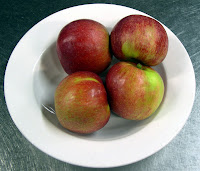 September 1: McIntosh. The Mac is an old stand by and a pretty solid general purpose apple, medium sized and red with the telltale Mac green spot or stripe. You can see these characteristics carry through in the Tydeman's Red and Paula Red above. The Mac is pleasantly sweet and tart with moderately firm flesh and a moderately thick skin. I would like a touch more firmness to the flesh and a thinner skin, but all in all, it's a damn fine eating apple and a solid cooking apple.
 September 11: Northern Spy. As you can see, this is a big green, oddly shaped apple with red highlights where the sun has hit it. Northern Spy (also spelled Spie) is a very firm tart apple with greenish flesh and a thin skin. I like it a lot for cider, pies, and for sauce.
 September 12: Jonagold. If you couldn't guess from the name, Jonagold is a cross between the Jonathan (see above) and the Golden Delicious (see below). I like Jonathan as an early eating apple while the Golden Delicious is just OK for cooking in that it holds its shape well. Jonagold is just OK for eating out of hand, wanting to go a little soft with age, while it cooks about as well as the Golden Delicious. As you can see, it's a large apple that goes red over green.
 September 18: Golden Delicious. What to say about this medium to large yellowish apple with the classic shape that so many people desire? It's fairly crunchy, holds its shape when cooked, and is sweet. Despite its popularity, I find it very one note and sweetly boring.
 September 19: Empire. I always smile when I see Empires in the market because they are my eldest daughter's favorites and for good reason. Although they are small red apples with yellow green blushing, they are big on crunch and tartness balanced with sweetness. I like this small apple a lot for eating out of hand, which is not surprising because it is the result of a cross of the McIntosh, a great eating apple, with the Red Delicious.
 September 22: Grimes Golden. Discovered in what is now West Virginia around the turn of the 19th century, this oddly-shaped green apple with russet blotching has good green apple flavor, but the texture could be crisper. The skin is a bit tough. It is one of the probable parents of the Golden Delicious.
 September 29: Stayman. This good looking red apple often sports vertical streaks and is sweet-tart and very crisp. I enjoy eating it about as much as the Empire, which is a lot. It's often called Stayman Winesap or Stayman's Winesap, but that moniker begs confusion with the Winesap, a much later apple.
 October 2: Red Delicious. While there are a lot of Red Delicious grown here for the canning industry, quantity does not make it a good apple. This thick-skinned yellow-fleshed apple tastes very sweet with almost no apple flavor. In its commercial form, it is just not very good, although I have tasted some earlier unimproved Reds that are a lot better than the beautiful tasteless junk that we grow today.
 October 2: Cortland. I'm not a fan of this white-fleshed apple with just so-so flavor, especially in light of its thick skin and soft, mealy texture. If you look at the coloration of the apple hanging off the rim of the bowl, you can see the resemblance in this highly colored apple to its McIntosh parent (McIntosh x Ben Davis). In the less highly colored apples, you can see the common vertical striping.
 October 10: York. You can recognize this large red apple easily from its roughly trapezoidal cross section. I really like eating and cooking with this all purpose apple. It has good crunch, good sugar, and good acid and probably best of all, it is a great keeping apple and the one that we resort to in March, April, and May while we are waiting for the new crop of Transparents in June. So named because it was discovered in nearby York, PA, this apple holds its shape in cooking well and is a great canner. One of my must have apples.
 October 10: Fuji. Fuji is a big seller in Japan where it was developed as a cross between the Red Delicious and the Ralls Genet, an old French apple brought right here to Virginia by Thomas Jefferson. Appeal in the Japanese market stems from its round uniformity and its crunchy sweetness. That said, this apple doesn't interest me much at all. Although I like the crunch, the flavor could use a lot more tartness to be more useful in my kitchen.
 October 24: Golden Russet. I wait very patiently all year for the Golden Russets to appear and then I take almost all the production in our local market. Oink. Oink. Some say they're not the prettiest apples with all that russeting, but I find them attractive. This old apple, from the 17th century most likely, is not even all that good to eat out of hand, being fairly mealy with a thick skin. But what it has is an excellent acid and sweetness balance that makes it great for cider and juice. This is one of my go-to cooking apples.
It's really pretty sad that in the nearly 20 years that I have lived here, I have seen orchards succumb to subdivisions and to overseas competition. And because of our idiotic labor laws, I've seen fruit hanging in orchards because we can't get enough labor to pick the apples. The system for bringing in legal migrant labor (mostly from Haiti, it would seem) cannot adjust to real-time needs of a crop that can be unpredictable.
But I guess what irritates me most is that our friends and neighbors labor all year to grow and harvest wonderful local apples and yet our grocery stores stock nothing but apples imported from elsewhere. That, and far too many people are unwilling to seek out the local apples at farmers markets and farm stands.
Are you one of those people who would go to the Mega-Mart and buy a Chinese apple? I'm asking you to reconsider that and support our local growers.
In 2009, I decided to keep a record of when which apples arrived in the local market. This is mainly for my amusement, but it will also better help me plan my menus in the future. These dates are approximate because apples do not always arrive in the market as soon as they are picked. And we grow other varieties such as Macoun, Spitzenburg, and Black Twig that did not make it into the market: 2009 was a bad year for a lot of apples.
 June 26: Yellow Transparent. Despite the name, this is a really small light green apple and the earliest of all that we grow around here. It has the classic Golden Delicious shape with the faintest red blush on the top when fully ripe. Because of its burst of green apple malic acid, it's not a great apple for eating out of hand, while for cooking applications, it is very soft, so it is best used for sauce. Its primary distinction is that is early. And that's a good thing, because all our storage apples have been exhausted for a month.
 July 14: Lodi. Lodi, as you can see, looks similar to the Yellow Transparent and it seems to be just a bit larger, firmer, and sweeter than the super tart Transparent. Lodi was developed to be a replacement for the Transparent, and even though it is slightly later than the Transparent, it is still a very early apple. I like it a lot better than the Transparent. It is best for pies and sauces and is not a great out of hand eating apple.
 July 21: Tydeman's Red. Also known as Tydeman's Early, this apple looks a good bit like its McIntosh parent (x Worcester Pearmain). It's a medium-sized apple, larger than the small Transparent and Lodi, with a good crisp bite. Tydeman's is an OK early apple for eating out of hand, but I'm not crazy for it.
 July 25: Summer Rambo. You might think that the name Rambo has something to do with the large size of this apple, but it's just a corruption of the name of this French apple, Rambour or Rombour. So far, it's the tastiest of the early apples. It's a fairly flat and often lopsided apple. As a green apple it is fairly crisp and is OK for eating out of hand. As it ripens, it softens and gets very juicy.
 August 7: Ginger Gold. Ginger Gold is a Virginia apple, having been found as a sport in Nelson County after the devastation caused by Hurricane Camille in 1969. It looks a bit like its Golden Delicious parent (a probable cross with Albemarle Pippin and an unknown third apple). While it is well known around here as the best early eating apple and a yellow summer apple that tastes like a fall apple, Ginger Gold is primarily an early commercial canning apple. This is the first apple of the season that I will go out of my way to eat, being crisp, sweet, and tart. It also resists oxidizing fairly well, so is well suited to the restaurant kitchen where we have to worry about browning.
 August 11: Paula Red. A mutation of the venerable MacIntosh, the Paula Red looks like the Mac and favors the Tydeman's Red, which also descends from the Mac. I like the flavor, but the texture is a bit soft for eating out of hand, so I like it better for sauce. Still, Paula's a solid summer apple with good acidity and sweetness, leaning to the tart side like a good fall apple. This apple doesn't keep all that well. It gets softer as it ages, so eat up.
 August 15: Gala. Gala is a really small apple that is very firm and crisp and pretty distinctive in the market because of its yellow-orange cast. Sadly, it tastes only sweet and doesn't have that good acid necessary for balance, so I find it tiring to eat. If we could cross the firm texture of the Gala with the great acidity of the Paula Red, we'd have a fantastic summer apple!
 August 15: Golden Supreme. This big apple looks like a Golden Delicious, but the flavor is not as good, though the texture is better. I find the very thick skins obnoxious for eating out of hand. This apple works very well, however, for cooking. The flavor is nothing special so it's best relegated to an early season pie and cooking apple.
 August 25: Jonathan. Related to Esopus Spitzenburg, the Jonathan is a commonly grown apple in Virginia, being one of the first good red apples to market. Sweeter than it is tart, the Jonathan appeals less to me than the McIntosh, but it's a solid week earlier to market than the Mac. Jonathan is round and red with a fairly thin skin and it eats well out of hand, as I am demonstrating as I type. Also a good cooking apple.
 September 1: McIntosh. The Mac is an old stand by and a pretty solid general purpose apple, medium sized and red with the telltale Mac green spot or stripe. You can see these characteristics carry through in the Tydeman's Red and Paula Red above. The Mac is pleasantly sweet and tart with moderately firm flesh and a moderately thick skin. I would like a touch more firmness to the flesh and a thinner skin, but all in all, it's a damn fine eating apple and a solid cooking apple.
 September 11: Northern Spy. As you can see, this is a big green, oddly shaped apple with red highlights where the sun has hit it. Northern Spy (also spelled Spie) is a very firm tart apple with greenish flesh and a thin skin. I like it a lot for cider, pies, and for sauce.
 September 12: Jonagold. If you couldn't guess from the name, Jonagold is a cross between the Jonathan (see above) and the Golden Delicious (see below). I like Jonathan as an early eating apple while the Golden Delicious is just OK for cooking in that it holds its shape well. Jonagold is just OK for eating out of hand, wanting to go a little soft with age, while it cooks about as well as the Golden Delicious. As you can see, it's a large apple that goes red over green.
 September 18: Golden Delicious. What to say about this medium to large yellowish apple with the classic shape that so many people desire? It's fairly crunchy, holds its shape when cooked, and is sweet. Despite its popularity, I find it very one note and sweetly boring.
 September 19: Empire. I always smile when I see Empires in the market because they are my eldest daughter's favorites and for good reason. Although they are small red apples with yellow green blushing, they are big on crunch and tartness balanced with sweetness. I like this small apple a lot for eating out of hand, which is not surprising because it is the result of a cross of the McIntosh, a great eating apple, with the Red Delicious.
 September 22: Grimes Golden. Discovered in what is now West Virginia around the turn of the 19th century, this oddly-shaped green apple with russet blotching has good green apple flavor, but the texture could be crisper. The skin is a bit tough. It is one of the probable parents of the Golden Delicious.
 September 29: Stayman. This good looking red apple often sports vertical streaks and is sweet-tart and very crisp. I enjoy eating it about as much as the Empire, which is a lot. It's often called Stayman Winesap or Stayman's Winesap, but that moniker begs confusion with the Winesap, a much later apple.
 October 2: Red Delicious. While there are a lot of Red Delicious grown here for the canning industry, quantity does not make it a good apple. This thick-skinned yellow-fleshed apple tastes very sweet with almost no apple flavor. In its commercial form, it is just not very good, although I have tasted some earlier unimproved Reds that are a lot better than the beautiful tasteless junk that we grow today.
 October 2: Cortland. I'm not a fan of this white-fleshed apple with just so-so flavor, especially in light of its thick skin and soft, mealy texture. If you look at the coloration of the apple hanging off the rim of the bowl, you can see the resemblance in this highly colored apple to its McIntosh parent (McIntosh x Ben Davis). In the less highly colored apples, you can see the common vertical striping.
 October 10: York. You can recognize this large red apple easily from its roughly trapezoidal cross section. I really like eating and cooking with this all purpose apple. It has good crunch, good sugar, and good acid and probably best of all, it is a great keeping apple and the one that we resort to in March, April, and May while we are waiting for the new crop of Transparents in June. So named because it was discovered in nearby York, PA, this apple holds its shape in cooking well and is a great canner. One of my must have apples.
 October 10: Fuji. Fuji is a big seller in Japan where it was developed as a cross between the Red Delicious and the Ralls Genet, an old French apple brought right here to Virginia by Thomas Jefferson. Appeal in the Japanese market stems from its round uniformity and its crunchy sweetness. That said, this apple doesn't interest me much at all. Although I like the crunch, the flavor could use a lot more tartness to be more useful in my kitchen.
 October 24: Golden Russet. I wait very patiently all year for the Golden Russets to appear and then I take almost all the production in our local market. Oink. Oink. Some say they're not the prettiest apples with all that russeting, but I find them attractive. This old apple, from the 17th century most likely, is not even all that good to eat out of hand, being fairly mealy with a thick skin. But what it has is an excellent acid and sweetness balance that makes it great for cider and juice. This is one of my go-to cooking apples.
Wednesday, November 25, 2009
Happy Thanksgiving!
By way of wishing everyone a Happy Thanksgiving, let me share the recipe for a bread pudding that you might want to include in your repertoire.
Notes: This recipe makes a half hotel pan (11.5"L x 9.75"W x 2.25"D). Actually, I only ever make full hotel pans, but this is as close as I can scale this for home use. For bread, I use 7 of the 4-ounce demi-baguettes that we use for table service. We grind all our spices fresh at the restaurant so they are very pungent. You may need to increase the quantity of spices if you are using preground spices. As with all recipes, season to taste.
Pumpkin Butterscotch Pecan Bread Pudding
pan spray
28 ounces hearty white bread, cubed
2 cups butterscotch chips
2 cups pecan halves
8 large eggs
1 cup white sugar
1 tablespoon vanilla extract
1 teaspoon ground allspice
1/2 teaspoon ground nutmeg
1/2 teaspoon ground cinnamon
1 pinch salt
1 cup pumpkin purée
1 and 1/2 quarts heavy cream
Preheat your oven to slow, 300-350F. Coat your pan with pan spray (not necessary, but it makes clean up a lot easier). Mix the bread cubes, chips, and pecans and place in the pan. Mix all the remaining ingredients save the cream, then when well mixed, add the cream and stir. Taste for seasoning and adjust to your liking. Pour the custard over the bread and press the bread down into the custard. Place the pudding on a sheet tray and cook until not quite set in the center. Let rest for 20 minutes before serving. The top will probably brown before the center is set. Once browned, cover with aluminum foil and continue to bake. My puddings generally cook for the final thirty minutes under foil. Cook time varies (there's no thermostat on my oven) but it takes about two hours total.
I hope you enjoy this recipe and from all of the staff here at the restaurant, we wish you a Happy Thanksgiving!
Notes: This recipe makes a half hotel pan (11.5"L x 9.75"W x 2.25"D). Actually, I only ever make full hotel pans, but this is as close as I can scale this for home use. For bread, I use 7 of the 4-ounce demi-baguettes that we use for table service. We grind all our spices fresh at the restaurant so they are very pungent. You may need to increase the quantity of spices if you are using preground spices. As with all recipes, season to taste.
Pumpkin Butterscotch Pecan Bread Pudding
pan spray
28 ounces hearty white bread, cubed
2 cups butterscotch chips
2 cups pecan halves
8 large eggs
1 cup white sugar
1 tablespoon vanilla extract
1 teaspoon ground allspice
1/2 teaspoon ground nutmeg
1/2 teaspoon ground cinnamon
1 pinch salt
1 cup pumpkin purée
1 and 1/2 quarts heavy cream
Preheat your oven to slow, 300-350F. Coat your pan with pan spray (not necessary, but it makes clean up a lot easier). Mix the bread cubes, chips, and pecans and place in the pan. Mix all the remaining ingredients save the cream, then when well mixed, add the cream and stir. Taste for seasoning and adjust to your liking. Pour the custard over the bread and press the bread down into the custard. Place the pudding on a sheet tray and cook until not quite set in the center. Let rest for 20 minutes before serving. The top will probably brown before the center is set. Once browned, cover with aluminum foil and continue to bake. My puddings generally cook for the final thirty minutes under foil. Cook time varies (there's no thermostat on my oven) but it takes about two hours total.
I hope you enjoy this recipe and from all of the staff here at the restaurant, we wish you a Happy Thanksgiving!
Saturday, November 21, 2009
Goodbye Fried Green Tomatoes!
We have two seasons for fried green tomatoes, early July when the vines have set the first green fruit of the year and November, when we use all the fruit that we were forced to pick before the first frost back in October. And last night saw us cook the very last green tomato of the year. That always means that Thanksgiving is just around the corner.
Customers love fried green tomatoes so and I'm never sure why, but when they're on the menu, they sell like crazy. I'm OK with them, but they aren't something I would go out of my way to order at a restaurant, perhaps because I have cooked so many hundreds or thousands of orders in my life. Still, I can see how a crispy crust on a slightly tart fruit when paired with a bit of goat cheese and a glass of Sauvignon Blanc could be hard to resist.
I have been known to spoof fried green tomatoes from time to time as well. Just recently, we did fried green apples as a dessert: a real winner. And sometimes in the middle of winter when imported tomatillos are inexpensive, I'll put fried green tomatillos on the menu just for grins, and perhaps to quell that desperate sort of longing for warmer weather.
Anyway, goodbye fried green tomatoes at least until early next summer. We've had fun again this year, perhaps too much fun because I'm so done with cooking order after order. Now it's time to move on to brussels sprouts, turnips, kale, collards, celery root, and so forth. Soon enough I'll be tired of playing with these leaf and root crops and I'll be longing once again for fried green tomatoes.
Customers love fried green tomatoes so and I'm never sure why, but when they're on the menu, they sell like crazy. I'm OK with them, but they aren't something I would go out of my way to order at a restaurant, perhaps because I have cooked so many hundreds or thousands of orders in my life. Still, I can see how a crispy crust on a slightly tart fruit when paired with a bit of goat cheese and a glass of Sauvignon Blanc could be hard to resist.
I have been known to spoof fried green tomatoes from time to time as well. Just recently, we did fried green apples as a dessert: a real winner. And sometimes in the middle of winter when imported tomatillos are inexpensive, I'll put fried green tomatillos on the menu just for grins, and perhaps to quell that desperate sort of longing for warmer weather.
Anyway, goodbye fried green tomatoes at least until early next summer. We've had fun again this year, perhaps too much fun because I'm so done with cooking order after order. Now it's time to move on to brussels sprouts, turnips, kale, collards, celery root, and so forth. Soon enough I'll be tired of playing with these leaf and root crops and I'll be longing once again for fried green tomatoes.
Friday, November 13, 2009
Truth in Advertising
Here's a new one on me. We get all kinds of excuses why people need to cancel reservations, but never heard this one before.
"I need to cancel my reservation because my husband's being a big jerk!"
"I need to cancel my reservation because my husband's being a big jerk!"
Monday, November 9, 2009
Turkey Wine
It's that time of the year when the phone starts ringing and the emails starting arriving. Everyone wants to know what wine to pair with turkey. Let me preface my answer with there is no single correct match; there are many acceptable matches; and that most people stress way too much about the subject.
And before I go any further, just let me state that Pinot Noir is the universal food wine. When in doubt, Pinot Noir.
Delving into the subject a bit further, you must realize that the turkey in itself does not drive the pairing decision, for it's about as mild a meat as you can encounter. Driving the pairing decision are all those myriad side dishes, some very aggressively seasoned and some very sweet or sweet and sour.
When in doubt, Pinot Noir.
With all the fruity sweet and sour going on at Thanksgiving, I like a wine that can stand up to the fruit. There are five categories of wine that I have paired very successfully with a full Thanksgiving meal and those are rosé, sparkling wine, fruity unoaked whites, lightly oaked light red wines, and fruit-forward reds.
Rosé. In general, rosé wines pair with a lot of difficult dishes; you'll find cranberry notes in many that will work well at Thanksgiving. And as most of these wines are made for immediate consumption, I like to empty my cooler of the remaining rosés of the current vintage at this time of year.
Sparkling Wine. Champagne is the LBD (little black dress) of the wine world. It's almost always appropriate and goes with so many things. But while Champagne works pretty well, the sweetness of a lot of Thanksgiving dishes may turn it a little sour or tinny, so I look to other more fruity bubblies this time of year. Now is the time to consider a gorgeous rosé Crémant d'Alsace, a sparkling Shiraz from down under, or a sparkling Chenin Blanc such as Vouvray.
Fruity Unoaked White. My preference in Thanksgiving wines runs to reds, simply because of the weather. Cold weather has me seeking a red wine. But I always have a bottle or two of fruity Riesling, Alsatian Pinot Blanc, or Gewürztraminer open for those who prefer white. These are all great turkey wines.
Light Red Wines. Because turkey is such a light meat, I don't want the wine to overpower it. This eliminates Cabernet, Merlot, Malbec and so forth from the running. This is the time of year that I love to serve a delightful Beaujolais, Pinot Noir, or maybe even a lightly oaked light red from Italy, such as Sangiovese or Nebbiolo.
Fruity Red Wines. Thanksgiving dinner is one of the spiciest meals most people will eat during the year; many dishes are loaded with cinnamon, cloves, and nutmeg. Another approach to selecting a wine is to complement these spices with a spicy wine such as a Zinfandel, Shiraz, Syrah, and other spicy fruit-foward wines or wines with soft tannins. I really like a fruity Grenache for its spiciness.
Oh yeah, when in doubt, Pinot Noir.
So what am I pouring at Thanksgiving? Lots and lots of choices of the wines I've discussed above so that everyone has something and hopefully so that people will try something new. And what's in my glass? Do you have to ask?
When in doubt, Pinot Noir.
And before I go any further, just let me state that Pinot Noir is the universal food wine. When in doubt, Pinot Noir.
Delving into the subject a bit further, you must realize that the turkey in itself does not drive the pairing decision, for it's about as mild a meat as you can encounter. Driving the pairing decision are all those myriad side dishes, some very aggressively seasoned and some very sweet or sweet and sour.
When in doubt, Pinot Noir.
With all the fruity sweet and sour going on at Thanksgiving, I like a wine that can stand up to the fruit. There are five categories of wine that I have paired very successfully with a full Thanksgiving meal and those are rosé, sparkling wine, fruity unoaked whites, lightly oaked light red wines, and fruit-forward reds.
Rosé. In general, rosé wines pair with a lot of difficult dishes; you'll find cranberry notes in many that will work well at Thanksgiving. And as most of these wines are made for immediate consumption, I like to empty my cooler of the remaining rosés of the current vintage at this time of year.
Sparkling Wine. Champagne is the LBD (little black dress) of the wine world. It's almost always appropriate and goes with so many things. But while Champagne works pretty well, the sweetness of a lot of Thanksgiving dishes may turn it a little sour or tinny, so I look to other more fruity bubblies this time of year. Now is the time to consider a gorgeous rosé Crémant d'Alsace, a sparkling Shiraz from down under, or a sparkling Chenin Blanc such as Vouvray.
Fruity Unoaked White. My preference in Thanksgiving wines runs to reds, simply because of the weather. Cold weather has me seeking a red wine. But I always have a bottle or two of fruity Riesling, Alsatian Pinot Blanc, or Gewürztraminer open for those who prefer white. These are all great turkey wines.
Light Red Wines. Because turkey is such a light meat, I don't want the wine to overpower it. This eliminates Cabernet, Merlot, Malbec and so forth from the running. This is the time of year that I love to serve a delightful Beaujolais, Pinot Noir, or maybe even a lightly oaked light red from Italy, such as Sangiovese or Nebbiolo.
Fruity Red Wines. Thanksgiving dinner is one of the spiciest meals most people will eat during the year; many dishes are loaded with cinnamon, cloves, and nutmeg. Another approach to selecting a wine is to complement these spices with a spicy wine such as a Zinfandel, Shiraz, Syrah, and other spicy fruit-foward wines or wines with soft tannins. I really like a fruity Grenache for its spiciness.
Oh yeah, when in doubt, Pinot Noir.
So what am I pouring at Thanksgiving? Lots and lots of choices of the wines I've discussed above so that everyone has something and hopefully so that people will try something new. And what's in my glass? Do you have to ask?
When in doubt, Pinot Noir.
Subscribe to:
Posts (Atom)

