We're in the heart of Virginia apple country here in Winchester, known as the Apple Capital, which might explain why I play in the Apple Capital Hockey League. Virginia is in the top five or six apple growing states which combined produce over 85% of our domestic crop. Virginia's on par with California and Pennsylvania, but behind Washington, Michigan, and New York. So, it's an important industry for us.
It's really pretty sad that in the nearly 20 years that I have lived here, I have seen orchards succumb to subdivisions and to overseas competition. And because of our idiotic labor laws, I've seen fruit hanging in orchards because we can't get enough labor to pick the apples. The system for bringing in legal migrant labor (mostly from Haiti, it would seem) cannot adjust to real-time needs of a crop that can be unpredictable.
But I guess what irritates me most is that our friends and neighbors labor all year to grow and harvest wonderful local apples and yet our grocery stores stock nothing but apples imported from elsewhere. That, and far too many people are unwilling to seek out the local apples at farmers markets and farm stands.
Are you one of those people who would go to the Mega-Mart and buy a Chinese apple? I'm asking you to reconsider that and support our local growers.
In 2009, I decided to keep a record of when which apples arrived in the local market. This is mainly for my amusement, but it will also better help me plan my menus in the future. These dates are approximate because apples do not always arrive in the market as soon as they are picked. And we grow other varieties such as Macoun, Spitzenburg, and Black Twig that did not make it into the market: 2009 was a bad year for a lot of apples.
 June 26: Yellow Transparent
. Despite the name, this is a really small light green apple and the earliest of all that we grow around here. It has the classic Golden Delicious shape with the faintest red blush on the top when fully ripe. Because of its burst of green apple malic acid, it's not a great apple for eating out of hand, while for cooking applications, it is very soft, so it is best used for sauce. Its primary distinction is that is early. And that's a good thing, because all our storage apples have been exhausted for a month.
 July 14: Lodi
. Lodi, as you can see, looks similar to the Yellow Transparent and it seems to be just a bit larger, firmer, and sweeter than the super tart Transparent. Lodi was developed to be a replacement for the Transparent, and even though it is slightly later than the Transparent, it is still a very early apple. I like it a lot better than the Transparent. It is best for pies and sauces and is not a great out of hand eating apple.
 July 21: Tydeman's Red
. Also known as Tydeman's Early, this apple looks a good bit like its McIntosh parent (x Worcester Pearmain). It's a medium-sized apple, larger than the small Transparent and Lodi, with a good crisp bite. Tydeman's is an OK early apple for eating out of hand, but I'm not crazy for it.
 July 25: Summer Rambo
. You might think that the name Rambo has something to do with the large size of this apple, but it's just a corruption of the name of this French apple, Rambour or Rombour. So far, it's the tastiest of the early apples. It's a fairly flat and often lopsided apple. As a green apple it is fairly crisp and is OK for eating out of hand. As it ripens, it softens and gets very juicy.
 August 7: Ginger Gold
. Ginger Gold is a Virginia apple, having been found as a sport in Nelson County after the devastation caused by Hurricane Camille in 1969. It looks a bit like its Golden Delicious parent (a probable cross with Albemarle Pippin and an unknown third apple). While it is well known around here as the best early eating apple and a yellow summer apple that tastes like a fall apple, Ginger Gold is primarily an early commercial canning apple. This is the first apple of the season that I will go out of my way to eat, being crisp, sweet, and tart. It also resists oxidizing fairly well, so is well suited to the restaurant kitchen where we have to worry about browning.
 August 11: Paula Red
. A mutation of the venerable MacIntosh, the Paula Red looks like the Mac and favors the Tydeman's Red, which also descends from the Mac. I like the flavor, but the texture is a bit soft for eating out of hand, so I like it better for sauce. Still, Paula's a solid summer apple with good acidity and sweetness, leaning to the tart side like a good fall apple. This apple doesn't keep all that well. It gets softer as it ages, so eat up.
 August 15: Gala
. Gala is a really small apple that is very firm and crisp and pretty distinctive in the market because of its yellow-orange cast. Sadly, it tastes only sweet and doesn't have that good acid necessary for balance, so I find it tiring to eat. If we could cross the firm texture of the Gala with the great acidity of the Paula Red, we'd have a fantastic summer apple!
 August 15: Golden Supreme
. This big apple looks like a Golden Delicious, but the flavor is not as good, though the texture is better. I find the very thick skins obnoxious for eating out of hand. This apple works very well, however, for cooking. The flavor is nothing special so it's best relegated to an early season pie and cooking apple.
 August 25: Jonathan
. Related to Esopus Spitzenburg, the Jonathan is a commonly grown apple in Virginia, being one of the first good red apples to market. Sweeter than it is tart, the Jonathan appeals less to me than the McIntosh, but it's a solid week earlier to market than the Mac. Jonathan is round and red with a fairly thin skin and it eats well out of hand, as I am demonstrating as I type. Also a good cooking apple.
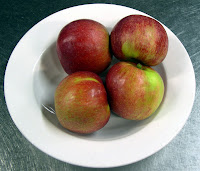 September 1: McIntosh
. The Mac is an old stand by and a pretty solid general purpose apple, medium sized and red with the telltale Mac green spot or stripe. You can see these characteristics carry through in the Tydeman's Red and Paula Red above. The Mac is pleasantly sweet and tart with moderately firm flesh and a moderately thick skin. I would like a touch more firmness to the flesh and a thinner skin, but all in all, it's a damn fine eating apple and a solid cooking apple.
 September 11: Northern Spy
. As you can see, this is a big green, oddly shaped apple with red highlights where the sun has hit it. Northern Spy (also spelled Spie) is a very firm tart apple with greenish flesh and a thin skin. I like it a lot for cider, pies, and for sauce.
 September 12: Jonagold
. If you couldn't guess from the name, Jonagold is a cross between the Jonathan (see above) and the Golden Delicious (see below). I like Jonathan as an early eating apple while the Golden Delicious is just OK for cooking in that it holds its shape well. Jonagold is just OK for eating out of hand, wanting to go a little soft with age, while it cooks about as well as the Golden Delicious. As you can see, it's a large apple that goes red over green.
 September 18: Golden Delicious
. What to say about this medium to large yellowish apple with the classic shape that so many people desire? It's fairly crunchy, holds its shape when cooked, and is sweet. Despite its popularity, I find it very one note and sweetly boring.
 September 19: Empire
. I always smile when I see Empires in the market because they are my eldest daughter's favorites and for good reason. Although they are small red apples with yellow green blushing, they are big on crunch and tartness balanced with sweetness. I like this small apple a lot for eating out of hand, which is not surprising because it is the result of a cross of the McIntosh, a great eating apple, with the Red Delicious.
 September 22: Grimes Golden
. Discovered in what is now West Virginia around the turn of the 19th century, this oddly-shaped green apple with russet blotching has good green apple flavor, but the texture could be crisper. The skin is a bit tough. It is one of the probable parents of the Golden Delicious.
 September 29: Stayman
. This good looking red apple often sports vertical streaks and is sweet-tart and very crisp. I enjoy eating it about as much as the Empire, which is a lot. It's often called Stayman Winesap or Stayman's Winesap, but that moniker begs confusion with the Winesap, a much later apple.
 October 2: Red Delicious
. While there are a lot of Red Delicious grown here for the canning industry, quantity does not make it a good apple. This thick-skinned yellow-fleshed apple tastes very sweet with almost no apple flavor. In its commercial form, it is just not very good, although I have tasted some earlier unimproved Reds that are a lot better than the beautiful tasteless junk that we grow today.
 October 2: Cortland
. I'm not a fan of this white-fleshed apple with just so-so flavor, especially in light of its thick skin and soft, mealy texture. If you look at the coloration of the apple hanging off the rim of the bowl, you can see the resemblance in this highly colored apple to its McIntosh parent (McIntosh x Ben Davis). In the less highly colored apples, you can see the common vertical striping.
 October 10: York
. You can recognize this large red apple easily from its roughly trapezoidal cross section. I really like eating and cooking with this all purpose apple. It has good crunch, good sugar, and good acid and probably best of all, it is a great keeping apple and the one that we resort to in March, April, and May while we are waiting for the new crop of Transparents in June. So named because it was discovered in nearby York, PA, this apple holds its shape in cooking well and is a great canner. One of my must have apples.
 October 10: Fuji
. Fuji is a big seller in Japan where it was developed as a cross between the Red Delicious and the Ralls Genet, an old French apple brought right here to Virginia by Thomas Jefferson. Appeal in the Japanese market stems from its round uniformity and its crunchy sweetness. That said, this apple doesn't interest me much at all. Although I like the crunch, the flavor could use a lot more tartness to be more useful in my kitchen.
 October 24: Golden Russet
. I wait very patiently all year for the Golden Russets to appear and then I take almost all the production in our local market. Oink. Oink. Some say they're not the prettiest apples with all that russeting, but I find them attractive. This old apple, from the 17th century most likely, is not even all that good to eat out of hand, being fairly mealy with a thick skin. But what it has is an excellent acid and sweetness balance that makes it great for cider and juice. This is one of my go-to cooking apples.

 Dueling Pork Belly. You may have noticed a theme to recent Chef's Tasting menus: pork belly. In our quest to convert people to the Pork Belly Legion™, we seem to be serving it everywhere. Here, we have two quick one-biters for our amuse course.
 Seared Sea Scallop. This dish is the result of us having baby Shanghai bok choy, lop cheung (Chinese sausage), and pickled mustard greens in the cooler and trying to find a way to use them. Coupled with this, Matt just delivered us a huge bunch of chicken feet when he last brought us rabbits, so we had a big batch of super good chicken stock in the cooler as well. Soup was a natural thought given this bunch of ingredients, but we decided to change the form and do the old soup in the wonton trick. In the photo, you see a soup-filled wonton down and a quarter of a baby bok choy, cilantro leaves, pickled mustard greens, green onions, and lop cheung coins over, with a scallop topping the feast.
 Wild Mushrooms on Celery Root Latke. There is nothing earth shattering here, just plain old-fashioned deliciousness. In recent weeks, we have really taken a liking to celery root paired with wild mushrooms and this is that pairing's latest incarnation. The chanterelle mushrooms (the last of the season before we switch to hedgehogs for the winter) are finished old-school, with veal demiglace and heavy cream. Classic French habits die hard in old chefs!
 Roasted Red Drum. This is a test use of Tony's puttanesca-style lentils. I am a big fan of lentils with fish; the pairing just works for me. And pasta puttanesca, with it's bold seasonings, just may be my all-time favorite pasta dish. Here you see the lentils flavored with olives, capers, anchovies, garlic, basil, and crushed red pepper flakes under a piece of drum that has been rubbed with olive oil, salt, pepper, crushed red pepper flakes, and garlic, and then roasted. This is headed for the dinner menu this weekend. It will probably perplex customers, but I love the pairing and the plate presentation is clean and inviting.
 Jerked Veal with Sweet Potato Spätzle. And now for something completely different and a dish that will never go any further than this. We've been serving a classic schnitzel with spätzle on the dinner menu this week. Tony had the idea of taking that dish and doing a Caribbean riff on it. The veal cutlets were rubbed and marinated with our house-made jerk paste then grilled, sliced, and stacked Lincoln Log-style. On top of this stack you see a cranberry salsa made from cranberries, lime, jerk paste, allspice, and cilantro. The salsa was pretty good and may be something we would try again. Next to this you see the sweet potato spätzle, browned with brunoise of sweet potato, and finished with a touch of grated ginger, lime zest, and allspice. I was unhappy with the presentation and the Caribbean flavors just didn't add anything to the dish; they weren't bad, but if they don't add anything, why are they there?
 Caramel Apple Butterscotch Bread Pudding. What? This doesn't look like a bread pudding? Well, it is. These small local Blushing Golden apples are hollowed out and then baked with the bread pudding inside. Sauced with house-made dulce de leche, crème anglaise, and a touch of maple syrup, this dish was a fun way to finish dinner.


