
Some of you may know that I love to cook Cajun and Creole food. I'm not from Louisiana at all, but somehow I feel that it is in my blood. I've spent a lot of time eating and visiting in New Orleans and points south and west all over South Louisiana. I even speak a bit of the language. My first college French professor was a Cajun from Thibodaux on Bayou Lafourche, where I've been and eaten several times. But I gotta say that y'all speak some crazy French là-bas!
That reminds me of a former life in the software world about twenty years ago, when I was temporarily at Johnson Space Center in Clear Lake, TX, there was popular Cajun hole in the wall just past the Center on the curve of the lake. The servers took a shine to me and would drag me through the kitchen and force me to sample everything. By the time I got back to the dining room, I was too full to eat any more, but I had to order something and no matter what I ordered, there were always more things on my table than I ordered. I learned a lot from tasting those dishes and from the gazillions of questions that I peppered the cooks and the servers with.
Anyway, having cooked the food for just shy of 30 years now, I am so comfortable with it that I would have no problem stepping onto the line at any New Orleans restaurant and banging out the food.
What brings all this to mind is that Saturday, I had only a little bit of alligator sausage left, not enough to serve on its own, so like frugal cooks everywhere, I made it into soup, gumbo to be exact. And while I was making the roux (in a very big hurry, perhaps too much of a hurry), somehow it got me in three places on the lips and four or five on the cheeks. And I was reminded yet again why Paul Prudhomme calls it Cajun Napalm!
By all means, do make your own roux over high heat and don't be afraid of it. Just be careful, more careful than I was! Oh yeah, one other word of wisdom from the been-there-done-that school of learning, don't put your flour into wickedly hot oil as a lot of chefs do. What happens when you pour water into hot oil? It flashes to steam and explodes hot oil everywhere. If your flour contains a lot of water from the ambient humidity, things can go kaboom! Not good.
Epilogue, March 14, 2009: I posted a step-by-step roux making photo essay which you might want to see.
Monday, November 10, 2008


Sunday, November 9, 2008
Idiot Fish
 No, I'm not talking about the clown you have in your fish bowl that swims upside down and jumps out of the water just for fun. I'm talking about a fish from Alaskan waters, that FLF (funny looking fish) to the right. Photo courtesy of the Alaska Fisheries Science Center/NOAA.
While I really like the name Idiot Fish, I'm thinking that Caricature Fish or Cartoon Fish might be more appropriate. Doesn't it look like a caricature of a fish? The Chinese name which translates to Red Dragon Fish is pretty cool too. The official common name of this fish (Sebastolobus alascanus) is Shortspine Thornyhead. That's not terrible as the names of fish go; it's certainly much better than Salmon or Perch or Bass. It also goes by Rock Cod, Channel Rockcod, Shortspine Channel Rockfish, and Spinycheek Rockfish.
My introduction to this fish started innocently enough. I was at the Freight Station Farmers Market some time ago when Beth Nowak mentioned that her brother, a fisherman in Alaska, had sent her some Idiot Fish and that she would bring me one. And she did. And I cooked it. And it was really good. And she brought me another one to cook at the market yesterday during my fish cooking demonstration, hence this post today.
We don't see this fish on the east coast because they are prized in Japan and the bulk of the catch goes there, especially given that the Japanese are willing to pay a higher price. In Japan, the fish is called Kichiji (although properly that name belongs to a cousin, Sebastolobus macrochir, Broadbanded Thornyhead). There are about nine very similar species of Sebastolobus, many of which get lumped under the name Idiot Fish.
In Japan, the fish is generally served on the bone and is traditionally braised in soy sauce, mirin, and sake. Having tasted the fish, I can see how that would be very delicious. Idiot Fish is very high in oil content; in fact, it reminds me of Sablefish (Alaskan Black Cod) in that regard. The texture is not as firm and in my experience (two fish), you must handle it delicately and it wants to fall apart/melt. I think the Japanese have it right: filets are probably not the best application for this fish.
Sadly, the fish is becoming endangered, so I won't be creating a market for it at the restaurant. That's a shame really, because given its Japanese colloquial name of Kinki, can you imagine what recipe we might devise for it on our April Fool's menu? ;)
Saturday, November 8, 2008
Fish, Anyone?
 Thanks to everyone who came out to the Freight Station Farmers Market this morning to shop and to sample the fish that I was cooking. Beth Nowak (to the right) sells fish that her brother Jim catches in Alaskan waters and she supplied the samples that I cooked.
Beth gave me some Salmon, smoked Sablefish, and an Idiotfish to work with. Idiotfish is the colloquial name for any of several Rockfish/Scorpionfish that range from the northern US west coast up to Alaska, across the Aleutians, and down to Japan. More on Idiotfish in a subsequent post.
 Idiotfish, also known by its Japanese colloquial name kinki, is a high oil (good omega-3 source), white fish. It has a fairly fine texture with an oil content similar to sablefish. It's very tasty and because of the oil can stand up to big flavors. Here it is as Pimentón-Crusted Idiotfish with Chorizo, Tomatoes, Olives, and Almonds.
 Here's a piece of salmon (it looked like the tail of a red salmon, but the species doesn't matter) in a red Thai curry with Thai basil and kaffir lime.
Not shown are several dishes including a chowder made from fish stock (from the bones and fins of the Idiotfish and the skin of the Sablefish), smoked Sablefish, parsnips, leeks, onions, Yukon Gold potatoes, bay leaves, thyme, and heavy cream.
Beth was handing out a series of recipes that I developed for her many, many years ago. Ask her for a copy next time you're at the market, if you want tips on how to cook fish. It also goes through standard chowder procedure at length.
Thursday, November 6, 2008
Cauliflower Mushrooms, Etc.
We just received the first shipment of the year of cauliflower mushrooms (Sparassis crispa) from our supplier in Oregon yesterday, a day late because he wrecked his truck on Monday, foraging on Mount Hood. That's one of the things that you learn when dealing with small suppliers: they're absolutely focused on getting you the best quality product, but they're people too and their lives do intrude on their businesses.
We've been unable to get product at times because of illness and surgery, problems with children, and any number of the same problems that you and I face on a daily basis. Working with small suppliers is definitely not like calling an 800 number at 10pm at night and having a truck appear at your door the following morning. But warts and all, I wouldn't have it any other way. I like buying from small business owners who are invested in their businesses.
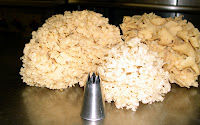 As you can see in the photo, cauliflower mushrooms come by their name for pretty obvious reasons. You can see that they range in color from almost white to the color of egg noodles, with very curly texture to more egg noodle-like texture. The pastry tube gives you a good idea of the size. Although they grow a lot larger, these small ones are the best tasting and least chewy.
Almost nothing smells fresher and more alive than a box of fresh cauliflower mushrooms. When I opened this box, my entire kitchen smelled of pine forest, primal and alive, and better than any air freshener ever concocted. There might also be a hint of cucumber in the fragrance.
Part of the reason for the fragrance may be because they grow on the roots of trees, mainly pine and spruce. It may also be because they are generally loaded with spruce needles, if collected in a spruce forest, so they need careful cleaning. Separate each of the egg noodle-shaped pieces from the tough stems and wash well. Water won't hurt cauliflower mushrooms.
When first faced with these mushrooms years ago, I let their form dictate their use. They look like egg pasta, so I treated them like egg pasta and I have been very happy ever since. And because they are slightly cartilaginous, they hold their shape just like pasta; that is, they don't wilt like other mushrooms. And like pasta, they have a very mild, non-mushroomy flavor, albeit with a touch of pine.
Cauliflower mushrooms are one of my favorite of the edible mushrooms. As my sous chef said last night when tasting the vegan special described below, "I love these mushrooms!"
Last night, a customer booked a table and failed to mention when booking that he is vegan. Fortunately it was slow enough that I could go to his table to talk with him. He asked me if we had any tempeh, seitan, or tofu. No, we don't stock these items, especially without warning. As a rule, I don't play games with meat substitutes. I create vegetarian dishes that proudly feature vegetables rather than meat wannabe products.
As the conversation unfolded (and it was truly like peeling the layers off an onion), I discovered that he doesn't like tomatoes, potatoes, peppers, and spicy food. Poof, there went 98% of my standard vegan repertoire. And of course, our vegetarian special, Sweet Potato Risotto with Braised Arugula, was not vegan, not even close.
After hearing the litany of foods that he couldn't or wouldn't eat, I finally asked him in desperation what he would eat, figuring that to be a much shorter list. He started by saying pasta, beans, rice, and salad. A little more prodding from me got him to exclaim that he loves mushrooms. Armed with that, I went back to the kitchen and started to doodle on the back of a menu with my sous chef.
We started with a pasta with roasted artichokes, roasted cipollini, and braised broccolini. We discussed adding various mushrooms and then I remembered the cauliflower mushrooms. Why not scrap the pasta and use the cauliflowers as egg noodles in the "pasta?"
So, we pan-seared quartered artichokes and whole cipollini and put them in the oven to roast, while we blanched broccolini. Into a sauté pan went extra virgin olive oil and about four ounces of cauliflower mushrooms. Once they had cooked a minute or so, in went the artichokes, cipollini, broccolini, and some garlic. We finished it with a splash of white wine to finish braising the broccolini, salt, pepper, and fresh parsley.
I couldn't help but think how good this would be with some sun-dried tomatoes, crushed red pepper flakes, and a swirl of butter to finish it!
I also couldn't help but think how lucky this guy was not to be eating a salad for dinner. Vegans, vegetarians, and others with restricted diets, please do us the courtesy of calling ahead and letting us know about your diet before you spring it on us in the dining room. You'll be happier and we'll be happier.
We've been unable to get product at times because of illness and surgery, problems with children, and any number of the same problems that you and I face on a daily basis. Working with small suppliers is definitely not like calling an 800 number at 10pm at night and having a truck appear at your door the following morning. But warts and all, I wouldn't have it any other way. I like buying from small business owners who are invested in their businesses.
 As you can see in the photo, cauliflower mushrooms come by their name for pretty obvious reasons. You can see that they range in color from almost white to the color of egg noodles, with very curly texture to more egg noodle-like texture. The pastry tube gives you a good idea of the size. Although they grow a lot larger, these small ones are the best tasting and least chewy.
Almost nothing smells fresher and more alive than a box of fresh cauliflower mushrooms. When I opened this box, my entire kitchen smelled of pine forest, primal and alive, and better than any air freshener ever concocted. There might also be a hint of cucumber in the fragrance.
Part of the reason for the fragrance may be because they grow on the roots of trees, mainly pine and spruce. It may also be because they are generally loaded with spruce needles, if collected in a spruce forest, so they need careful cleaning. Separate each of the egg noodle-shaped pieces from the tough stems and wash well. Water won't hurt cauliflower mushrooms.
When first faced with these mushrooms years ago, I let their form dictate their use. They look like egg pasta, so I treated them like egg pasta and I have been very happy ever since. And because they are slightly cartilaginous, they hold their shape just like pasta; that is, they don't wilt like other mushrooms. And like pasta, they have a very mild, non-mushroomy flavor, albeit with a touch of pine.
Cauliflower mushrooms are one of my favorite of the edible mushrooms. As my sous chef said last night when tasting the vegan special described below, "I love these mushrooms!"
Last night, a customer booked a table and failed to mention when booking that he is vegan. Fortunately it was slow enough that I could go to his table to talk with him. He asked me if we had any tempeh, seitan, or tofu. No, we don't stock these items, especially without warning. As a rule, I don't play games with meat substitutes. I create vegetarian dishes that proudly feature vegetables rather than meat wannabe products.
As the conversation unfolded (and it was truly like peeling the layers off an onion), I discovered that he doesn't like tomatoes, potatoes, peppers, and spicy food. Poof, there went 98% of my standard vegan repertoire. And of course, our vegetarian special, Sweet Potato Risotto with Braised Arugula, was not vegan, not even close.
After hearing the litany of foods that he couldn't or wouldn't eat, I finally asked him in desperation what he would eat, figuring that to be a much shorter list. He started by saying pasta, beans, rice, and salad. A little more prodding from me got him to exclaim that he loves mushrooms. Armed with that, I went back to the kitchen and started to doodle on the back of a menu with my sous chef.
We started with a pasta with roasted artichokes, roasted cipollini, and braised broccolini. We discussed adding various mushrooms and then I remembered the cauliflower mushrooms. Why not scrap the pasta and use the cauliflowers as egg noodles in the "pasta?"
So, we pan-seared quartered artichokes and whole cipollini and put them in the oven to roast, while we blanched broccolini. Into a sauté pan went extra virgin olive oil and about four ounces of cauliflower mushrooms. Once they had cooked a minute or so, in went the artichokes, cipollini, broccolini, and some garlic. We finished it with a splash of white wine to finish braising the broccolini, salt, pepper, and fresh parsley.
I couldn't help but think how good this would be with some sun-dried tomatoes, crushed red pepper flakes, and a swirl of butter to finish it!
I also couldn't help but think how lucky this guy was not to be eating a salad for dinner. Vegans, vegetarians, and others with restricted diets, please do us the courtesy of calling ahead and letting us know about your diet before you spring it on us in the dining room. You'll be happier and we'll be happier.
Wednesday, November 5, 2008
Guinea Hen
 Tonight, local guinea hens begin their run on the menu, until they are exhausted. I have 16 hens from Haskins Family Farm in Middletown, Virginia. Photo courtesy of JoePhoto from flickr.com.
Chefs love guinea hen because they're small enough (about two pounds) to roast and they don't tend to dry out as do pheasants, which is very important for restaurant service. They're also really versatile birds; anything you can do with chicken, you can do with guinea. Customers love guinea hens because they taste more chickeny than chicken. Ask my kids about guinea, if you have any doubt.
Domesticated from birds in the pheasant family that call west Africa home, the average guinea is a good looking black bird with tiny white circular spots all over, making it look silver from a distance.
They're kind of fun to have wandering around the yard—they're hell on bugs—but they have an idiot cackle that can drive you nuts after a while. That cackle makes them pretty reasonable watch animals, though. Nobody surprises you if you have guineas around. But, if you've ever tried to move a flock of them out of the way so that you could move your truck, you'd know they aren't the brightest of creatures.
Here's your daily dose of trivia: a young guinea is called a keet.
Bob and Mary Haskins sell their products including eggs, chickens, guineas, and Berkshire pork at various locations including the farmers market on the Old Town Mall in Winchester on Saturday mornings. You can reach them at info@haskinsfamilyfarm.com.
Tuesday, November 4, 2008
Chefs and Corn Dogs
Last night, I went to the Monday Night Football game with some friends—Ouch! That Steelers run defense is for real!— and once we got into the stadium, somehow the talk turned to food, which is a little odd, because we just finished tailgating in the parking lot and were well and truly sated.
One of the guys started talking about how nice a corn dog would be with his beer, and then he turned to me and said, "I guess since you're a chef, you don't eat junk food." And this, just after we finished downing tequila-lime chicken wings and pizza roll stuffed with Reuben sandwich ingredients.
Is that how the rest of the world thinks of us? I know that almost nobody will invite a chef to dinner because the food couldn't possibly be good enough. Did you know that most good chefs are omnivores? And that we appreciate any food that we did not have to cook? And that on our salaries (our lack therof), a free meal is a free meal? And that on our day off, the last thing we want to eat is restaurant food?
Come on, I'm the guy who used to spoof corn dogs on our tapas menu by dipping diminiutive Surry sausages into blue corn and Hatch chile batter, frying them, and then serving them with local maple syrup.
So, yeah, that corn dog with my beer sounds just great!
One of the guys started talking about how nice a corn dog would be with his beer, and then he turned to me and said, "I guess since you're a chef, you don't eat junk food." And this, just after we finished downing tequila-lime chicken wings and pizza roll stuffed with Reuben sandwich ingredients.
Is that how the rest of the world thinks of us? I know that almost nobody will invite a chef to dinner because the food couldn't possibly be good enough. Did you know that most good chefs are omnivores? And that we appreciate any food that we did not have to cook? And that on our salaries (our lack therof), a free meal is a free meal? And that on our day off, the last thing we want to eat is restaurant food?
Come on, I'm the guy who used to spoof corn dogs on our tapas menu by dipping diminiutive Surry sausages into blue corn and Hatch chile batter, frying them, and then serving them with local maple syrup.
So, yeah, that corn dog with my beer sounds just great!
Monday, November 3, 2008
Duck in Kriek
I've always claimed that there are very few original inventions in cooking and anyone who claims to have invented a dish is probably fooling himself. I know that the vast majority of times that I have a novel idea, I can go out on the internet and find that someone has already had that same idea. Here's a case in point.
A customer sent me an email recently stating that he had a bunch of kriek in his basement, asking if I had ever cooked with it and what he might do with it. I answered that I had used it various ways over the years, mostly in desserts. Kriek-macerated fresh fruit is wonderful and kriek makes a great sabayon. I also answered that right now, I feel like braising duck in it with dried sour cherries, shallots, and thyme.
Let me digress to say that kriek is a Belgian beer spontaneously fermented with naturally occuring yeasts. After the primary fermentation, sour cherries are added, causing a secondary fermentation. The beer is dry, a touch sour from the wheat added to the barley and from the native yeasts, and it picks up color, flavor, and aroma from the cherries.
The dish I was seeing in my mind was kriek-braised Moulard duck legs with grilled Moulard duck breast, bacon-roasted Brussels sprouts and chestnuts, and a sauce of the reduced braising liquid augmented with demiglace. Unfortunately, our sprouts are about three weeks away from being ready. I did find some celery root in the market, but not a vast quantity, so I thought I would purée it and stretch it with potatoes.
After I had featured the dish on the menu this past weekend, I got curious. I've never braised duck in kriek before nor ever encountered it, but I couldn't imagine that I am the first to have ever done it, so just for giggles I typed "duck kriek" into the Google oracle to see just how often it had been done before.
The second hit was from a beer dinner in San Francisco that featured:
Duck Braised in Hansens Kriek
Slowly cooked Duck Legs With Shallots, Thyme, Dried Montmorency Cherries
topped with a Duck Kriek Demi-Glace on a Bed of Celery Root Potato Puree
with Milk Poached White Asparagus
This is identical to what I thought of, less the asparagus.
So to the chef who a few years ago took the trouble to call me to let me know that I had ripped off one of his dishes, I say get over yourself friend. I'm willing to bet that hundreds of people did it before you.
A customer sent me an email recently stating that he had a bunch of kriek in his basement, asking if I had ever cooked with it and what he might do with it. I answered that I had used it various ways over the years, mostly in desserts. Kriek-macerated fresh fruit is wonderful and kriek makes a great sabayon. I also answered that right now, I feel like braising duck in it with dried sour cherries, shallots, and thyme.
Let me digress to say that kriek is a Belgian beer spontaneously fermented with naturally occuring yeasts. After the primary fermentation, sour cherries are added, causing a secondary fermentation. The beer is dry, a touch sour from the wheat added to the barley and from the native yeasts, and it picks up color, flavor, and aroma from the cherries.
The dish I was seeing in my mind was kriek-braised Moulard duck legs with grilled Moulard duck breast, bacon-roasted Brussels sprouts and chestnuts, and a sauce of the reduced braising liquid augmented with demiglace. Unfortunately, our sprouts are about three weeks away from being ready. I did find some celery root in the market, but not a vast quantity, so I thought I would purée it and stretch it with potatoes.
After I had featured the dish on the menu this past weekend, I got curious. I've never braised duck in kriek before nor ever encountered it, but I couldn't imagine that I am the first to have ever done it, so just for giggles I typed "duck kriek" into the Google oracle to see just how often it had been done before.
The second hit was from a beer dinner in San Francisco that featured:
This is identical to what I thought of, less the asparagus.
So to the chef who a few years ago took the trouble to call me to let me know that I had ripped off one of his dishes, I say get over yourself friend. I'm willing to bet that hundreds of people did it before you.
Subscribe to:
Comments (Atom)

