We just did a Chef's Tasting on Thursday night with the theme of Spring. We decided to let the menu be informed by not only the ingredients that are available now in the spring but by the ideas and memories evoked by the season.
I am really pleased with this menu and think that it clearly states who I am as a chef right now and speaks to the food that appeals to me: simple, fresh, direct, highly flavorful, yet still a bit whimsical and playful, not too serious for its own good. I like this menu because the dishes are largely pared to their essence—not too many ingredients on the plate, but just enough. It is very difficult as a chef to pare dishes to their core: it forces excellence in the thought behind a dish, the ingredients themselves, and of course, in technique.
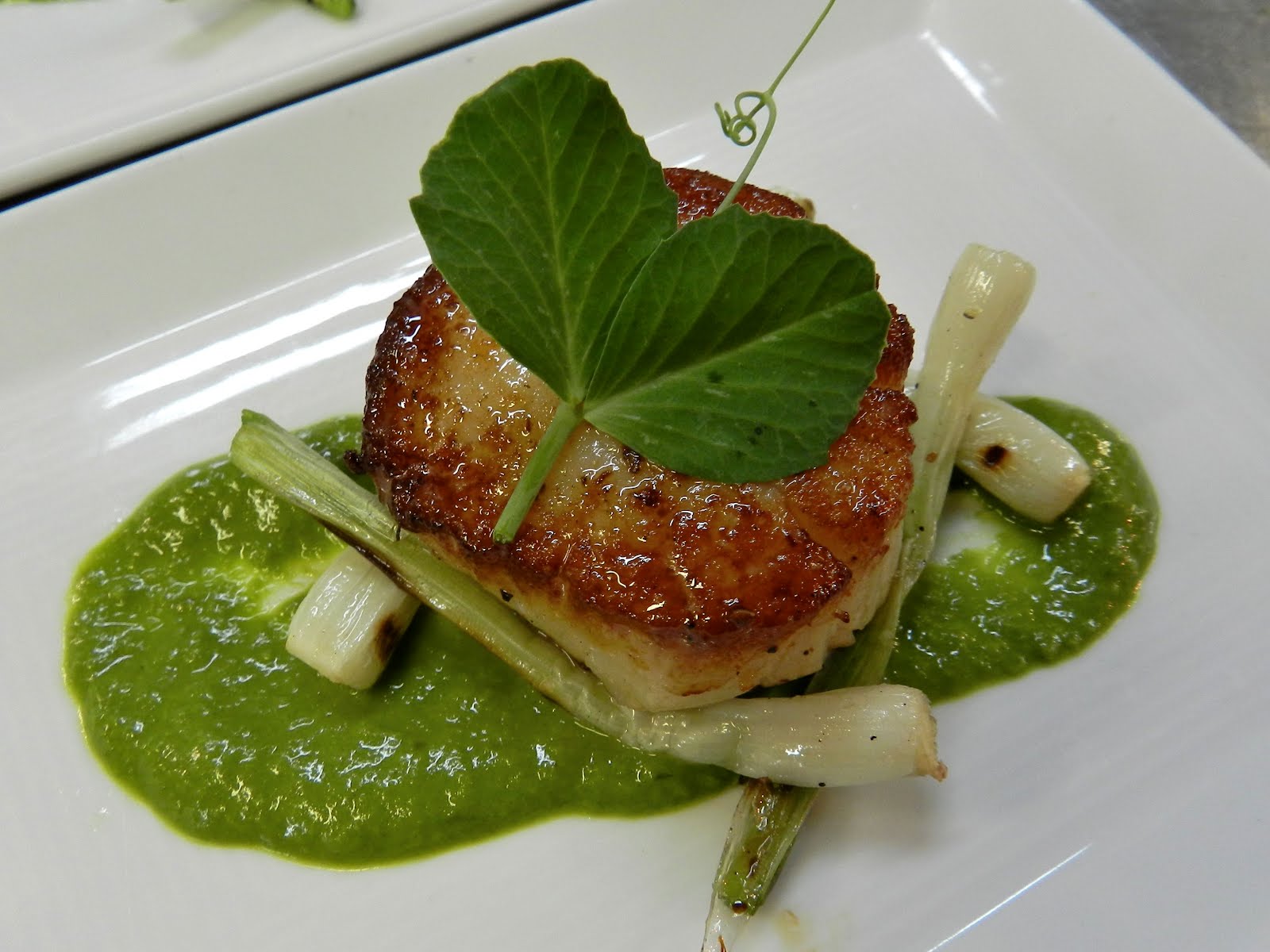
Sea Scallop. Spring always brings great scallops as new grounds are opened. I wanted to highlight our beautiful scallops against some of our local spring greens. The scallop is sitting on a purée of ramp greens and grilled baby spring onions and topped with a sugar snap tendril from my garden. The ramp bulbs have long since vanished into sopa de ajo.
Arctic Char. Spring always has me looking forward to salmon as it begins its spawning run up the rivers. It's just a little too early yet for salmon, but we do have two nice salmonids in house right now, arctic char and steelhead trout. Last week, we put up a batch of cured steelhead trout, so-called gravlax of steelhead trout, and we had a bunch of trimmings to work with.
On this plate, you see a mousse of roasted steelhead gravlax, fennel fronds from my garden, very lightly pickled hothouse cucumbers, seared arctic char, and a wonton containing gravlax, chives, and sour cream. The wonton came from wanting some crunchy element on the dish. And in the end, we decided to take the traditional bagel toppings and put them inside a crispy wonton as a somewhat cheesy (pun intended) nod to the God-awful crab rangoon served in ersatz Chinese restaurants. A little humor never hurt a dish as far I can tell.
Eggs, Bacon, and Toast. Now that spring has sprung and the days are getting longer, Sarah's ducks are cranking out far more eggs that we can possibly use to make our pastries. [Oh by the way, wondering why our pastries are so good? Blame the duck eggs!] So this dish was born of a need to consume duck eggs and of course also to showcase our awesome house-cured Berkshire pork belly.
Down on the plate, you see grilled and buttered focaccia topped with maple syrup-braised pork belly and a poached duck egg. We went through a dozen different plate presentations and finally in the spirit of consuming as many duck eggs as possible, decided to benedictify it with a lemon zest-augmented hollandaise. This sublime stack of wanton sinfulness is bejeweled with a crown of cilantro flowers from my garden.
Risotto. This dish didn't start as a risotto at all. For the longest time, it was just a list of ingredients: asparagus, morels, and duck confit. Our guests were very lucky that the first asparagus and the first morels of the year arrived in our kitchen simultaneously, lucky because they are ingredients that marry in the best kind of way. Morels, the king of mushrooms (you bolete fans are all wrong), deserve, no, they cry out for cured pork products. And what is better than cured pork? Our house-cured duck confit all poached in its unctuous duck fat bath!
So we had three awesome flavors that needed a neutral base to carry them and hence the risotto entered the picture, the rice marrying the ingredients and serving as a base for the garnishes: grilled asparagus, chive blossoms from my garden, and a morel dipped in cornstarch and crisped in hot oil. Ambrosial!
Picnic. I don't know what spring has on your mind, but a picnic is definitely on my mind. This dish is our homage to classic American picnic food: fried chicken, deviled eggs, and potato salad. Our fried chicken is an herb-marinated and grilled quail. Our deviled eggs are naturally quail eggs. And our potato salad, well, it is better than most potato salad you will ever eat, is instantly recognizable as potato salad, and yet, contains zero potatoes.
The potato salad is down on the plate letting us stand the boned-out quail up against it with the deviled egg halves nestled against it. Just under the quail and spilling out to the side of the eggs is an outstanding amarena cherry mosto cotto, cherry juice and grape must cooked down to almost a balsamic vinegar like syrup. To complete the cherry metaphor is a bit of dried cherry and celery salsa. Not only is it a great palate cleanser with the sweet-tart cherry working against the bitter crunchy celery, it is a reminder that cherries, that most delicious and first stone fruit of the new year, are just around the corner.
Oh, the potato salad. It's celery root, red onion, green onion, Surry sausage (our local Virginia smoked pork sausage), and parsley, all bound with mayonnaise.
Spring Lamb. No protein could be more spring in my mind than spring lamb and this one just arrived from the slaughterhouse. This lamb is so good that it really didn't need us to do much with it. I made a pesto from the tons of fresh mint growing in the boxes out in front of the restaurant and after boning out the lamb saddle, marinated the deboned loins in the pesto. In the vein of not doing very much with the lamb, I decided to serve it very classically, with pommes duchesse, mashed potatoes augmented with [duck] egg yolks and baked. Although you can't see it, the lamb is napped with a glace d'agneau, a highly concentrated lamb stock that we made from all the bones from the last lamb we received. It is so concentrated that it remains jellied at room temperature. We reheated it with a little white truffle juice.
The herbs I picked from my backyard in the morning. The lower herb in the photo is sheep sorrel which I included because lemony sorrel and lamb is a classic pairing, but also because I found it amusing to pair sheep with lamb! Corny, but true. The yellow blossom and the leaf above it is from a wild mustard plant. Lamb and mustard is a delicious combo. I often will drain the pan juices into a sauce pan after roasting a leg of lamb, add a little red wine, a little lamb glace, and then after straining it, will add Dijon mustard as a liaison to thicken the sauce. That, for me, is what the mustard greens on this plate evoke.
Rhubarb. Before there is any fruit in the spring, there is rhubarb, very much a vegetable, but one that we treat as a fruit. The only question here was how to provide a delicious foil for the sweet-tart rhubarb compote (rhubarb, cranberry juice, and sugar). Spring leads me to light desserts and light always leads me to Greek yogurt panna cotta, this one flavored with lemon zest and poppy seeds. For garnishes, you see a poppy seed tuile and lemon balm from my garden. The surprising element here is the black locust blossoms which had just opened for the very first time the morning of the dinner. I picked these from the backyard and just before serving them, tossed them in a dressing of honey, lemon juice, and lemon zest. The locust blossoms have a flavor at sweet pea crossed with honeysuckle nectar. They are delicious.
Showing posts with label celery root. Show all posts
Saturday, April 21, 2012
"Spring"—A Chef's Tasting
Labels:
arctic char,
asparagus,
celery root,
cherries,
desserts,
duck,
eggs,
gravlax,
lamb,
menus,
mushrooms,
panna cotta,
photos,
pork belly,
quail,
risotto,
scallops,
sorrel,
trout,
wild edibles
Friday, March 16, 2012
Guajes and Smoked Octopus
We keep on playing games with food here and some things work and are worth repeating and others get relegated to the it-was-interesting-but-not-that-interesting file. Here are photos from our latest Chef's Table, our regular 6pm 6-course tasting that we hold every Thursday evening.
California Roll Salad. We decided to deconstruct a California roll and present it as a salad. Honestly, though I am sure that the flavors are all fine, I'm underwhelmed by the result in the sense that it is probably not as good as a straight up California roll. I think there is too much going on here, something that I am not often guilty of: avocado, sesame seeds, wasabi, guaje seeds, yellow tomato, puffed wild rice, crab marinated in yuzu vinaigrette, tobiko, and slivers of nori. All fine ingredients but fails to adhere to less-is-more and I'm not wild about the presentation either. Minor fail.

Skate Cheeks. Everyone who eats seafood should try skate cheeks at least once. They are such wonderful morsels of pillowy goodness. You see them here in a sautée of artichokes hearts and pancetta, finished with white wine, herbs, and butter. Life is very good after you eat this dish.

Rosemary-Smoked Octopus. For me, this was the highlight of the dinner. I have never had smoked octopus before and not sure what prompted me to smoke it this time, but I am hooked. This is a really good dish. We poached the octopus in court bouillon until it was tender and chilled it overnight, then I cold smoked it lightly over cherry wood and fresh rosemary. At service, I tossed the octopus in unfiltered extra virgin olive oil and fleur de sel and warmed it on the grill. You see it sitting on an orzo, feta, and oregano custard. The dish is garnished with more olive oil, a squeeze of lemon juice, and the tiniest of sprigs of oregano that are just now popping up outside the restaurant. This dish is a winner, hands down: well conceived, well executed, nicely presented, and outstandingly delicious.

Grilled Brined Pork Tenderloin. We had some leftover trimmings from a pork tenderloin entrée, so we decided to brine and grill them to show off our dried cherry olivada and amarena cherry mosto cotto. The brine is salt, brown sugar, allspice, and pepper. The "olivada" is a tapenade-like condiment consisting of dried cherries, olives, anchovies, capers, garlic, thyme, oregano, lemon juice, and extra virgin olive oil. We colored a parsnip purée with spinach for contrast on the plate. Very tasty.

Local Lamb Rack Roulade. I removed every other bone from a large lamb rack and then butterflied and stuffed the rib-eye with a mixture of brunoise of sunchoke (Jerusalem artichoke), rosemary, Dijon mustard, panko, and goat cheese. Then I rolled the rib-eye back up, tied, seared, and roasted it. Here you see it with a wild watercress pesto and a glazed lozenge of celery root.

Baked Alaska. How often do you see Baked Alaska at a restaurant? When made correctly, it's a light and whimsical ending to a meal. On a base of sliced pineapple, we mounded our jackfruit and Meyer lemon granita and then piped on a layer of coconut Italian meringue made from the whites of all the local duck eggs that go into our pastries.
California Roll Salad. We decided to deconstruct a California roll and present it as a salad. Honestly, though I am sure that the flavors are all fine, I'm underwhelmed by the result in the sense that it is probably not as good as a straight up California roll. I think there is too much going on here, something that I am not often guilty of: avocado, sesame seeds, wasabi, guaje seeds, yellow tomato, puffed wild rice, crab marinated in yuzu vinaigrette, tobiko, and slivers of nori. All fine ingredients but fails to adhere to less-is-more and I'm not wild about the presentation either. Minor fail.
Skate Cheeks. Everyone who eats seafood should try skate cheeks at least once. They are such wonderful morsels of pillowy goodness. You see them here in a sautée of artichokes hearts and pancetta, finished with white wine, herbs, and butter. Life is very good after you eat this dish.
Rosemary-Smoked Octopus. For me, this was the highlight of the dinner. I have never had smoked octopus before and not sure what prompted me to smoke it this time, but I am hooked. This is a really good dish. We poached the octopus in court bouillon until it was tender and chilled it overnight, then I cold smoked it lightly over cherry wood and fresh rosemary. At service, I tossed the octopus in unfiltered extra virgin olive oil and fleur de sel and warmed it on the grill. You see it sitting on an orzo, feta, and oregano custard. The dish is garnished with more olive oil, a squeeze of lemon juice, and the tiniest of sprigs of oregano that are just now popping up outside the restaurant. This dish is a winner, hands down: well conceived, well executed, nicely presented, and outstandingly delicious.
Grilled Brined Pork Tenderloin. We had some leftover trimmings from a pork tenderloin entrée, so we decided to brine and grill them to show off our dried cherry olivada and amarena cherry mosto cotto. The brine is salt, brown sugar, allspice, and pepper. The "olivada" is a tapenade-like condiment consisting of dried cherries, olives, anchovies, capers, garlic, thyme, oregano, lemon juice, and extra virgin olive oil. We colored a parsnip purée with spinach for contrast on the plate. Very tasty.
Local Lamb Rack Roulade. I removed every other bone from a large lamb rack and then butterflied and stuffed the rib-eye with a mixture of brunoise of sunchoke (Jerusalem artichoke), rosemary, Dijon mustard, panko, and goat cheese. Then I rolled the rib-eye back up, tied, seared, and roasted it. Here you see it with a wild watercress pesto and a glazed lozenge of celery root.
Baked Alaska. How often do you see Baked Alaska at a restaurant? When made correctly, it's a light and whimsical ending to a meal. On a base of sliced pineapple, we mounded our jackfruit and Meyer lemon granita and then piped on a layer of coconut Italian meringue made from the whites of all the local duck eggs that go into our pastries.
Friday, December 16, 2011
Chef's Tasting
Here are the photos from last night's Chef's Table. We used our customers as guinea pigs in a sense: we were auditioning new dishes for the main dinner menu. In most cases, this is the first time we've tried these dishes. Some may go on to feature on the main menu, some may get tweaked and tried again, and at least one will be relegated to the bit-bin here on the blog.
Dueling Pork Belly. You may have noticed a theme to recent Chef's Tasting menus: pork belly. In our quest to convert people to the Pork Belly Legion™, we seem to be serving it everywhere. Here, we have two quick one-biters for our amuse course.
The first (closest) is the way we have been featuring pork belly on the main dinner menu since we first started experimenting with this combination back in November for another tasting. Sitting on a mound of grits is the pork belly, which is drizzled with local hickory bark syrup, and topped with what we are calling a red grape "olivada" after the Italian condiment of the same name. It consists of red grapes, olives, capers, anchovies, lemon juice, oregano, and olive oil.
The second presentation (the farthest away) is a classic Vietnamese treatment of pork belly, but one we've never featured here at the restaurant. I braised the pork belly in a sauce that I made from caramel, fish sauce, black pepper, and shallots. You see the pork belly sitting on a mound of grits, topped with more of the braising caramel sauce, and topped with a cilantro leaf.
Seared Sea Scallop. This dish is the result of us having baby Shanghai bok choy, lop cheung (Chinese sausage), and pickled mustard greens in the cooler and trying to find a way to use them. Coupled with this, Matt just delivered us a huge bunch of chicken feet when he last brought us rabbits, so we had a big batch of super good chicken stock in the cooler as well. Soup was a natural thought given this bunch of ingredients, but we decided to change the form and do the old soup in the wonton trick. In the photo, you see a soup-filled wonton down and a quarter of a baby bok choy, cilantro leaves, pickled mustard greens, green onions, and lop cheung coins over, with a scallop topping the feast.
What you don't see is a tiny bit of the fish sauce caramel from the pork belly underneath the wonton. When the guest cuts into the wonton, the ginger-flavored chicken stock spews forth, mixes with the caramel, and fills the bowl with a delicious soup broth. It worked as intended, but the guests seemed non-plussed by the dish: they didn't seem to know how to eat it. Not knowing how I should eat something has never stopped me from trying, but then I am not most people, and that is why we test some of these dishes at the Chef's Table before launching them in the main dining room. This dish, as good as it looked and smelled and as fun as it appeared to us to be, will probably never make it to the dining room.
Wild Mushrooms on Celery Root Latke. There is nothing earth shattering here, just plain old-fashioned deliciousness. In recent weeks, we have really taken a liking to celery root paired with wild mushrooms and this is that pairing's latest incarnation. The chanterelle mushrooms (the last of the season before we switch to hedgehogs for the winter) are finished old-school, with veal demiglace and heavy cream. Classic French habits die hard in old chefs!
Roasted Red Drum. This is a test use of Tony's puttanesca-style lentils. I am a big fan of lentils with fish; the pairing just works for me. And pasta puttanesca, with it's bold seasonings, just may be my all-time favorite pasta dish. Here you see the lentils flavored with olives, capers, anchovies, garlic, basil, and crushed red pepper flakes under a piece of drum that has been rubbed with olive oil, salt, pepper, crushed red pepper flakes, and garlic, and then roasted. This is headed for the dinner menu this weekend. It will probably perplex customers, but I love the pairing and the plate presentation is clean and inviting.
Jerked Veal with Sweet Potato Spätzle. And now for something completely different and a dish that will never go any further than this. We've been serving a classic schnitzel with spätzle on the dinner menu this week. Tony had the idea of taking that dish and doing a Caribbean riff on it. The veal cutlets were rubbed and marinated with our house-made jerk paste then grilled, sliced, and stacked Lincoln Log-style. On top of this stack you see a cranberry salsa made from cranberries, lime, jerk paste, allspice, and cilantro. The salsa was pretty good and may be something we would try again. Next to this you see the sweet potato spätzle, browned with brunoise of sweet potato, and finished with a touch of grated ginger, lime zest, and allspice. I was unhappy with the presentation and the Caribbean flavors just didn't add anything to the dish; they weren't bad, but if they don't add anything, why are they there?
Caramel Apple Butterscotch Bread Pudding. What? This doesn't look like a bread pudding? Well, it is. These small local Blushing Golden apples are hollowed out and then baked with the bread pudding inside. Sauced with house-made dulce de leche, crème anglaise, and a touch of maple syrup, this dish was a fun way to finish dinner.
The first (closest) is the way we have been featuring pork belly on the main dinner menu since we first started experimenting with this combination back in November for another tasting. Sitting on a mound of grits is the pork belly, which is drizzled with local hickory bark syrup, and topped with what we are calling a red grape "olivada" after the Italian condiment of the same name. It consists of red grapes, olives, capers, anchovies, lemon juice, oregano, and olive oil.
The second presentation (the farthest away) is a classic Vietnamese treatment of pork belly, but one we've never featured here at the restaurant. I braised the pork belly in a sauce that I made from caramel, fish sauce, black pepper, and shallots. You see the pork belly sitting on a mound of grits, topped with more of the braising caramel sauce, and topped with a cilantro leaf.
What you don't see is a tiny bit of the fish sauce caramel from the pork belly underneath the wonton. When the guest cuts into the wonton, the ginger-flavored chicken stock spews forth, mixes with the caramel, and fills the bowl with a delicious soup broth. It worked as intended, but the guests seemed non-plussed by the dish: they didn't seem to know how to eat it. Not knowing how I should eat something has never stopped me from trying, but then I am not most people, and that is why we test some of these dishes at the Chef's Table before launching them in the main dining room. This dish, as good as it looked and smelled and as fun as it appeared to us to be, will probably never make it to the dining room.
Labels:
apples,
bok choy,
bread pudding,
celery root,
cranberries,
fish,
latke,
lentils,
lop cheung,
menus,
mushrooms,
photos,
pork,
pork belly,
scallops,
spaetzle,
veal,
wonton
Friday, March 11, 2011
Chef's Table
Here are more photos from a recent Chef's Table. We had some fun with these dishes. As always, they are a result of collaboration among the cooks and me. In creating these menus, everyone throws in ideas and we see what sticks. Usually some hybrids happen and for the better.

Cucumber Summer Roll. We were kicking around amuse ideas and somehow got onto summer rolls when Tony offered the idea of using cucumber instead of rice paper. I ultimately changed this course from an Asian-inspired one to a more European-flavored one, to bring it in line with the rest of the menu. Inside the roll is cucumber, carrot, parsley stems, and court bouillon-poached shrimp bound with a mayonnaise flavored with lemon zest, dill, and capers. Crunchy with big flavor, yet very refreshing, everything a good amuse should be.

Rockfish. We've been on a fish-in-broth kick for a few tasting menus now (because we love the idea of half soup, half entrée) and so we came quite naturally to rockfish (the local name for striped bass, this from the Chesapeake Bay) with wild mushrooms and a Surry sausage jus. Sometime in the middle of the night before the tasting, I hit me to put the fish on a base of parsnip crème caramel to add some sweetness and richness to the dish. (Don't ask me why I decided this or even how, I don't have a clue. Like most of my food ideas, it just appeared in my brain). The caramel is very dark so it is not very sweet and there is no sugar in the custard. The flavors worked very well and I think the guests were intrigued with the it-looks-like-dessert-but-its-a-fish-dish aspect.

Breakfast. This is just the kind of dish that tickles a lot of chefs and brings out the kid in us. Who doesn't love breakfast for dinner? We've had a version of this dish on the dinner menu for about a week and apparently our customers don't love breakfast for dinner! It seems de rigueur in these parts to order a salad before dinner rather than something that we have put our creative energy into. Sigh. You see down on the plate a pimentón sauce and Virginia maple syrup (yes, we make damn fine maple syrup in Virginia too) and on top of that a napoleon of parsnip latkes and grilled rounds of Alan Benton's country sausage, all topped with a poached quail egg and a dribble of hollandaise: Eggs Benedict gone miniature.

Nest Egg. This dish is the merger of two other ideas, one a Carolina Gold and Sea Island red pea hoppin' john risotto and the other a polenta ball stuffed with oxtail ragù. We ended up stuffing the oxtail into the risotto and forming it into eggs, serving it on a nest of chiffonaded romaine, a nod to the Lenten season. I'm sure this must have been fun to eat, cracking through the crisp panko crust to get at the silky risotto and the liquid ragù.

Shepherd's Pie. What to do with a lamb saddle? Answering that question is how we arrived at this dish. I think it was Tony's idea to stuff it with all the mirepoix and seasoning that we usually put into shepherd's pie. While we were reinterpreting the classic, we decided to put the mash (in this case, parsnip and celery root) on the bottom, down on the plate, to hold the rounds of lamb loin roulade. I boned the saddle such that the tenderloin and the top loin (both sides of the T-bone) were intact and rolled it so that the top loin wrapped the tenderloin, the rare part you see in the center. Quite successful. Travis' stuffing was dynamite.

Apricot Tart. Bad Ed! Bad Chef! This dessert was way too big for a tasting. But I really couldn't help myself. The tart crust is shortbread, heavy on cornstarch so that it is light and crisp. This is topped with lemon curd, light on sugar so that it remains tart, and moistened dried apricots. In the background, you see a phyllo cup with vanilla bean ice cream. Crème anglaise over everything. Too much! I promise I will try harder to come up with smaller dessert courses in the future (not really!).

Cucumber Summer Roll. We were kicking around amuse ideas and somehow got onto summer rolls when Tony offered the idea of using cucumber instead of rice paper. I ultimately changed this course from an Asian-inspired one to a more European-flavored one, to bring it in line with the rest of the menu. Inside the roll is cucumber, carrot, parsley stems, and court bouillon-poached shrimp bound with a mayonnaise flavored with lemon zest, dill, and capers. Crunchy with big flavor, yet very refreshing, everything a good amuse should be.

Rockfish. We've been on a fish-in-broth kick for a few tasting menus now (because we love the idea of half soup, half entrée) and so we came quite naturally to rockfish (the local name for striped bass, this from the Chesapeake Bay) with wild mushrooms and a Surry sausage jus. Sometime in the middle of the night before the tasting, I hit me to put the fish on a base of parsnip crème caramel to add some sweetness and richness to the dish. (Don't ask me why I decided this or even how, I don't have a clue. Like most of my food ideas, it just appeared in my brain). The caramel is very dark so it is not very sweet and there is no sugar in the custard. The flavors worked very well and I think the guests were intrigued with the it-looks-like-dessert-but-its-a-fish-dish aspect.

Breakfast. This is just the kind of dish that tickles a lot of chefs and brings out the kid in us. Who doesn't love breakfast for dinner? We've had a version of this dish on the dinner menu for about a week and apparently our customers don't love breakfast for dinner! It seems de rigueur in these parts to order a salad before dinner rather than something that we have put our creative energy into. Sigh. You see down on the plate a pimentón sauce and Virginia maple syrup (yes, we make damn fine maple syrup in Virginia too) and on top of that a napoleon of parsnip latkes and grilled rounds of Alan Benton's country sausage, all topped with a poached quail egg and a dribble of hollandaise: Eggs Benedict gone miniature.

Nest Egg. This dish is the merger of two other ideas, one a Carolina Gold and Sea Island red pea hoppin' john risotto and the other a polenta ball stuffed with oxtail ragù. We ended up stuffing the oxtail into the risotto and forming it into eggs, serving it on a nest of chiffonaded romaine, a nod to the Lenten season. I'm sure this must have been fun to eat, cracking through the crisp panko crust to get at the silky risotto and the liquid ragù.

Shepherd's Pie. What to do with a lamb saddle? Answering that question is how we arrived at this dish. I think it was Tony's idea to stuff it with all the mirepoix and seasoning that we usually put into shepherd's pie. While we were reinterpreting the classic, we decided to put the mash (in this case, parsnip and celery root) on the bottom, down on the plate, to hold the rounds of lamb loin roulade. I boned the saddle such that the tenderloin and the top loin (both sides of the T-bone) were intact and rolled it so that the top loin wrapped the tenderloin, the rare part you see in the center. Quite successful. Travis' stuffing was dynamite.

Apricot Tart. Bad Ed! Bad Chef! This dessert was way too big for a tasting. But I really couldn't help myself. The tart crust is shortbread, heavy on cornstarch so that it is light and crisp. This is topped with lemon curd, light on sugar so that it remains tart, and moistened dried apricots. In the background, you see a phyllo cup with vanilla bean ice cream. Crème anglaise over everything. Too much! I promise I will try harder to come up with smaller dessert courses in the future (not really!).
Saturday, March 5, 2011
Root Vegetable Recipes
One Block West is a seasonal restaurant and so our menu changes daily in response to what we find at the market and what our growers bring us. And what we get in the winter is root vegetables, lots and lots of root vegetables. And so we have become quite skilled at incorporating them into our menu, even into desserts such as Parsnip Crème Brûlée and Almond, Cranberry, and Sweet Potato Florentines. In wanting to pass along my love for root vegetables, I chose that as the topic for my first class of my new series of cooking classes. Here then are the recipes from my recent Root Vegetables class. I hope that you find them useful. If something is unclear, feel free to post a comment or send me a direct email and I will clarify it.
Céleri Rémoulade. This is my take on the French classic. Often in France, cooks grind the celery root with a Mouli, which gives a very soft and flaccid feel to the dish. I prefer to julienne the celery root which gives it a lot more texture. This salad is best prepared several hours ahead of time or even the day before to give the celery root a chance to soften. I love this slaw as a garnish for pulled pork. I love the mustardy quality of this dressing; feel free to modify to your taste.
2 pounds celery root, peeled and julienned
1 egg yolk
2 teaspoons lemon juice
2 teaspoons white wine vinegar
2 tablespoons Dijon mustard
1/2 teaspoon salt
3/4 cup extra virgin olive oil
Make the dressing by whisking the egg, lemon juice, vinegar, mustard, and salt together. Slowly drizzle in the olive oil while whisking, making a loose mayonnaise. Add the celery root and toss well. Adjust to taste. You could certainly add some fresh herbs to this for both color and flavor.
Parsnip Latkes. We make so many latkes at the restaurant. They make great bases on which to display other foods and more importantly, who doesn't love a good latke? Parsnips are our favorite right now, but we make latkes from almost all root vegetables including potatoes, carrots, celery root, and sweet potatoes. Hint: if you're using sweet potatoes, use a lower flame. The sugar in the potatoes wants to burn before the latke is cooked.
4 large parsnips
1/2 small onion
2 tablespoons minced parsley
2 tablespoons flour
1 large egg
1/2 teaspoon salt
pinch black pepper
canola oil
Peel the parsnips and grate them using the coarse side of a box grater into a large bowl. Unlike potatoes, you do not need to squeeze the water out of the parsnips. Grate the onion into the bowl. Add the parsley, flour, egg, salt, and pepper. Mix well. Heat a sauté pan over medium high heat and film with oil. Drop a bit of the parsnip mixture into your pan and flatten into a pancake. A heaping tablespoon yields silver dollar size latkes; three tablespoons yields a 4-inch latke. Cook until golden brown on the bottom and flip. Finish cooking and remove to paper toweling. Sprinkle with kosher salt. Eat one and congratulate yourself on a job well done!
Turnip Bacon Purée. I don't understand why people frown on turnips so much. They're sweet and they're excellent anywhere from raw to puréed. I developed this dish as a silky accompaniment to roast heirloom pork. The sweetness of the turnips and the smokiness of the slab bacon meld deliciously with pork.
4 ounces slab bacon, in small dice
1 pound small turnips, peeled and diced
2 tablespoons heavy cream, optional
salt and pepper
Start cooking the diced bacon in a small sauce pan over medium flame to render some bacon grease, but do not cook the bacon through. Turn up the flame and add the turnips. Brown the turnips slightly. Then cover with water, reduce the flame to medium, and cook until the turnips are soft. Transfer to the food processor and purée. Add heavy cream if you like for richness (I did not do this in the class as I am lactose intolerant) and season to taste.
Fennel Orange Salad. I figure a lot of people have seen fennel in the grocery store and have no clue what to do with it. I wanted to show how friendly and easy this vegetable is. This salad combines oranges, fennel, roasted olives, and a touch of feta cheese.
1 large fennel bulb, julienned
2 tablespoons fennel greens, finely sliced
zest of one orange
3 seedless oranges, sectioned
1/2 cup roasted olives (recipe follows)
1/4 cup feta cheese crumbles
2 teaspoons extra virgin olive oil
salt and pepper to taste
Mix all ingredients in a bowl. Season to taste. I covered how to section citrus fruit some years ago. See this post if you are unfamiliar with how to do it.
Roasted Olives
1/2 cup mixed olives, pitted
2 cloves garlic, minced
1 pinch red pepper flakes
4-5 fresh rosemary needles, minced
1/2 teaspoon fennel seeds
1 pinch black pepper
Toss all ingredients and place on a sheet tray. Heat in a hot oven (400F) until sizzling, about 10 minutes. You can also do this on the stove top over a low flame (which is what I did in the class).

Bourbon Flambéed Sweet Potato Hash. This is a quick and fun take on hash that is wonderful with game and it sure wouldn't be bad for Thanksgiving either.
4 ounces slab bacon, diced
1 medium sweet potato, about a pound, diced
1 medium yellow onion, diced
2 cloves garlic, minced
1 ounce bourbon
1/2 cup sweetened dried cranberries
1/2 cup toasted pecans
salt and pepper to taste
Heat a sauté pan over high heat and add the bacon and sweet potatoes. Cook 2-3 minutes, stirring to keep from sticking. Add the onions and cook until translucent 2-3 minutes. Add the garlic and cook another minute. Add the bourbon and let it burn off. Check a sweet potato for doneness. If it needs to cook a bit more, add a couple tablespoons of water to the pan to help the sweet potatoe steam. When the sweet potatoes are done, add the cranberries and pecans, mix well and season to taste.
Céleri Rémoulade. This is my take on the French classic. Often in France, cooks grind the celery root with a Mouli, which gives a very soft and flaccid feel to the dish. I prefer to julienne the celery root which gives it a lot more texture. This salad is best prepared several hours ahead of time or even the day before to give the celery root a chance to soften. I love this slaw as a garnish for pulled pork. I love the mustardy quality of this dressing; feel free to modify to your taste.
2 pounds celery root, peeled and julienned
1 egg yolk
2 teaspoons lemon juice
2 teaspoons white wine vinegar
2 tablespoons Dijon mustard
1/2 teaspoon salt
3/4 cup extra virgin olive oil
Make the dressing by whisking the egg, lemon juice, vinegar, mustard, and salt together. Slowly drizzle in the olive oil while whisking, making a loose mayonnaise. Add the celery root and toss well. Adjust to taste. You could certainly add some fresh herbs to this for both color and flavor.
Parsnip Latkes. We make so many latkes at the restaurant. They make great bases on which to display other foods and more importantly, who doesn't love a good latke? Parsnips are our favorite right now, but we make latkes from almost all root vegetables including potatoes, carrots, celery root, and sweet potatoes. Hint: if you're using sweet potatoes, use a lower flame. The sugar in the potatoes wants to burn before the latke is cooked.
4 large parsnips
1/2 small onion
2 tablespoons minced parsley
2 tablespoons flour
1 large egg
1/2 teaspoon salt
pinch black pepper
canola oil
Peel the parsnips and grate them using the coarse side of a box grater into a large bowl. Unlike potatoes, you do not need to squeeze the water out of the parsnips. Grate the onion into the bowl. Add the parsley, flour, egg, salt, and pepper. Mix well. Heat a sauté pan over medium high heat and film with oil. Drop a bit of the parsnip mixture into your pan and flatten into a pancake. A heaping tablespoon yields silver dollar size latkes; three tablespoons yields a 4-inch latke. Cook until golden brown on the bottom and flip. Finish cooking and remove to paper toweling. Sprinkle with kosher salt. Eat one and congratulate yourself on a job well done!
Turnip Bacon Purée. I don't understand why people frown on turnips so much. They're sweet and they're excellent anywhere from raw to puréed. I developed this dish as a silky accompaniment to roast heirloom pork. The sweetness of the turnips and the smokiness of the slab bacon meld deliciously with pork.
4 ounces slab bacon, in small dice
1 pound small turnips, peeled and diced
2 tablespoons heavy cream, optional
salt and pepper
Start cooking the diced bacon in a small sauce pan over medium flame to render some bacon grease, but do not cook the bacon through. Turn up the flame and add the turnips. Brown the turnips slightly. Then cover with water, reduce the flame to medium, and cook until the turnips are soft. Transfer to the food processor and purée. Add heavy cream if you like for richness (I did not do this in the class as I am lactose intolerant) and season to taste.
Fennel Orange Salad. I figure a lot of people have seen fennel in the grocery store and have no clue what to do with it. I wanted to show how friendly and easy this vegetable is. This salad combines oranges, fennel, roasted olives, and a touch of feta cheese.
1 large fennel bulb, julienned
2 tablespoons fennel greens, finely sliced
zest of one orange
3 seedless oranges, sectioned
1/2 cup roasted olives (recipe follows)
1/4 cup feta cheese crumbles
2 teaspoons extra virgin olive oil
salt and pepper to taste
Mix all ingredients in a bowl. Season to taste. I covered how to section citrus fruit some years ago. See this post if you are unfamiliar with how to do it.
Roasted Olives
1/2 cup mixed olives, pitted
2 cloves garlic, minced
1 pinch red pepper flakes
4-5 fresh rosemary needles, minced
1/2 teaspoon fennel seeds
1 pinch black pepper
Toss all ingredients and place on a sheet tray. Heat in a hot oven (400F) until sizzling, about 10 minutes. You can also do this on the stove top over a low flame (which is what I did in the class).

Bourbon Flambéed Sweet Potato Hash. This is a quick and fun take on hash that is wonderful with game and it sure wouldn't be bad for Thanksgiving either.
4 ounces slab bacon, diced
1 medium sweet potato, about a pound, diced
1 medium yellow onion, diced
2 cloves garlic, minced
1 ounce bourbon
1/2 cup sweetened dried cranberries
1/2 cup toasted pecans
salt and pepper to taste
Heat a sauté pan over high heat and add the bacon and sweet potatoes. Cook 2-3 minutes, stirring to keep from sticking. Add the onions and cook until translucent 2-3 minutes. Add the garlic and cook another minute. Add the bourbon and let it burn off. Check a sweet potato for doneness. If it needs to cook a bit more, add a couple tablespoons of water to the pan to help the sweet potatoe steam. When the sweet potatoes are done, add the cranberries and pecans, mix well and season to taste.
Labels:
celery root,
fennel,
olives,
oranges,
parsnips,
recipes,
sweet potatoes
Friday, January 21, 2011
Seafood and Root Vegetables
Root Vegetables. They're just not that cool, but that's pretty much what is in our cooler right now, it being the middle of winter. And when a couple from Warrenton engaged us to do a tasting menu for them last week, that is all we had in house to work with. They also requested no meat for their menu, but they love all manner of seafood, so we used that as our starting point for their custom menu.
While planning their menu, I had this slightly whack idea: why not pair a different seafood with a different winter root vegetable for each course, except for dessert? So we randomly paired each of six seafoods with six winter root vegetables used this as the basis for our menu. Doing the menu this way proved to be a great intellectual challenge: pairing seafood with root vegetables is rarely ever done. Here are the results of our brainstorming.

Scallops and Parsnips. We took our cue for this dish from brandade de morue from the south of France. The modern interpretation of brandade is a silky paste of salt cod, potatoes, olive oil, and garlic. We decided to try it with salted scallops and parsnips instead. And topped with a seared scallop, it worked extremely well. We're very pleased with this dish.

Crab and Sweet Potatoes. This is a complexly flavored sweet potato bisque seasoned with kaffir lime, green curry paste, Thai basil, and coconut milk. I no longer remember the genesis of this soup, but I think we have done similar sauces in the past. The bisque is topped with crabmeat marinated in a kaffir lime vinaigrette. We liked this so much that it went directly on to our nightly menu as an appetizer.

Oysters and Celery Root. We've done a lot of celery root purées this winter already and were looking for different ways to showcase this delicious vegetable, especially for a way to highlight it in its raw form. Immediately springing to mind was a celery root rémoulade that I had at Tujague's in New Orleans about 20 years ago. From here, it was an easy leap to an oyster Po Boy topped with celery rémoulade. The celery root fries were a last minute addition and the answer to the question to my cooks, "Does celery root make good fries?" Indeed, it does not. It makes outstanding fries. Live and learn.

Lobster and Leeks. This is what happens when we take our shrimp and grits from the lunch menu and amp it up with lobster, leeks, and truffles. The grits are Anson Mills as usual, but amended with a lot of creamed leeks. Truly decadent grits. The lobster is just along for the ride when compared to these grits.

Mussels and Red Onions. I confess that I went really overboard here. I am the one chef that you can generally count on not to mess with the form of an ingredient and here I go making mussels into a musselwurst. I have done every form of fried, stuffed, baked, and steamed mussel imaginable over the years and for some reason, I decided to just go crazy. So we have a mussel and caramelized red onion sausage on a bun with caramelized red onion mustard, caramelized red onions, and pickled red onions. It was a damned good seafood sausage if I say so myself, but my bun, to be polite, sucked.

Fish and Daikon. And finally, we deal with daikon. There's a ton of daikon at the farmers market now and I've been using a lot of it. Daikon led me to free associate with sablefish because sablefish is very highly prized in Japan. The natural application for daikon is raw and done in an Asian theme, so I wanted to stay away from that. I kept saying to the cooks, "Let's do something classic and French." We tried a bunch of things from grilled daikon, OK, to red wine-braised daikon, horrible, when Chris said, "Daikon Pommes Anna!" So we have seared sablefish on a daikon "pommes Anna" with wild mushrooms and a beurre rouge. The daikon pommes Anna was very tricky to pull off; daikon does not have the starch that potatoes do, so getting the cake to hold together was a problem. Once the technical issue was resolved, the result is a beautiful and classically European take on ingredients that are typically treated in an Asian style. Mission accomplished!
While planning their menu, I had this slightly whack idea: why not pair a different seafood with a different winter root vegetable for each course, except for dessert? So we randomly paired each of six seafoods with six winter root vegetables used this as the basis for our menu. Doing the menu this way proved to be a great intellectual challenge: pairing seafood with root vegetables is rarely ever done. Here are the results of our brainstorming.

Scallops and Parsnips. We took our cue for this dish from brandade de morue from the south of France. The modern interpretation of brandade is a silky paste of salt cod, potatoes, olive oil, and garlic. We decided to try it with salted scallops and parsnips instead. And topped with a seared scallop, it worked extremely well. We're very pleased with this dish.

Crab and Sweet Potatoes. This is a complexly flavored sweet potato bisque seasoned with kaffir lime, green curry paste, Thai basil, and coconut milk. I no longer remember the genesis of this soup, but I think we have done similar sauces in the past. The bisque is topped with crabmeat marinated in a kaffir lime vinaigrette. We liked this so much that it went directly on to our nightly menu as an appetizer.

Oysters and Celery Root. We've done a lot of celery root purées this winter already and were looking for different ways to showcase this delicious vegetable, especially for a way to highlight it in its raw form. Immediately springing to mind was a celery root rémoulade that I had at Tujague's in New Orleans about 20 years ago. From here, it was an easy leap to an oyster Po Boy topped with celery rémoulade. The celery root fries were a last minute addition and the answer to the question to my cooks, "Does celery root make good fries?" Indeed, it does not. It makes outstanding fries. Live and learn.

Lobster and Leeks. This is what happens when we take our shrimp and grits from the lunch menu and amp it up with lobster, leeks, and truffles. The grits are Anson Mills as usual, but amended with a lot of creamed leeks. Truly decadent grits. The lobster is just along for the ride when compared to these grits.

Mussels and Red Onions. I confess that I went really overboard here. I am the one chef that you can generally count on not to mess with the form of an ingredient and here I go making mussels into a musselwurst. I have done every form of fried, stuffed, baked, and steamed mussel imaginable over the years and for some reason, I decided to just go crazy. So we have a mussel and caramelized red onion sausage on a bun with caramelized red onion mustard, caramelized red onions, and pickled red onions. It was a damned good seafood sausage if I say so myself, but my bun, to be polite, sucked.

Fish and Daikon. And finally, we deal with daikon. There's a ton of daikon at the farmers market now and I've been using a lot of it. Daikon led me to free associate with sablefish because sablefish is very highly prized in Japan. The natural application for daikon is raw and done in an Asian theme, so I wanted to stay away from that. I kept saying to the cooks, "Let's do something classic and French." We tried a bunch of things from grilled daikon, OK, to red wine-braised daikon, horrible, when Chris said, "Daikon Pommes Anna!" So we have seared sablefish on a daikon "pommes Anna" with wild mushrooms and a beurre rouge. The daikon pommes Anna was very tricky to pull off; daikon does not have the starch that potatoes do, so getting the cake to hold together was a problem. Once the technical issue was resolved, the result is a beautiful and classically European take on ingredients that are typically treated in an Asian style. Mission accomplished!
Subscribe to:
Posts (Atom)