Showing posts with label gravlax. Show all posts

Saturday, April 21, 2012

"Spring"—A Chef's Tasting

We just did a Chef's Tasting on Thursday night with the theme of Spring. We decided to let the menu be informed by not only the ingredients that are available now in the spring but by the ideas and memories evoked by the season.

I am really pleased with this menu and think that it clearly states who I am as a chef right now and speaks to the food that appeals to me: simple, fresh, direct, highly flavorful, yet still a bit whimsical and playful, not too serious for its own good. I like this menu because the dishes are largely pared to their essence—not too many ingredients on the plate, but just enough. It is very difficult as a chef to pare dishes to their core: it forces excellence in the thought behind a dish, the ingredients themselves, and of course, in technique.

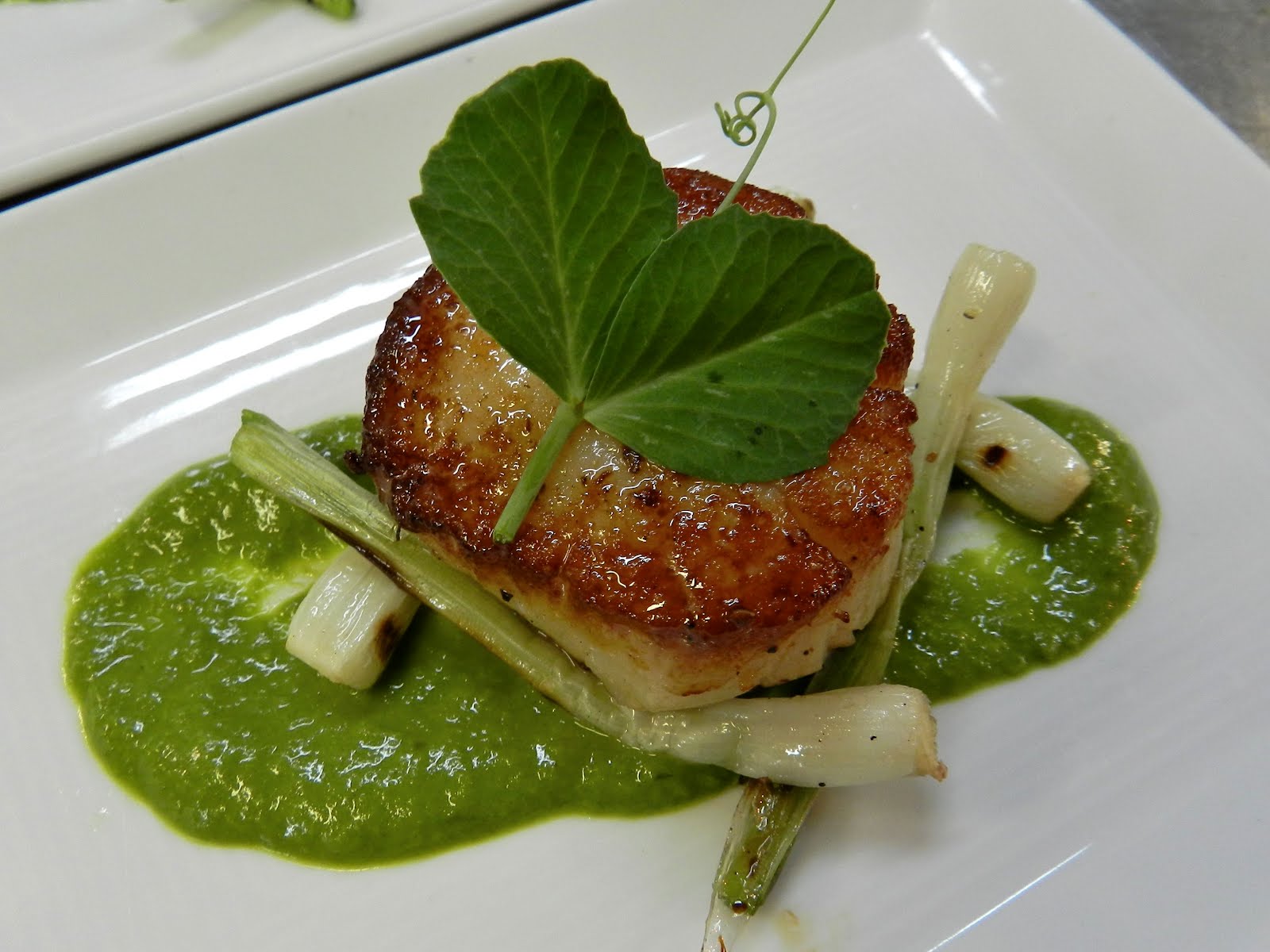
Sea Scallop. Spring always brings great scallops as new grounds are opened. I wanted to highlight our beautiful scallops against some of our local spring greens. The scallop is sitting on a purée of ramp greens and grilled baby spring onions and topped with a sugar snap tendril from my garden. The ramp bulbs have long since vanished into sopa de ajo.

Arctic Char. Spring always has me looking forward to salmon as it begins its spawning run up the rivers. It's just a little too early yet for salmon, but we do have two nice salmonids in house right now, arctic char and steelhead trout. Last week, we put up a batch of cured steelhead trout, so-called gravlax of steelhead trout, and we had a bunch of trimmings to work with.

On this plate, you see a mousse of roasted steelhead gravlax, fennel fronds from my garden, very lightly pickled hothouse cucumbers, seared arctic char, and a wonton containing gravlax, chives, and sour cream. The wonton came from wanting some crunchy element on the dish. And in the end, we decided to take the traditional bagel toppings and put them inside a crispy wonton as a somewhat cheesy (pun intended) nod to the God-awful crab rangoon served in ersatz Chinese restaurants. A little humor never hurt a dish as far I can tell.


Eggs, Bacon, and Toast. Now that spring has sprung and the days are getting longer, Sarah's ducks are cranking out far more eggs that we can possibly use to make our pastries. [Oh by the way, wondering why our pastries are so good? Blame the duck eggs!] So this dish was born of a need to consume duck eggs and of course also to showcase our awesome house-cured Berkshire pork belly.

Down on the plate, you see grilled and buttered focaccia topped with maple syrup-braised pork belly and a poached duck egg. We went through a dozen different plate presentations and finally in the spirit of consuming as many duck eggs as possible, decided to benedictify it with a lemon zest-augmented hollandaise. This sublime stack of wanton sinfulness is bejeweled with a crown of cilantro flowers from my garden.


Risotto. This dish didn't start as a risotto at all. For the longest time, it was just a list of ingredients: asparagus, morels, and duck confit. Our guests were very lucky that the first asparagus and the first morels of the year arrived in our kitchen simultaneously, lucky because they are ingredients that marry in the best kind of way. Morels, the king of mushrooms (you bolete fans are all wrong), deserve, no, they cry out for cured pork products. And what is better than cured pork? Our house-cured duck confit all poached in its unctuous duck fat bath!

So we had three awesome flavors that needed a neutral base to carry them and hence the risotto entered the picture, the rice marrying the ingredients and serving as a base for the garnishes: grilled asparagus, chive blossoms from my garden, and a morel dipped in cornstarch and crisped in hot oil. Ambrosial!


Picnic. I don't know what spring has on your mind, but a picnic is definitely on my mind. This dish is our homage to classic American picnic food: fried chicken, deviled eggs, and potato salad. Our fried chicken is an herb-marinated and grilled quail. Our deviled eggs are naturally quail eggs. And our potato salad, well, it is better than most potato salad you will ever eat, is instantly recognizable as potato salad, and yet, contains zero potatoes.

The potato salad is down on the plate letting us stand the boned-out quail up against it with the deviled egg halves nestled against it. Just under the quail and spilling out to the side of the eggs is an outstanding amarena cherry mosto cotto, cherry juice and grape must cooked down to almost a balsamic vinegar like syrup. To complete the cherry metaphor is a bit of dried cherry and celery salsa. Not only is it a great palate cleanser with the sweet-tart cherry working against the bitter crunchy celery, it is a reminder that cherries, that most delicious and first stone fruit of the new year, are just around the corner.

Oh, the potato salad. It's celery root, red onion, green onion, Surry sausage (our local Virginia smoked pork sausage), and parsley, all bound with mayonnaise.


Spring Lamb. No protein could be more spring in my mind than spring lamb and this one just arrived from the slaughterhouse. This lamb is so good that it really didn't need us to do much with it. I made a pesto from the tons of fresh mint growing in the boxes out in front of the restaurant and after boning out the lamb saddle, marinated the deboned loins in the pesto. In the vein of not doing very much with the lamb, I decided to serve it very classically, with pommes duchesse, mashed potatoes augmented with [duck] egg yolks and baked. Although you can't see it, the lamb is napped with a glace d'agneau, a highly concentrated lamb stock that we made from all the bones from the last lamb we received. It is so concentrated that it remains jellied at room temperature. We reheated it with a little white truffle juice.

The herbs I picked from my backyard in the morning. The lower herb in the photo is sheep sorrel which I included because lemony sorrel and lamb is a classic pairing, but also because I found it amusing to pair sheep with lamb! Corny, but true. The yellow blossom and the leaf above it is from a wild mustard plant. Lamb and mustard is a delicious combo. I often will drain the pan juices into a sauce pan after roasting a leg of lamb, add a little red wine, a little lamb glace, and then after straining it, will add Dijon mustard as a liaison to thicken the sauce. That, for me, is what the mustard greens on this plate evoke.


Rhubarb. Before there is any fruit in the spring, there is rhubarb, very much a vegetable, but one that we treat as a fruit. The only question here was how to provide a delicious foil for the sweet-tart rhubarb compote (rhubarb, cranberry juice, and sugar). Spring leads me to light desserts and light always leads me to Greek yogurt panna cotta, this one flavored with lemon zest and poppy seeds. For garnishes, you see a poppy seed tuile and lemon balm from my garden. The surprising element here is the black locust blossoms which had just opened for the very first time the morning of the dinner. I picked these from the backyard and just before serving them, tossed them in a dressing of honey, lemon juice, and lemon zest. The locust blossoms have a flavor at sweet pea crossed with honeysuckle nectar. They are delicious.

Saturday, February 19, 2011

Chef's Tasting

We just did a tasting for Phil and Deirdre Armstrong of Harvest Thyme Herb Farm in Staunton, VA, suppliers of herbs and vegetables to fine restaurants in the Staunton and Charlottesville area, as well as fellow bloggers. We wish we lived closer together so that we could work together.


Gravlax of Brook Trout. I'm a sucker for all kinds of cured and smoked fish, so when I got a delivery of way too many brookies, I decided to do a traditional salmon cure on some of them, hence the appropriation of the term gravlax. Garnishes are caperberries, dilled sour cream, red ribbon (aka blood) sorrel from the flats growing in our kitchen, and chervil which overwintered outside on the deck. I especially like the deep red color that the overwintered chervil takes on.

The crispy brown bits are parsnip crisps, something that we arrived at serendipitously. I love to serve smoked fish with latkes and we have been doing a lot of parnsip latkes lately. The night before the tasting, one of the cooks made a latke that was too big to fit onto the komatsuna garnish that I had already laid out on a plate, so I had him cut the latke down with a round cutter. That left all the crispy edge bits on the cutting board for chef snackies. The crispy edge bits were so good that we decided to do all crispy bits for the tasting.


Guinea Breast. We had a couple of guinea breasts laying around with no other use in mind, so we did a little ghetto sous vide on them and served them in a bowl of Surry sausage jus, with blanched Kentucky Wonder bean sprouts. Who knew you could eat baby bean plants? I sure as hell didn't think of it until Billie Clifton of Sunflower Cottage, our local microgreen supplier, brought some in a couple weeks back. To answer your question, they taste just like green beans. Go figure.


Porcini Carolina Gold Risotto with Wild Mushrooms, Guanciale, and Sage. We just had to do a wild mushroom course because we have wild mushrooms coming out of our ears now. It's been a great winter season for both black trumpets and hedgehogs. This is a really simple risotto of Anson Mills Carolina Gold rice, dried porcini, fresh sage from my home garden, and spectacular guanciale from La Quercia in Iowa. This is the last of my supply from La Quercia but even as good as it is, I'm looking forward to trying the guanciale from the home team in Manakin, VA, Olli Salumeria Americana. How cool is it to have two great suppliers of guanciale?

Garnishes are black trumpet mushrooms, hedgehog mushrooms, prosciutto crsips, fresh sage, and a cheese crisp made from porcini powder and pecorino Sardo. What you don't see in the photo is the barely poached quail egg beneath the robe of risotto. I love this trick. The egg yolk really enriches the risotto.


Pork Confit with Polenta Poblano Spoonbread and Salsa Verde. Ordinarily we don't do tomatillos out of season, but they were already in house from a very specific tasting that we did last weekend. I like to think of this dish as something you would get if your Southern grandma were of Mexican descent. It combines Southern classics spoonbread and fried green tomatoes with poblanos and salsa verde. And the crispy pork confit evokes carnitas, but the flavor is different because we used some orange zest and cognac in seasoning the pork before we cured it.

So what you see on the plate from left to right is a swoosh of salsa verde (poblanos, onions, tomatillos, cilantro, garlic), a fried green tomatillo, crispy pork confit threads, pimentón sauce (the orange sauce), and a cube of pork confit sitting on top of the spoonbread (leftover polenta, roasted poblano purée, cream, and eggs).


Bestilla of Border Springs Lamb. We get lambs in on a regular basis and tend to use the primary cuts (racks, loin chops, and legs) first. Then we end up with a lot of tiny foreshanks and necks in freezer after several months. That's when I get to braising, because braising is my favorite cooking technique and the neck and shank meat is the best meat on the lamb. This time, Craig's wonderful lamb ended up in a classic Moroccan tagine, a stew redolent of spices. I have made hundreds of tagines in my career and this was one of the best; I'm really honing in on just about the perfect spicing to showcase the lamb without overwhelming it. After braising, the lamb gets separated from the vegetables and the sauce. The lamb gets pulled and mixed back with the vegetables and the defatted and reduced sauce.

I wanted to showcase this beautiful pulled lamb, so I came pretty quickly to a classic bestilla. Rather than scramble eggs into the filling in the classic manner, I packed the pastries with lamb and buried a raw quail egg in the center, which then baked into a solid egg in the oven. We generally accompany our lamb tagine with chizu, a spicy carrot slaw. I wanted to use the chizu as a sauce and so we made a vinaigrette of it like we do with kimchee à la David Chang of Momofuku. Because of the high water content in the carrots, we had to use a touch of xanthan to bind the water and keep the vinaigrette from bleeding. The other sauce is a mixture of ras al hanout (an Arab spice mix) and Greek yogurt.

The salad garnish we called a winter salad. It consists of everything green that we could find, dressed with a preserved lemon vinaigrette. From what I remember, the salad contains brussels sprouts petals, tiny broccoli leaves, micro arugula, micro bulls blood beets, and chervil.


White Chocolate Goat Cheese Cheesecake with Sweet Potato, Almond, and Cranberry Florentine. I wanted to use sweet potatoes in the dessert course and it struck me to substitute them for the candied orange peel in a classic florentine, a crunchy cookie containing nuts and candied fruit glued together with honey, cream, and sugar. Florentines are often coated or drizzled with chocolate. We coated ours entirely with white chocolate and then used the Florentine as a crust for a white chocolate and goat cheese cheesecake. I've made hundreds if not thousands of cheesecakes in my life, but never with goat cheese, although that seems a pretty obvious thing to do. I enjoyed the goat cheese flavor; it reminded me of a panna cotta made with yogurt in which the acidity of the cheese/yogurt plays off the sugar to give a well balanced end result. Garnish is a drizzle of blueberry crème anglaise.

Saturday, January 8, 2011

Chef's Table

Here are the photos from our last Chef's Table of 2010. These dishes characterize my cooking mood right now: simple, classic, elegant, comforting, and a little playful. This menu was not about pushing boundaries or exploring techniques; it was merely about taking the best of what we had in house, cooking it well, and presenting it nicely.


Roulade of Smoked Salmon. I do all manner of charcuterie and cold meat dishes through the year. Towards New Year's Eve, I always start thinking of smoked salmon or gravlax. Rather than make a square- or rectangular-shaped terrine, I like to do a roulade. I think the presentation possibilities are nicer with the round form. Stuffed with a simple herbed cream cheese and capers.


Oyster "Stew". I wanted to do a traditional oyster stew, another dish that I always gravitate to for New Year's. Tony wanted to do fried oysters. This then is the compromise. I love to serve dishes up in martini glasses: it's often unexpected and it shows off the food well. I wish I had the time to photograph this well. Alas, there's no time on the line to fuss with lighting and backgrounds.


Truffled Blackeyed Pea Risotto with Duck Confit. This is a dish that hopped (pun intended) into my mind about three weeks ago. In the South, for good luck at New Year's, we always serve blackeyed peas and collard greens, both cooked with liberal amounts of pork products. This is my homage to that tradition and the tradition of Hoppin' John, substituting our house-cured duck confit for the traditional pork. You should have smelled the kitchen when I scattered the truffles over the hot risotto. Amazing!

In hindsight, I should have used Carolina Gold rice instead of arborio to further the metaphor. Oh well, next time. And damn, wouldn't a poached quail egg sitting on top of this, all ready to break open and ooze into the risotto, be super sexy? Ach! I can't be at the top of my game all the time.


Duck Schnitzel with Orange Spätzle. Here's a dish that I came up with some years ago just for a different way of presenting our Moulard duck breasts. We split duck breasts and pound them like schnitzel, then bread and fry them. The breading is panko, pecans, and pecorino. Garnished with a little red wine syrup and orange spätzle. It's a great dish but never seems to sell when on the menu. Something, I don't know what, scares diners. Maybe they don't know what schnitzel is.


Lamb Shank Puttanesca. If you're a lunch regular at the restaurant and a foodie, you'll recognize the origins of Ed's Pasta in Salsa Puttanesca, a classic sauce of tomatoes, red pepper flakes, anchovies, olives, and capers. With its vibrant and bold flavors, this sauce appeals greatly to me and I was just in the mood for some puttanesca when we were brainstorming this menu. Put that together with the bag of tiny lamb foreshanks that we have been collecting in the freezer because they are too small for a standard dinner entrée and you come up with this dish. Paired with a little roasted garlic rosemary polenta, you have full-flavored classic comfort food.


Chocolate Soufflé. In reading through the draft menu trying to figure out what to do for dessert, it occurred to me to keep it simple, classic, and comforting. Soufflés are so classic that you never see them offered on dessert menus any longer; pastry chefs consider them beneath their dignity. Pity, because this chocolate soufflé is as good a gooey, runny chocolate extravagance as you will ever find.

Saturday, January 2, 2010

Roulade of Gravlax

Let's start off the new year with one of the dishes that we served as an appetizer on our New Year's Eve menu, a roulade of gravlax. I cured a side of salmon for many days in salt, sugar, and a lot of white pepper and then dried the salmon for several more days in the refrigerator to yield what I call prosciutto of salmon, for its ham-like consistency. You could substitute any kind of thinly sliced fish or even ham in this appetizer. This post is about the technique; I leave the flavorings up to you. The tiny leaves you see are micro-lemongrass, which echo the lemon zest in the cream cheese filling.

Start by laying out plastic film on your counter top. If you're using narrow film, you may want to overlap two pieces as I did. Lay out your fish in a large rectangle as you see here. In practice, it doesn't really matter how the pieces overlap each other. Patch any large holes with small bits of fish.

Make certain your filling is very soft, otherwise, you'll not be able to spread it on the fish without destroying your layout. This filling is softened cream cheese flavored with fresh dill, lemon zest, minced capers, and white pepper. I didn't add any salt because the ham-like salmon is really salty and the capers add enough salt to the filling. I've also used all manner of seafood mousses as fillings. Experiment and have fun.

Working very carefully, spread the filling over the fish. Take your time. I will be rolling this from the right edge to the left edge. Notice that I start the filling close to the right edge, but leave a large margin on the left side so that I have an extra flap of fish to help seal the roulade. Also leave a bit of margin on the two ends so that you don't push the filling out onto the counter as you roll the roulade.

Obligatory food porn shot number 1. Doesn't this look good? Notice how faded the salmon looks? That's because I salted it for so long; the longer the cure, the paler the fish in my experience. This fish was a fairly typical salmon red to begin with. The fish was in the cure about a total of 7-8 days, which is a long time for salmon. The longer the cure, the drier and saltier the fish, as well. If you cure your own fish, you'll have to experiment to see what you like.

Using the plastic film, turn over the first little bit of the edge of the roll on itself. Once you have turned over the first little bit, use your fingers to tighten up the roll, keeping the film between your fingers and the fish. Use the film to keep pulling the fish over itself, forming a tight cylinder as you go. The film is absent in the subsequent photos to keep the glare down; this is merely for photographic convenience.

Here is the roulade, rolled about half way. Notice how I have tightened the roll up as much as possible. There is a fine line between tight enough and so tight that you start forcing the filling out of the seams. Be gentle; using the film to form the roll helps you keep the pressure gentle. If you do touch the roll with your hands, use the flats of your palms and roll gently. It's not hard to do, but go slowly until you get the hang of it.

Obligatory food porn shot number two in which the photographer feels compelled to give tight, close up shots of highly edible foodstuffs. The ends of the roulade will be naturally a bit ragged as you see here and that's OK. However, it is a terrible shame that you will have to trim and eat these little snack bits rather than serving them to your guests. Poor you!

Here you see the completed (but unwrapped) roll just before I put it in the refrigerator to chill. Notice about a third of the way down that there is a slight void between a couple of pieces of gravlax (where you see the white filling peeking out). This is nothing to worry about or even try to fix: small voids here and there will not compromise the integrity of the roll once it firms up in the refrigerator. The solid filling will bind everything.

Roll the roulade in the film. I discarded one of the two pieces on the counter and rolled the fish in the other. Gently roll it back and forth on the counter to make the cylinder as uniform as possible. Place on a tray and refrigerate for at least four hours and preferably overnight. You want the filling to firm up as much as possible. If you are in a mad rush, use the freezer.

Here's what you are aiming for, a tight roulade with few internal voids. My hints for slicing the roulade: make sure the roulade is very cold, use a very thin knife with cullens such as a gravlax knife or ham slicer, slice directly through the plastic film, and wash the blade in warm water between slices.

Sunday, January 25, 2009

Where Have All the Good Eaters Gone?

I'm feeling really happy about getting slammed last night for the first time in months, but also feeling a little depressed at the same time. This past week, I put a lot of effort into designing dishes that you can't get just anywhere else, but customers largely ignored those dishes this weekend, going for safer options, things that they already know that they like. Where's the spirit of dining adventure?

Food Arts publishes a semi-regular column called "Hits and Flops" which details chefs' dishes that really took off and those that really didn't. Here's my weekend list of those that went nowhere.

Terrine of Local Lamb Flavored with Pistachios, Dried Cranberries, and Marsala

It's no secret that I love to make charcuterie and this terrine was particularly nice, studded with veal tongue, and enriched with rabbit liver. And the plate doesn't look too bad either, does it?

Gravlax of Steelhead Trout on Scottish Oat Cake with Sour Cream Drizzle and Capers

I had an extra side of Steelhead, so I decided to do it gravlax-style, cured with white pepper, dill, sugar, and salt. And it turned out great: the texture is finer and silkier than Salmon. Thinking back to foods that I like to eat with a glass of Scotch, I just had to make a Scottish oat cake to go under the rosette of Steelhead.

Grilled, Teriyaki-Glazed King Oyster Mushrooms

These big meaty King Oysters were just calling out to me, "Grill Me!" So, I did, and with sushi and more specifically unagi on the brain, I made a teriyaki glaze for these mushrooms. So good!

Mâche and Persimmon Salad with Goat Cheese and Toasted Hazelnuts

This is quite possibly one of the most striking salads that I have designed (though I can see it in the spring time with Johnny Jump Ups mixed in with the mâche). It's also extremely tasty, but way too weird for local tastes.

Prosciutto-Wrapped, Goat Cheese-Stuffed Loin of Rabbit

This dish was really slow to move, but we finally sold through it last night. You like goat cheese and chicken breasts don't you? You love ham on everything. Then why not the same treatment for rabbit? As delicious as it was striking on the plate, this dish was a tough sell with customers. The legs went into the gratin that accompanied the loin. Everyone who ate this dish loved it, but it deserves to sell better.

Just where have all the good eaters gone?