I really love composing and cooking tasting menus for a lot of reasons. In building a cohesive menu from scratch, I have a strong sense of engagement and I enjoy and welcome the intellectual challenge. Also, I get out of the rut of cooking the same old crab cakes and filets mignons that pay our rent month in and month out. And I enjoy cooking for people who are willing to have their palates challenged. This frees me to not only show off the bounty of local ingredients with which we are blessed to work, but it also lets me serve delicious things that wouldn't sell well on the main menu, and it lets me experiment to a certain extent by taking some risks that I wouldn't under normal dinner circumstances. Did I also mention that this is how I like to eat? When I go out, I just want the chef to send out small bites every 20 minutes or so.
A lot of restaurants have tasting menus and many of them run a tasting menu for a fixed period of time, such as a week or a month or a season. Each tasting menu that we do is custom designed for a particular client. Even if we are doing tasting menus for multiple parties simultaneously, they will be having different menus. Admittedly it's a crazy way to run a restaurant, but then my sanity escaped to the ether some years back. But in this way, the cooking is very personal. I am cooking for a specific client and not just for anybody who walks in off the street and happens to order the tasting menu.
I don't post many of the Chef's Tastings that we do simply for lack of photographs. It's often too busy to photograph our work or because we're in a rush, photos for a certain course just do not turn out. Shooting macro shots by handholding in a busy kitchen on reflective stainless steel tables under really crappy fluorescent lighting is somewhat short of ideal, especially when I brace the camera against the table and someone down the line hip checks the table at the same time I'm shooting.
But the pace and karma Saturday night all aligned perfectly and I got some good shots, good enough for blogging, at least. Not great, but good enough considering the terrible lighting. They follow below.
I was pleased that the clients actually encouraged me to pair this menu with Virginia wines. Often I have to cajole some clients into letting me show off some of our local wines. The following is a highly seasonal menu, one that screams late fall, exactly what I was aiming for:
Chef's TastingSaturday, October 31, 2009
Crème Brûlée of Mapled Foie Graspoached cranberries, bread crisp
Chrysalis Petit Manseng Virginia 2007
------
Fan of Tataki of Opah and Local Daikonlemon zest, fleur de sel
White Hall Viognier Virginia 2007
------
Stone Crab Clawsparsnip purée, vanilla bean beurre blanc, salad burnet
Glen Manor Sauvignon Blanc Virginia 2008
------
Veal and Rabbit Terrinequick-pickled local cucamelons; whole grain honey mustard
Swedenburg Pinot Noir Virginia 2008
------
Local Lamb Ribs in the Style of Peking DuckFabbioli Chambourcin Virginia 2007
------
Lightly Grilled Caribou Tenderloinduck fat-sautéed matsutake mushrooms and sunchokes; dried blueberries; elderberry and truffle demiglace; local organic spigarello
Linden Claret Virginia 2005
------
A Study in Local ApplesCheesy apple crêpe, apple granita, apple-kaffir lime compote, fried green apple with apple cider reduction; Kerrygold Ivernia cheese
Local Apple Cider-Calvados “Martini”
 Crème Brûlée of Mapled Foie Gras
. This dish started with a lobe of foie in the cooler that I needed to use and with the local Chrysalis Petit Manseng that I wanted to serve. Americans seem always to want the sweet wines at the end of dinner instead of as an aperitif, so I wanted to buck that by serving the sweet wine up front. I wanted to add some sweetness to the dish to work with the wine and initially I was thinking about brûléeing a slice of foie, and from there it wasn't a huge leap to crème brûlée. The maple syrup was almost an afterthought, mainly a liaison with the maple leaf garnish on the plate. To offset some of the richness, we just barely poached fresh cranberries in simple syrup. We served this warm out of the oven and I have to say that it was a brilliant dish.
 Fan of Tataki of Opah and Local Daikon
. I had a really clear piece of Opah that I wanted to feature and the first local daikon of the year just arrived in the farmer's market the morning of the tasting. I put a slight pickle on the daikon, for a salty and acidic counterpoint to the barely seared Opah. The flavor combination of the two and the texture contrast between the two were fine, but in the end, I'm not crazy about this dish or the presentation.
 Stone Crab Claws
. Stone crab season just opened so I wanted to celebrate that with this dish. I feel like I went out on a limb here a little putting stone crab claws on a parsnip purée. Garnishes are a vanilla beurre blanc and salad burnet. I felt the combination of the slightly sweet and herbal parsnip worked amazingly well with the vanilla and the crab. This dish is a winner and visually appealing too.
 Veal and Rabbit Terrine
. This is another one of my terrines; there's always one in the cooler. While I generally don't use liver in my terrines (because of knee-jerk customer reaction), I used the livers out of four rabbits along with a good splash of cream to bind this terrine. A touch of Cognac doesn't hurt either. Interior garnishes are black truffles, pistachios, dried cranberries, veal tongue, green peppercorns, and rabbit loin. Really a very tasty effort. I opted for the artsy photograph here so the interior garnish is tough to see; pity. In the foreground you see that our nasturtiums haven't given up the ghost yet and in the background you see the last of the local
cucamelons, lightly pickled.
 Local Lamb Ribs in the Style of Peking Duck
. Selling ribs in a fine dining restaurant is an exercise in futility, a real pity because they are so good. We have to sell the ribs somehow, so they most often end up on tasting menus. I am a huge fan of braised dishes (slow-cooked with a little liquid) and especially of the style called red cooking from northern China. We rubbed the lamb ribs in garlic and five-spice powder and braised them with soy sauce, white wine, brown sugar, hoisin sauce, star anise, cinnamon, ginger, garlic, and green onions, then let the ribs stand in the braising liquid overnight. We pulled the rib meat and minced it, defatted the braising liquid and reduced it slightly (soy is very salty!), augmented the braising liquid with a little hoisin and sesame oil to make a sauce, then mixed the minced lamb with the sauce, bias-cut green onions, and white sesame seeds. We then brushed a crêpe with the sauce and stuffed it with the minced lamb. This is absolutely delicious and much more flavorful than duck done the same way.
 Lightly Grilled Caribou Tenderloin
. Caribou is a mild and delicious deer that under the best of circumstances is difficult to obtain, so I was happy to be able to get a little bit for this tasting. This dish is all about fall: lightly grilled caribou over a nest formed from local
spigarello (a leaf broccoli) and filled with a sauté of just-dug Jerusalem artichokes and fresh matsutake mushrooms from Oregon. We finished this with a few dried blueberries and a demiglace augmented with local elderberry syrup and black truffles.
 A Study in Local Apples
. I'd be really remiss here in the heart of Virginia's apple country not to do a dessert of local apples. I had wanted to do a separate cheese course, but the menu was starting to get a little long so we combined the dessert and cheese courses into a single course. Cheese and apples, especially apple pie, is a natural combination at least in the school of traditional southern cooking in which I was raised. A big slice of sharp Cheddar (rat cheese as we called it) was a must with apple pie.
When I was at the farmers market on Tuesday last week, I was getting some green tomatoes for fried green tomatoes. In the next bin were some green apples causing me to flash on fried green apples. I did an instant market survey ("Hey, what do y'all think of fried green apples as a dessert course?") and the conclusion was that it couldn't be bad, so I came back to the restaurant where Chris and I started to experiment with apple thickness, coatings, and seasonings. After a half a dozen samples we got it right. You see fried green apple under the cheese and the crêpe in the photo above. We removed the core of the apple and plugged it with a piece of apple so that the whole would be edible.
On the plate from left to right you see apple compote (Golden Russet apples) cooked down with local honey and kaffir lime, topped with a blade of vanilla grass. Then the fried green apple with the cheese wedge. The crêpe holds wedges of Empire apples roasted with honey and cinnamon, along with grated cheese. The crepe was warmed in the oven to melt the cheese, then topped with a bit more cheese. Under the fried green tomato you see a syrup that we make by straining and reducing local cider until it is syrupy. On the far right, you see a small serving of apple granita, made from 8 varieties of apples and almost no sugar. I'm really happy with the flavors, but the presentation is a bit monochromatic.
 Local Apple Cider-Calvados “Martini”
. I didn't want another dessert wine with this menu (remember, we started with one) and I had a couple gallons of local cider on hand in the cooler, so I mixed up a cocktail of cider, Calvados, lemon juice, vanilla syrup, and some bitters. The glass is rimmed with cinnamon sugar. The apple slice is from a sweet Fuji; the cider is naturally sweet so a tart apple would have been unpleasantly mouth puckering.




 Crème Brûlée of Mapled Foie Gras. This dish started with a lobe of foie in the cooler that I needed to use and with the local Chrysalis Petit Manseng that I wanted to serve. Americans seem always to want the sweet wines at the end of dinner instead of as an aperitif, so I wanted to buck that by serving the sweet wine up front. I wanted to add some sweetness to the dish to work with the wine and initially I was thinking about brûléeing a slice of foie, and from there it wasn't a huge leap to crème brûlée. The maple syrup was almost an afterthought, mainly a liaison with the maple leaf garnish on the plate. To offset some of the richness, we just barely poached fresh cranberries in simple syrup. We served this warm out of the oven and I have to say that it was a brilliant dish.
 Fan of Tataki of Opah and Local Daikon. I had a really clear piece of Opah that I wanted to feature and the first local daikon of the year just arrived in the farmer's market the morning of the tasting. I put a slight pickle on the daikon, for a salty and acidic counterpoint to the barely seared Opah. The flavor combination of the two and the texture contrast between the two were fine, but in the end, I'm not crazy about this dish or the presentation.
 Stone Crab Claws. Stone crab season just opened so I wanted to celebrate that with this dish. I feel like I went out on a limb here a little putting stone crab claws on a parsnip purée. Garnishes are a vanilla beurre blanc and salad burnet. I felt the combination of the slightly sweet and herbal parsnip worked amazingly well with the vanilla and the crab. This dish is a winner and visually appealing too.
 Veal and Rabbit Terrine. This is another one of my terrines; there's always one in the cooler. While I generally don't use liver in my terrines (because of knee-jerk customer reaction), I used the livers out of four rabbits along with a good splash of cream to bind this terrine. A touch of Cognac doesn't hurt either. Interior garnishes are black truffles, pistachios, dried cranberries, veal tongue, green peppercorns, and rabbit loin. Really a very tasty effort. I opted for the artsy photograph here so the interior garnish is tough to see; pity. In the foreground you see that our nasturtiums haven't given up the ghost yet and in the background you see the last of the local cucamelons, lightly pickled.
 Local Lamb Ribs in the Style of Peking Duck. Selling ribs in a fine dining restaurant is an exercise in futility, a real pity because they are so good. We have to sell the ribs somehow, so they most often end up on tasting menus. I am a huge fan of braised dishes (slow-cooked with a little liquid) and especially of the style called red cooking from northern China. We rubbed the lamb ribs in garlic and five-spice powder and braised them with soy sauce, white wine, brown sugar, hoisin sauce, star anise, cinnamon, ginger, garlic, and green onions, then let the ribs stand in the braising liquid overnight. We pulled the rib meat and minced it, defatted the braising liquid and reduced it slightly (soy is very salty!), augmented the braising liquid with a little hoisin and sesame oil to make a sauce, then mixed the minced lamb with the sauce, bias-cut green onions, and white sesame seeds. We then brushed a crêpe with the sauce and stuffed it with the minced lamb. This is absolutely delicious and much more flavorful than duck done the same way.
 Lightly Grilled Caribou Tenderloin. Caribou is a mild and delicious deer that under the best of circumstances is difficult to obtain, so I was happy to be able to get a little bit for this tasting. This dish is all about fall: lightly grilled caribou over a nest formed from local spigarello (a leaf broccoli) and filled with a sauté of just-dug Jerusalem artichokes and fresh matsutake mushrooms from Oregon. We finished this with a few dried blueberries and a demiglace augmented with local elderberry syrup and black truffles.
 A Study in Local Apples. I'd be really remiss here in the heart of Virginia's apple country not to do a dessert of local apples. I had wanted to do a separate cheese course, but the menu was starting to get a little long so we combined the dessert and cheese courses into a single course. Cheese and apples, especially apple pie, is a natural combination at least in the school of traditional southern cooking in which I was raised. A big slice of sharp Cheddar (rat cheese as we called it) was a must with apple pie.
 Local Apple Cider-Calvados “Martini”. I didn't want another dessert wine with this menu (remember, we started with one) and I had a couple gallons of local cider on hand in the cooler, so I mixed up a cocktail of cider, Calvados, lemon juice, vanilla syrup, and some bitters. The glass is rimmed with cinnamon sugar. The apple slice is from a sweet Fuji; the cider is naturally sweet so a tart apple would have been unpleasantly mouth puckering.
 This is a pun, a wink at Luis Uno-Ojo, and an Americanization of a Mexican version of an American dish. Whew! Many years ago, my friend Luis from Guadalajara (Jalisco) introduced me to a soup that he calls cóctel (cocktail), a cold tomato and beef bouillon soup garnished with poached shrimp, avocados, cilantro, and so forth. His cóctel is a soup version of Cóctel de Camarones, the American classic Shrimp Cocktail. I reverted the soup to a true cocktail of beef consommé, tomato juice, and a good shot of that Jaliscan joy juice, tequila. I always serve it up in a martini glass as you see here, rimmed with cumin salt and finished with a fun garnish including shrimp. This version is garnished with a shrimp skewered around a piece of chorizo, then grilled. Putting the fun back in dinner and the cocktail back in Shrimp Cocktail, Guadalajara-Style!
 After our brief trip south of the border, we brought things right back to Virginia with some local softshells, the first of the year from the Chesapeake Bay. The lemon zest and crab stuffing is a flavor idea that I stole from a crab cake appetizer from Tracy O'Grady at Willow (Tracy, your crab cakes rock!). A little organic blue cornmeal from a local mill gave a bit of crunch and the grapefruit beurre blanc brought the dish in line with a really grapefruity Sauvignon Blanc.
 I got a perfect pastured chicken and it was easily the highlight of this particular dinner. I loved the resulting dish so much that I've already blogged about it. Classic French technique meets impeccable local American ingredients, paired with Jim Law's equally impeccable Linden Hardscrabble Chardonnay.
 Upscale fajitas anyone? I had a lovely local organic veal skirt steak in the cooler along with the remnants of a case of poblano chiles that had seen better days. I've replaced the corn tortilla with an organic blue cornmeal hoe cake (cornmeal, garlic-infused butter, salt, pepper, and boiling water) and converted the rather limp poblanos to a roasted poblano crema. The skirt steak is lightly marinated in garlic, fresh baby cilantro, and kaffir lime, then lightly grilled to medium rare, rested, and sliced across the grain.
 Somehow, Brandon and I were both thinking samosas at the same time, so I made a bunch of them. We decided to stay away from traditional Indian spices and go with a more or less traditional Shepherd's Pie filling: lamb, mirepoix, herbs, garlic, gravy from lamb stock, and mashed potatoes. A quick reduction of Grenache and rosemary bound with demiglace gave us a sauce and then a sweet and spicy apricot chutney (what would be called a pickle in India) finished the plates that you see Brandon setting up here.
 And the finished plates. I'm OK with white/negative space on a plate, as you can see here. Oh yeah, the samosas were banging—like little lamb empanadas. Yum.
 Here you can see the fried rice cake and the spinach down in the soup plate, before we add the bison. The fried rice cake is merely fried rice bound with egg and fried into a pancake. Easy as can be and a crowd pleaser. We have this beautiful whole local spinach, cut off just above the roots, so we blanch it, toss it in butter and then curl it on the dish, in this case on top of the rice cake.
 And here is the final dish with the bison on top and the sauce over and around. Red cooking is an awesome braising technique that you should have in your arsenal. I need to do a blog post just on that. In short, it's a classic Chinese braise in which the meat is cooked in a sweet and spicy liquid made from soy sauce, white wine (Shaoxing is typical), brown sugar or caramel, ginger, garlic, green onions, and sweet spices such as star anise, black pepper, Szechuan pepper, cinnamon or cassia, and so forth.
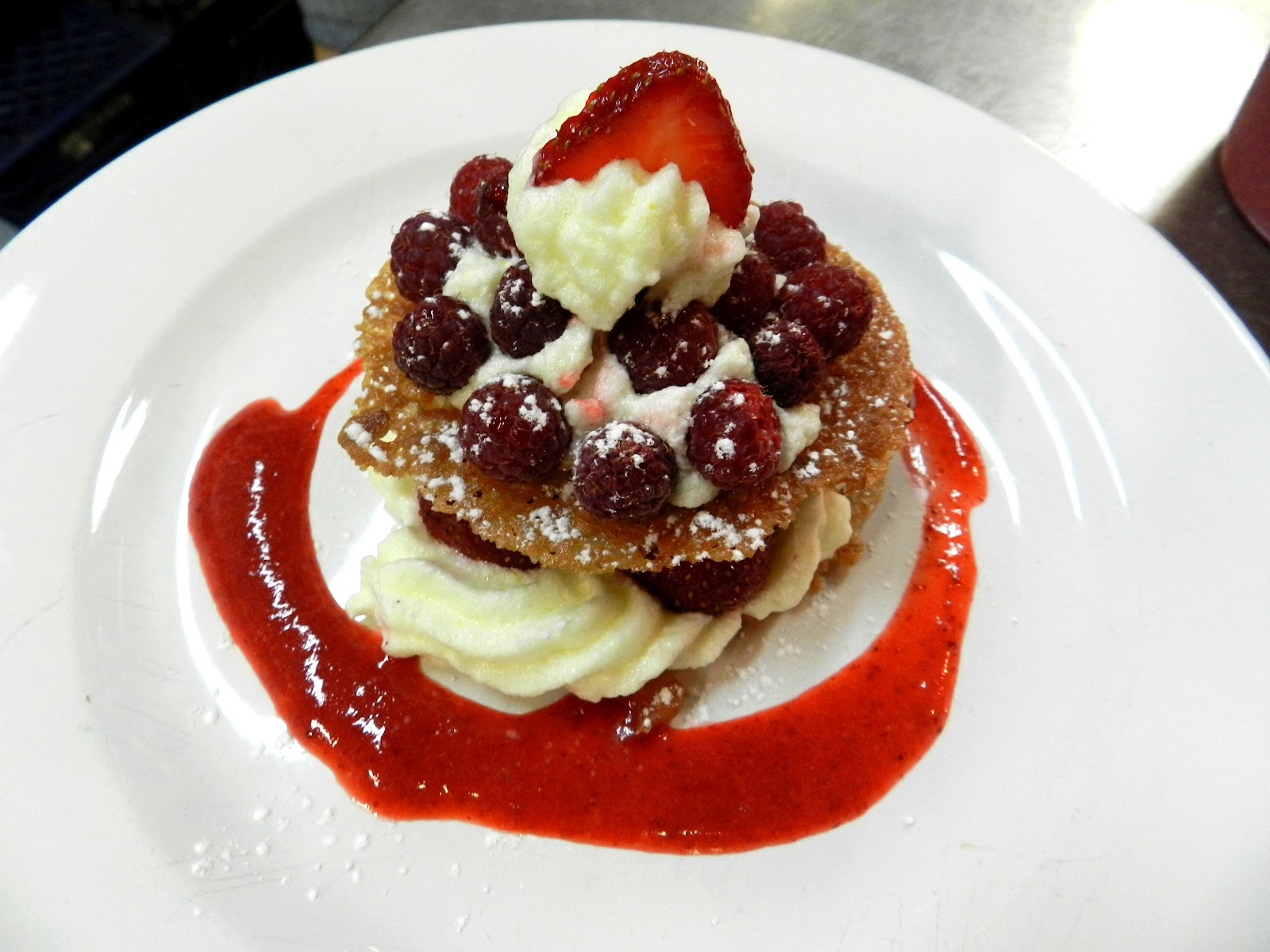
 Finally, local strawberries arrived after 11 months of being gone. Throw together strawberry purée, Italian meringue, and whipped cream and what do you get? A frozen strawberry soufflé if you're patient enough to wait for it to freeze. The mint and lemon verbena are from our herbs growing outside the front door of the restaurant.
 Eggs OBW, in the fuzzy picture to the right (sorry, my Nikon battery died, so photo courtesy of my daughter and her little point-and-shoot), is my version of Eggs Benedict (which I don't really like at all). I used to run this as an elegant tapa or appetizer, but now I mainly do it for demonstrations. If we did brunch here, which we will never do, this dish would feature prominently.


