Last night, we put on our monthly wine dinner, this month featuring the wines of
Linden Vineyards, with special guests Jim Law and Shari Avenius. This is the fourth or fifth year in a row that Jim has been with us in June. I always look forward to this dinner because the wines are so great. I sincerely believe that Jim makes the best wines in Virginia and among the best in the country. It's always a pleasure to see if my food stands up to the test of his wines.
I'm very happy with the way that the dinner came off, the way the staff handled the dining room, the wine and food pairings, and especially the portion sizes. I think we finally managed to get them right. As chefs, we like to feed people and in multi-course dinners, we are sorely tempted to put way too much food on the plate. I would say that we put exactly enough food out last night and no more. It is always good to go away from a meal satisfied, but not bloated.
Here's the menu from the dinner. Discussion of how we arrived at the menu and notes on the individual dishes and wine pairings follow.
Grilled Prosciutto-Wrapped Hawaiian King Prawns
Lemon Balm Beurre Blanc
Sauvignon Blanc “Avenius” 2007
Caramelized Sea Scallop on Potato-Bacon Chowder
Chardonnay “Hardscrabble” 2005
Roulade of Lamb Tenderloin, Spinach, and Goat Cheese
Grilled Vegetable Hummus
Petit Verdot 2005
Grilled Bison Flat-Iron
White Corn Salad; Hardscrabble Red Demiglace
Red “Hardscrabble” 2005
Cherry-Chile Compote on Torched Pineapple
Late Harvest Vidal 2004
Menu DevelopmentSome menus just fly off my pen and onto paper (yes, I write them out longhand), but this was not one of them. I started thinking about the menu some months ago, but nothing really came to me and so I put it off until Sunday, at which point I really couldn't put it off too much longer, to be able to order center of the plate proteins to arrive by Thursday.
I sketched out a very rough menu on Sunday, just trying to make some basic decisions about which proteins to order. At that point, I had some kind of ravioli with braised duck (either stuffed with duck or sauced with a duck Bolognese) paired with the Petit Verdot and veal brisket paired with the Hardscrabble red.
I wasn't happy with these because it put two braised dishes back to back in a summer menu and the pairing of veal and a big Bordeaux-style red would be a stretch. I could make it work, but the sauce I would have had to put with the veal would have obscured its delicate flavor.
Come Monday, I was so wrapped up in filming my forthcoming
PBS shows that I forgot to call my meat and game broker to find out what he had on hand that might spark a creative idea for my menu.
Tuesday morning, because I had forgotten on Monday, I rushed to get an order in before the 9:30am cutoff for next day delivery. I managed to order the prawns and some rabbits and bison
palerons for my weekend menus. At that point, I wasn't planning to serve bison for the wine dinner.
Tuesday afternoon, once we got the line set up for dinner service, it was do or die for this menu. Brandon and I went out on the deck and started sketching ideas out, but nothing was coming, so we went in and tasted the wines for the dinner. Back out on the deck, we started hashing out the menu again.
I decided while tasting to put the bison on with the Hardscrabble red and I knew that I wanted prawns to go with the Sauvignon Blanc. I drink a lot of the Hardscrabble Chardonnay, so I knew as far back as Sunday that I was going to do some kind of scallop chowder with it.
That left us to find a basic direction for the Petit Verdot course and the Late Harvest course. My initial idea of duck (or perhaps wild boar) was based on my tasting of the 2002 Petit Verdot, the last bottling prior to 2005. I am really happy that I tasted the 2005 rather than relying on my memory of the 2002, because the 2005 fairly screamed "lamb!" at me.
For the dessert course, Brandon thought cherries and I thought raspberries, mainly because I have a cooler full of raspberries. There was never any doubt that we would do fruit. I let him sway me to cherries and was intrigued by the possibilities of his idea of putting chiles in the cherries as a counterpoint to the residual sugar in the wine. I lobbied strongly for dried red chiles because I didn't want any vegetal character from a green chile coming through in the dessert. I pushed for some pineapple to bring the cherries back towards the tropical flavors in the wine. Then Brandon had the idea of torching the pineapple like a crème brûlée and we were about done. I tossed some candied pineapple into the mix. This is a good example of how dishes come together.
At this point, the hard work was over and all we needed to do was to figure out the cuts of meat, cooking methods, garnishes, and plate presentations. That really is the easy work and we knocked that out in about 10 minutes. Once the primary component of the dish is set, the rest is just tweaking the dish to work with the wine. Because Jim's wines are so good, I always want to let them take center stage. Keeping this in mind, we worked to keep the food very simple and the flavorings fairly muted.
Grilled Prosciutto-Wrapped Hawaiian King PrawnsThis is a straightforward dish to go with the classically Sancerre-styled Avenius Sauvignon Blanc. Because this SB is very ripe with a full mid-palate, I wanted a bit more substance to the dish so we brought the saltiness of the ham into play. These prawns are naturally very sweet, so the salty ham is an excellent counterpoint. Shrimp, for all its virtues, has very little fat and the one thing that a high acid wine needs as a foil is some fat. So, we provided our own with a simple beurre blanc made from the very floral lemon balm growing in the planter just outside the front door.
Caramelized Sea Scallop on Potato-Bacon ChowderThis Chard could easily be a white Burgundy. It's got a lot of well integrated oak that gives it vanilla and caramel flavors, but it's also got enough acidity to stay pretty well balanced. If ever a wine screamed out for a cream sauce, this is it. I love the interplay of smoked foods with oaked Chardonnays, so with smoke and cream on the brain, a bacon-laced chowder came right to me. I reduced the cream in the chowder to a very thick sauce and plated the chowder right under the caramelized scallop. I toyed with smoking the scallop or putting the scallop in the chowder, but I wanted the drama of sitting the scallop on top of the chowder and I also wanted that lovely layer of caramel on the scallop to play with the caramel notes in the wine.
Roulade of Lamb Tenderloin, Spinach, and Goat CheeseI did it again! I made myself say "
Wow!" I hate it when I do that! This was an amazing dish and one that I need to remember to keep in the repertoire. Butterflying the tiny tenderloins and stuffing and rolling them was a bear, but it was so worth it.
Once I decided to put lamb with the Petit Verdot, we arrived quickly at a roulade of tenderloin. I love spinach and goat cheese with lamb, so that was a no-brainer for a stuffing: all three ingredients have an essential earthy character in common. This Petit Verdot, for the same reason that it wants lamb, wants grilled vegetables: the grill smoke and roasted flavors work well with the earthy, leathery, dark fruit. It was an instant leap from grilled vegetables to grilled vegetable hummus as a garnish. I'm not conscious of the thought process in this transition; I merely wrote "grilled vegetable hummus" on the menu next to the lamb and that was that.
The hummus was in itself outstanding. I grilled and finely diced yellow squash, green squash, and eggplant. Then I slowly cooked a lot of garlic in extra virgin olive oil and added that the vegetables. Next, I made three different batches of hummus in three different flavors and consistencies: a very smooth lemony one, a medium smooth pimentón one, and a chunky tapenade one. I mixed all three with the vegetables for a variety of flavors and textures.
Grilled Bison Flat-IronThis was a really simple grilled meat dish designed as a foil for the delicious Hardscrabble Red Bordeaux-style blend. I seamed out the flat-iron steaks from the bison palerons (this was not a happy experience and is not something I am likely to ever do again!) and marinated them for 24 hours in extra virgin olive oil, garlic, black pepper, and soy sauce. Then we grilled them and served them over a fresh corn salad of grilled white corn, raw white corn, tomatoes, onions, and parsley.
I originally thought of putting the bison on polenta cakes, but because it was so warm out, we went with Brandon's idea of a cool and fresh corn salad. In hot weather, I find that a temperature contrast is always welcome.
Cherry-Chile Compote on Torched PineappleWhen pairing desserts with dessert wines such as the Linden Late Harvest Vidal, you must always keep the sweetness of the dessert less than that of the wine, or the wine will taste sour in comparison to the dessert. A great way to work with the fruitiness of dessert wines and avoid a lot of sugar is to use really ripe fruit with little or no added sugar.
For this dish, we sprinkled vanilla sugar (we store vanilla beans in fine sugar) over the pineapple, hit it with the torch à la crème brûlée for a glossy caramel layer, topped it with the compote of fresh cherries cooked down with arbol chiles, and put a few slivers of candied pineapple over the top.
The chiles added an interesting dimension to the dessert. The little bit of heat that they added to the cherries gave the cool, sweet wine a little fire to put out, making the wine seem all the more refreshing, an interesting trick if you ever need to pair food with sweet wine.
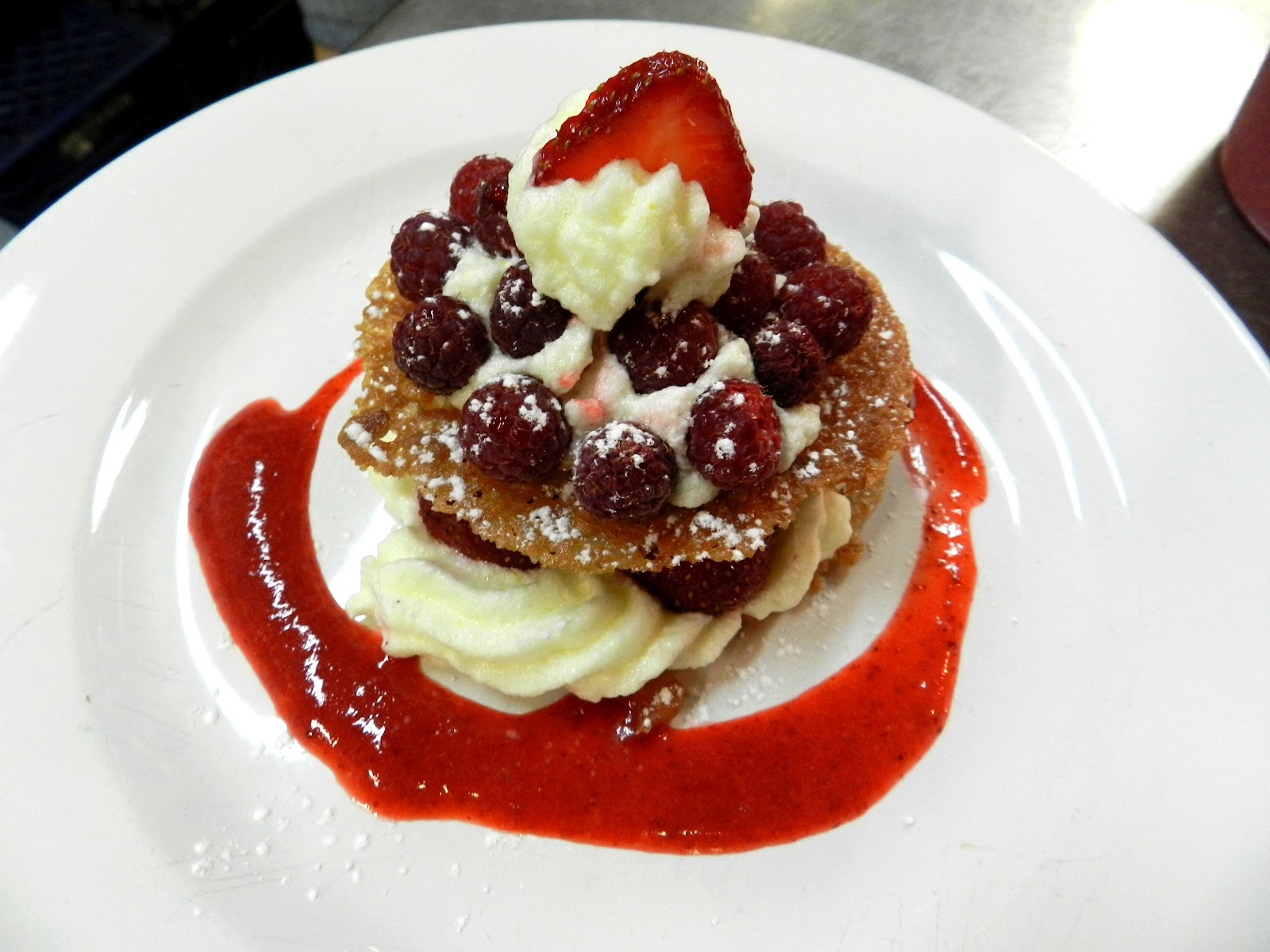
Hartley, you're right. A crisp cookie or tuile would have been appropriate here, but the humidity got the best of us. I made tuiles last week in similar humidity and they did not last an hour before they went soggy. I wanted to do a shortbread biscuit, but shortbread is impossible to do under humid conditions. So, I threw in the towel. In retrospect, I should have made some almond biscotti, but I had enough on my plate already in pulling off this dinner.
Enough. Off to break down the rabbits for tonight's menu....



 Jerusalem Artichoke Soup. We have a super abundance of Jerusalem artichokes in our cooler just now and they are a natural for soup. They bring an almost inimitable silky appealing texture to soup. The downside is that they can bring a dull and listless grey color to the party as well. To mask this, we added a tiny bit of roasted red pepper for an orange hue, but not enough to flavor the soup. Too much of a silky soup can really bore your tastebuds, so we had to bring some acid to the party, which we did in the form of a roasted red pepper and goat cheese mousse. The acidic goat cheese is just the thing to keep your palate refreshed. Paired with a lemony Spanish Albariño.
 Yukon Gold and Two Onion Potato Cakes. Here are the llapingachos that started this whole menu, made from local Yukon golds with a grated three-milk (goat, sheep, and cow) cheese, green onions, and caramelized onions. To reiterate the cheese, we have sauced these cakes with a warm cheese and beer sauce, using the same cheese as in the potato cakes and a very hoppy amber ale to give the cheese sauce a touch of hoppy bitterness to keep it from being cloying. The green sauce is a green onion cream that brings a cool acid bite to counterpose the rich cheese sauce. Paired with Chilean Pinot Noir. This could have easily paired with a white wine, but the customer's preference is red wine.
 French Onion Soup Bruschetta. Not really sure where this dish came from except that we were probably cold on the day that we brainstormed this and wanted soup to warm us up. This is an exercise in reimagining a classic soup. We took the soup and puréed it to become the sauce for the plate and put the onions on top of the croustade rather than under it. High cuisine? Not. Delicious? You bet. Paired with a medium-bodied, lower acidity Willamette Pinot from Yamhill-Carlton.
 Rapini "Wellington." Again, I don't remember the genesis of this dish. With three of us throwing ideas at the wall and seeing what sticks, creating dishes is a very crazy process. In any case, we decided to showcase our beautiful local rapini as a quasi-Wellington. I learned long ago that wrapping wet ingredients in puff pastry is a big fail, so we baked the puff separately and then topped it with the lightly bitter rapini, a duxelles of black trumpet mushrooms, and then a bit of herbed soft cheese to help marry the spicy earthiness of the mushrooms with the vegetal bitterness of the rapini. In the South, we always serve vinegar with our braised greens. The plate sauce of porcini stock and balsamic vinegar finished with a hint of cream (to round out the vinegar's tang) is a nod to that. Paired with a very high end Argentine Malbec.
 Fairy Tale Squash Flan. Eat your vegetables! There's probably no more sinful way to eat your squash than as a silky flan flavored with cinnamon and maple syrup, and garnished with gianduia, crème anglaise, maple syrup, gianduia powder, a chocolate cigarette, crispy salted phyllo, and a pumpkinseed brittle flavored with pimentón and sea salt. Paired with a 10-year old tawny Port.


 Scallop and Watermelon Seviche. We have a watermelon in house so we can pickle the rind and we had to have a way to use the flesh. This is a start.
 Summer Salad. How to showcase fresh tomatoes and fresh mozzarella without doing the same old insalata caprese? We let the bowls shape the warm mozzarella into disks, marinated them in a pesto made from lemon verbena, and then built the salad on top of the mozzarella. Garnished with cherry and pear tomatoes, fresh corn, tomato dice, and sliced West Indian gherkins.
 Arctic Char. We went round and round on what to do with the char. I love char (and any of the salmonids, really) with fresh tomato. I won the argument. Hmm, I sign the paychecks. Any correlation? And once more with the gorgeous new potatoes, because they are new but once a year. Some really garlicky aïoli and a little dill to finish the dish.
 Red-Cooked Lamb Shank. This dish could appear at any season, but we just got a lamb in with its tiny shanks just begging to be braised. Full on northern Chinese treatment, braised with soy, rice wine, brown sugar, five spice, cinnamon, ginger, garlic, green onions, and star anise. Quick fried rice for garnish. Fried rice contains chives, egg, country ham, black trumpet mushrooms, and carrots.
 Plum Cake. A less is more dish. Plum soup down, half a split polenta cake topped with roasted plums, topped with the other half of the polenta cake, zabaglione, and a half a plum. This was all about showing off these wonderful round plums that taste like prune plums. The grower doesn't even know what kind of plum it is. All I know is that they taste great.
 Creamy Parsnip-Leek Soup with Chive Oil and Parsnip Latke. I love soup all the time, but never more so than when it is cold and last night, as expected, was really cold for November, in the low 20s. I decided on parsnips because they're in the market now, they are so good, and so few Americans have ever tasted them. Except for the parsnips, this was a classic leek and potato soup. I decided to highlight the versatility of the parsnip by garnishing the soup with a latke. Parsnip latkes are even better than potato latkes.
 Five-Spice Duck Soup Wonton with Green Onions, Soy- and Ginger-Braised Black Mushrooms, and House-Cured Duck Confit. I love Chinese comfort food, especially the red-cooked dishes, long slow braises with soy sauce, rice wine, star anise, ginger, garlic, and green onions. I also adore Chinese noodle soups, especially hand-pulled noodles in duck broth with roast duck. This dish then pays homage to Chinese tradition, but as I like to play with dishes and make people think about what they're eating, I took the traditional duck soup and put it inside the noodles, making duck soup wontons.
 Lemon-Oil Poached Filet of Idiot Fish
  Tartiflette—Rose Fingerling Potatoes, Virginia Slab Bacon, and Onions Baked under Réblochon Cheese. Tartiflette is a modern French classic comfort dish from the Savoie. This rendition is fairly faithful to the original, save that I used rose-colored fingerling potatoes instead of yellow potatoes and that I used Picpoul rather than a local wine from the Savoie. Because of the cold weather, I wanted to do an instantly recognizable comfort dish. And what American doesn't recognize highfalutin home fries with cheese?
 Trio of Rabbit Preparations: Prosciutto-Wrapped Brined Loin with Pan Sauce, Crispy Raviolo of Juniper-Cured Confit with Juniper Salt and Gin Beurre Blanc, Rillettes with Asian Pear and Blood Orange Marmalade. After the comfort food of the middle course, I wanted once again to push the customers' boundaries with the next dish. Rabbit shouldn't push anyone's boundaries, but it's not something many Americans have tried or would willingly try, which is why I like to include it on tasting menus: to show people that rabbit is indeed versatile and tasty.
 Trio of Goat Cheese Truffles: Pickled Peach and Cajun-Spiced Pecans, Cranberry and Walnut, Blood Orange and Candied Fennel Seed. I am a huge fan of cheese. A formal dinner just doesn't seem right to me without a cheese course. And while I rarely eat dessert when I am dining out, I will often order cheese to finish my meal. I used this cheese course to segue between the last savory course and the sweet dessert course by making each of the truffles successively sweeter.
 Sour Cherry Granita; Cherry-Chocolate Mousse with Kriek Sabayon. This dessert is about temperature and texture contrast. I wanted to play the crunchy texture of the granita against the smoothness of the mousse and I wanted to contrast the warm kriek sabayon (egg yolks and wine, or in this case, beer whisked over a steam bath until foamy) with the cool mousse. Also, I've never been a fan of sweets, so my desserts tend to be low in sugar. The granita, the mousse, and the sabayon were all barely sweetened.


