Showing posts with label eggs. Show all posts

Thursday, April 11, 2013

Chef's Tasting

Friends came by recently for a tasting and here is what they ate. Although it wasn't intentional, there's a bit of an egg theme going on here, with quail, duck, and goose eggs featured. It's just a good thing that the birds are laying again!

Salmon Three Ways
Salmon Three Ways. We were just looking for something bright and fresh to start the meal with and we just happen to have some beautiful salmon on hand now. I made a quasi tartare sauce with cornichons, capers, dill, and finely minced gravlax that I topped with a nice piece of fatty belly and then that with a brined, pepper-crusted, and smoked piece of salmon.

Duck and Maitake Mushroom Frittata
Duck and Maitake Mushroom Frittata. We made a simple frittata of duck confit, maitake mushrooms, and duck eggs and then paired it with a daikon and cucumber kimchee, to have something bright to offset the richness of the frittata. This dish sounded fine on paper, but it seems an incomplete thought to me.

Breakfast
Breakfast. There have been many breakfast variations on our tasting menus over the years, because it is just such a damned good dish. This version was designed to show off my latest sausage: ground pork shoulder, Mangalitsa pork belly, and prune purée. The maple syrup is now local from Gene Nowak at Mayfair Farm.


Rabbit Loin with Fennel-Chestnut Sauce

Rabbit Loin. This dish doesn't look all that bright, but I guarantee it was the best dish of the meal. The loin is rolled in fennel pollen before seeing the grill for just long enough to mark it up. Rabbit and fennel is a sublime combination and this sauce that I created last week with caramelized fennel and chestnuts is simply amazing. Note the rabbit loin cooked only to medium; that's how you have to do it.

Lamb Sausage, Moroccan Carrot Slaw, Chickpea Cake
Lamb Sausage. I like the vibrant spices and flavors from northern Africa and tried to bring them together here on a plate. The herbaceous and garlicky lamb sausage is mixed with a carrot slaw made from a fiery harissa and julienned carrots. I made this harissa rather heavier with caraway and fennel than I usually do. The chickpea cake is flavored with sun-dried tomatoes, olives, and some of the preserved lemons that we put up last fall.

"Duck à l'Orange"
Duck à l'Orange. When we break down ducks, legs for confit and breasts for grilling or roasting, we collect the so-called breast tenders, the little muscle that sits atop the breast bone beneath the breast itself. These we pounded out and schnitzled in a crust of panko and five-spice powder. Garnished with orange brown butter, orange suprêmes, and a little salad of micro arugula and tiny mint leaves from our bed outside the restaurant.

Chocolate Peanut Cake, Cayenne Peanut Brittle, Goose Egg Anglaise
Chocolate-Peanut Cake. This is merely chocolate ganache, peanut butter, and goose eggs baked in a water bath until somewhat set, then gently rewarmed so that the center is very gooey and nearly runny. Garnishes are a goose egg crème anglaise, cassis jam, and a peanut brittle that I have made with a lot of salt (salty caramel, yum!) and cayenne pepper. Surprise!

Thursday, August 2, 2012

Another Tasting

With a menu that changes every night and tastings happening all the time, the only way that we can remember what we cooked is to document it here. Sorry if we are boring you with all these pictures!

Tribute to Summer
Tribute to Summer. When squash blooms and tomatoes are in season, we just have to serve them. We have waited patiently all year for them and now is the time to celebrate them. On the left of the plate is a squash bloom stuffed with grated squash that we have cooked down for hours with heavy cream and seasoned with dill, feta, and basil. We beer batter the bloom and lightly fry it. Served with two goat cheese mousses: one with pesto, the other with sun-dried tomatoes.

On the right you see slices of fresh tomato, fried green tomato, and fresh mozzarella that we make in house each day. I still haven't figured out how to photograph these long plates so that they look good. Sorry, I'll stick to my night job.

Rockfish with Corn Chowder

Rockfish with Corn Chowder. Finally, big rock season opened on Long Island and we were able to get the first rock (striped bass) in months. Rockfish is the king of the American table for good reason and although I am very happy that the fishery is so tightly controlled, it means that we go long periods (spawning season in the summer especially) without being able to get any. We used this beautiful 15-pounder to showcase our crop of new fingering potatoes, white corn, and my new batch of house-cured pancetta. I was so disappointed with the commercial pancetta that we have been getting that I started curing my own from Berkshire pork bellies and the end result is so good that we are never going back to commercial pancetta.

Prosciutto-Wrapped Rabbit
Rabbit?!? That doesn't look like rabbit! We're guilty of a little food trompe l'oeil here in that we have taken rabbit and made it look like a steak. Our rabbit farmers are almost drowning us in rabbits this summer and we are constantly looking for ways to use them. In this case, we braise the rabbits in white wine and herbs, debone them, cook the braising liquid down with cream, sauté some mirepoix, and mix the rabbit, sauce, and veg and let it chill in the cooler. Then we form the chilled rabbit into little steak-like patties and wrap all sides with prosciutto. Served on a bed of carrots, leeks, the last of the early peas, and brussels sprouts petals finished with a splash of rabbit stock and cream. Off the hook good!

Scallop-Stuffed Morel, Corn Crème Caramel, Pork Belly Jus
Morel. We're having a weird year this year in that we're able to get beautiful morels all the way up into August when we should have switched over to chanterelles some weeks ago. Don't knock it. Morels have chanterelles beat hands down. This is admittedly a dish that is a little bit out there but I think all the flavors work well together. The morel is stuffed with a scallop and chive mousse, so you get a sweet oniony contrast to the crispy earthy morel, floured, egg washed, floured and lightly fried, then oven-finished. The morel is sitting on a classic crème caramel—that's right, a classic dessert—made from a white corn custard flavored with chives. The custard is totally savory, only the dark caramel on top adds a touch of sweetness, other than the natural sweetness of the corn. The chives echo the chives in the scallop mousse and the caramel contrasts with the naturally salty pork belly jus. The jus is the good stuff left over in the bottom of the roasting pan when we finish cooking the pork bellies for our regular menus. We have thinned it to reduce the salt level and fined it with egg whites to clarify it.

Eggplant Purée, Pork Belly, Quail Egg
Pork Belly. Almost no menu here is complete without pork belly. This dish is a blatant rip-off of the Turkish classic Hünkar Beğendi, eggplant purée topped with lamb. The eggplants were grilled, puréed, and mixed with a classic Mornay sauce made with hard sheep's milk cheese. Topped with crispy pork belly and a poached quail egg. Just sinful!

Lamb Loin, Tomato Salad
Lamb Saddle. While we were over in the Mediterranean, we also took a stop in North Africa. We had just got a lamb in, so I boned out the saddle and marinated the whole loins in ras el hanout, sumac, and touch of smoked paprika. The loins were simply grilled to rare, sliced, and fanned over a salad of fresh cherry tomatoes, house-cured preserved lemons, Niçoise olives, fresh chickpeas, mint, tomato vinaigrette, and a touch of hummus to bind the salad.

Panna Cotta with Blackberries and Anise Hyssop
Panna Cotta. Down on the plate you see a ribbon of three flavors of panna cotta: blackberry, apricot, and blueberry, three of the most abundant fruits right now. The plate is garnished with a little quick blueberry jam, apricot coulis, oat and sunflower seed granola, crème anglaise, honey-lime blackberries, and anise hyssop.

Saturday, June 2, 2012

Chef's Table

Each Thursday night we host up to 8 people at a communal table in our back bar for the Chef's Table. It's fun for us because unlike formal tastings where clients give us their likes and dislikes and we build a menu around that, for the Chef's Table we cook what we feel. More than that, we are experimenting with dishes, ingredients, and techniques. It's great way for us to start working on a concept for a new dish and get some immediate feedback. Some dishes work well, some need improvement, and well, some will never grace our table again.

Borage Granita, Sockeye Tartare, Cold Pea Soup with Riesling
What does one do with a surfeit of borage? Granita came to mind for us and we really liked its cucumber flavor as an amuse bouche.
Warm Rabbit "Terrine", Dijon Vichyssoise
Local purple potatoes and garlic chives on the bottom, local rabbit in a Dijon cream in the middle, local snow peas on top, warm cream of leek and potato soup flavored with a hint of Dijon mustard around. Pain in the rear to plate.
Duck, Duck, Goose
On the plate is a slab of sourdough bread French toast made with a goose egg custard and fried in foie gras fat. On top of this is what we call duck bacon, breast tenders that we cure in salt, sugar, and pink salt and then smoke. The next layer is scrambled goose egg with chives, done in the classic French preparation oeufs brouillés, whisked over a water bath until creamy and custardy. On top are threads of house-cured duck confit that we have shredded and deep fried. Maple syrup completes this delicious, over-the-top dish. The duck bacon was killer.
Sockeye Two Ways
Sockeye belly flaps (the really good stuff) confited in duck fat on a salad of tomatoes, Niçoise olives, fresh basil, and sliced caperberries; seared sockeye filet on lentils with bacon. Not much novel here; just letting the first sockeye of the year shine.
Île Flottante; Horchata Crème Anglaise
Playing games with chufa (aka tiger nuts) from Spain, we decided to make a classic horchata and convert that to a crème anglaise. What to do with crème anglaise? Float an almond meringue in it, old school style and top it with some fresh strawberries and a poppyseed tuile. The novelty for us here is that we cooked the meringue in the microwave, just to see if it could be done. Yep, easy enough.

Friday, June 1, 2012

Alien Ingredient #30: Goose Eggs

Here at the restaurant, we use a lot of eggs as you might imagine. We are very fortunate to use duck eggs almost exclusively in our pastries and as a result, our pastries are killer rich and delicious. As an aside, all our recipes specify eggs by weight, so it is trivial for us to substitute an equivalent weight of duck eggs for chicken eggs. Doing things by weight, besides being how professional kitchens do things, has always been a necessity for us because we have never used standardized eggs. When our supplier's chickens were young, we would receive tiny pullet eggs and later on, as the Rhode Island Reds got to maturity, we'd get honking great eggs that were twice the size of pullet eggs and half again bigger than a store-bought extra large egg.

Goose, Extra Large Duck, Duck, Extra Large Chicken, Quail
We are super fortunate that our duck egg supplier has a goose or two that are laying eggs, so she brought us some goose eggs for grins. As you can see in the photo, goose eggs run about three times the size of an extra large egg. Besides being huge, the yolks are very different from chicken or duck eggs, almost custardy or pasty. When cooked, goose eggs are much more similar to duck eggs than chicken eggs in that they are intensely eggy and rich. We easily prefer duck or goose eggs to chicken eggs for scrambled eggs, and that is saying something because our fresh chicken eggs taste awesome.

Duck, Duck, Goose
Here you see one application of our goose eggs in a dish that we call Duck, Duck, Goose. On the plate is a slab of sourdough bread French toast made with a goose egg custard and fried in foie gras fat. On top of this is what we call duck bacon, breast tenders that we cure in salt, sugar, and pink salt and then smoke. The next layer is scrambled goose egg with chives, done in the classic French preparation oeufs brouillés, whisked over a water bath until creamy and custardy. On top are threads of duck confit that we have shredded and deep fried. Maple syrup completes this delicious and over the top decadent dish.

Vote: Goose eggs are awesome and we prefer them to chicken eggs. Duck eggs are equally awesome!

Saturday, April 21, 2012

"Spring"—A Chef's Tasting

We just did a Chef's Tasting on Thursday night with the theme of Spring. We decided to let the menu be informed by not only the ingredients that are available now in the spring but by the ideas and memories evoked by the season.

I am really pleased with this menu and think that it clearly states who I am as a chef right now and speaks to the food that appeals to me: simple, fresh, direct, highly flavorful, yet still a bit whimsical and playful, not too serious for its own good. I like this menu because the dishes are largely pared to their essence—not too many ingredients on the plate, but just enough. It is very difficult as a chef to pare dishes to their core: it forces excellence in the thought behind a dish, the ingredients themselves, and of course, in technique.

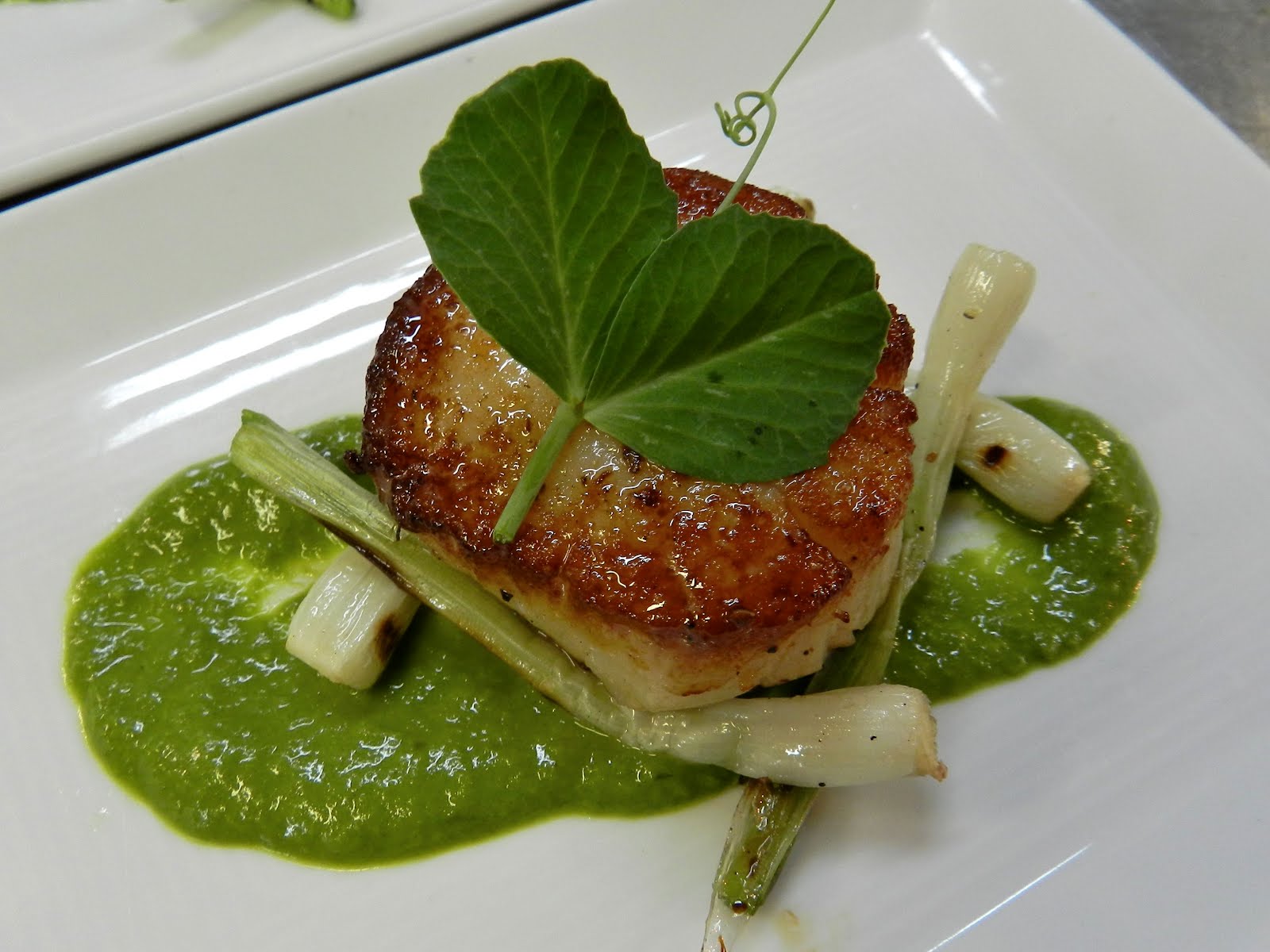
Sea Scallop. Spring always brings great scallops as new grounds are opened. I wanted to highlight our beautiful scallops against some of our local spring greens. The scallop is sitting on a purée of ramp greens and grilled baby spring onions and topped with a sugar snap tendril from my garden. The ramp bulbs have long since vanished into sopa de ajo.


Arctic Char. Spring always has me looking forward to salmon as it begins its spawning run up the rivers. It's just a little too early yet for salmon, but we do have two nice salmonids in house right now, arctic char and steelhead trout. Last week, we put up a batch of cured steelhead trout, so-called gravlax of steelhead trout, and we had a bunch of trimmings to work with.

On this plate, you see a mousse of roasted steelhead gravlax, fennel fronds from my garden, very lightly pickled hothouse cucumbers, seared arctic char, and a wonton containing gravlax, chives, and sour cream. The wonton came from wanting some crunchy element on the dish. And in the end, we decided to take the traditional bagel toppings and put them inside a crispy wonton as a somewhat cheesy (pun intended) nod to the God-awful crab rangoon served in ersatz Chinese restaurants. A little humor never hurt a dish as far I can tell.


Eggs, Bacon, and Toast. Now that spring has sprung and the days are getting longer, Sarah's ducks are cranking out far more eggs that we can possibly use to make our pastries. [Oh by the way, wondering why our pastries are so good? Blame the duck eggs!] So this dish was born of a need to consume duck eggs and of course also to showcase our awesome house-cured Berkshire pork belly.

Down on the plate, you see grilled and buttered focaccia topped with maple syrup-braised pork belly and a poached duck egg. We went through a dozen different plate presentations and finally in the spirit of consuming as many duck eggs as possible, decided to benedictify it with a lemon zest-augmented hollandaise. This sublime stack of wanton sinfulness is bejeweled with a crown of cilantro flowers from my garden.


Risotto. This dish didn't start as a risotto at all. For the longest time, it was just a list of ingredients: asparagus, morels, and duck confit. Our guests were very lucky that the first asparagus and the first morels of the year arrived in our kitchen simultaneously, lucky because they are ingredients that marry in the best kind of way. Morels, the king of mushrooms (you bolete fans are all wrong), deserve, no, they cry out for cured pork products. And what is better than cured pork? Our house-cured duck confit all poached in its unctuous duck fat bath!

So we had three awesome flavors that needed a neutral base to carry them and hence the risotto entered the picture, the rice marrying the ingredients and serving as a base for the garnishes: grilled asparagus, chive blossoms from my garden, and a morel dipped in cornstarch and crisped in hot oil. Ambrosial!


Picnic. I don't know what spring has on your mind, but a picnic is definitely on my mind. This dish is our homage to classic American picnic food: fried chicken, deviled eggs, and potato salad. Our fried chicken is an herb-marinated and grilled quail. Our deviled eggs are naturally quail eggs. And our potato salad, well, it is better than most potato salad you will ever eat, is instantly recognizable as potato salad, and yet, contains zero potatoes.

The potato salad is down on the plate letting us stand the boned-out quail up against it with the deviled egg halves nestled against it. Just under the quail and spilling out to the side of the eggs is an outstanding amarena cherry mosto cotto, cherry juice and grape must cooked down to almost a balsamic vinegar like syrup. To complete the cherry metaphor is a bit of dried cherry and celery salsa. Not only is it a great palate cleanser with the sweet-tart cherry working against the bitter crunchy celery, it is a reminder that cherries, that most delicious and first stone fruit of the new year, are just around the corner.

Oh, the potato salad. It's celery root, red onion, green onion, Surry sausage (our local Virginia smoked pork sausage), and parsley, all bound with mayonnaise.


Spring Lamb. No protein could be more spring in my mind than spring lamb and this one just arrived from the slaughterhouse. This lamb is so good that it really didn't need us to do much with it. I made a pesto from the tons of fresh mint growing in the boxes out in front of the restaurant and after boning out the lamb saddle, marinated the deboned loins in the pesto. In the vein of not doing very much with the lamb, I decided to serve it very classically, with pommes duchesse, mashed potatoes augmented with [duck] egg yolks and baked. Although you can't see it, the lamb is napped with a glace d'agneau, a highly concentrated lamb stock that we made from all the bones from the last lamb we received. It is so concentrated that it remains jellied at room temperature. We reheated it with a little white truffle juice.

The herbs I picked from my backyard in the morning. The lower herb in the photo is sheep sorrel which I included because lemony sorrel and lamb is a classic pairing, but also because I found it amusing to pair sheep with lamb! Corny, but true. The yellow blossom and the leaf above it is from a wild mustard plant. Lamb and mustard is a delicious combo. I often will drain the pan juices into a sauce pan after roasting a leg of lamb, add a little red wine, a little lamb glace, and then after straining it, will add Dijon mustard as a liaison to thicken the sauce. That, for me, is what the mustard greens on this plate evoke.


Rhubarb. Before there is any fruit in the spring, there is rhubarb, very much a vegetable, but one that we treat as a fruit. The only question here was how to provide a delicious foil for the sweet-tart rhubarb compote (rhubarb, cranberry juice, and sugar). Spring leads me to light desserts and light always leads me to Greek yogurt panna cotta, this one flavored with lemon zest and poppy seeds. For garnishes, you see a poppy seed tuile and lemon balm from my garden. The surprising element here is the black locust blossoms which had just opened for the very first time the morning of the dinner. I picked these from the backyard and just before serving them, tossed them in a dressing of honey, lemon juice, and lemon zest. The locust blossoms have a flavor at sweet pea crossed with honeysuckle nectar. They are delicious.

Friday, March 11, 2011

Chef's Table

Here are more photos from a recent Chef's Table. We had some fun with these dishes. As always, they are a result of collaboration among the cooks and me. In creating these menus, everyone throws in ideas and we see what sticks. Usually some hybrids happen and for the better.


Cucumber Summer Roll. We were kicking around amuse ideas and somehow got onto summer rolls when Tony offered the idea of using cucumber instead of rice paper. I ultimately changed this course from an Asian-inspired one to a more European-flavored one, to bring it in line with the rest of the menu. Inside the roll is cucumber, carrot, parsley stems, and court bouillon-poached shrimp bound with a mayonnaise flavored with lemon zest, dill, and capers. Crunchy with big flavor, yet very refreshing, everything a good amuse should be.


Rockfish. We've been on a fish-in-broth kick for a few tasting menus now (because we love the idea of half soup, half entrée) and so we came quite naturally to rockfish (the local name for striped bass, this from the Chesapeake Bay) with wild mushrooms and a Surry sausage jus. Sometime in the middle of the night before the tasting, I hit me to put the fish on a base of parsnip crème caramel to add some sweetness and richness to the dish. (Don't ask me why I decided this or even how, I don't have a clue. Like most of my food ideas, it just appeared in my brain). The caramel is very dark so it is not very sweet and there is no sugar in the custard. The flavors worked very well and I think the guests were intrigued with the it-looks-like-dessert-but-its-a-fish-dish aspect.


Breakfast. This is just the kind of dish that tickles a lot of chefs and brings out the kid in us. Who doesn't love breakfast for dinner? We've had a version of this dish on the dinner menu for about a week and apparently our customers don't love breakfast for dinner! It seems de rigueur in these parts to order a salad before dinner rather than something that we have put our creative energy into. Sigh. You see down on the plate a pimentón sauce and Virginia maple syrup (yes, we make damn fine maple syrup in Virginia too) and on top of that a napoleon of parsnip latkes and grilled rounds of Alan Benton's country sausage, all topped with a poached quail egg and a dribble of hollandaise: Eggs Benedict gone miniature.


Nest Egg. This dish is the merger of two other ideas, one a Carolina Gold and Sea Island red pea hoppin' john risotto and the other a polenta ball stuffed with oxtail ragù. We ended up stuffing the oxtail into the risotto and forming it into eggs, serving it on a nest of chiffonaded romaine, a nod to the Lenten season. I'm sure this must have been fun to eat, cracking through the crisp panko crust to get at the silky risotto and the liquid ragù.


Shepherd's Pie. What to do with a lamb saddle? Answering that question is how we arrived at this dish. I think it was Tony's idea to stuff it with all the mirepoix and seasoning that we usually put into shepherd's pie. While we were reinterpreting the classic, we decided to put the mash (in this case, parsnip and celery root) on the bottom, down on the plate, to hold the rounds of lamb loin roulade. I boned the saddle such that the tenderloin and the top loin (both sides of the T-bone) were intact and rolled it so that the top loin wrapped the tenderloin, the rare part you see in the center. Quite successful. Travis' stuffing was dynamite.


Apricot Tart. Bad Ed! Bad Chef! This dessert was way too big for a tasting. But I really couldn't help myself. The tart crust is shortbread, heavy on cornstarch so that it is light and crisp. This is topped with lemon curd, light on sugar so that it remains tart, and moistened dried apricots. In the background, you see a phyllo cup with vanilla bean ice cream. Crème anglaise over everything. Too much! I promise I will try harder to come up with smaller dessert courses in the future (not really!).

Tuesday, January 12, 2010

Eggshell Color

A friend and I got to discussing eggs and that got me to wondering if chickens had been bred to select for eggshell coloration. I know of certain fowl that lay turquoise blue to olive green eggs, such as Araucanas and Pheasants, fowl that lay white eggs such as Leghorns, and fowl that lay brown eggs such as Orpingtons and Rhode Island Reds.

All the chicken eggs in our kitchen are brown. Why? Because that's the color that our farmer's Rhode Island Red hens lay. If they laid white eggs, we'd have eggs with white shells. I've used tens and tens of thousands of eggs in my life and one thing is clear, shell color makes no difference to the egg inside.

What matters for flavor is freshness and a fresh egg is a good egg, except for boiled eggs. The shells of fresh eggs do not want to release from the albumen, but that's the subject of another article.

I notice a reverse snob appeal to brown eggs that has developed over the past couple of decades. Factory eggs here in the US, all the rage in the 1950's and 60's, tend to be white because the birds that produce the most eggs the fastest (hence the cheapest) lay white eggs. In recent decades, people have come to associate factory eggs with all things big, bad, and industrial, hence the movement to brown eggs, which many people assume are somehow intrinsically better than white eggs.

I'll say it again that shell color has no bearing on the egg inside. Eggshell coloration is hereditary and comes from pigments deposited (or in the case of white eggshells, not deposited) onto the outer layers of the white shell.

Brown eggs are significantly more expensive than white eggs in US markets for two reasons. Chickens that lay brown eggs tend to be from larger breeds that require more feed and they tend to lay fewer, larger eggs. So it generally costs more to produce brown eggs than white. Coupling this real production expense with the misunderstanding that brown eggs are somehow better than white eggs lets producers command higher prices for brown eggs.

So again, buy your eggs based on freshness and not on shell color.

For a glimpse into the wide variety of eggshell coloration, from snow white to chocolate, with blue and pink thrown in for grins, see the following charts:

Henderson's Handy-Dandy Chicken Chart

Egg Shell Colour Chart by Breed of Hen

Friday, April 3, 2009

We're So Lucky!

We're so lucky to have local farmers to bring us fresh eggs to the restaurant whenever we need them. From left to right, the tiny spotted eggs are quail eggs, the medium green eggs are pheasant, and the large brown eggs are chicken eggs. Not pictured are the large white duck eggs.

Monday, February 23, 2009

An Eclectic Menu

On Saturday night, we did another of my tasting menus to celebrate a 60th birthday. I really enjoyed creating and executing this menu. Unlike some menus, it came together in about five minutes and I was off to the races. The customers requested something Moroccan and something Indian, which helped guide a couple of the choices. This post is not going to be short. I am trying to record some of my thoughts here for my own reference in the future. I think my cooking is getting much more refined, a bit more cerebral, and hopefully, more playful too.

Pennsylvania Dutch Dried Corn and Virginia Slab Bacon Soup. I've been playing with textures in food a lot more in the last six months or so and I wanted this dish to be a play on the textures of corn. Cope's Dried Sweet Corn is a product of nearby Lancaster County, PA and something that I have been experimenting with of late. It is sweet corn that is picked while still young and tender and then dried. The interesting thing about it is that it is equally good reconstituted or dried.

I wanted this dish to set the tone for the evening: at once comforting, playful, thought provoking, and interactive. The soup is classic Southern "fried corn" in flavor, comfort food par excellence. Fried corn in my family is when you render several strips of bacon and then slice fresh sweet corn into the bacon fat and cook it until it thickens, like creamed corn.

I laid out the garnishes along the plate, from the cup to the edge of the plate—smoked duck, chives, dried corn, duck cracklings (duck skin and fat rendered to crispy, crunchy awesomeness). Rather than garnish the soup directly myself, I left that to my guests for two reasons. First, there is no way to manipulate the garnishes without using your fingers. I wanted my guests to interact with the food, which should have a tactile component as well as the more usual components. I hoped that using their fingers would set the customers at ease and set the tone that while the food is serious, it should be seriously fun. And second, I hoped that the customers would experiment with the different flavor combinations and textures. And they did. The cracklings were a huge hit.

I paired this with a Virginia Viognier, an excellent pairing. I'm going to say this again for everyone to hear: we make the best Viognier in the world here in Virginia.

Crispy Fried Oyster. This dish is a play on the oyster theme, combining salsify (also called Oyster Plant) and oysters. I wanted to see if pairing them would be harmonious and more than the sum of their individual contributions. I poached the salsify and then set it in an aspic of Sauvignon Blanc and oyster liquor. You can see the salsify terrine better by following the salsify link just above.

I topped the terrine with a large fried oyster and a touch of micro-celery for flavor contrast. I set up a deliberate temperature contrast between the hot oyster and the cold terrine. The pairing went well enough, especially when served with a glass of the same Sauvignon Blanc as in the gelée, but I don't think it was memorable enough to repeat. The effect was kind of white-on-white, technically interesting, visually appealing, and tasty enough, but perhaps too subtle.

Huevos Rancheros. This is a dish that I really liked on a lot of levels. Huevos Rancheros is a dish that many of us know and love: a fried egg and salsa on top of tortillas. I really like to reimagine classic dishes with the same classic flavors, but with different forms and textures. Sometimes I want you to really think about what you're eating and what role flavor, temperature, and texture play in your perception of a dish.

The first thing I thought about was the tortilla. Gringos have a predominant preference for wheat flour tortillas rather than the classic corn masa tortillas that the dish is usually served on. I decided to play on this by using the form of wheat that we most often treat as corn: semolina. What do we mostly do with semolina, if we're not making pasta? Boil it up into a mush like polenta—think gnocchi di semolina or Cream of Wheat, which if thick enough resembles masa. And the pasta yellow color doesn't hurt in the trompe l'oeil effect either. So, I cooked the semolina fairly thick, spread it in a thin layer, let it set up, cut rounds out, and toasted them in a dry pan just like cooking tortillas on a comal.

Next: the egg. The small size of the dish required a quail egg, which I decided to poach rather than fry. I'm not a fan of crispy edges on eggs (maybe you are, but my mother made me eat them every day for years and now that I'm an adult, I will be damned if I eat another or inflict them on my customers. Mom, I love you, but no more eggs!).

Once I had the poached quail egg in mind, the thought of that runny, thinly encapsulated yolk got me thinking that I should mimic it with the salsa. So into the blender and a bit of reverse spherification magic and voilà, spherical salsa marinated in chorizo oil. I had to use just a touch of xanthan gum on the salsa to get it to mimic the texture of the egg yolk; it was just a wee bit too watery otherwise. A bit of rendered chorizo and a splash of pimentón sauce completes the dish.

The only thing that bothers me about this dish is the olive color of the salsa. In blending the salsa, the green cilantro, green onion, and green chile mixed with the red tomato to make a nice ripe olive color. But the cilantro and chile were critical to the flavor. Maybe I can figure out how to extract the cilantro and chile flavors some day and end up with a tomato-colored salsa.

Note to those who would follow after me: you must reduce the quantity of onion significantly. My first attempt was a standard salsa whose flavor when blended was dominated by onion to the point where it became inedible. Crushing the onion in the blender turns it into a beast. Use 75% less onion than you would for a standard chopped salsa and lay way off the garlic.

I paired this with a light Sicilian Sangiovese.

Deconstruction of Bestilla. I just happened to see Mario do a version of bestilla on Iron Chef last weekend and I was thinking as I was watching that I could do it better. And when my customer asked for a Moroccan dish in the tasting, I had my chance.

Let me apologize for the crappy photo. Things were mightily hectic on the line when I took this and I got bumped every time that I took a picture. This is the only one that is halfway acceptable; none of the good low-angle shots came out. You try handholding a camera with a macro lens, flash off, stopped way down because of crappy lighting, on a screamingly busy restaurant line and see what your results are!

I wanted to play with people's notions of what constitutes a sweet course and what constitutes a savory course and Arab-inspired cuisine is wonderful at blending savory and sweet.

There is nothing unusual in the traditional chicken (I just couldn't get pigeons for this tasting) tagine that serves as the basis for my bestilla. But, rather than encasing the traditional filling in pastry, I decided to do a napoleon of layers of pastry and fillings. This would emphasize the crackle and crunch of the pastry that would otherwise be dulled by the steam from the filling.

In making the pastry, I layered pastry sheets with cinnamon and sugar and cooked them in the oven to the point of dark caramelization to give a bitterness to play against the sweetness of the chicken. I am already wondering what effect cocoa powder between the pastry layers would have. I sprinkled the pastry liberally with cinnamon and powdered sugar before assembling the napoleon.

The bottom layer of the napoleon is spinach sautéed with golden raisins, almonds, and red onions that were marinated in vinegar and sugar. The center layer is the traditional pulled chicken. The top is finished with the highly reduced sauce bound with eggs. I wanted a custardy effect rather than a scrambled egg effect so the eggs were whisked rapidly in the manner of classic oeufs brouillés.

I set a fruity Marlborough Pinot Noir against all the spices and flavors and it worked quite well.

Punjabi Lamb Kebab. There is nothing new or creative in this dish; it is quite simply classic Punjabi cuisine in the miniature. I marinated some shoulder of local lamb in my special lamb masala, garlic, ginger, and yoghurt for 24 hours, then grilled it. Lacking a tandoor, I grilled the miniature naan. The garnishes—raita, dhania chatni (cilantro/coriander chutney), and dal makhani (urad dal with grated tomatoes and special saunf masala)—are all typical. Nothing novel here, just solid good eats.

I chose a big Nero d’Avola from Sicily to stand up to the big flavors in this dish.

Hibiscus Crème Caramel. Sometimes I think that pastry chefs get carried away and lose sight of the tried and true desserts such as crème caramel whose silky custard is such a classic comfort food.

I brewed a tea of hibiscus flowers and loose black (Keemun Panda) tea with some dried cranberries to amplify the red color. Then I added sugar and cooked the tea into a syrup which you see garnishing the plate. The cream base, I steeped with more hibiscus flowers, and the baked custard, I topped with a candied hibiscus flower.

This was paired with a gorgeous pink Crémant d’Alsace, whose color echoed the hibiscus and whose strawberry, cranberry, and rhubarb flavors meshed elegantly with the matching hibiscus flavors—a perfect pairing in my book.

Seven Textures of Chocolate. And now just after I said that sometimes pastry chefs get carried away, here I go getting carried away on a chocolate fantasy. You should know that I am not motivated in the least by chocolate and pastry is not my thing, although I have a pretty deft hand at it. By choice, I don't eat sweets, so it is profoundly strange that I should labor so much over a single sweet composition, which you see here at low-angle running down the plating table.

You can see from left to right a three-chocolate mousse, three different chocolate bonbons, a streak of ganache paint, a straw of tempered dark chocolate resting on a cube of my sinfully rich and decadent Bête Noir, a quenelle of my quick fudge, and finally, an espresso cup of banging Mexican hot chocolate. I included the hot chocolate to help tease the chocolate-jaded palate back to life with a big hit of pasilla chile.

Can I just say in passing that I hate working with white chocolate? My hat is off to those of you who have the patience to work with it.

I paired this with a straightforward ruby Port, but a delicious local raspberry Merlot or a huge Amarone would have worked equally well, if not better.

Friday, December 26, 2008

Frittate

A frittata is an Italian egg dish that is often described as an omelette. Frittate (uno frittata, due frittate) are actually more like egg tortes or or cakes than omelettes. In Italy, they would flip the frittata in the pan to cook both sides. It seems much simpler to finish the frittata in the oven, rather than trying to flip it. You can put anything you like in the frittata for fillings. Here is what we do at the restaurant for a small frittata.

One Block West Frittata

1 tablespoon oil
3 large eggs, well beaten
fresh basil, chiffonaded, to taste
garlic, to taste
salt and pepper to taste
1 small tomato, chopped (fresh or canned)
1 small redskin potato, boiled and sliced
1 tablespoon diced pancetta or diced ham
a few spinach leaves, blanched or wilted
1 tablespoon feta cheese, crumbled
grated Pecorino or Parmigiano cheese

Preheat the oven to hot, 400-450. Preheat a small ovenproof skillet (8”) over medium flame. Meanwhile, beat the eggs really well with basil, garlic, salt and pepper. If you take your time and beat the eggs well, incorporating some air, you will end up with a fluffier frittata [which is why my frittate always look better than the ones my line cooks make—they always want to rush things]. Add the oil to the pan, then the beaten eggs. Let the eggs set on the bottom of the pan for a moment, then add the tomato, potato, pancetta, spinach, and feta.

Let the eggs set around the edges, until the frittata is about half cooked. Sprinkle the top with grated cheese and place it into the hot oven. Cook until the center is set and the frittata is risen. Remove to a plate, slice into wedges, and serve immediately.

An 8” 3-egg frittata and a salad feeds two people, or one very hungry one. A 10” frittata (increase the eggs to 8) should feed four people, with a salad. Cooking time on an 8-egg frittata will almost double from 7-8 minutes to about 15-20 minutes.

Variations. We serve a different frittata special everyday here at the restaurant. Here are some ideas:

Pancetta, Rapini, and Fresh Mozzarella Cheese
Pancetta, Sun-Dried Tomatoes, and Spinach
Caramelized Onion, Asparagus, and Artichoke Hearts
Pancetta, Red Onion, Artichoke Heart, Feta, and Basil
Chorizo, Onion, Manchego, Thyme, and Potato
Bread Cubes, Fresh Tomato, and Basil
Pasta, Spinach, Pine Nuts, Dill, Garlic, and Lemon Zest
Crab, Herbed Cream Cheese, and Chives
Fennel, Artichoke, and Goat Cheese
Tomato, Basil, and Fresh Mozzarella
Tomato, Spinach, Dill, Pepperoncini, Olives, and Feta
Balsamic-Glazed Red Onion, Roasted Red Pepper, and Serrano Ham
Grilled Chicken, Croutons, Asparagus, and Muenster Cheese
Chipotle Cream Cheese and Kielbasa
Wild Mushrooms, Caramelized Onions, and Brie
Fennel, Tomatoes, and Olives

As you can see, the possibilities are endless.

Wednesday, October 8, 2008

Grand Marnier Soufflé

A customer asked if I would make a Grand Marnier soufflé for his 30th anniversary, to which I replied, "No problem!" Soufflés, while they look like kitchen wizardry, are really simple to make. And I kind of like making them. There is something really neat about putting a mousse of egg whites in the oven and pulling out a perfectly risen soufflé. I'm sorry that this is such a crappy photograph, because this soufflé was nearly perfect, rising almost three inches above a 2-inch soufflé dish. We served this with a Chocolate Grand Marnier Crème Anglaise.

I don't eat desserts (sweets don't appeal to me), so I rarely make desserts. I've always been of the opinion that you should cook things that you like and are passionate about, otherwise the passion won't shine through. And so, I leave most of the pastry work to the other cooks in the kitchen. I could be a fine pastry chef—I can create desserts equally as easily as any other kind of dish—but I don't want to be. But I have to admit that I really do like to make soufflés.

Most soufflés, including this Grand Marnier soufflé, are made with a béchamel base. Béchamel is not necessary if your flavorings have sufficient viscosity (such as chocolate or certain vegetable purées). I make my dessert soufflé béchamels with heavy cream. You may use milk if you prefer.

Grand Marnier Soufflé

For each 4-ounce soufflé dish, you will need:

2 fluid ounces of very thick, lightly sweetened béchamel
zest of half an orange
1 tablespoon of Grand Marnier
2 egg yolks

2 egg whites
1 tablespoon of sugar

butter
sugar
parchment (silicone) paper
masking tape or string

To the room temperature béchamel, add the orange zest, Grand Marnier, and egg yolks. Mix very well. Whisk the room temperature egg whites to nearly soft peak stage, add the sugar, and bring to the soft peak stage. Add 1/3 of the egg whites to the béchamel base and mix to lighten the base. Gently fold in the remaining egg whites and note that the mixture does not have to be perfectly mixed. Place the mixture in a prepared soufflé mold and place in a 375F oven until risen and set, about 20 minutes.

To prepare a soufflé mold for a sweet soufflé, rub the mold with soft butter and coat with sugar, dumping out the excess sugar. Fold a piece of parchment paper and wrap around the mold, securing with masking tape or string, as you see in the photo.

Thursday, May 15, 2008

On Crossing Your Ts

Today, I got really tired of the spell checker in Word bitching at me about my spelling of the word omelette. The spell checker, in its infinite wisdom, wants the word omelet. I added omelette to my personal dictionary so that the spell checker will just shut up.

I have this nagging suspicion that omelet is what they taught us in grade school, but my spelling went to hell as I started studying at first French and then a succession of other languages. I am no longer sure how to spell a lot of words in any language.

What I do know is that if I write omelette in either English text or French text, people understand what I am saying, and that is quite good enough for me.

Almost quite good enough I should have said, for I really do have a deep-seated need to spell things correctly when possible.

So I turned to a couple of American dictionaries and the OED, all of which prefer the spelling omelet. The OED prefers it mainly, I conclude, because omelet antedates omelette by several hundred years. The American dictionaries, I surmise, prefer the shorter spelling simply because it is shorter.

But, I found a different preference in the real world. I went to each of the primary English language Google sites (America, UK, Australia, and Canada [sorry Kiwis!]) and queried both terms, searching the .com, .uk, .au, and .ca pages. As you can see below, the English speaking world seemingly and overwhelmingly prefers omelette, as do I, despite the dictionaries.

google.com: omelet 2,420,000, omelette 3,390,000
google.co.uk: omelet 54,000, omelette 307,000
google.com.au: omelet 22,500, omelette 93,500
google.ca: omelet 57,900, omelette 103,000

As for teaching you how to make one, by either name, that's not a subject to broach in a blog. While anyone can make an omelette at home, making a great omelette for restaurant service takes the right pan and a lot of practice. You'd better get cracking!

Monday, May 12, 2008

Eggs One Block West

Yesterday was Mother's Day and each year, I make breakfast for my wife, usually with the help of my daughters; however, they were nowhere to be found this year. This year, I had no time to plan, so I brought home a couple of things from the restaurant to make Eggs One Block West.

Eggs OBW, in the fuzzy picture to the right (sorry, my Nikon battery died, so photo courtesy of my daughter and her little point-and-shoot), is my version of Eggs Benedict (which I don't really like at all). I used to run this as an elegant tapa or appetizer, but now I mainly do it for demonstrations. If we did brunch here, which we will never do, this dish would feature prominently.

Eggs OBW comprises a round of corn pancake flavored with finely minced Surry sausage, a crab cake, a round of prosciutto, a 3-minute poached egg, and pimentón sauce.

There's not too much I can give you in the way of recipes here because this is really a wing-it kind of dish, but I can give you some pointers.

For the pancake, mix 3/4 cup corn meal and 3/4 cup flour with a half teaspoon of salt, a teaspoon of baking powder, an egg, a minced Surry sausage, and enough milk to make a smooth batter. Tips for cooking pancakes: a batter that is a little more fluid will spread better in the pan; use moderate heat and give the pancakes enough time to cook in the center before flipping: you'll see the bubbles forming in the batter as it cooks.

Everyone has a crab cake recipe. Mine are a mix of lump and jumbo lump because without any other filler, I depend on the lump to take on the role of filler. Crab cakes made only of jumbo lump don't hold together well. I add celery, parsley, salt, white pepper, and eggs. I bind my crab cakes with mayonnaise* and the tiniest bit of panko (bread crumbs).
*I have tried many kinds of binder including egg whites, béchamel, sour cream, fish mousse, scallop mousse, crab mousse, etc. and I have yet to find a better binder than mayonnaise.

Sometimes I place the rounds of prosciutto between two sheets of parchment paper between two sheet pans and bake them in the oven to crisp them, but I am actually happier using raw prosciutto in Eggs OBW.

I poach eggs in gently shimmering water acidulated with a splash of vinegar (and a dash of salt for flavor). To my taste, three minutes is just the right cook time.

Finally, my pimentón sauce is a traditional mayonnaise flavored with bittersweet pimentón.