Showing posts with label chicken. Show all posts

Saturday, March 3, 2012

Japanese Dinner

Here are the photos from a recent Japanese-themed dinner. The customer came to us with a menu in hand, so there wasn't a whole lot of wiggle room.

Salmon Sashimi with Pickled Daikon. Just a quick 24-hour pickle on the local daikon; thickened house-made ponzu on the plate. We let our ponzu brew for 48 hours before taking out the kombu and the hana-katsuo. We decided to use limes for the ponzu rather than bottled yuzu: fresh fruit tastes better, though limes taste different than yuzu.

Mushroom Mini Pizzas. The customer, having just returned from two weeks in Japan, says that mini pizzas are all the rage right now. We wouldn't know, but we do know how to make pizzas. You see hon-shimeji mushrooms (actually a mix of brown and white beech and pioppini) sautéed with a touch of garlic and ginger and finished with a splash of tamari. The sauce is soft tofu blended with ponzu. We thought it was a delicious touch bringing both creaminess and acid to the pizzette.

Yakitori. You see both chicken thighs and hearts skewered here, brushed with our house-made taré. We put the chicken in a soy- and ginger-based marinade for 48 hours. The taré sauce, based on chicken bones, took 48 hours to make and it has such a rich meaty sweetness. I couldn't find any cockscombs on such short notice; that would have been really cool as part of this dish. As it was, most of the guests didn't touch the hearts, which we happily snacked in the kitchen. The hearts are definitely the best part of this dish.

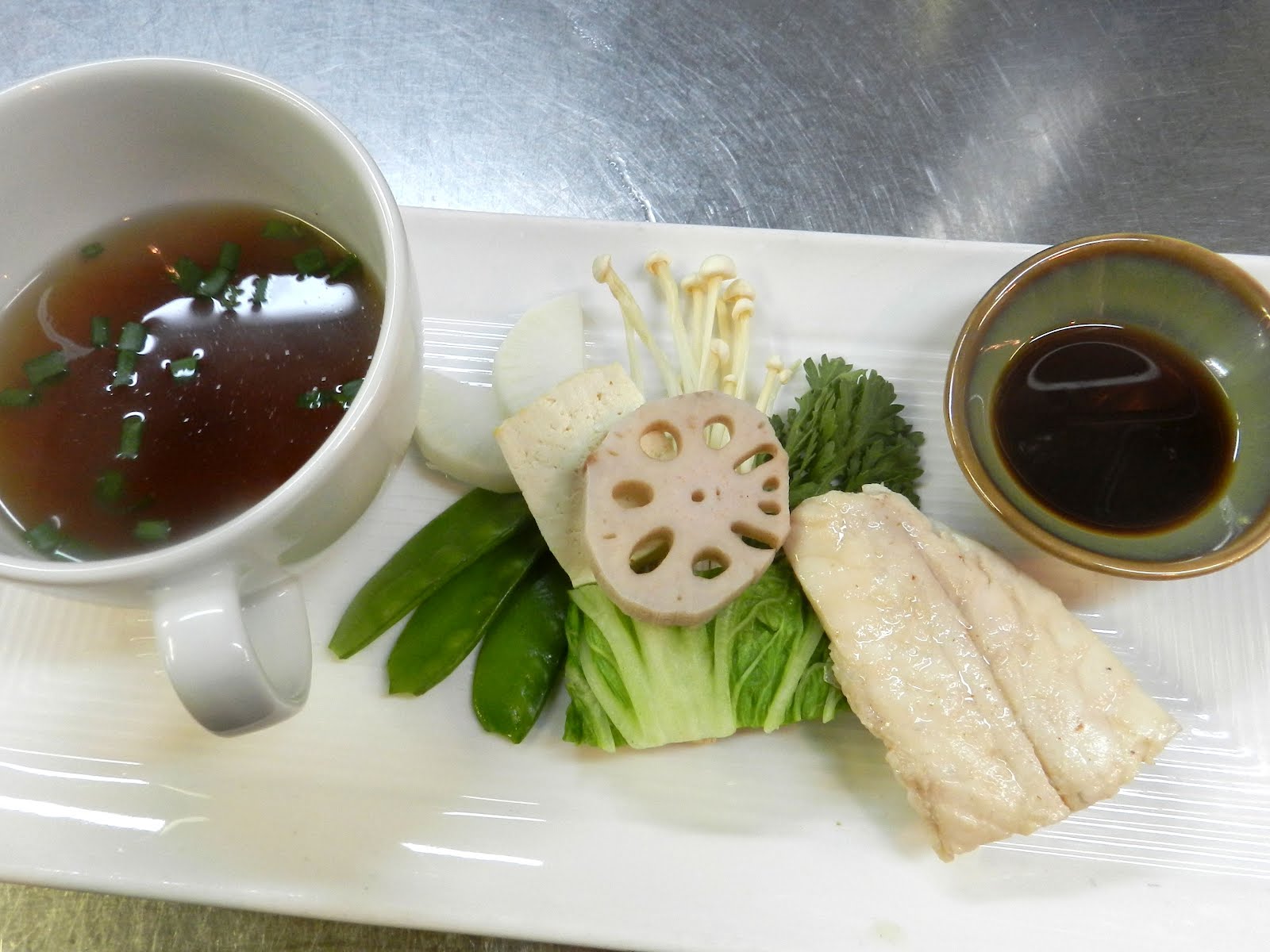
"Chirinabe". How do I tell a customer who is in love with a menu that we are not equipped to do a traditional nabe? I don't and I wing it, hence the quotation marks around chirinabe (fish hot pot). We just don't have the equipment to put communal hot pots on the tables (and the American customers would have freaked out at a communal pot anyway), so we blanched the vegetables and poached the black sea bass before plating them with a cup of boiling stock and small dish of ponzu for dipping. The garnishes, clockwise from the snow peas, are snow peas, daikon, enokitake, shungiku, sea bass, napa, tofu, and lotus root.

Purple Yam Custard. I wanted to finish with rice and then some fresh fruit. Customer wanted a dessert. So here is a pan-Asian dessert: a brûléed custard of Okinawa sweet potato, sesame seed brittle, and some fresh jackfruit in simple syrup. At least I managed to keep the dish non-sweet and sneak some fruit in too. The white flecks are sesame oil powder.

Wednesday, February 15, 2012

Alien Ingredient #13: Silkie (Black) Chicken

You've seen them on cooking shows on TV, those small black-skinned chickens. I'm certain that other than its coloration, it's just another kind of chicken. But since I've never cooked one (though there was one in particular I wanted to cook, but more on that story in a minute) I am curious if it has a richer flavor than the chickens we normally eat.


These black-skinned birds are Silkies, an old breed probably originating in China. Although black-feathered ones exist, I've only ever seen the ones with fluffy white feathers and black wattles. Wikipedia currently says "Silkies are well known for their calm, friendly temperament. Among the most docile of poultry, Silkies are considered an ideal pet." Which brings me back the the Silkie I once wanted to cook.

When I was a kid, we had a Silkie rooster that reigned over the flock of bantams that scurried here and there about our yard eating bugs and whatever else they could find. This pint-sized rooster wannabe was a white furball with a black face and undoubtedly lays claim to the title of the nastiest son of a bitch to walk the face of the planet. I hated that chicken. Every time I would go into the chicken pen to look for eggs or to feed the chickens and ducks, that damned bird would come flying at me, his three-inch spurs forward in full-on combat mode, trying to slash me. I guess he hated me too. What the hell does Wikipedia know anyway? Maybe I will just go and edit the Silkie entry.

Back to the chicken at hand. Expecting a tougher than usual bird, I poached this scrawny chicken, first for one hour and then for a second. Not a good sign. I can report that what little meat there was on this tiny bird was tough as leather despite the leisurely poaching. And there was no fat on the bird anywhere: there was only about a tablespoon of fat on top of the broth. The meat is only slightly darker than the average chicken, but it is not black as some have reported. The skin does not necessarily separate from the meat very easily: that may be why some people are confused about the color of the meat. Some of the bones and all the cartilage are black, though.

What about flavor? The meat has a rich chicken flavor, almost as good as the best chickens I have ever had, but it is tough almost beyond compare. The broth is where all the goodness is. Once I picked the chicken, I reheated the meager five ounces of meat with the broth, green onions, ginger, garlic, and a touch of soy sauce. After 10 minutes, I added shredded napa cabbage. The soup as you see it here is truly delicious despite the tough meat. Crew comments: "Bomb!" and "Excellent!"

Vote: Nah! Silkies have good chicken flavor, but the meat is tough and the flavor is not good enough to merit the $13 price tag for this 18-ounce bird.

Friday, September 25, 2009

Craziness, Redux

I last posted about the semi-lunacy of taking in bushels and bushels of local produce and lots of local meats and in under 48 hours, concocting a menu using all those ingredients and serving it to 60+ people (see "Craziness"). It's not really as crazy an endeavor as it sounds: it is in larger scale what we do every day here at the restaurant—react to the fresh, local products coming in the door to create the dinner menu for the day.

Before I get started, I have to give a big thanks to the ladies from Preserve Frederick for all their help in coordinating logistics: amazing job! And both the front of the house crew and back of the house crew did fantastic jobs, letting me move from the kitchen to the dining room at will and greet and mingle with our guests. Great job everyone! Service was amazingly smooth!

To recap, last evening we held a sold-out farm-to-table dinner for the benefit of Preserve Frederick in conjunction with the Piedmont Environmental Council. The net proceeds will go to Preserve Frederick for the publication of next year's edition of the Buy Fresh-Buy Local guide, that connects local producers and consumers of agricultural products.

From the restaurant perspective, I've been leading the fresh-local parade for the past seven years and I am happy to have been able to help raise funds to publish a guide that might help our local producers connect with other restaurants and the general public. Who knows? Maybe we can convince other restaurants to keep their money here in our local economy.

After triaging all the food that came in the door, the cooks and I started sketching out ideas for using the products and dealing with issues such as feeding 60+ people with 7 pounds of pork. Here's the final menu that we ended up with after receiving the final donations at around 2:30pm before the dinner:

Gazpacho with Crispy Squash Cake

Gratin of Natural Chicken in Mustard Sauce

Thai Beef Salad

Puerco con Mojo on Corn Cake with Tomato, Tomatillo, and Groundcherry Salsa

Irish Stew with Butternut Squash Purée

White Chocolate, Pecan, and Roasted Apple Bread Pudding with Crème Anglaise


Gazpacho with Crispy Squash Cake. We made a fairly traditional tomato gazpacho with lots of diced vegetables for garnish, including yellow, red and green peppers, beets, and corn. If the beets are very young and sweet, you can use a lot; if they are very earthy, they will dominate. These were very earthy so we had to use restraint. We flavored the soup with lots of sherry vinegar and a healthy dose of Tabasco.

With the soup, we served one of our famous squash cakes: yellow squash grated and cooked for three hours in heavy cream with garlic and basil and bound with pecorino romano and bread crumbs, chilled, formed into cakes, and fried.

Gratin of Natural Chicken in Mustard Sauce. Needing to feed 60 people from 5 chickens (albeit huge ones), we had to take the chicken off the bone and stretch it. We poached the huge Corn Rock Cross chickens; poached a traditional mirepoix of leeks, carrots, and celery in the chicken stock to further flavor it; then reduced the stock with heavy cream and added a final liaison of Dijon mustard. After mixing the chicken, vegetables, and sauce, we baked it under an herbed breadcrumb crust. This is one of the key tricks of the professional kitchen: cook everything separately to the point where it is perfectly cooked and then combine all the ingredients. I wouldn't expect home cooks to do this (and dirty that many pans) but this is how we get our chicken perfectly tender and our vegetables just done.

Thai Beef Salad. What to do with chuck and sirloin steaks and how to stretch a small amount for a crowd? With chuck, you either have to cook it a little or a lot. We went for a little, first marinating the beef in a touch of the salad dressing, then grilling it to medium rare, chilling it, then slicing it and removing the nasty bits. This we mixed with a julienne of carrots, sliced green onions, mounds of Thai basil, cilantro, a few cherry tomatoes and lots of dressing. The dressing is lime juice, brown sugar, kaffir lime, fish sauce, and local first-pressing canola oil. We served this over some impeccable baby greens that were picked just before the dinner. Kaffir lime is not typical in this salad, but I have a lot on hand that I need to use.

Puerco con Mojo on Corn Cake with Tomato, Tomatillo, and Groundcherry Salsa. We had only 7 pounds of shoulder, bone-in at that, to feed a crowd, so we knew we were going to braise the pork and pull it. We braised the pork in a classic Cuban mojo of sour orange juice, cilantro, oregano, garlic, and cumin, then shredded it and mixed it with a Cuban-style arroz verde (green rice) and a salsa of cherry tomatoes, peppers, local tomatillos, and local groundcherries.

We shaved a lot of fresh corn, just picked in the afternoon, mixed it with local poblanos (these were way spicy!), garlic, and Virginia cornmeal from which we made delicious little pancakes on which to serve the pork.

Irish Stew with Butternut Squash Purée. I cubed four legs of lamb and stewed them in Petit Verdot from Jefferson Cellars as the base for this "stew." It was non-traditional in that while I did stew the lamb, I sautéed the accompanying carrots, celery, and onions, and roasted local Yukon Gold and Kennebec potatoes with rosemary. After straining and reducing the lamb stock, I bound it with a classic beurre manié, and mixed it into the meat and vegetables just before service.

For the butternut purée we peeled, cubed, and roasted the first butternut squash of the season. We then mashed them and seasoned with a touch of butter, nutmeg, salt, and white pepper. Roasting small cubes of squash to the point of slight caramelization yields a depth of flavor that you cannot get by other means.

White Chocolate, Pecan, and Roasted Apple Bread Pudding with Crème Anglaise. I think that everyone who ate this bread pudding will all agree that it was the best that I have ever made; it was pure money! The key is using premium products: our fantastic baguettes, local Jonagold and Empire apples roasted with cinnamon and local honey, white chocolate, toasted pecan halves, a little (about two gallons) 40+% heavy cream, a couple vanilla beans, and dozens of local Rhode Island Red eggs. Besides using the best quality ingredients possible, the other trick with bread pudding is knowing when to take it out of the oven. If you let it set up totally in the oven, it's overcooked, still good, but not money!

Thanks to the following farmers for their kind support of this event:

Echo Ridge Farm
Freight Station Farmers Market
Hardin Natural Chicken
Hedgebrook Farm
Linda's Mercantile
Marker-Miller Orchards
North Branch Farm
Richard's Fruit Market
Virginia Lamb

Thursday, June 4, 2009

Chef's Tasting

Last week, Brandon and I did a Chef's Tasting for two of our longtime customers and two of their friends. Sometimes we go all out with technical tricks (soup filled dumplings, spherical piquillo peppers, etc.) but we just weren't feeling it for this tasting.

The day before the tasting, we had the first tremendous flood of local goods of this growing season and so we just decided to showcase what awesome food products we had and leave the technical tours de force for other tastings. I think these dishes show my less-is-more philosophy: just enough ingredients on a plate and no more.

Shrimp Cóctel

This is a pun, a wink at Luis Uno-Ojo, and an Americanization of a Mexican version of an American dish. Whew! Many years ago, my friend Luis from Guadalajara (Jalisco) introduced me to a soup that he calls cóctel (cocktail), a cold tomato and beef bouillon soup garnished with poached shrimp, avocados, cilantro, and so forth. His cóctel is a soup version of Cóctel de Camarones, the American classic Shrimp Cocktail. I reverted the soup to a true cocktail of beef consommé, tomato juice, and a good shot of that Jaliscan joy juice, tequila. I always serve it up in a martini glass as you see here, rimmed with cumin salt and finished with a fun garnish including shrimp. This version is garnished with a shrimp skewered around a piece of chorizo, then grilled. Putting the fun back in dinner and the cocktail back in Shrimp Cocktail, Guadalajara-Style!

Blue Cornmeal-Crusted, Crab- and Lemon Zest-Stuffed Softshell Crab with Grapefruit Beurre Blanc

After our brief trip south of the border, we brought things right back to Virginia with some local softshells, the first of the year from the Chesapeake Bay. The lemon zest and crab stuffing is a flavor idea that I stole from a crab cake appetizer from Tracy O'Grady at Willow (Tracy, your crab cakes rock!). A little organic blue cornmeal from a local mill gave a bit of crunch and the grapefruit beurre blanc brought the dish in line with a really grapefruity Sauvignon Blanc.

Chicken with Morels and Haricots Verts

I got a perfect pastured chicken and it was easily the highlight of this particular dinner. I loved the resulting dish so much that I've already blogged about it. Classic French technique meets impeccable local American ingredients, paired with Jim Law's equally impeccable Linden Hardscrabble Chardonnay.

Local Veal Skirt Steak, Blue Cornmeal Hoe Cake, and Poblano Crema

Upscale fajitas anyone? I had a lovely local organic veal skirt steak in the cooler along with the remnants of a case of poblano chiles that had seen better days. I've replaced the corn tortilla with an organic blue cornmeal hoe cake (cornmeal, garlic-infused butter, salt, pepper, and boiling water) and converted the rather limp poblanos to a roasted poblano crema. The skirt steak is lightly marinated in garlic, fresh baby cilantro, and kaffir lime, then lightly grilled to medium rare, rested, and sliced across the grain.

Lamb Samosas with Apricot Chutney and Red Wine Rosemary Demiglace

One of the things about working with local lamb is that we only get so many cuts off of each lamb. With each batch of lamb, we get chops (rack and loin), shanks, ribs, leg and shoulder (usually in kebabs), and then all the scraps go into ground. Needless to say, we have a lot of ground lamb to work through, so we're always having to find ways to use it.

Somehow, Brandon and I were both thinking samosas at the same time, so I made a bunch of them. We decided to stay away from traditional Indian spices and go with a more or less traditional Shepherd's Pie filling: lamb, mirepoix, herbs, garlic, gravy from lamb stock, and mashed potatoes. A quick reduction of Grenache and rosemary bound with demiglace gave us a sauce and then a sweet and spicy apricot chutney (what would be called a pickle in India) finished the plates that you see Brandon setting up here.

And the finished plates. I'm OK with white/negative space on a plate, as you can see here. Oh yeah, the samosas were banging—like little lamb empanadas. Yum.


Red-Cooked Bison Short Ribs with Local Spinach and Fried Rice Cake

Here you can see the fried rice cake and the spinach down in the soup plate, before we add the bison. The fried rice cake is merely fried rice bound with egg and fried into a pancake. Easy as can be and a crowd pleaser. We have this beautiful whole local spinach, cut off just above the roots, so we blanch it, toss it in butter and then curl it on the dish, in this case on top of the rice cake.

And here is the final dish with the bison on top and the sauce over and around. Red cooking is an awesome braising technique that you should have in your arsenal. I need to do a blog post just on that. In short, it's a classic Chinese braise in which the meat is cooked in a sweet and spicy liquid made from soy sauce, white wine (Shaoxing is typical), brown sugar or caramel, ginger, garlic, green onions, and sweet spices such as star anise, black pepper, Szechuan pepper, cinnamon or cassia, and so forth.

We braised the bison ribs in such a liquid, then strained the liquid, refreshed it with fresh spices, green onions, garlic, and ginger, reduced the sauce, strained it, added a bit of hoisin sauce, and brought it down to final sauce consistency. In China, the sauce is often used over and over to braise new dishes; at the restaurant, such practice, no matter how delicious, would certainly raise red flags at the Health Department.

Frozen Strawberry Soufflé with Lemon Verbena-Mint Shortbread Cookies

Finally, local strawberries arrived after 11 months of being gone. Throw together strawberry purée, Italian meringue, and whipped cream and what do you get? A frozen strawberry soufflé if you're patient enough to wait for it to freeze. The mint and lemon verbena are from our herbs growing outside the front door of the restaurant.

Thursday, May 28, 2009

To a Chicken

There are some flavors that are so deeply rooted in your soul that you'll never forget them. For me, I cannot forget what chicken tasted like at my grandmother's house where the bird was recently brought in from the chicken house. I still remember that essential chicken goodness now forty years later because it left a visceral imprint on my taste memory. I would recapture that memory but for a brief instant twenty-five years later in a small restaurant in the Beaujolais when eating Coq au Beaujolais made with a Bresse chicken from a nearby town. And since then, I have been searching for that elusive grail.

Every new pastured chicken producer in my area has promised chicken with flavor and I have cooked their birds only to find them underwhelming. Good birds, yes, but flavor approaching my taste memory, no. The birds were the wrong kind, bred for quick market weight and not for flavor. But recently, I got a chicken from another farm in the area. And something about the chicken spoke to me. I can't tell you why, but I just knew by holding the bird in my hands that it was going to be a great chicken. It sounds funny, but so be it.

I have often said to people when they ask me how I decide to fix something that I let the product tell me what to do with it. Holding this chicken, an idea popped into my head about what to do with it, almost as if the chicken were dictating what I should do to it. There is no way that I could have done anything else with this bird other than what came into my mind; this bird was destined to be cooked in this particular way and no other. Call me strange; I don't really care.

Last evening, I put the chicken in a weak brine, mainly to remove any traces of blood. This morning, I clarified a pound of butter and after patting the chicken dry, I bathed it, spooning boiling clarified butter over it for the better part of a half an hour, getting a perfectly tight, golden brown, caramelized skin.

Once golden all over, I put it into a covered pan with a bottle of fruity Pinot Blanc and let it cook ever so slowly for about two hours. We held the chicken warm while we strained the braising liquid, reduced it, and finished it with cream, shallots, thyme, and fresh morels. We pulled the chicken off the bones and served each guest some light meat and some dark along with the tiniest local asparagus cooked separately, morels, and the sauce. Photo above, shown with haricots verts and not asparagus.

The result? Sublime. Chicken, you were worthy of this labor intensive preparation and I salute you. Now where are your kin?

Tuesday, March 17, 2009

Chicken Cacciatore Soup

Sunday all over the east coast was a dreary, cool, rainy kind of day, a not yet spring, hanging on the cusp kind of day. A non-motivating kind of read the Sunday paper day where the dog wraps herself around your feet to ward off the damp rawness kind of day. A true soup day.

I'd already been down to the restaurant and made lunch for some friends who traveled over from Northern Virginia and on the way out the door to come back home, I thought about grabbing something for dinner, but then I thought that surely there must be enough stuff in my admittedly bare refrigerator for a pot of soup.

I knew I had a chicken carcass in the fridge and if you've got a chicken, you've got soup. Roast chicken on Monday night yields Monday night dinner, another meal later in the week, and a big pot of soup on Sunday. At least it does for our family of four that is not terribly meat-oriented. Chickens are most useful creatures to have in the fridge.

My wife was traveling and I called her to find out if she had any ideas about what kind of soup she wanted, she being the picky one, and surprisingly she said she wanted something with tomatoes in it. Usually, she claims she doesn't care until it gets on the table and then it's not what she wanted. ;)

That got me thinking and suddenly Chicken Cacciatore popped into my head. I decided that I wanted a soup that was similar to a very thin pizza sauce, without a whole lot of texture, basically a tomato soup. While I would put large chunks of vegetables in my Chicken Cacciatore, I decided to minimize them for this soup.

The key to the following recipe is the quality of the stock: the more intensely flavored the stock, the better. I would say that if you are not going to find a lazy day to make stock, you're going to find this soup very disappointing.

I just happened to have a ham bone in my fridge too, which went into my stock pot with the chicken carcass, the chicken roasting juices, and some celery scraps. After two hours, I strained the stock and reduced it to about a quart and a half of intense chicken goodness with a little country ham background. I picked and chopped the chicken while the beagle ensured that the floor stayed spotless.

Chicken Cacciatore Soup

1-1/2 quarts chicken stock
1 28-ounce can crushed tomatoes
1 small onion, finely diced
4-6 cloves garlic, minced
1 teaspoon dried basil
1/2 teaspoon dried oregano
1-1/2 cups cooked chicken, finely chopped
salt and pepper to taste

Combine the chicken stock, tomato sauce, onion, garlic, basil, and oregano and bring to a simmer. Simmer for 20 minutes or until the onion is done. Stir in the chicken and season to taste.

I decided not to precook the onion and garlic. It could have been laziness, the desire not to dirty another pan, or perhaps I just wanted to go with the more dominant flavor of raw garlic. I didn't have to add any salt because of the ham bone in my stock. And because my tomatoes were really ripe, I didn't need to add any sugar to counter their acidity.

Red and green peppers and mushrooms would be really good in this soup, but as I said, I was just going for a simple tomato soup. It was simply delicious.

Monday, February 23, 2009

An Eclectic Menu

On Saturday night, we did another of my tasting menus to celebrate a 60th birthday. I really enjoyed creating and executing this menu. Unlike some menus, it came together in about five minutes and I was off to the races. The customers requested something Moroccan and something Indian, which helped guide a couple of the choices. This post is not going to be short. I am trying to record some of my thoughts here for my own reference in the future. I think my cooking is getting much more refined, a bit more cerebral, and hopefully, more playful too.

Pennsylvania Dutch Dried Corn and Virginia Slab Bacon Soup. I've been playing with textures in food a lot more in the last six months or so and I wanted this dish to be a play on the textures of corn. Cope's Dried Sweet Corn is a product of nearby Lancaster County, PA and something that I have been experimenting with of late. It is sweet corn that is picked while still young and tender and then dried. The interesting thing about it is that it is equally good reconstituted or dried.

I wanted this dish to set the tone for the evening: at once comforting, playful, thought provoking, and interactive. The soup is classic Southern "fried corn" in flavor, comfort food par excellence. Fried corn in my family is when you render several strips of bacon and then slice fresh sweet corn into the bacon fat and cook it until it thickens, like creamed corn.

I laid out the garnishes along the plate, from the cup to the edge of the plate—smoked duck, chives, dried corn, duck cracklings (duck skin and fat rendered to crispy, crunchy awesomeness). Rather than garnish the soup directly myself, I left that to my guests for two reasons. First, there is no way to manipulate the garnishes without using your fingers. I wanted my guests to interact with the food, which should have a tactile component as well as the more usual components. I hoped that using their fingers would set the customers at ease and set the tone that while the food is serious, it should be seriously fun. And second, I hoped that the customers would experiment with the different flavor combinations and textures. And they did. The cracklings were a huge hit.

I paired this with a Virginia Viognier, an excellent pairing. I'm going to say this again for everyone to hear: we make the best Viognier in the world here in Virginia.

Crispy Fried Oyster. This dish is a play on the oyster theme, combining salsify (also called Oyster Plant) and oysters. I wanted to see if pairing them would be harmonious and more than the sum of their individual contributions. I poached the salsify and then set it in an aspic of Sauvignon Blanc and oyster liquor. You can see the salsify terrine better by following the salsify link just above.

I topped the terrine with a large fried oyster and a touch of micro-celery for flavor contrast. I set up a deliberate temperature contrast between the hot oyster and the cold terrine. The pairing went well enough, especially when served with a glass of the same Sauvignon Blanc as in the gelée, but I don't think it was memorable enough to repeat. The effect was kind of white-on-white, technically interesting, visually appealing, and tasty enough, but perhaps too subtle.

Huevos Rancheros. This is a dish that I really liked on a lot of levels. Huevos Rancheros is a dish that many of us know and love: a fried egg and salsa on top of tortillas. I really like to reimagine classic dishes with the same classic flavors, but with different forms and textures. Sometimes I want you to really think about what you're eating and what role flavor, temperature, and texture play in your perception of a dish.

The first thing I thought about was the tortilla. Gringos have a predominant preference for wheat flour tortillas rather than the classic corn masa tortillas that the dish is usually served on. I decided to play on this by using the form of wheat that we most often treat as corn: semolina. What do we mostly do with semolina, if we're not making pasta? Boil it up into a mush like polenta—think gnocchi di semolina or Cream of Wheat, which if thick enough resembles masa. And the pasta yellow color doesn't hurt in the trompe l'oeil effect either. So, I cooked the semolina fairly thick, spread it in a thin layer, let it set up, cut rounds out, and toasted them in a dry pan just like cooking tortillas on a comal.

Next: the egg. The small size of the dish required a quail egg, which I decided to poach rather than fry. I'm not a fan of crispy edges on eggs (maybe you are, but my mother made me eat them every day for years and now that I'm an adult, I will be damned if I eat another or inflict them on my customers. Mom, I love you, but no more eggs!).

Once I had the poached quail egg in mind, the thought of that runny, thinly encapsulated yolk got me thinking that I should mimic it with the salsa. So into the blender and a bit of reverse spherification magic and voilà, spherical salsa marinated in chorizo oil. I had to use just a touch of xanthan gum on the salsa to get it to mimic the texture of the egg yolk; it was just a wee bit too watery otherwise. A bit of rendered chorizo and a splash of pimentón sauce completes the dish.

The only thing that bothers me about this dish is the olive color of the salsa. In blending the salsa, the green cilantro, green onion, and green chile mixed with the red tomato to make a nice ripe olive color. But the cilantro and chile were critical to the flavor. Maybe I can figure out how to extract the cilantro and chile flavors some day and end up with a tomato-colored salsa.

Note to those who would follow after me: you must reduce the quantity of onion significantly. My first attempt was a standard salsa whose flavor when blended was dominated by onion to the point where it became inedible. Crushing the onion in the blender turns it into a beast. Use 75% less onion than you would for a standard chopped salsa and lay way off the garlic.

I paired this with a light Sicilian Sangiovese.

Deconstruction of Bestilla. I just happened to see Mario do a version of bestilla on Iron Chef last weekend and I was thinking as I was watching that I could do it better. And when my customer asked for a Moroccan dish in the tasting, I had my chance.

Let me apologize for the crappy photo. Things were mightily hectic on the line when I took this and I got bumped every time that I took a picture. This is the only one that is halfway acceptable; none of the good low-angle shots came out. You try handholding a camera with a macro lens, flash off, stopped way down because of crappy lighting, on a screamingly busy restaurant line and see what your results are!

I wanted to play with people's notions of what constitutes a sweet course and what constitutes a savory course and Arab-inspired cuisine is wonderful at blending savory and sweet.

There is nothing unusual in the traditional chicken (I just couldn't get pigeons for this tasting) tagine that serves as the basis for my bestilla. But, rather than encasing the traditional filling in pastry, I decided to do a napoleon of layers of pastry and fillings. This would emphasize the crackle and crunch of the pastry that would otherwise be dulled by the steam from the filling.

In making the pastry, I layered pastry sheets with cinnamon and sugar and cooked them in the oven to the point of dark caramelization to give a bitterness to play against the sweetness of the chicken. I am already wondering what effect cocoa powder between the pastry layers would have. I sprinkled the pastry liberally with cinnamon and powdered sugar before assembling the napoleon.

The bottom layer of the napoleon is spinach sautéed with golden raisins, almonds, and red onions that were marinated in vinegar and sugar. The center layer is the traditional pulled chicken. The top is finished with the highly reduced sauce bound with eggs. I wanted a custardy effect rather than a scrambled egg effect so the eggs were whisked rapidly in the manner of classic oeufs brouillés.

I set a fruity Marlborough Pinot Noir against all the spices and flavors and it worked quite well.

Punjabi Lamb Kebab. There is nothing new or creative in this dish; it is quite simply classic Punjabi cuisine in the miniature. I marinated some shoulder of local lamb in my special lamb masala, garlic, ginger, and yoghurt for 24 hours, then grilled it. Lacking a tandoor, I grilled the miniature naan. The garnishes—raita, dhania chatni (cilantro/coriander chutney), and dal makhani (urad dal with grated tomatoes and special saunf masala)—are all typical. Nothing novel here, just solid good eats.

I chose a big Nero d’Avola from Sicily to stand up to the big flavors in this dish.

Hibiscus Crème Caramel. Sometimes I think that pastry chefs get carried away and lose sight of the tried and true desserts such as crème caramel whose silky custard is such a classic comfort food.

I brewed a tea of hibiscus flowers and loose black (Keemun Panda) tea with some dried cranberries to amplify the red color. Then I added sugar and cooked the tea into a syrup which you see garnishing the plate. The cream base, I steeped with more hibiscus flowers, and the baked custard, I topped with a candied hibiscus flower.

This was paired with a gorgeous pink Crémant d’Alsace, whose color echoed the hibiscus and whose strawberry, cranberry, and rhubarb flavors meshed elegantly with the matching hibiscus flavors—a perfect pairing in my book.

Seven Textures of Chocolate. And now just after I said that sometimes pastry chefs get carried away, here I go getting carried away on a chocolate fantasy. You should know that I am not motivated in the least by chocolate and pastry is not my thing, although I have a pretty deft hand at it. By choice, I don't eat sweets, so it is profoundly strange that I should labor so much over a single sweet composition, which you see here at low-angle running down the plating table.

You can see from left to right a three-chocolate mousse, three different chocolate bonbons, a streak of ganache paint, a straw of tempered dark chocolate resting on a cube of my sinfully rich and decadent Bête Noir, a quenelle of my quick fudge, and finally, an espresso cup of banging Mexican hot chocolate. I included the hot chocolate to help tease the chocolate-jaded palate back to life with a big hit of pasilla chile.

Can I just say in passing that I hate working with white chocolate? My hat is off to those of you who have the patience to work with it.

I paired this with a straightforward ruby Port, but a delicious local raspberry Merlot or a huge Amarone would have worked equally well, if not better.

Tuesday, October 14, 2008

Arroz con Pollo


My kids are at the restaurant for dinner tonight and I, like cooking parents everywhere, sometimes struggle to find dishes with good kid appeal for dinner. But I'm not struggling tonight because I'm making arroz con pollo. Vegetarians aside, is there anyone who doesn't love chicken and rice?

Arroz con pollo is one of those dishes that sometimes causes skirmishes (read "religious wars") for the mere reason that everyone's abuela (grandmother) makes the best version in the world. The truth is that everyone's arroz con pollo is pretty decent, with the exception of a version that one of my Mexican dishwashers made for me. He claimed that arroz con pollo was one of his great dishes; apparently he cannot even warm a taco in a microwave.

I'm a through-and-through gringo with no Latino or Spanish heritage, so it's not possible for my grandmother to have one of those "best in the world" versions of arroz con pollo. This is greatly liberating for me in that I am able to steal bits and pieces of the dish from around the world and not have my version judged by the grandma standard.

For my version tonight, I'm starting by marinating bone-in, skin-on chicken thighs in a classic Cuban mojo of lime juice (sorry, no sour oranges in the house), olive oil, garlic, cilantro, oregano, cumin, black pepper, and here I go deviating again, pimentón.

The choice of rice is critical. Arroz requires a short-grained rice so that it has a risotto- or paella-like texture, so I went into the pantry to get some Arborio rice. The traditional rice for paella is Sollana (aka Calasparra) or Bomba, both available at La Tienda; to reduce items in inventory, we stock only Arborio, which is a good, but not perfect, substitute. In the pantry, however, I got sidetracked by the Carolina Gold rice from Anson Mills, which is also a fantastic rice short-grained rice. Tonight, may your abuela not roll in her grave, I'm using Carolina Gold.

Not to put to fine a point on it, arroz is all about the quality of the rice. When I order arroz in a Mexican restaurant and I get Uncle Ben's, that's a clear signal that they don't care about the quality of their food. But, I can understand that if you've got starving kids and 45 minutes to get dinner on the table, you're going to use whatever you have in your pantry. Just make sure you get some good rice on your next trip to the store.

I also like my arroz more like paella in flavoring, so I am using a bit of chorizo in it, backed up by the pimentón. I also am using fresh tomatoes rather than tomato paste as in many versions of arroz. And, a big pinch of saffron will find its way into the pan.

To start my dish, I made some annatto oil (1/4 cup vegetable oil heated with 2 teaspoons of annatto seeds; seeds removed) in which I will brown the chicken and then cook my sofrito of yellow onion and red Corno di Toro pepper.

Here then is a recipe for approximately what I did. I didn't measure the liquid at all; I have cooked so many rice dishes in my life that I can just eyeball it. Fortunately, rice is pretty forgiving and you can always add more liquid if you need it. Serves 8.

Ed's Confused Arroz con Pollo

Chicken Mojo

8 skin-on, bone-in chicken thighs
juice of three limes, two sour oranges, or one orange and one lime
2 tablespoons minced garlic
1 tablespoon minced cilantro
1 teaspoon dried oregano
1/4 cup extra virgin olive oil
1/2 teaspoon black pepper, coarsely ground

Mix the chicken with all of the mojo ingredients and refrigerate until you are ready to cook it.

Mise en Place

1/4 cup annatto oil
1 yellow onion, diced
1 red pepper, diced
4 ounces hard spanish chorizo, diced
1 large tomato, diced
1 12-ounce bottle lager beer
salt and pepper
large pinch of saffron threads
2 cups short-grained rice (Carolina Gold, Arborio, Bomba)
1 quart water or stock

Preheat your oven to 350F. Heat the annatto oil in a large sautoir or other oven proof pan. Brown the chicken and remove. Add the onion and pepper and cook until the onion starts to wilt, about three minutes. Add the chorizo and tomatoes and cook for another minute. Add the beer, salt, pepper, saffron, and any remaining mojo from the chicken; stir well. Return the chicken to the pan and let cook, turning once, about 4 to 5 minutes per side, then remove again. Add the rice to the pan with about three cups of water or stock. Stir well and let return to the boil. Place the chicken on the rice evenly and in a single layer. Cover the pan and place into the oven for 25 minutes. Remove from the oven and check for doneness and need for more liquid. Cook longer and add more liquid as appropriate.

¡Buen Provecho!

Sunday, April 13, 2008

Sell, Menu, Sell!

Let's face it. We restaurateurs are in business to sell food and our primary sales tool is our menu. All of us have had experiences with really great dishes that did not sell. In fact, Food Arts has a regular column called "Hits and Flops" in which chefs and pastry chefs discuss dishes that are wild successes and really great dishes that just wouldn't move.

I buy items in very small quantities and I change my menu daily, replacing the items that sell out with new ones, so I rarely have situations where dishes just don't move.

But I encountered just such a situation this week. A customer requested that we put a chicken dish on the menu for his group of 22 people. We rarely ever have chicken on the menu for the simple reason that it's what most people eat at home, and they are not coming to One Block West to eat what they eat at home. Or at least that's my rationalization for not putting an ingredient that I find extremely boring on the menu.

But, when I do put chicken on the menu (folks, I will not verb a noun and say "when I menu chicken"), say a roasted poussin or a tagine of chicken with olives and preserved lemons, it flies off the menu. A lot of customers perceive chicken as a safe option when faced with a menu that includes bison, wild boar, ostrich, squab, and sashimi. And I think that's what my customer was looking for: something safe for his guests.

Knowing that, I recreated a dish that I had in a private home in Burgundy: a freshly killed chicken stewed in white Burgundy with fresh herbs and vegetables from the garden behind the house, finished with some heavy cream. The grandmother that prepared this dish was justifiably proud of it. It was pure, simple, fresh, and clearly of the moment.

I gussied the dish up a bit for restaurant service. I braised bone-in, skin-on chicken thighs* in Chardonnay with leeks and a bouquet garni, then skinned and defatted the chicken when done. From the stock, I made a thyme-infused cream sauce. I poached tournéed baby carrots and haricots verts separately and roasted cipollini onions. At service, I reheated the chicken in the cream sauce and added the perfectly cooked vegetables at the last second to warm through. All the components were carefully plated in a large bowl, napped with the sauce, and garnished with fresh thyme. In short, it was a gorgeous, elegant, and tasty dish.

*Yes, I said thighs, which have all the flavor in the chicken. Don't get me started on boneless, skinless chicken breasts—the Wonder® Bread of the chicken world. That's a topic for a rant and this post is not a rant.

In honor of the grandmother whose name I have forgotten, I named the dish quite simply enough Poulet Grandmère and it appeared on the menu thus:

Poulet Grandmère
Chicken Stewed in White Wine; Served with Baby Vegetables in an Herb Cream Sauce

The result: we sold none of the 20 portions I prepared. Of the 50-plus entrées ordered that night, zero were chicken. As I mentioned above, we never strike out with chicken. After dinner service, I went back to my desk to ponder this.

I came to two conclusions. First, people were likely put off by the French name of the dish. I'm guessing that they wouldn't venture to pronounce* it or they read only the bold type and didn't understand that poulet is chicken. Second, if they read the description, they may have been put off by "stewed," thinking it too homey a dish for fine dining.

*How do you learn to pronounce things if you don't try? When faced with a menu item I cannot pronounce (Thai, Vietnamese, Korean, etc.), I ask my server. Then one of two things happens. The server says, "I don't have a clue!" and we all have a great laugh. Or, the server and I go back and forth until I get the pronunciation down. Either way, the pronunciation does not stop me from ordering.

Sitting at my desk, I made two changes to the menu for the next night, thus:

Chicken with Baby Vegetables
Chicken Slow-Cooked in White Wine; Served with Baby Vegetables in an Herb Cream Sauce

And the result? Fourteen portions sold. And you thought that all we chefs have to do is worry about cooking!