Showing posts with label wild edibles. Show all posts

Friday, April 26, 2013

Spring Tasting

Finally, after a long, long winter, we finally have some spring ingredients to feature in a tasting! This tasting features mint, ramps, green garlic, and asparagus.

Tilefish Mojito Seviche

Tilefile Mojito Seviche. Finally we have some fresh mint to work with and this is an experiment in making it work in a savory application. The seviche contains diced tilefish, brunoise of red onion and jalapeño, green onions, grape tomato, cilantro, mint, lime zest, red pepper flakes, and lime juice. The glass, we rimmed in Hawaiian black sea salt, and the garnishes are lime, mint, and a scoop of mojito sorbet (lime, mint, simple syrup).

Smoked Bluefish
Smoked Bluefish. Bluefish, like most oily fish, takes to brine and smoke, well, like a fish takes to water. And smoky fish loves mild, creamy cheeses. So it didn't take too much to put together a crostino topped with lemon-black pepper goat cheese, ramp pesto, and smoked blue fish. And then pair it with a napoleon of cucumber and smoked bluefish-cream cheese mousse. A little lemon oil brings some citrus brightness to the plate.

Rabbit, Asparagus, and Green Garlic
Rabbit, Asparagus, and Green Garlic. I love green garlic in risotto, ditto asparagus. Here the risotto has both green garlic and asparagus stems. The asparagus tips are grilled for a smoky char that will help the dish pair with a Pinot Noir. On top is a bit of our pulled rabbit wrapped in prosciutto.

Pork and Ramps
Pork and Ramps. I bet you didn't know that I stood there and cleaned ramps for three $%#^&! hours the other day. The tops I made into a classic sopa de ajo (roasted garlic soup with bread, pimentón, and a splash of cream) and the greens Tony made into a classic cream of greens soup. These two soups are yin-yanged on the plate and garnished with grilled ramps and chorizo oil. I made some pork scraps into an awesome chorizo and this is what is in the beggars purse.

Carrots and Ginger
Carrots and Ginger. We still don't have any fruit to work with for desserts so we are still playing games with winter storage vegetables. This is a carrot and ginger upside down cake. The cake is made with polenta to give it some tooth. Crème anglaise, lemon cream cheese, crystallized ginger, and maple syrup-candied carrot comprise the garnishes.

Saturday, February 16, 2013

February Tasting

It's been a very long time since I posted anything here, since before the holidays. The holidays are a struggle in themselves and then comes January. Slow month for sure, but filled with paperwork trying to close the prior year, get W-2s to the employees, and get our taxes done. And then starts all the planning for Valentine's Day, which just having passed is giving me the luxury of a little free time to post some photos. So, we've done lots of tastings in the interim, but had no time to blog about them.

And then, it's just smack in the middle of winter with no exciting produce or products to stimulate our creativity. I really don't have anything more to say about parsnips right now, you know?

We didn't do a good job with portion sizes here. This was way too much food for a seven-course dinner, but then in our defense, it was freezing out and we were serving comfort food, stuff that we always seem to serve too much of.

Clam Imperial
Clam Imperial. One good thing about winter is that we seem to get really sweet and tasty clams, when the clammers can get out. And when the ground is not too frozen, we can dig some leeks to go with those clams. Clams in a rich béchamel with smoky Surry sausage and leeks is a wonderful thing, as comforting as the best chowder, only richer and more sinful.

Char with Caramelized Fennel
Char with Caramelized Fennel. We lucked into some really nice fennel and the char was merely the vehicle for serving the sinfully unctuous braised and caramelized fennel. Served with a round of fennel and orange butter.

Mushrooms and Grits
Mushrooms and Grits. Nothing more comforting in my book than crispy mushrooms on a pile of warm, creamy grits. This dish has hedgehogs, bluets, and both white and brown clamshells (aka beech mushrooms).


Ballotine of Rabbit and Boar
Ballotine of Rabbit and Boar. Our rabbit guy walked in the door with five rabbits the afternoon of this tasting, so I boned out an entire loin with flaps and stuffed it with a sausage that I made from wild boar, blanched strips of carrots, and blanched rapini stems. In another season I would have used haricots verts or asparagus, but being February, the only thing long, skinny, and green that I could find was the tender stems of some baby rapini from a local greenhouse. I might have wrapped this ballotine in crépine/caul fat, but I didn't have any, so I used prosciutto. Served with a little cavolo nero.

Piccadillo Dulce of Lamb Shank
Picadillo Dulce of Lamb Shank. This was actually a dish built around the pimentón aïoli that you see on the plate. In the south of France, they would call this mayonnaise a rouille (rust). I like the smoky flavor that comes from the smoked peppers in the pimentón. I had a lamb shank in the cooler that was just aching to become a sweet and sour dish, flavored with olives, almonds, golden raisins, garlic, sweet red and yellow peppers, onions, poblano peppers, pimentón, cumin, oregano, brown sugar, and Sherry vinegar. You also see a smoky chickpea salad with roasted red pepper and raw red onion, dressed with olive oil, Sherry vinegar, and more pimentón.


Smoked Duck, Sweet Potatoes, and Beluga Lentils
Smoked Duck with Sweet Potatoes and Beluga Lentils. This is a dish that I conceived as a one-biter on top of a water biscuit for a local winery to pair with their newly released Syrah. And so I upsized it and served it with Syrah for our tasting. The particular Syrahs that I paired with this have an earthiness that I echoed in the sweet potatoes but more so in the lentils. The lentils have bacon in them and they, along with the smoked Moulard breast, help enhance the smoky quality of the wine. To pull out the inherent pepperiness of the Syrah grape, I used a syrup of Tasmanian pepper.

Cranberry-Apricot Fregotto with Maple-Glazed Pork Belly
Cranberry-Apricot Fregotto with Maple-Glazed Pork Belly. This dish aims for an almost savory finish, though we may have got carried away with the maple syrup on the candied pork belly. The fregotto, a neologism of my own concoction from fregola and risotto, indicating fregola sarda cooked in the style of a risotto, is quite tart and bright, having been cooked with unsweetened cranberry purée. We sweetened it a touch at service by adding dried apricots, dried cranberries, and a touch of maple syrup.

Saturday, April 21, 2012

"Spring"—A Chef's Tasting

We just did a Chef's Tasting on Thursday night with the theme of Spring. We decided to let the menu be informed by not only the ingredients that are available now in the spring but by the ideas and memories evoked by the season.

I am really pleased with this menu and think that it clearly states who I am as a chef right now and speaks to the food that appeals to me: simple, fresh, direct, highly flavorful, yet still a bit whimsical and playful, not too serious for its own good. I like this menu because the dishes are largely pared to their essence—not too many ingredients on the plate, but just enough. It is very difficult as a chef to pare dishes to their core: it forces excellence in the thought behind a dish, the ingredients themselves, and of course, in technique.

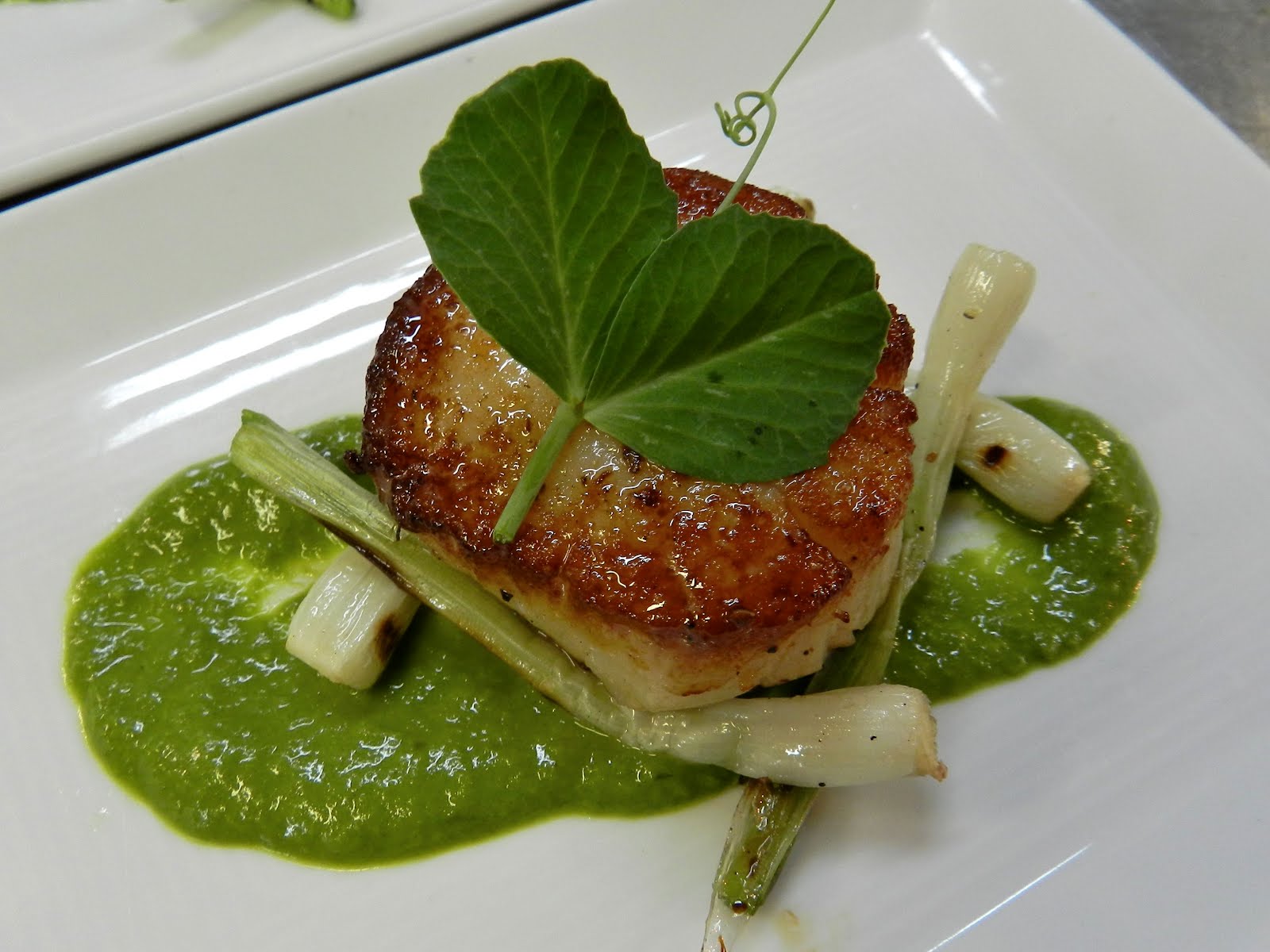
Sea Scallop. Spring always brings great scallops as new grounds are opened. I wanted to highlight our beautiful scallops against some of our local spring greens. The scallop is sitting on a purée of ramp greens and grilled baby spring onions and topped with a sugar snap tendril from my garden. The ramp bulbs have long since vanished into sopa de ajo.


Arctic Char. Spring always has me looking forward to salmon as it begins its spawning run up the rivers. It's just a little too early yet for salmon, but we do have two nice salmonids in house right now, arctic char and steelhead trout. Last week, we put up a batch of cured steelhead trout, so-called gravlax of steelhead trout, and we had a bunch of trimmings to work with.

On this plate, you see a mousse of roasted steelhead gravlax, fennel fronds from my garden, very lightly pickled hothouse cucumbers, seared arctic char, and a wonton containing gravlax, chives, and sour cream. The wonton came from wanting some crunchy element on the dish. And in the end, we decided to take the traditional bagel toppings and put them inside a crispy wonton as a somewhat cheesy (pun intended) nod to the God-awful crab rangoon served in ersatz Chinese restaurants. A little humor never hurt a dish as far I can tell.


Eggs, Bacon, and Toast. Now that spring has sprung and the days are getting longer, Sarah's ducks are cranking out far more eggs that we can possibly use to make our pastries. [Oh by the way, wondering why our pastries are so good? Blame the duck eggs!] So this dish was born of a need to consume duck eggs and of course also to showcase our awesome house-cured Berkshire pork belly.

Down on the plate, you see grilled and buttered focaccia topped with maple syrup-braised pork belly and a poached duck egg. We went through a dozen different plate presentations and finally in the spirit of consuming as many duck eggs as possible, decided to benedictify it with a lemon zest-augmented hollandaise. This sublime stack of wanton sinfulness is bejeweled with a crown of cilantro flowers from my garden.


Risotto. This dish didn't start as a risotto at all. For the longest time, it was just a list of ingredients: asparagus, morels, and duck confit. Our guests were very lucky that the first asparagus and the first morels of the year arrived in our kitchen simultaneously, lucky because they are ingredients that marry in the best kind of way. Morels, the king of mushrooms (you bolete fans are all wrong), deserve, no, they cry out for cured pork products. And what is better than cured pork? Our house-cured duck confit all poached in its unctuous duck fat bath!

So we had three awesome flavors that needed a neutral base to carry them and hence the risotto entered the picture, the rice marrying the ingredients and serving as a base for the garnishes: grilled asparagus, chive blossoms from my garden, and a morel dipped in cornstarch and crisped in hot oil. Ambrosial!


Picnic. I don't know what spring has on your mind, but a picnic is definitely on my mind. This dish is our homage to classic American picnic food: fried chicken, deviled eggs, and potato salad. Our fried chicken is an herb-marinated and grilled quail. Our deviled eggs are naturally quail eggs. And our potato salad, well, it is better than most potato salad you will ever eat, is instantly recognizable as potato salad, and yet, contains zero potatoes.

The potato salad is down on the plate letting us stand the boned-out quail up against it with the deviled egg halves nestled against it. Just under the quail and spilling out to the side of the eggs is an outstanding amarena cherry mosto cotto, cherry juice and grape must cooked down to almost a balsamic vinegar like syrup. To complete the cherry metaphor is a bit of dried cherry and celery salsa. Not only is it a great palate cleanser with the sweet-tart cherry working against the bitter crunchy celery, it is a reminder that cherries, that most delicious and first stone fruit of the new year, are just around the corner.

Oh, the potato salad. It's celery root, red onion, green onion, Surry sausage (our local Virginia smoked pork sausage), and parsley, all bound with mayonnaise.


Spring Lamb. No protein could be more spring in my mind than spring lamb and this one just arrived from the slaughterhouse. This lamb is so good that it really didn't need us to do much with it. I made a pesto from the tons of fresh mint growing in the boxes out in front of the restaurant and after boning out the lamb saddle, marinated the deboned loins in the pesto. In the vein of not doing very much with the lamb, I decided to serve it very classically, with pommes duchesse, mashed potatoes augmented with [duck] egg yolks and baked. Although you can't see it, the lamb is napped with a glace d'agneau, a highly concentrated lamb stock that we made from all the bones from the last lamb we received. It is so concentrated that it remains jellied at room temperature. We reheated it with a little white truffle juice.

The herbs I picked from my backyard in the morning. The lower herb in the photo is sheep sorrel which I included because lemony sorrel and lamb is a classic pairing, but also because I found it amusing to pair sheep with lamb! Corny, but true. The yellow blossom and the leaf above it is from a wild mustard plant. Lamb and mustard is a delicious combo. I often will drain the pan juices into a sauce pan after roasting a leg of lamb, add a little red wine, a little lamb glace, and then after straining it, will add Dijon mustard as a liaison to thicken the sauce. That, for me, is what the mustard greens on this plate evoke.


Rhubarb. Before there is any fruit in the spring, there is rhubarb, very much a vegetable, but one that we treat as a fruit. The only question here was how to provide a delicious foil for the sweet-tart rhubarb compote (rhubarb, cranberry juice, and sugar). Spring leads me to light desserts and light always leads me to Greek yogurt panna cotta, this one flavored with lemon zest and poppy seeds. For garnishes, you see a poppy seed tuile and lemon balm from my garden. The surprising element here is the black locust blossoms which had just opened for the very first time the morning of the dinner. I picked these from the backyard and just before serving them, tossed them in a dressing of honey, lemon juice, and lemon zest. The locust blossoms have a flavor at sweet pea crossed with honeysuckle nectar. They are delicious.

Thursday, July 29, 2010

Purslane

Sorry for the dearth of posts recently. Staffing and personal issues have taken a huge toll on my free time.

I've always been a fan of foraging for food: it's hard to beat the price of free food! Now that it is mid-summer, local purslane is in full swing and there happens to be a bunch growing in the crack where the asphalt of the parking lot meets the stucco of the restaurant. And how ironic that this wild Portulaca (P. oleracea) with its tiny yellow blooms is growing under the window boxes full of its showy cousins with the big pink and fuchsia blossoms.


But be careful when foraging anything whose identity you're not certain of. Growing in the same crack right next to the purslane is a Spotted Spurge (Euphorbia maculata) which I have seen people confuse with purslane and which is mildly toxic. Spotted spurge, as you can see, has very thin stems which exude a milky sap when broken and has tiny leaves that are opposite each other on the stems. This is an entirely different growth habit from the purslane with its large succulent stems and whorls of leaves, largely at the end of its stems.


Here in the United States, purslane is considered a weed; however, it finds favor as a salad and cooking herb around the world. In Mexico, purslane is called verdolaga and while it is often used in green chile and pork stews, I like it best when used raw on tacos. Nothing like carnitas on a fresh corn tortilla with a nice tart green tomatillo salsa and a sprig of purslane. And in the Mediterranean and Middle East, you'll see purslane leaves in all manner of chopped salads and often in tzatziki-style yogurt sauces and salads.

We use purslane in salads (just the leaves) where the crunchy and slightly tart leaves make a pleasant addition. We also toss some in sautés with spinach, garlic, and olive oil. The whole plant is edible, stems, leaves, and blooms, but I find the stems a bit much, so I just strip off the leaves. Also, because purslane is a succulent, it has a mucilaginous quality similar to okra. I like purslane best when raw or just slightly cooked: it becomes a bit slimy for me when cooked longer.

It's pretty neat and no doubt you have some growing in one of your gardens or flower beds. Give it a try.

Friday, July 23, 2010

Chef's Tasting

I finally managed to get some photos from last night's Chef's Table menu. It's often too busy to photo the food.

Leek and Potato Shooter. A shooter of classic Vichyssoise topped with an oca latke and micro onion greens. Oca is a rare Andean tuber that strikes me as a cross between a fingerling potato and a sunchoke/Jerusalem artichoke. Oca is an Oxalis (O. tuberosa), so it brings a little of that classic sweet-tart oxalic acid flavor to the party. The micro onion greens are from Chef's Garden and are not onions at all. What they are, I don't really know, but they have a small tomato-like leaf and a great onion flavor. The idea behind this dish is that you eat the latke in a single bite and chase it with the soup.

Cantaloupe Carpaccio. Mandoline-cut local cantaloupe topped with cubes of cantaloupe marinated in lime zest and agave nectar, Thai basil oil, micro Thai basil, purslane, and red ribbon (aka blood) sorrel. I'm so glad that cantaloupes are just starting to ripen here. Notice the generous grind of pepper on the dish; cantaloupe loves pepper: it brings out the sweetness in the melon. Wine pairing: Broadbent Vinho Verde NV.

Tomato. We should have tomatoes coming out of our ears by now what with all this scorching weather, but nobody can seem to get tomatoes to ripen this year. We have been hoarding and ripening a very few tomatoes just for this tasting. Here you see tomato ricotta gnocchi in a pool of pesto garnished with micro opal basil, a small tomato stuffed with yellow tomato granita, and a tomato taco suave. The tortilla is masa and tomato, the filling is tomato dice tossed in pesto, and the garnishes are sun-dried tomato sour cream and micro basil. I was very pleased with the amount of flavor we managed to pull from the yellow tomato granita, which we served with a grind of sea salt on top. Wine pairing: Château de Ségriès Tavel Rosé 2009.

Lamb Makisushi. This dish is the answer to the question, "How do we serve lamb like sushi?" You see a maki roll of grilled summer squash, Israeli couscous, and braised lamb shank. The green garnish is leek leaves. The wasabi is colored mashed potatoes, the gari (pickled ginger) is pickled zucchini, and the soy sauce is the lamb braising liquid. High cuisine? I don't know. Fun? Most definitely. Wine pairing: Fabbioli Cabernet Franc Virginia 2008.

Napoleon of Pulled Pork. This dish represents summer to us. We were looking for a way to showcase corn, squash, and tomatoes in the same dish. You see a napoleon whose layers are, from the bottom to the top, sinfully unctuous squash cake, pulled pork, pimentón- and cornmeal-crusted green tomato, pulled pork, and fresh corn cake. The pork is shoulder that we have braised in the Cuban style: classic puerco con mojo. Garnishes are micro cilantro, sweet corn sauce, charred corn, red and orange pepper confetti, and chipotle adobo. Wine pairing: Fabbioli Chambourcin Virginia 2008.

Blueberry Cheesecake. I'm starting to move away from the slice of dessert on a plate school and moving more to deconstructed desserts. Here you see bite-sized blueberry cheesecakes, fresh blueberries, blueberry sauce, crème anglaise, graham cracker crust, and micro lemon balm. I'm very happy with this dessert. Wine pairing: Di Lenardo Verduzzo Passito Venezia Giulia 2003.

Thursday, June 3, 2010

25th Anniversary 9-Course Vegetarian Tasting

Earlier this week, we did a nine-course vegetarian tasting menu for a couple's 25th wedding anniversary. In some respects, the timing was good, this being the last week for local asparagus and sugar snaps, and being the first week for English peas. In other respects, doing vegetarian menus before the onset of the summer vegetables such as squashes, peppers, tomatoes, and eggplants poses its challenges.

This menu is truly a menu of the season and was inspired in large part by what we found at the farmers market and what our growers brought to us: green garlic, garlic scapes, sugar snaps, English peas, fava beans, fennel, asparagus, dandelions, mulberries, morels, and shiitake mushrooms.


Sopa de Ajo. Creamy Soup of Local Green Garlic; Roasted Garlic Scape; Garlic Scape Pesto. This was inspired by the abundance of green garlic and garlic scapes that we have from thinning our garlic and keeping them from blooming so that they will focus on making garlic bulbs. Wine Pairing: Feffiñanes Albariño Rias Baixas 2008.


Fennel. Salad of Fennel Confit, Fennel Latke, and Fennel Slaw; Pernod Cream. We have so much fennel on hand now that we are looking for creative ways to use it. Fennel confit was marinated in herbs, garlic and olive oil then grilled and then poached in olive oil for 10 hours. The greens you see are red-stemmed dandelions. Wine Pairing: White Hall Vineyards Viognier Virginia 2008.


Spring. Sauté of Morels, Peas, Sugar Snaps, Favas, and Garlic Scapes; Achiote Pasta. This was conceived as an open-faced raviolo showing off all the spring vegetables on hand. The morels and veg were cooked in the Tuscan style called trifolati, in the style of truffles, with butter, garlic, and lots of fresh parsley. There's no better spring sauté in the world! Wine Pairing: La Slina Gavi di Gavi 2008.


Napoleon of Local Shiitake Mushrooms. Roasted Shiitakes; Crispy Goat Cheese; Crispy Shiitake Bits; Balsamic Gel. I love shiitakes and goat cheese together (anybody remember my shiitake polenta with herbed goat cheese mousse?) so the napoleon flowed naturally from the disk shape of the mushrooms and the cheese. We wanted some bacon for this dish; the crispy shiitake bits do a great job standing in for the bacon. Balsamic vinegar works really well with shiitakes too. I wanted to use the balsamic as a plate garnish but didn't want to reduce it and get that muddy caramelized balsamic flavor, so I gelled it. Wine Pairing: Swedenburg Pinot Noir Virginia 2008.


Vegetarian Yiouvetsi. Baked Orzo with Tomatoes, Artichokes, Preserved Lemons & Local Goat’s Milk Feta. My Greek friends know that I'm a fairly deft hand with a traditional yiouvetsi, baked orzo with lamb and tomatoes, redolent with olive oil, lemon, and fresh oregano, topped with feta cheese. I had heard of Michael Psilakis doing a vegetarian one, but I never knew what he put in it. That idea has been in the back of my brain for a long time and I am happy to have had the chance to bring it to a menu. This one contains tomatoes, onions, artichokes, house-cured preserved lemons, and garlic scapes. It may not look like much in the photo, but the flavors are intensely amazing. Thanks to Alan at Spriggs Delight Farm for the feta. Wine Pairing: Dupeuble Beaujolais 2008.


Panisse. Fried Chickpea Cake; Smoky Chickpea Salad; Roasted Red Pepper Hummus. For red wine vegetarian courses when tomatoes are not in season, I look to paprika and last year's roasted red peppers. And I love chickpeas. I eat them every day; they are my primary source of protein. This then is a loving homage to the many forms of chickpeas. Note to anyone listening: we tried to make the smoky chickpea salad with fried chickpeas, thinking we could get them crunchy. Instead, they just got leathery and no bueno. Wine Pairing: Borgia Campo de Borja 2008.


Stuffed Piquillo. Sweet Red Piquillo Pepper Stuffed with Israeli Couscous in the Style of Paella. You may have seen me make this couscous on WVPT. It is a customer and staff favorite because the flavors are so amazing. The couscous is flavored with sweet yellow and red peppers, artichoke hearts, yellow onions, green onions, tomatoes, saffron, garlic, and pimentón. And piquillos are the best tasting red pepper in the world. All in all, a terrific dish. Wine Pairing: Finca Sobreño Toro 2005.


Cheese Plate. Artisanal Cheeses; Mulberries; Caerphilly-Pecorino Crackers. I don't eat sweets after a meal; they just don't appeal to me. But I love to finish dinner with cheese and a glass of wine so when the customer told me he'd like to finish dinner with cheese, he was talking my language. I foraged some mulberries and made some crackers to accompany the three artisanal cheeses, one each from New York, Wisconsin, and Virginia. Wine Pairing: Linden Claret Virginia 2006.


Gorgonzola Cheesecake. Candied Walnuts; Port Reduction. Another riff on the cheese theme to end dinner is my subtle gorgonzola cheesecake made with Gorgonzola Dolce. This is my kind of way to finish a meal: all the classic port accompaniments reworked into a dessert. Wine Pairing: Warre’s Otima 10-year old Tawny Port.

Saturday, May 16, 2009

Cream of Stinging Nettle Soup

Whew, it's been a busy few days leaving me scant time to blog. Lots of special menus, meeeting after meeting, etc. Here's a quick post about a funny from last night.

Making use of the local bounty of stinging nettles, we put a cream of stinging nettle soup on last night's menu as an appetizer. Flavorwise, it's similar to cream of asparagus or spinach.

After a deuce finished their dinner, they approached me on the way out of the restaurant and the woman said, "We have a funny story to tell you." They looked at each other and he said to her, "You go ahead."

"I've got to tell you," she said, "after the soup came to the table, my husband looked at me and asked, 'Where are the jellyfish?'" We all got a good chuckle out of that. I love people that can laugh at themselves!

Thursday, May 7, 2009

Indian Celery

Here's a new one on me, folks, Indian Celery. A friend on the west coast sent it to me. When I opened the box, I thought it was wild fennel. You can't blame me for thinking that: the plant is clearly an umbellifer. But you can smell wild fennel from a long way off and this plant has no smell to speak of. When I tasted a bit of the bloom, I got a huge celery bomb. Wow, this stuff is potent! I'm not sure of the exact species, but this is a Lomatium.

That's about all I know except the stems are too woody already to eat, so I'll use the blooms. I think I'll finely dice it and use it like fennel pollen for garnish.

What do you know about this plant?

Tuesday, May 5, 2009

Ramps

One of the servers came to find me today saying, "somebody's here with some greens." I'm always looking for new locals to do business with, so I went to investigate and from the end of the hall, I saw a sackful of the "greens" to the right. I was expecting salad greens, not these particular harbingers of spring. Many locals need no explanation that these are ramps (Allium tricoccum), wild lily-leaved members of the greater onion family.

From mid-April to mid-May, we find ramps in the local woods; they're fond of rich, moist soil in areas where they can get some sunlight. When walking through the woods this time of year, I find the lanceolate lily-like and leek-colored leaves highly distinctive and growing in patches, just like lily-of-the-valley, which is poisonous. Fortunately, ramps and only ramps have a distinctive garlic odor, making them easily to distinguish from any plants that might confuse you.

Some of the locals call them ramsons or wild leeks, but just about all the rest of us call them ramps. Ramson (hramsan) is an Old English term for the European version of this plant (Allium ursinum). Apparently the term came to the east coast of the US with the English settlers and was corrupted to ramp.

Ramps are becoming very popular, to the point of being trendy, with big city chefs plus there has always been good demand for them at the many ramp festivals around here this time of year. Unfortunately, this is putting a lot of pressure on the plant. If you forage for ramps yourself, leave some to reproduce another year.

To prepare ramps, wash them well as you would any onion and use them raw or cooked, both bulbs and greens, in any manner that you would use onions, green onions, or leeks. Ramps have a flavor that is a cross between an onion and garlic. Sometimes I blanch them to mellow the garlic flavor a bit, but I've found that the odor is more assertive than the actual plant tastes.

I like to caramelize ramps to heighten their natural sweetness. Caramelized ramps have been a big hit at my house on pizza with bresaola and smoked gouda. The traditional preparation around here is to make home fries of ramps and potatoes. Also great in soups (think leek and potato), risotti, stews, stir fries, and braises, the ramp is a vegetable of many talents as are all the alliums.

Wednesday, April 29, 2009

Purple Dead Nettle

Recently, I've been serving a lot of foraged salads and most of them include Purple Dead Nettle (Lamium purpureum) mainly because I have a lot of it in my yard and flower beds. Purple Dead Nettle—not a true nettle at all—looks superficially similar to both the closely related Henbit (Lamium amplexicaule) and the unrelated Ground Ivy (Glechoma hederacea).

I prefer the very young leaves of Purple Dead Nettle (they're less hairy than the more mature leaves). You have to dress this plant very lightly in salads because the hairs collect dressing and it is easy to overdress a salad. I also use the younger bloom spikes, pinching them off the stems. The large square stems I discard. Purple Dead Nettle has an agreeable green flavor, with a smell that is slightly medicinal. Because it can dominate a salad, I tend to use no more than about 20% of Purple Dead Nettle in my mix.

In this photo, you see two stalks of Purple Dead Nettle rising above a field of Ground Ivy with the occasional violet (Viola spp.). Violets are quite edible, both bloom and young leaves. Violet flowers, like their domestic cousins the Pansy, have a slight floral flavor. I use them mainly for color in salads. The leaves are a bit earthy in the good way that Swiss Chard and the other beet greens are earthy. Ground Ivy (aka Creeping Charlie) is also edible, but I find it really medicinal, so I use it sparingly and mainly for the blooms.

Monday, April 27, 2009

Foraged Salad

This is a salad that I designed last week to pair with the lovely 2007 Viognier from White Hall Vineyards just outside of Charlottesville, VA. This wine is ripe and full with loads of tropical fruit, just about everything you'd want out of a Viognier (Condrieu eat you heart out!).

To work with the fruit in the wine, I knew that I wanted to use mango, but I also wanted to do it in an unusual way. Longtime customers know that I am a fan of framing a salad by placing it on top of a flat base, such as summer greens on grilled focaccia or my grilled fig, goat cheese and arugula salad on a base of prosciutto slices. In this case, I decided to make a gelée of the mango and use it as a runner down the salad plate.

The salad is foraged from my yard—purple and white violets, henbit, chickweed, pansy flowers, and maple blossoms—all dressed with a light lemon dressing (lemon juice and salad oil).

Mango Gelée

1 cup water
1/2 ounce gelatin
3 mangoes, peeled and chopped
1 teaspoon vanilla extract
sugar or honey, salt, and lime juice to taste
half sheet tray
Silpat

Bloom the gelatin by pouring it over the cold water and letting it stand while you prep the mangoes.

Blend the mangoes to a purée. They should be ripe enough to purée on their own without any additional liquid; add water if you need liquid to make the blender work. Pass through a strainer. Add the vanilla and season to taste with sugar, salt, and lime juice, if the mangoes need more acid.

Gently heat the purée over a medium flame. When the mango starts to bubble, add the gelatin and turn off the heat. Mix well until the gelatin melts.

Place the Silpat in the bottom of the sheet tray. Pour the purée over the Silpat and tilt the tray so that the entire surface is covered in an even layer of mango. Refrigerate until solid.

Using a butter knife, slice the mango jelly into whatever shapes you desire. Peel them carefully away from the Silpat.

Saturday, April 4, 2009

Foraged Greens

One good thing about spring is that wild greens appear before cultivated greens, giving us a jumpstart on fresh salads and a well-deserved break from winter foods.


First of our foraged greens on tonight's menu is Common Chickweed, Stellaria media, a really invasive pest in my flower gardens. I take revenge on it by eating it and feeding it to my customers! I first learned of its edibility in Lancaster County, Pennsylvania in local recipes for quiches and quiche-like egg dishes containing chickweed.

Next up is the violet, Viola spp. What we call violets are the wild cousins of the cultivated violas, johnny-jump-ups, and pansies. Before the pansies in the window boxes at the restaurant can set good blooms in late April, I can harvest beautiful violets from my yard. In addition to making lovely garnish, they're great, both young leaves and blooms, in salads.

And last, but certainly not least among our foraged greens for this evening, is Miner's Lettuce, Claytonia perfoliata, a tasty salad herb from the west coast. These were harvested by a Laotian family from the Columbia River valley in Oregon.

I'm finally happy to have to really fresh greens on the menu. To rephrase the old saw about men and trash and treasure, one man's weed is another man's feed.

Monday, March 23, 2009

Merkels and Such

It coming up rapidly on the season for local morels, I am getting ready for the annual phone calls asking, "Do you buy merkels?" In my experience, merkel is a somewhat local term for morels and clearly a corruption of the Latin genus Morchella, despite all kinds of amusing apocryphal tales about the name.

In Virginia, I know the term merkel to be used in the hills around the northern terminus of the Skyline Drive, where a lot of our morels come from. We also get a lot out of the local apple orchards.

My mother, who is from tobacco country on the Virginia side of the North Carolina border, and her family, always called them hickory chickens. Perhaps they grew in close proximity to hickory trees in that part of the state. I was too young, just a toddler, when my grandfather and his brother would lead a posse out into the woods to return with grocery sacks of the prized mushrooms, too young to remember anything about where they grew.

Out in Southwestern Virginia towards coal country, the hillfolk call morels Molly Moochers. Why? I've no clue.

I've also heard certain oldtimers refer to them as fish or fish mushrooms, though why I don't know.

I'm interested in what others call these mushrooms. What are they called in your neck of the woods?

Friday, March 20, 2009

Morels with Pancetta on Pappardelle

Last evening a customer enjoyed our most recent morel entrée which is a direct take off on a similar appetizer that we made during last year's morel season.

You'll notice that I include a cured pork product in both dishes; it's because pork and mushrooms have a great affinity for one another: think bacon and mushrooms! Sometimes I omit the cream and use veal demiglace instead. Sometimes when I use the cream, I mix in a tablespoon of veal demiglace at the end. This dish is also benefits from the addition of a vegetable, especially a foraged one such as wild asparagus, fiddleheads, or stinging nettle leaves. Asparagus and spinach are great as well.

Morels with Pancetta on Pappardelle

8 ounces pappardelle
1 tablespoon clarified butter
2 ounces pancetta in 3/8" dice
1 shallot, halved and thinly sliced vertically
6 ounces fresh morels
1 teaspoon fresh thyme leaves (lemon thyme is particularly good)
pinch salt and pepper
1/2 cup heavy cream

Cook the pappardelle in boiling water until done. Meanwhile, heat the clarified butter in a sauté pan and add the pancetta. After this has cooked a minute, add the shallots and continue to cook until the pancetta is nearly crisp and the shallots have started to caramelize.

Add the morels and thyme and cook for another couple of minutes, stirring. Add a pinch of salt and pepper and then the heavy cream. Cook until the morels are soft and the cream is reduced. Add more cream or water as necessary. Add the cooked noodles and mix well. Adjust the seasoning. Garnish with fresh thyme.

Serves two.

Friday, March 6, 2009

Stinging Nettles: Love and Hate

The first nettles of the year are in and they're going on the menu tonight in a Cream of Parsnip and Nettle Soup. I like the mild, green, herbal, almost spinach-like flavor of nettles, which never fail to remind me of spring, but I hate the stingers. Despite double gloving yesterday, I can still feel where my thumbs got bit a couple of times. Ouch! Reminds me of close encounters of the nettle kind when I was a kid.

Saturday, January 31, 2009

Black Gold

As soon as I unlocked the front door to the restaurant this morning, I was greeted by the most remarkable and very welcome scent of black truffles. We put a couple pounds of truffles in the cooler late last night and they donated their inimitable fragrance to the restaurant.

The photo to the right shows a bowl of black truffles (Tuber melanosporum). I have no idea what we are going to do with them yet (tonight's Chef's Table will see some). Because of their pungency and price (you're looking at several hundred dollars worth), we use them very sparingly.

Many chefs shave them wantonly over all kinds of dishes in a kind of more-is-better, gilding-the-lily (the Bard actually wrote "paint the lily," but this is a food blog, not an English blog) approach, but I have always felt that truffles require a neutral foil to bring out their best qualities.

For me, truffles do not get any better than when showcased on top of a risotto, a warm potato salad, or on an omelette or scrambled eggs. Chicken serves the same neutral role when served en demi-deuil (in half mourning), with truffles under the breast skin. And scallops can do the same when prepared in black tie à la Daniel Boulud.

What I will do with my truffles, only time will tell. If you'd like to sample some, call me and let's do it.

Thursday, December 4, 2008

Goodbye Chanterelles

It's December and the Golden Chanterelle mushrooms (Cantharellus cibarius) have disappeared after a several month run here at One Block West. Goodbye chanterelles! See you next year! But weep not, for the end of chanterelle season always signals the beginning of the seasons for both hedgehog mushrooms and black trumpets.

Hedgehog mushrooms (Hydnum repandum), so called because they don't have gills like typical mushrooms but rather teeth-like spore bearing structures that resemble the spines on a hedgehog. Hedgehogs range the color spectrum from light blonde to almost golden, similar to a golden chanterelle. I like to call them mushrooms with training wheels, because they are one of the best tasting and easiest to like mushrooms. For those just starting to eat wild mushrooms, hedgehogs are the perfect introductory mushroom. There are similar looking inedible mushrooms, so hedgehogs are perhaps not a great mushroom for the beginning forager.

The other mushroom that we have in stock right now is the Black Trumpet (Craterellus fallax), also known by the French name Trompet de mort, Death Trumpet. It's possible that our mushrooms are in fact Horn of Plenty Mushrooms (C. cornucopioides), very similar cousins to Black Trumpets, so similar in fact, that some mycological taxonomists are not sure that the two represent distinct species. Oh well, let the taxonomists argue, we're calling them Black Trumpets and enjoying them.

Trumpets run the color spectrum from light brown to gray to black to almost blue black. They are not easily confused with other mushrooms and are therefore a pretty reliable mushroom for the novice forager. Make sure that you clean trumpets well. Their funnel-shaped bodies collect all manner of dirt, especially bits of oak leaves, because trumpets are almost always found in oak (and beech) forests.

Want to be sinful? Go buy a wheel of really good Camembert or Brie, some puff pastry sheets, and a half a pound of trumpets. Sauté the trumpets in clarified butter with some shallots and season with salt and pepper. Slice the cheese in half horizontally and hollow out each half a bit. Stuff the cheese with the mushrooms and reassemble it. Wrap in puff pastry and bake until brown. If you don't love this dish, you're probably lactose intolerant like me!

I find it interesting that both Hedgehogs and Black Trumpets are closely related to Chanterelles. And next up in our line up in late winter with be another Chanterelle, the Yellowfoot (Craterellus tubaeformis), about the only mushroom going after hedgehogs give out and until we get the first flush of local morels in April.

Thursday, November 6, 2008

Cauliflower Mushrooms, Etc.

We just received the first shipment of the year of cauliflower mushrooms (Sparassis crispa) from our supplier in Oregon yesterday, a day late because he wrecked his truck on Monday, foraging on Mount Hood. That's one of the things that you learn when dealing with small suppliers: they're absolutely focused on getting you the best quality product, but they're people too and their lives do intrude on their businesses.

We've been unable to get product at times because of illness and surgery, problems with children, and any number of the same problems that you and I face on a daily basis. Working with small suppliers is definitely not like calling an 800 number at 10pm at night and having a truck appear at your door the following morning. But warts and all, I wouldn't have it any other way. I like buying from small business owners who are invested in their businesses.

As you can see in the photo, cauliflower mushrooms come by their name for pretty obvious reasons. You can see that they range in color from almost white to the color of egg noodles, with very curly texture to more egg noodle-like texture. The pastry tube gives you a good idea of the size. Although they grow a lot larger, these small ones are the best tasting and least chewy.

Almost nothing smells fresher and more alive than a box of fresh cauliflower mushrooms. When I opened this box, my entire kitchen smelled of pine forest, primal and alive, and better than any air freshener ever concocted. There might also be a hint of cucumber in the fragrance.

Part of the reason for the fragrance may be because they grow on the roots of trees, mainly pine and spruce. It may also be because they are generally loaded with spruce needles, if collected in a spruce forest, so they need careful cleaning. Separate each of the egg noodle-shaped pieces from the tough stems and wash well. Water won't hurt cauliflower mushrooms.

When first faced with these mushrooms years ago, I let their form dictate their use. They look like egg pasta, so I treated them like egg pasta and I have been very happy ever since. And because they are slightly cartilaginous, they hold their shape just like pasta; that is, they don't wilt like other mushrooms. And like pasta, they have a very mild, non-mushroomy flavor, albeit with a touch of pine.

Cauliflower mushrooms are one of my favorite of the edible mushrooms. As my sous chef said last night when tasting the vegan special described below, "I love these mushrooms!"

Last night, a customer booked a table and failed to mention when booking that he is vegan. Fortunately it was slow enough that I could go to his table to talk with him. He asked me if we had any tempeh, seitan, or tofu. No, we don't stock these items, especially without warning. As a rule, I don't play games with meat substitutes. I create vegetarian dishes that proudly feature vegetables rather than meat wannabe products.

As the conversation unfolded (and it was truly like peeling the layers off an onion), I discovered that he doesn't like tomatoes, potatoes, peppers, and spicy food. Poof, there went 98% of my standard vegan repertoire. And of course, our vegetarian special, Sweet Potato Risotto with Braised Arugula, was not vegan, not even close.

After hearing the litany of foods that he couldn't or wouldn't eat, I finally asked him in desperation what he would eat, figuring that to be a much shorter list. He started by saying pasta, beans, rice, and salad. A little more prodding from me got him to exclaim that he loves mushrooms. Armed with that, I went back to the kitchen and started to doodle on the back of a menu with my sous chef.

We started with a pasta with roasted artichokes, roasted cipollini, and braised broccolini. We discussed adding various mushrooms and then I remembered the cauliflower mushrooms. Why not scrap the pasta and use the cauliflowers as egg noodles in the "pasta?"

So, we pan-seared quartered artichokes and whole cipollini and put them in the oven to roast, while we blanched broccolini. Into a sauté pan went extra virgin olive oil and about four ounces of cauliflower mushrooms. Once they had cooked a minute or so, in went the artichokes, cipollini, broccolini, and some garlic. We finished it with a splash of white wine to finish braising the broccolini, salt, pepper, and fresh parsley.

I couldn't help but think how good this would be with some sun-dried tomatoes, crushed red pepper flakes, and a swirl of butter to finish it!

I also couldn't help but think how lucky this guy was not to be eating a salad for dinner. Vegans, vegetarians, and others with restricted diets, please do us the courtesy of calling ahead and letting us know about your diet before you spring it on us in the dining room. You'll be happier and we'll be happier.

Saturday, September 27, 2008

Chicken of the Woods Mushrooms

We just received the first shipment of the year of chicken of the woods mushrooms (Laetiporus sulphureus), also known as chicken mushrooms or sulfur shelf fungi. As you can see in the photo, the upper surface is generally a bright orange, while the bottom surface is a sulfur yellow, though these are much more beige than many I have seen in the past.

Coloration is highly variable (or there are many closely related species, I'm not sure). Local chickens tend to be more vanilla colored with bright saffron fringes. These came from our forager in Oregon.

I have read that the name chicken comes from the fact that the interior of the sliced fungus is colored exactly like cooked chicken breast, that it has a firm texture that resembles chicken breast, and that it has a flavor of lemony chicken. I don't find the chicken flavor: all I detect is bland mushroom that will take on whatever flavors you cook it with, making it a useful meat substitute, though I much prefer to showcase the mushroom on its own rather than have it play stand-in for something else.

When working with chickens, make sure that you harvest or buy the young, tender ones. Older ones are just too tough and fibrous for decent eating. Look closely for insect holes; sulfur shelves are highly prone to insect damage. These, while they look a little beat around the edges, are still quite tender and they also represent some of the largest specimens in the box we received, for ease of photography. The smaller ones are much nicer than these.

I'll keep adding ideas for using these mushrooms to this post as we work our way through the mushrooms at the restaurant. So far:

  • Chicken of the Woods and Chanterelles Baked under Brie

  • Chicken of the Woods Lasagne Puttanesca

  • Chicken of the Woods and Bacon Frittata

Wednesday, August 13, 2008

Porcini

Most of you that know me well know that I have a love affair with one of the great mushrooms of the world, the porcino aka cèpe or bolete (from Boletus edulis). It is second in my book only to the morel.

Our late September weather (Yes, Virginia, it is mid-August, but doesn't it feel great! I've never lived through a cooler summer.) has got me thinking porcini as it does every year. Next week during our annual vacation, I will be sitting somewhere, no doubt poolside, with my composition book in hand, scheming new porcini dishes for the fall menus.

While spring has me looking forward to fresh porcini from our forager in Oregon, fall has me thinking about dried porcini. If you've never sampled the two, then you won't know that they might as well be two different mushrooms. Even though I really enjoy fresh porcini, especially with butter and parsley, I love dried porcini.

Drying porcini does something magical to them: it concentrates the flavor surely, but it also deepens it and enriches it in a way that I can only feebly describe. Dried porcini have an aroma that is pure essence of the earth. That perfume is the perfect accompaniment to the smell of fallen leaves and this is surely why the change of seasons in the fall brings porcini to the forefront of my consciousness.

One of my favorite dishes on this earth is porcini risotto and no doubt this will appear many, many times on my menus throughout the fall and winter. I just do not see how food gets any better than creamy Arborio rice, rich porcini, and (oh let's just say this out loud and pretend we don't care about calories) a great heaping wad of butter and mound of grated pecorino Romano*.
*So many traditional risotto recipes call for Parmigiano-Reggiano, but why? Why use that glorious cheese which is best suited for eating out of hand with fresh figs and prosciutto in any application where its greatness is grated away?

For flavoring risotto, making sauces, and enriching soups, my most common uses for dried porcini, there is no need to buy top grade porcini. Porcini, as far as I can tell, are graded on size; you pay more for larger, more uniform pieces of dried porcini. Conversely, in fresh porcini, the smaller mushrooms are much more highly prized than the larger ones. In any case, you don't need lovely large pieces of porcini for any of these applications. Grades, from the top down, run AA, A, B, etc.

When buying dried porcini, always check the bag for bugs. I've often encountered bags of old porcini which the moths have reduced to near dust. Those bags never go in our pantry.

Think about me next time you reach into your pantry and get out the dried porcini. You can always call to see if I am available for dinner. ;)