
The snow in the forecast this week got me thinking back about January night four or five years ago, about a particularly obnoxious table of four people. This table is indelibly etched in my mind and is the kind of table that makes everyone in the restaurant business ask, "Why do we put up with this?"
It was a pitch black, snowy January weeknight when not a creature was stirring, not even a mouse. [Cut me some slack. I was going to start out "It was a dark and stormy night...."] Our boredom was broken by the chime of the front door and in walked two couples, late 30s to early 40s, nice looking and seemingly well educated, all very happy. One of the women announced that they were starving and were looking forward to a good dinner. We exchanged pleasantries with the two couples as they were being shown to their table.
Soon after they got to the table, however, the same woman announced to the server "Oh, we're just having appetizers and drinks," which generally means that our prices are higher than the table expected. OK, we do hear that from time to time and we deal with it. We all have budgets and we've all been to restaurants whose prices were higher than we could afford. Those of us who work in this business do not have unlimited means.
Right after this, the griping and snide comments started. In response to the bowl of olives that we bring to each table at the beginning of dinner, "You better eat the pits too so you get your money's worth." When we brought their single order of prosciutto-wrapped scallops, an appetizer for one person consisting of two 2-ounce scallops, "Is that all there is?" and "Where's the rest of it?" When one of them needed to use the restroom, "You better hold it, they probably charge you to use the restroom here."
Because of the snow, the restaurant was deadly quiet and we could hear every one of these comments all the way across the restaurant. Of course, they were trying to make sure that we heard.
When we brought the bill, we also heard, "I can't believe they charge $8 for a Margarita." Yeah, well, believe it. You squeeze four limes for each Margarita and figure the costs for the limes, labor, and really good tequila and see if $8 isn't a bargain.
On their way out, they were so childish as to erase the "0" from the "$10" price on the special board for the scallop appetizer such that it read "$1." Like we weren't watching them do this.
Of course, such upstanding citizens can always be expected to tip really well. They left $5 on a $55 check, a fitting ending to their bravura performance.
And the answer to why we put up with this? Because the vast majority of customers are warm, kind, and charming and appreciate what we do. They're the reason we keep doing this every day despite the antics of a few clowns.
Showing posts with label etiquette. Show all posts
Showing posts with label etiquette. Show all posts
Saturday, January 22, 2011


Friday, May 8, 2009
A Letter to my Daughter
Prom season is upon us once again and this year, tomorrow in fact, will be my daughter's first prom experience. This is a letter to her.
Dear Lillie,
We love prom kids. I know it's hard to believe, but there we were, your mother and I, thirty years ago all spiffed up and ready to show everyone that we were in charge of the world. We love seeing you all dressed up and knowing that you have a bright future ahead of you. We love thinking back on our high school days and how much fun it was before the real world messed everything up!
But in the restaurant business, we also hate prom kids. We shouldn't hate; it's all wrong, I know. But still, we do. Part of what we love about you, your naïveté, causes us to hate you because you and your friends have a lot to learn about how to conduct yourselves in a restaurant.
You are in a unique position. You have worked in a restaurant and you have seen how hard the work is and you know how miserable it is to be faced with an ill-mannered table. You have the chance to educate your peers and you have the chance to make us restaurateurs love, if not all prom kids, at least your table.
Here are some pointers that I would appreciate if you would share with your friends.
1. If you make a reservation, show up. You know what no-shows do to a restaurant; they're killer. If Mom made that reservation for you and then gave you the money for dinner, show up and spend the money on dinner. No skipping dinner and spending the money on beer and weed.
2. And the corollary: show up with the number of people that you reserve for. I know you know how financially difficult it is for us to sacrifice three 4-tops to seat a party of ten when only four show up and we are out the revenue for the other 8 seats. Restaurateurs get really grumpy when this happens. And no, it's not OK to bring two more couples along without calling us first to find out if we have room to seat them.
3. Know how much dinner is going to cost before you go to the restaurant and plan accordingly. In this day and age, Google will find you the answer. Of course, you can put that cell phone that I pay for to good use as well to find out what dinner will cost. After you show up is not the time to decide it’s too expensive and only order appetizers. You, of all people, should know that to survive, restaurants depend on weekend tables ordering full meals.
4. If one of the cool young gentlemen you're with decides that the best way to attract the attention of the females in the party is by throwing food at one of the other guys, could you and all the other young ladies just smack him?
5. When you see your friends across the dining room and you just have to say what's up to them, could you refrain from yelling?
6. If one of the super coolsters in your limo decides that because I'm not serving alcohol to anyone dressed for prom, that he'll try to sneak it into my restaurant, let him know that this is a really bad idea. Not only is he going to have to deal with me, but by the time the cops and his parents get done with him, it will be a night he'll never forget. And it won't be because he has the prom pictures to prove it.
7. Payment is not optional. Just ask the young man who still goes to your high school who tried skating two years ago by making a big show of placing a $10 bill in the bill presenter, instead of what he really owed. He found it necessary to leave prom mid-way through to come correct his math before the police escorted him back to the restaurant. He also found it in his heart to leave a very large tip for his server; it was the least he could do to keep his father, a good friend of mine, ignorant of his son's feeble math skills.
8. Now that you have worked for tips, do you think tipping is optional? You keep an eye on your bill and you make certain that your group leaves a minimum of 20% for your server.
9. Remember Barney and his silly songs? "Please and thank you, they're the magic words!" Barney was right. Please treat your servers with respect and they will return the favor; they might even faint because it will be so unusual!
10. And finally, do I let you bring your cell phone to the dinner table? Enough said.
So, please go have a wonderful evening and look gorgeous and remind us all that we were in high school once too. But, if you could just do me a favor and share this letter with your friends, I would be grateful.
Love,
Dad
Dear Lillie,
We love prom kids. I know it's hard to believe, but there we were, your mother and I, thirty years ago all spiffed up and ready to show everyone that we were in charge of the world. We love seeing you all dressed up and knowing that you have a bright future ahead of you. We love thinking back on our high school days and how much fun it was before the real world messed everything up!
But in the restaurant business, we also hate prom kids. We shouldn't hate; it's all wrong, I know. But still, we do. Part of what we love about you, your naïveté, causes us to hate you because you and your friends have a lot to learn about how to conduct yourselves in a restaurant.
You are in a unique position. You have worked in a restaurant and you have seen how hard the work is and you know how miserable it is to be faced with an ill-mannered table. You have the chance to educate your peers and you have the chance to make us restaurateurs love, if not all prom kids, at least your table.
Here are some pointers that I would appreciate if you would share with your friends.
1. If you make a reservation, show up. You know what no-shows do to a restaurant; they're killer. If Mom made that reservation for you and then gave you the money for dinner, show up and spend the money on dinner. No skipping dinner and spending the money on beer and weed.
2. And the corollary: show up with the number of people that you reserve for. I know you know how financially difficult it is for us to sacrifice three 4-tops to seat a party of ten when only four show up and we are out the revenue for the other 8 seats. Restaurateurs get really grumpy when this happens. And no, it's not OK to bring two more couples along without calling us first to find out if we have room to seat them.
3. Know how much dinner is going to cost before you go to the restaurant and plan accordingly. In this day and age, Google will find you the answer. Of course, you can put that cell phone that I pay for to good use as well to find out what dinner will cost. After you show up is not the time to decide it’s too expensive and only order appetizers. You, of all people, should know that to survive, restaurants depend on weekend tables ordering full meals.
4. If one of the cool young gentlemen you're with decides that the best way to attract the attention of the females in the party is by throwing food at one of the other guys, could you and all the other young ladies just smack him?
5. When you see your friends across the dining room and you just have to say what's up to them, could you refrain from yelling?
6. If one of the super coolsters in your limo decides that because I'm not serving alcohol to anyone dressed for prom, that he'll try to sneak it into my restaurant, let him know that this is a really bad idea. Not only is he going to have to deal with me, but by the time the cops and his parents get done with him, it will be a night he'll never forget. And it won't be because he has the prom pictures to prove it.
7. Payment is not optional. Just ask the young man who still goes to your high school who tried skating two years ago by making a big show of placing a $10 bill in the bill presenter, instead of what he really owed. He found it necessary to leave prom mid-way through to come correct his math before the police escorted him back to the restaurant. He also found it in his heart to leave a very large tip for his server; it was the least he could do to keep his father, a good friend of mine, ignorant of his son's feeble math skills.
8. Now that you have worked for tips, do you think tipping is optional? You keep an eye on your bill and you make certain that your group leaves a minimum of 20% for your server.
9. Remember Barney and his silly songs? "Please and thank you, they're the magic words!" Barney was right. Please treat your servers with respect and they will return the favor; they might even faint because it will be so unusual!
10. And finally, do I let you bring your cell phone to the dinner table? Enough said.
So, please go have a wonderful evening and look gorgeous and remind us all that we were in high school once too. But, if you could just do me a favor and share this letter with your friends, I would be grateful.
Love,
Dad
Thursday, April 16, 2009
Timing Courses and Miracles
Last night after dinner, we were standing around talking about timing courses, pondering the eternal question, "When should the next course be served?" This question, like so many others, has no one correct answer. Each table has its own answer (and often each person at that table has a different answer) and expectation. Deviate from that expectation and the customer will not have as positive an experience as we would like. Deviate significantly and your service will be labelled as poor, even though the timing of getting food to the table rarely has much to do with the service staff.
Some people want their food out of the kitchen as soon as possible (especially at lunch when time is limited); others want to linger. I'm a lingerer. I like to have food come out of the kitchen slowly so that I have time to relax and get ready for the next course. I really don't like my next course on the table as soon as the previous one is cleared. But in Winchester, I'm definitely in the minority; this town wants its food on the table now.
At One Block West, it's on the shoulders of the front of the house staff to pace the meal for the customers. And it's a tricky job to interpret just what pace the customers want and relay that to the kitchen. My hat is off to those servers who do it well.
In some restaurants, the kitchen dictates the pace of the meal: I know very highly regarded restaurants that put up a course every 20 minutes unless the servers tell them to slow down. While that may work for them, it doesn't work for me. I was a customer a lot longer than I have been a chef and I've always looked at it from the customer's point of view. The customer sets the pace; so at my restaurant, the servers pace the meal. And our average customer wants his next course on the table not more than about five minutes after the preceeding course is cleared.
What can cause the timing to be longer than the table would like?
As I mentioned earlier, it is rarely the server's fault that food does not arrive quickly at a table. But, it does happen on a busy night that after clearing the appetizer course that the server or the assistant fails to fire the entrée course. I generally see the appetizer dishes coming back into the kitchen and will ask what table they're from if I'm not told. There's really very little excuse for the server not firing a table, but if you have ever waited tables, you know that on a busy night, your head is spinning with the next 10 things that you have to do right now. My hat is really off to good servers; they make a nearly impossible task look easy.
But when I'm busy plating, picking up food for one or more tables, or have my back to the door, a table getting cleared and not fired can get by me. As a failsafe, I can also see that a ticket is not progressing normally across my rail. That's when you'll hear me screaming for a runner to give me a status update on the table and woe unto him or her who does not hightail it into the dining room and get me an answer in the next 45 seconds.
I kind of pity this poor bastard, because if it is really busy, servers are going to be asking him for stuff in passing, he'll get flagged down by two tables needing something, the telephone will need to be answered, somebody will spill a drink that needs to be mopped, and he'll have the chef screaming at him if he isn't back in the kitchen in fifteen seconds. And you thought working in a restaurant was an easy job!
I've also seen tables get slowed down because the server forgot to turn in a ticket or a server in her haste will set a ticket down on the counter and it will blow off and under the counter before anyone notices. We are a small restaurant that uses handwritten tickets: a point-of-sale system makes no sense when our menu changes every day. And I surely don't miss going to bed at night with the racket of the ticket printer going off in my head.
From my station in the kitchen, I can see part of the dining room and as often as I can during service, I step out into the front server station to survey the tables. I'm running the seated tables against what my ticket rail tells me. If I spot a table without menus and without food and for which I don't have a ticket, I know there's a potential problem. Often, they've ordered cocktails and dinner and have asked the server not to fire the ticket until they've finished their cocktails. But I have caught a couple missing checks this way. The servers involved no longer work for me.
As for tickets blowing off the counter, we require the servers to hand them to the expediter (usually me) before leaving the kitchen. And that's about it for the servers causing delays.
Sometimes the food doesn't arrive at tables as expected because the tables have unreasonable expectations of when it should arrive. This usually happens when the table does not order a first course. When a table orders a first course, this gives us the time to start cooking things that take a long time so that they can be cooking while the table enjoys its first course. For example, roasting one of our really large 8-ounce quail stuffed with foie gras and prunes takes about 20 minutes, about 25 with resting time. If a table orders this dish without a first course, it's going to be about a half an hour before it arrives at the table.
In our point-and-click world of instant gratification, a half an hour is an eternity and surely the restaurant's service is pathetically slow if it can't get a quail on the table in less time. So, we discuss cooking times in our pre-shift meetings and I warn the servers of the potential issue when they bring in tickets like this. We try to anticipate this at the table and to set expectations about when the food will be out: "The quail takes about a half an hour, perhaps you'd like to order an appetizer to tide you over while you wait?"
Sometimes we fail to meet expectations because the tables don't tell us that they're in a hurry. We can expedite food through the kitchen, but only if we know that you want it to happen. So, if you're in a hurry, let us know. But be serious about it. I have seen way too many times a table inform us that they're in a big hurry which generally causes us to fire the second course at the same time as the first course, only to have the table dawdle over the first course for 20 minutes. In this case, we bring the second course to the table when it's done even if the first course is not finished. If we trashed the second course and recooked it, chances are very high that the table would finish the first course immediately and then be fuming at us for taking forever with the second course. Don't cry wolf. Be very explicit about your needs, as in, "We need to leave at 7:45 to catch the 8:15 show."
Sometimes tables confuse us. This past weekend, a table pre-ordered chocolate soufflés for their third course. They dawdled forever over their first course, so we slowed the soufflés down, even though they take about 25 minutes to cook. Normally, we'd start the soufflés just about the time that the second course goes to the dining room, so that they would be on the table about five to ten minutes after the second course was cleared. Rather than lingering over the second course as they had the first, the table bolted their second courses and the plates came back to the kitchen just as we were firing the soufflés. About fifteen minutes later and ten minutes before the soufflés were done, the host of the party informed the server that they were getting "impatient." All I can say is that we did our best to match the pace of the table.
Sometimes, one customer will spoil everything for the entire table. At times, we offer vast bone-in beef rib steaks known as Cowboy Steaks. Cowboys are so big that they take about a half an hour to get to medium rare. And well done cowboys are on the grill over the hour mark. We now refuse to cook cowboys over medium out of self defense as the following story illustrates.
We seated a table of eight people, all separate checks, and one of the guys ordered the behemoth cowboy well done. The server informed him that it would take over an hour on the grill and he replied that he didn't mind, but from the expressions on the faces of the other diners, it was clear that they did mind, but steak guy was oblivious. The server reported that they were OK for the first half an hour, but even though we kept them supplied with loaf after loaf of bread, the grousing started. By the time the food finally arrived, the whole table was in a really foul mood, starving no doubt, and grumbling vociferously about how slow the service was. It didn't improve the mood at all that all the tables around them got food in a timely manner. And in the end, the table punished the server both verbally and by tipping poorly.
That's it for the servers and the customers mucking about with timing the courses. Most of the time, the problem lies with the kitchen. Remember that if you feel like stiffing your server because the "service" was slow. The server is pretty much at the mercy of the kitchen in the vast majority of cases.
One weekend recently, we were down several employees because of illness. On a Saturday night, I was running the kitchen by myself and I had a line cook on dishes. The front of the house was really thin too, or I would have pulled an assistant back to the kitchen. I had no time to plan for this; it just happened. Fortunately, or so I thought at the beginning of service, the weather was foul and the reservation book was very light. Easy enough for a skeleton crew to handle.
Wrong! The front door opened and tables started walking in seemingly out of nowhere. Servers were bringing multiple tickets to the kitchen at the same time. I can move food out of a kitchen and for the first 90 minutes of service, I held my own, but at the point where I had tickets hanging on my rail for all but two of the tables in the restaurant, even my maniacal pace wasn't enough. Tables were having to wait about seven minutes longer on average for first courses and about fifteen minutes longer for second courses. Fortunately I was only in the deep weeds for about 45 minutes. Often, when a kitchen is slow, it's because it's short staffed.
At other times, food has to be recooked. A table will linger a lot longer than expected and we will have to pitch their food and start over. This causes a delay in the second course. Sometimes the table doesn't mind and sometimes they do. It's really a crapshoot.
And we do goof in the kitchen. One of the downsides of handwritten tickets is that sometimes we cook the wrong food, as in we cook a rockfish rather than a rack of lamb because we read "rock" on the ticket instead of "rack." That doesn't happen very much any more because we go over this situation in the pre-shift meeting and try to clarify the ticket with the server before the server gets out of the kitchen.
And handwritten checks let the servers write where they will. Sometimes for large parties, if the party orders out of order, the items ordered can end up at random locations on the check. One server in particular is prone to putting the last seat of the party all the way down at the bottom of the check where the dessert course generally goes. And in our haste, we miss that item and have to hold up the entire check while we recook it. It doesn't happen very often, but when it does, it's generally my fault. Now that I have worked long enough with this server, I'm much more prone to go through his check with a fine-toothed comb for big parties.
And, stuff just happens in the kitchen. The grill flames out and leaves nasty soot all over something and we have to pitch it and start over. Or as a cook turns to plate a piece of fish, another cook bumps his arm and the fish ends up wrecked against the floor tiles.
In all these cases when we screw up in the back, I believe in honesty with the customers. I tell the servers to let the customers know that we dropped the fish, that we're sorry, and we're recooking the check as fast as possible. Sometimes the servers tell us that the customers are so engrossed in conversation that they will never even notice an extra seven minutes for us to put up the food. But most of the time, customers appreciate the honesty.
So far, I have only touched on events that cause the food to be delayed to the dining room. But as I mentioned when I talked about my own dining preferences, it can be an equally grievous sin to get the food to the dining room too fast.
I must confess that on a really busy night, our natural instinct in the kitchen is that we just want to get that ticket off the rail, especially towards the end of the night when we are beat and just want a cold drink and to get off our feet. That's when we have to reign ourselves in and slow down.
Besides making customers feel rushed when the next course is served just as the previous one is being cleared, it creates havoc for the service team. The servers need time to change out silverware for the next course, to do wine service for the next course, and so forth. Jamming the food out of the kitchen ruins their service dance.
Knowing all the things that go into creating a great experience and all the things that can and do go wrong with timing food to the dining room, sometimes when I step out of the blindingly bright, overly noisy, and insanely hyperactive kitchen into the dimly lit, peacefully quiet, and calmly romantic dining room, I'm often amazed that customers are oblivious to the chaos that we have been through and I'm shocked as hell that we have pulled off yet another miracle. Here's to all of you out there in the miracle business!
Some people want their food out of the kitchen as soon as possible (especially at lunch when time is limited); others want to linger. I'm a lingerer. I like to have food come out of the kitchen slowly so that I have time to relax and get ready for the next course. I really don't like my next course on the table as soon as the previous one is cleared. But in Winchester, I'm definitely in the minority; this town wants its food on the table now.
At One Block West, it's on the shoulders of the front of the house staff to pace the meal for the customers. And it's a tricky job to interpret just what pace the customers want and relay that to the kitchen. My hat is off to those servers who do it well.
In some restaurants, the kitchen dictates the pace of the meal: I know very highly regarded restaurants that put up a course every 20 minutes unless the servers tell them to slow down. While that may work for them, it doesn't work for me. I was a customer a lot longer than I have been a chef and I've always looked at it from the customer's point of view. The customer sets the pace; so at my restaurant, the servers pace the meal. And our average customer wants his next course on the table not more than about five minutes after the preceeding course is cleared.
What can cause the timing to be longer than the table would like?
As I mentioned earlier, it is rarely the server's fault that food does not arrive quickly at a table. But, it does happen on a busy night that after clearing the appetizer course that the server or the assistant fails to fire the entrée course. I generally see the appetizer dishes coming back into the kitchen and will ask what table they're from if I'm not told. There's really very little excuse for the server not firing a table, but if you have ever waited tables, you know that on a busy night, your head is spinning with the next 10 things that you have to do right now. My hat is really off to good servers; they make a nearly impossible task look easy.
But when I'm busy plating, picking up food for one or more tables, or have my back to the door, a table getting cleared and not fired can get by me. As a failsafe, I can also see that a ticket is not progressing normally across my rail. That's when you'll hear me screaming for a runner to give me a status update on the table and woe unto him or her who does not hightail it into the dining room and get me an answer in the next 45 seconds.
I kind of pity this poor bastard, because if it is really busy, servers are going to be asking him for stuff in passing, he'll get flagged down by two tables needing something, the telephone will need to be answered, somebody will spill a drink that needs to be mopped, and he'll have the chef screaming at him if he isn't back in the kitchen in fifteen seconds. And you thought working in a restaurant was an easy job!
I've also seen tables get slowed down because the server forgot to turn in a ticket or a server in her haste will set a ticket down on the counter and it will blow off and under the counter before anyone notices. We are a small restaurant that uses handwritten tickets: a point-of-sale system makes no sense when our menu changes every day. And I surely don't miss going to bed at night with the racket of the ticket printer going off in my head.
From my station in the kitchen, I can see part of the dining room and as often as I can during service, I step out into the front server station to survey the tables. I'm running the seated tables against what my ticket rail tells me. If I spot a table without menus and without food and for which I don't have a ticket, I know there's a potential problem. Often, they've ordered cocktails and dinner and have asked the server not to fire the ticket until they've finished their cocktails. But I have caught a couple missing checks this way. The servers involved no longer work for me.
As for tickets blowing off the counter, we require the servers to hand them to the expediter (usually me) before leaving the kitchen. And that's about it for the servers causing delays.
Sometimes the food doesn't arrive at tables as expected because the tables have unreasonable expectations of when it should arrive. This usually happens when the table does not order a first course. When a table orders a first course, this gives us the time to start cooking things that take a long time so that they can be cooking while the table enjoys its first course. For example, roasting one of our really large 8-ounce quail stuffed with foie gras and prunes takes about 20 minutes, about 25 with resting time. If a table orders this dish without a first course, it's going to be about a half an hour before it arrives at the table.
In our point-and-click world of instant gratification, a half an hour is an eternity and surely the restaurant's service is pathetically slow if it can't get a quail on the table in less time. So, we discuss cooking times in our pre-shift meetings and I warn the servers of the potential issue when they bring in tickets like this. We try to anticipate this at the table and to set expectations about when the food will be out: "The quail takes about a half an hour, perhaps you'd like to order an appetizer to tide you over while you wait?"
Sometimes we fail to meet expectations because the tables don't tell us that they're in a hurry. We can expedite food through the kitchen, but only if we know that you want it to happen. So, if you're in a hurry, let us know. But be serious about it. I have seen way too many times a table inform us that they're in a big hurry which generally causes us to fire the second course at the same time as the first course, only to have the table dawdle over the first course for 20 minutes. In this case, we bring the second course to the table when it's done even if the first course is not finished. If we trashed the second course and recooked it, chances are very high that the table would finish the first course immediately and then be fuming at us for taking forever with the second course. Don't cry wolf. Be very explicit about your needs, as in, "We need to leave at 7:45 to catch the 8:15 show."
Sometimes tables confuse us. This past weekend, a table pre-ordered chocolate soufflés for their third course. They dawdled forever over their first course, so we slowed the soufflés down, even though they take about 25 minutes to cook. Normally, we'd start the soufflés just about the time that the second course goes to the dining room, so that they would be on the table about five to ten minutes after the second course was cleared. Rather than lingering over the second course as they had the first, the table bolted their second courses and the plates came back to the kitchen just as we were firing the soufflés. About fifteen minutes later and ten minutes before the soufflés were done, the host of the party informed the server that they were getting "impatient." All I can say is that we did our best to match the pace of the table.
Sometimes, one customer will spoil everything for the entire table. At times, we offer vast bone-in beef rib steaks known as Cowboy Steaks. Cowboys are so big that they take about a half an hour to get to medium rare. And well done cowboys are on the grill over the hour mark. We now refuse to cook cowboys over medium out of self defense as the following story illustrates.
We seated a table of eight people, all separate checks, and one of the guys ordered the behemoth cowboy well done. The server informed him that it would take over an hour on the grill and he replied that he didn't mind, but from the expressions on the faces of the other diners, it was clear that they did mind, but steak guy was oblivious. The server reported that they were OK for the first half an hour, but even though we kept them supplied with loaf after loaf of bread, the grousing started. By the time the food finally arrived, the whole table was in a really foul mood, starving no doubt, and grumbling vociferously about how slow the service was. It didn't improve the mood at all that all the tables around them got food in a timely manner. And in the end, the table punished the server both verbally and by tipping poorly.
That's it for the servers and the customers mucking about with timing the courses. Most of the time, the problem lies with the kitchen. Remember that if you feel like stiffing your server because the "service" was slow. The server is pretty much at the mercy of the kitchen in the vast majority of cases.
One weekend recently, we were down several employees because of illness. On a Saturday night, I was running the kitchen by myself and I had a line cook on dishes. The front of the house was really thin too, or I would have pulled an assistant back to the kitchen. I had no time to plan for this; it just happened. Fortunately, or so I thought at the beginning of service, the weather was foul and the reservation book was very light. Easy enough for a skeleton crew to handle.
Wrong! The front door opened and tables started walking in seemingly out of nowhere. Servers were bringing multiple tickets to the kitchen at the same time. I can move food out of a kitchen and for the first 90 minutes of service, I held my own, but at the point where I had tickets hanging on my rail for all but two of the tables in the restaurant, even my maniacal pace wasn't enough. Tables were having to wait about seven minutes longer on average for first courses and about fifteen minutes longer for second courses. Fortunately I was only in the deep weeds for about 45 minutes. Often, when a kitchen is slow, it's because it's short staffed.
At other times, food has to be recooked. A table will linger a lot longer than expected and we will have to pitch their food and start over. This causes a delay in the second course. Sometimes the table doesn't mind and sometimes they do. It's really a crapshoot.
And we do goof in the kitchen. One of the downsides of handwritten tickets is that sometimes we cook the wrong food, as in we cook a rockfish rather than a rack of lamb because we read "rock" on the ticket instead of "rack." That doesn't happen very much any more because we go over this situation in the pre-shift meeting and try to clarify the ticket with the server before the server gets out of the kitchen.
And handwritten checks let the servers write where they will. Sometimes for large parties, if the party orders out of order, the items ordered can end up at random locations on the check. One server in particular is prone to putting the last seat of the party all the way down at the bottom of the check where the dessert course generally goes. And in our haste, we miss that item and have to hold up the entire check while we recook it. It doesn't happen very often, but when it does, it's generally my fault. Now that I have worked long enough with this server, I'm much more prone to go through his check with a fine-toothed comb for big parties.
And, stuff just happens in the kitchen. The grill flames out and leaves nasty soot all over something and we have to pitch it and start over. Or as a cook turns to plate a piece of fish, another cook bumps his arm and the fish ends up wrecked against the floor tiles.
In all these cases when we screw up in the back, I believe in honesty with the customers. I tell the servers to let the customers know that we dropped the fish, that we're sorry, and we're recooking the check as fast as possible. Sometimes the servers tell us that the customers are so engrossed in conversation that they will never even notice an extra seven minutes for us to put up the food. But most of the time, customers appreciate the honesty.
So far, I have only touched on events that cause the food to be delayed to the dining room. But as I mentioned when I talked about my own dining preferences, it can be an equally grievous sin to get the food to the dining room too fast.
I must confess that on a really busy night, our natural instinct in the kitchen is that we just want to get that ticket off the rail, especially towards the end of the night when we are beat and just want a cold drink and to get off our feet. That's when we have to reign ourselves in and slow down.
Besides making customers feel rushed when the next course is served just as the previous one is being cleared, it creates havoc for the service team. The servers need time to change out silverware for the next course, to do wine service for the next course, and so forth. Jamming the food out of the kitchen ruins their service dance.
Knowing all the things that go into creating a great experience and all the things that can and do go wrong with timing food to the dining room, sometimes when I step out of the blindingly bright, overly noisy, and insanely hyperactive kitchen into the dimly lit, peacefully quiet, and calmly romantic dining room, I'm often amazed that customers are oblivious to the chaos that we have been through and I'm shocked as hell that we have pulled off yet another miracle. Here's to all of you out there in the miracle business!
Monday, March 16, 2009
Karma
 I just returned from my bank where I had to get change for our cash register and all the paper bills that they had were slick new ones. If you've ever handled paper money at all, you know that these things are a bear to count because they always want to stick together.
All these sticky bills reminded me of a customer some years ago, a Brit who brought three others to lunch, a guy who was not a very nice person, who was haughty, demanding, and condescending, just the kind of guy you want your daughter to date. NOT! Just the kind of person that the servers love to hate because they know that they will have to put up with a lot of grief for little to no tip.
After a few beers, his party of four had run up a lunch tab of nearly $100, $97.20 to be precise. At the conclusion of lunch, he put some cash in the bill presenter and left. We were too busy to count the cash as he left saying "keep the change," almost always a sure sign of a lousy tip. We weren't in a hurry to count the cash anyway as we didn't want to get irritated over the lousy tip that we were certain was coming.
After all the lunch customers left, the server asked me to guess how much tip the guy left and I guessed $105 for the total, or $7.80 in tip. She shook her head and said, "much lower" while handing me the bill presenter which contained a crisp $100 bill. It was about 20 minutes later as I fished the bill out of the presenter that something felt funny about it. And surely you have guessed by now that it was not a single hundred, but two glued ever so tightly together.
And folks, that's a big lesson in karma.
Thursday, March 5, 2009
A Tale of Two Nights
Last night was one of those odd nights in this business, a night in which we either loved or hated the tables, no in between ground. It was one of those nights where it was just slow enough that I got to visit with every table. There was an hour when I was tied to the kitchen, but I either got to visit with each table at the beginning or at the end of their dinner.
I like visiting with the tables. I get to catch up with friends, meet new friends, hear some amazing stories from customers, check on the food and service quality, and probably most importantly, to thank customers for their business and to let them know that I am a hands-on owner who cares.
On the positive side last night, we had a few tables of regulars with whom I got to catch up. And we had a large table of young ladies celebrating a 30th birthday, a table that requested a cheesecake. I haven't made one in 20 years, but by all accounts, mine included, the marbled chocolate cheesecake was a hit. Just like riding a bike—you never forget!
And on the negative side, a guy apparently brought a date to the restaurant to break up with her. Guys, some things are not fit for public places, and breaking up with your girl is one of them. It was so awkward for us to see how miserable she was, running frequently to the restroom to deal with the tears. You wasted your money on what could have been a good dinner and I'm sure that neither of you will ever be back, given that my restaurant is now a place of bad memories. And, you made all the staff and the tables around you highly uncomfortable. Thanks for ruining our night in addition to your own.
But the loser of the night award goes to a woman who walked in with some sort of malfunction. It was clear from the outset that she was not happy. No doubt, she was probably in an evil mood and that mood followed her into the restaurant. We all have days like that; just ask my staff about my mood on Tuesday morning after wrestling with computer problems all morning. So, I know all about being grumpy. But what I don't understand is her reaction to my table visit to see how their evening was progressing.
As I will do frequently, I approached the table and because the couple was not conversing and they were both looking at me, I asked, "May I get you anything else?" Not only is this an invitation to ask for more butter, to let me know that your opaque olive oil cruet or teapot needs a refill, that you really would like another glass of Port that you weren't sure about when the server last visited, and so forth, but it is also an invitation to talk about anything you want to. And if you don't want me around, I'm bright enough to recognize that, to thank you for dining with us, and to move along to the next table.
When I asked that question, the woman's face contorted into something resembling a snarl. The man assured me that they needed nothing. After that look, trust me, I wasted no time in moving to the next table.
After service, the server told me that the woman subsequently inquired who I was and then told him to relay to me that I should never ask a table if they needed anything else. Too bad for her that she came to a place where the owner is actually present and cares about customers and their experience. Next time, she should go to some random chain where they really don't care. This is one piece of grumpy advice that I will always remember, but never follow.
But on balance and despite the best efforts of the two bad tables to ruin my night, the good tables prevailed and I went home happy knowing that we had done a good job.
I like visiting with the tables. I get to catch up with friends, meet new friends, hear some amazing stories from customers, check on the food and service quality, and probably most importantly, to thank customers for their business and to let them know that I am a hands-on owner who cares.
On the positive side last night, we had a few tables of regulars with whom I got to catch up. And we had a large table of young ladies celebrating a 30th birthday, a table that requested a cheesecake. I haven't made one in 20 years, but by all accounts, mine included, the marbled chocolate cheesecake was a hit. Just like riding a bike—you never forget!
And on the negative side, a guy apparently brought a date to the restaurant to break up with her. Guys, some things are not fit for public places, and breaking up with your girl is one of them. It was so awkward for us to see how miserable she was, running frequently to the restroom to deal with the tears. You wasted your money on what could have been a good dinner and I'm sure that neither of you will ever be back, given that my restaurant is now a place of bad memories. And, you made all the staff and the tables around you highly uncomfortable. Thanks for ruining our night in addition to your own.
But the loser of the night award goes to a woman who walked in with some sort of malfunction. It was clear from the outset that she was not happy. No doubt, she was probably in an evil mood and that mood followed her into the restaurant. We all have days like that; just ask my staff about my mood on Tuesday morning after wrestling with computer problems all morning. So, I know all about being grumpy. But what I don't understand is her reaction to my table visit to see how their evening was progressing.
As I will do frequently, I approached the table and because the couple was not conversing and they were both looking at me, I asked, "May I get you anything else?" Not only is this an invitation to ask for more butter, to let me know that your opaque olive oil cruet or teapot needs a refill, that you really would like another glass of Port that you weren't sure about when the server last visited, and so forth, but it is also an invitation to talk about anything you want to. And if you don't want me around, I'm bright enough to recognize that, to thank you for dining with us, and to move along to the next table.
When I asked that question, the woman's face contorted into something resembling a snarl. The man assured me that they needed nothing. After that look, trust me, I wasted no time in moving to the next table.
After service, the server told me that the woman subsequently inquired who I was and then told him to relay to me that I should never ask a table if they needed anything else. Too bad for her that she came to a place where the owner is actually present and cares about customers and their experience. Next time, she should go to some random chain where they really don't care. This is one piece of grumpy advice that I will always remember, but never follow.
But on balance and despite the best efforts of the two bad tables to ruin my night, the good tables prevailed and I went home happy knowing that we had done a good job.
Saturday, February 28, 2009
Hair Happens
A few weekends ago, after a woman made a flamboyant scene over finding a hair (one that I believe was hers) in her dinner, another customer asked me, "What should we do if we find a hair?"
First, know that there are many sources of hair in food and that it doesn't do any good to point fingers at anyone. The hair could have already been in the food when the restaurant received it, it could have come from an employee or from your own body, or it could be a stray hair that happened to be on your clothing. If you at least allow the possibility that it might have come from you, say off of your sweater as the server passed the plate by you in setting it down, this might guide you in tempering your response.
Next, you should tell your server about the problem discretely. We want to know so that we can take corrective action, but the rest of the dining room would rather continue dining without hearing about it.
If it's not a big deal to you, you can remove the offending hair or eat around it. Or you can let us replace your meal. Or, if it is a really big deal and you cannot face the idea of eating further, let your server know that you prefer not to eat any more.
The absolute worst way to handle the situation is to make a scene in the dining room. Not only is it rude to the other guests in the dining room, but it will not endear you to the staff, whose role is to help you remedy the situation.
Here are two cases in point. Once a woman with long flaming orange hair chewed me out left, right, and center because she found a long flaming orange hair in her dinner. Why be ugly to the person who can help you? And then there was the piebald guy with the most crazy hair who made a big vociferous stink to me about one of his own very distinctive hairs on top of his dessert. He was so rude that he is not welcome back. These are prime examples of how not to handle the situation.
Then there was the lovely woman who discretely called me over and said, "The tip of a disposable pastry bag got loose in my beans. I work in a kitchen and I know how these things happen. I just wanted you to know." We would have gladly replaced her meal, but she was content just to put the little piece of plastic on her bread plate and keep eating. This is a good example of handling the situation where you find a foreign object, including a hair, in your food.
Just remember what the bumper sticker says: "Hair Happens." Well, it should say that. It doesn't happen very often, but it does. Remember that we didn't plan it that way and we want to make it right; causing a scene or yelling at us is only counterproductive.
First, know that there are many sources of hair in food and that it doesn't do any good to point fingers at anyone. The hair could have already been in the food when the restaurant received it, it could have come from an employee or from your own body, or it could be a stray hair that happened to be on your clothing. If you at least allow the possibility that it might have come from you, say off of your sweater as the server passed the plate by you in setting it down, this might guide you in tempering your response.
Next, you should tell your server about the problem discretely. We want to know so that we can take corrective action, but the rest of the dining room would rather continue dining without hearing about it.
If it's not a big deal to you, you can remove the offending hair or eat around it. Or you can let us replace your meal. Or, if it is a really big deal and you cannot face the idea of eating further, let your server know that you prefer not to eat any more.
The absolute worst way to handle the situation is to make a scene in the dining room. Not only is it rude to the other guests in the dining room, but it will not endear you to the staff, whose role is to help you remedy the situation.
Here are two cases in point. Once a woman with long flaming orange hair chewed me out left, right, and center because she found a long flaming orange hair in her dinner. Why be ugly to the person who can help you? And then there was the piebald guy with the most crazy hair who made a big vociferous stink to me about one of his own very distinctive hairs on top of his dessert. He was so rude that he is not welcome back. These are prime examples of how not to handle the situation.
Then there was the lovely woman who discretely called me over and said, "The tip of a disposable pastry bag got loose in my beans. I work in a kitchen and I know how these things happen. I just wanted you to know." We would have gladly replaced her meal, but she was content just to put the little piece of plastic on her bread plate and keep eating. This is a good example of handling the situation where you find a foreign object, including a hair, in your food.
Just remember what the bumper sticker says: "Hair Happens." Well, it should say that. It doesn't happen very often, but it does. Remember that we didn't plan it that way and we want to make it right; causing a scene or yelling at us is only counterproductive.
Saturday, December 6, 2008
Customer or Con Artist?
Have you ever been ripped off? If so, you know how it feels and you know how I'm feeling now.
The vast majority of our customers at the restaurant are honest, upstanding people. But every now and then, we have customers whose motives I suspect. It's happened twice this week and I believe that it's a premeditated act to get dinner comped.
The ploy goes thus. A customer orders a meal and we cook and serve it. The customer shows no signs of distress on starting to eat the meal and when the server goes back by the table, the customer doesn't indicate any sort of problem with the meal.
Several minutes later, the customer flags down the server and most indignantly and dramatically indicates that the meal has suddenly developed an incurable problem. It's tough, it's cold, it's nasty (yes, people are so rude that they do use that term), it's whatever.
Here we see two variations in the act. In the first, the customer will have eaten half of the primary protein and all of the garnishes or side dishes and will insist that we take the plate away and will insist that we cannot replace the dish with anything else.
In the second, the customer has eaten half the primary protein and insists, no, don't take it away, I'll just suffer through eating all the sides and garnishes.
Naturally in both these cases when the food comes back to the kitchen, we find nothing wrong with it. If there's something wrong with it, we're going to do whatever it takes to fix it, including comping the dish.
In both these cases however, the customer expects the entrée to be comped. That is the scam: eat enough food to be satisfied and then not leave the restaurateur any options but to comp the food. It's a minor form of fraud to be perfectly technical.
As a result of this, I'm seeing my way clear to implementing a new rule. If a customer has a problem with a plate, but refuses to let us cure the problem by replacing the plate with a similar one or something entirely different, and we cannot find a problem with the food, the customer will be billed for the food. Judicious application of this rule should send would-be scammers elsewhere, never to return.
The vast majority of our customers at the restaurant are honest, upstanding people. But every now and then, we have customers whose motives I suspect. It's happened twice this week and I believe that it's a premeditated act to get dinner comped.
The ploy goes thus. A customer orders a meal and we cook and serve it. The customer shows no signs of distress on starting to eat the meal and when the server goes back by the table, the customer doesn't indicate any sort of problem with the meal.
Several minutes later, the customer flags down the server and most indignantly and dramatically indicates that the meal has suddenly developed an incurable problem. It's tough, it's cold, it's nasty (yes, people are so rude that they do use that term), it's whatever.
Here we see two variations in the act. In the first, the customer will have eaten half of the primary protein and all of the garnishes or side dishes and will insist that we take the plate away and will insist that we cannot replace the dish with anything else.
In the second, the customer has eaten half the primary protein and insists, no, don't take it away, I'll just suffer through eating all the sides and garnishes.
Naturally in both these cases when the food comes back to the kitchen, we find nothing wrong with it. If there's something wrong with it, we're going to do whatever it takes to fix it, including comping the dish.
In both these cases however, the customer expects the entrée to be comped. That is the scam: eat enough food to be satisfied and then not leave the restaurateur any options but to comp the food. It's a minor form of fraud to be perfectly technical.
As a result of this, I'm seeing my way clear to implementing a new rule. If a customer has a problem with a plate, but refuses to let us cure the problem by replacing the plate with a similar one or something entirely different, and we cannot find a problem with the food, the customer will be billed for the food. Judicious application of this rule should send would-be scammers elsewhere, never to return.
Saturday, November 15, 2008
That Table
All of us in the business have one: the name in the reservation book that makes us cringe, that table. You know the table. You recognize it when the servers all scramble to make sure that the party is not seated in their section.
These are parties that secretly I would prefer were clients of your restaurant rather than mine, but money is money and while we don't like the experience, we'll suck it up and take the money.
We don't have many such tables, but there are a few such as the one I'm about to describe. After a couple-year hiatus, during which I really thought that just maybe we had pawned them off on a competitor, one really heinous couple came back to dine with us recently.
Our issues with them start at the front door: they project an air of entitlement that you couldn't dent with a cutlass. They make it plain that they are superior to you in every way.
If that weren't enough to rub us against the grain, let us recite the litany of customer sins: they're cheap, they don't tip, they're arrogant, they monopolize all your time with dozens of questions about the menu especially when you're busy as hell, they want to customize every dish that they order, they find fault with everything, they will send back at least one dish every time that they dine because nothing is ever good enough for them, they're never appreciative, they run you constantly for this and that, and probably worst of all, they are campers: they will just never leave.
On top of this, I have a couple of personal reasons to be ticked off with them. The husband has very distinctive hair and once he sent back a dessert with one of his own hairs on it and proceeded to chew me out at the table when I delivered the replacement dessert. I should have thrown him out.
And the wife, she is a real card [substitute favorite noun here]. She once called in the middle of Saturday night dinner service and demanded to be connected to me. That evening, she was putting on a dinner party that was way beyond her ability to carry off and she wanted a special ingredient that she thought I might have and she wanted some advice. In the middle of Saturday night dinner service! Does her arrogance know no bounds?
In desperation to get off the phone, I gave her a couple of words of wisdom and told her I would give her some of whatever long-forgotten ingredient it was she was seeking. She never even said, "Thank you," nor has she ever acknowledged that I helped her out. Why? Because she expects everyone to bow to her every whim.
Beyond whatever we may think about such tables, they are poison in the dining room because they put the service staff in a bad mood and that has to translate to the other tables. Worse, the other tables seated nearby have to listen to the incessant griping.
When faced with tables like this, we just have to go into what we call "server mode." We do exactly what we need to do to take care of the table and nothing more. We don't try to engage them in conversation and I certainly don't visit the table, lest I might fail to bite my tongue. They get bare bones, efficient, robotic service.
Besides the income, I only see one benefit to tables like these. They give us all the chance to exercise our professionalism.
These are parties that secretly I would prefer were clients of your restaurant rather than mine, but money is money and while we don't like the experience, we'll suck it up and take the money.
We don't have many such tables, but there are a few such as the one I'm about to describe. After a couple-year hiatus, during which I really thought that just maybe we had pawned them off on a competitor, one really heinous couple came back to dine with us recently.
Our issues with them start at the front door: they project an air of entitlement that you couldn't dent with a cutlass. They make it plain that they are superior to you in every way.
If that weren't enough to rub us against the grain, let us recite the litany of customer sins: they're cheap, they don't tip, they're arrogant, they monopolize all your time with dozens of questions about the menu especially when you're busy as hell, they want to customize every dish that they order, they find fault with everything, they will send back at least one dish every time that they dine because nothing is ever good enough for them, they're never appreciative, they run you constantly for this and that, and probably worst of all, they are campers: they will just never leave.
On top of this, I have a couple of personal reasons to be ticked off with them. The husband has very distinctive hair and once he sent back a dessert with one of his own hairs on it and proceeded to chew me out at the table when I delivered the replacement dessert. I should have thrown him out.
And the wife, she is a real card [substitute favorite noun here]. She once called in the middle of Saturday night dinner service and demanded to be connected to me. That evening, she was putting on a dinner party that was way beyond her ability to carry off and she wanted a special ingredient that she thought I might have and she wanted some advice. In the middle of Saturday night dinner service! Does her arrogance know no bounds?
In desperation to get off the phone, I gave her a couple of words of wisdom and told her I would give her some of whatever long-forgotten ingredient it was she was seeking. She never even said, "Thank you," nor has she ever acknowledged that I helped her out. Why? Because she expects everyone to bow to her every whim.
Beyond whatever we may think about such tables, they are poison in the dining room because they put the service staff in a bad mood and that has to translate to the other tables. Worse, the other tables seated nearby have to listen to the incessant griping.
When faced with tables like this, we just have to go into what we call "server mode." We do exactly what we need to do to take care of the table and nothing more. We don't try to engage them in conversation and I certainly don't visit the table, lest I might fail to bite my tongue. They get bare bones, efficient, robotic service.
Besides the income, I only see one benefit to tables like these. They give us all the chance to exercise our professionalism.
Thursday, November 6, 2008
Cauliflower Mushrooms, Etc.
We just received the first shipment of the year of cauliflower mushrooms (Sparassis crispa) from our supplier in Oregon yesterday, a day late because he wrecked his truck on Monday, foraging on Mount Hood. That's one of the things that you learn when dealing with small suppliers: they're absolutely focused on getting you the best quality product, but they're people too and their lives do intrude on their businesses.
We've been unable to get product at times because of illness and surgery, problems with children, and any number of the same problems that you and I face on a daily basis. Working with small suppliers is definitely not like calling an 800 number at 10pm at night and having a truck appear at your door the following morning. But warts and all, I wouldn't have it any other way. I like buying from small business owners who are invested in their businesses.
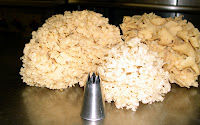 As you can see in the photo, cauliflower mushrooms come by their name for pretty obvious reasons. You can see that they range in color from almost white to the color of egg noodles, with very curly texture to more egg noodle-like texture. The pastry tube gives you a good idea of the size. Although they grow a lot larger, these small ones are the best tasting and least chewy.
Almost nothing smells fresher and more alive than a box of fresh cauliflower mushrooms. When I opened this box, my entire kitchen smelled of pine forest, primal and alive, and better than any air freshener ever concocted. There might also be a hint of cucumber in the fragrance.
Part of the reason for the fragrance may be because they grow on the roots of trees, mainly pine and spruce. It may also be because they are generally loaded with spruce needles, if collected in a spruce forest, so they need careful cleaning. Separate each of the egg noodle-shaped pieces from the tough stems and wash well. Water won't hurt cauliflower mushrooms.
When first faced with these mushrooms years ago, I let their form dictate their use. They look like egg pasta, so I treated them like egg pasta and I have been very happy ever since. And because they are slightly cartilaginous, they hold their shape just like pasta; that is, they don't wilt like other mushrooms. And like pasta, they have a very mild, non-mushroomy flavor, albeit with a touch of pine.
Cauliflower mushrooms are one of my favorite of the edible mushrooms. As my sous chef said last night when tasting the vegan special described below, "I love these mushrooms!"
Last night, a customer booked a table and failed to mention when booking that he is vegan. Fortunately it was slow enough that I could go to his table to talk with him. He asked me if we had any tempeh, seitan, or tofu. No, we don't stock these items, especially without warning. As a rule, I don't play games with meat substitutes. I create vegetarian dishes that proudly feature vegetables rather than meat wannabe products.
As the conversation unfolded (and it was truly like peeling the layers off an onion), I discovered that he doesn't like tomatoes, potatoes, peppers, and spicy food. Poof, there went 98% of my standard vegan repertoire. And of course, our vegetarian special, Sweet Potato Risotto with Braised Arugula, was not vegan, not even close.
After hearing the litany of foods that he couldn't or wouldn't eat, I finally asked him in desperation what he would eat, figuring that to be a much shorter list. He started by saying pasta, beans, rice, and salad. A little more prodding from me got him to exclaim that he loves mushrooms. Armed with that, I went back to the kitchen and started to doodle on the back of a menu with my sous chef.
We started with a pasta with roasted artichokes, roasted cipollini, and braised broccolini. We discussed adding various mushrooms and then I remembered the cauliflower mushrooms. Why not scrap the pasta and use the cauliflowers as egg noodles in the "pasta?"
So, we pan-seared quartered artichokes and whole cipollini and put them in the oven to roast, while we blanched broccolini. Into a sauté pan went extra virgin olive oil and about four ounces of cauliflower mushrooms. Once they had cooked a minute or so, in went the artichokes, cipollini, broccolini, and some garlic. We finished it with a splash of white wine to finish braising the broccolini, salt, pepper, and fresh parsley.
I couldn't help but think how good this would be with some sun-dried tomatoes, crushed red pepper flakes, and a swirl of butter to finish it!
I also couldn't help but think how lucky this guy was not to be eating a salad for dinner. Vegans, vegetarians, and others with restricted diets, please do us the courtesy of calling ahead and letting us know about your diet before you spring it on us in the dining room. You'll be happier and we'll be happier.
We've been unable to get product at times because of illness and surgery, problems with children, and any number of the same problems that you and I face on a daily basis. Working with small suppliers is definitely not like calling an 800 number at 10pm at night and having a truck appear at your door the following morning. But warts and all, I wouldn't have it any other way. I like buying from small business owners who are invested in their businesses.
 As you can see in the photo, cauliflower mushrooms come by their name for pretty obvious reasons. You can see that they range in color from almost white to the color of egg noodles, with very curly texture to more egg noodle-like texture. The pastry tube gives you a good idea of the size. Although they grow a lot larger, these small ones are the best tasting and least chewy.
Almost nothing smells fresher and more alive than a box of fresh cauliflower mushrooms. When I opened this box, my entire kitchen smelled of pine forest, primal and alive, and better than any air freshener ever concocted. There might also be a hint of cucumber in the fragrance.
Part of the reason for the fragrance may be because they grow on the roots of trees, mainly pine and spruce. It may also be because they are generally loaded with spruce needles, if collected in a spruce forest, so they need careful cleaning. Separate each of the egg noodle-shaped pieces from the tough stems and wash well. Water won't hurt cauliflower mushrooms.
When first faced with these mushrooms years ago, I let their form dictate their use. They look like egg pasta, so I treated them like egg pasta and I have been very happy ever since. And because they are slightly cartilaginous, they hold their shape just like pasta; that is, they don't wilt like other mushrooms. And like pasta, they have a very mild, non-mushroomy flavor, albeit with a touch of pine.
Cauliflower mushrooms are one of my favorite of the edible mushrooms. As my sous chef said last night when tasting the vegan special described below, "I love these mushrooms!"
Last night, a customer booked a table and failed to mention when booking that he is vegan. Fortunately it was slow enough that I could go to his table to talk with him. He asked me if we had any tempeh, seitan, or tofu. No, we don't stock these items, especially without warning. As a rule, I don't play games with meat substitutes. I create vegetarian dishes that proudly feature vegetables rather than meat wannabe products.
As the conversation unfolded (and it was truly like peeling the layers off an onion), I discovered that he doesn't like tomatoes, potatoes, peppers, and spicy food. Poof, there went 98% of my standard vegan repertoire. And of course, our vegetarian special, Sweet Potato Risotto with Braised Arugula, was not vegan, not even close.
After hearing the litany of foods that he couldn't or wouldn't eat, I finally asked him in desperation what he would eat, figuring that to be a much shorter list. He started by saying pasta, beans, rice, and salad. A little more prodding from me got him to exclaim that he loves mushrooms. Armed with that, I went back to the kitchen and started to doodle on the back of a menu with my sous chef.
We started with a pasta with roasted artichokes, roasted cipollini, and braised broccolini. We discussed adding various mushrooms and then I remembered the cauliflower mushrooms. Why not scrap the pasta and use the cauliflowers as egg noodles in the "pasta?"
So, we pan-seared quartered artichokes and whole cipollini and put them in the oven to roast, while we blanched broccolini. Into a sauté pan went extra virgin olive oil and about four ounces of cauliflower mushrooms. Once they had cooked a minute or so, in went the artichokes, cipollini, broccolini, and some garlic. We finished it with a splash of white wine to finish braising the broccolini, salt, pepper, and fresh parsley.
I couldn't help but think how good this would be with some sun-dried tomatoes, crushed red pepper flakes, and a swirl of butter to finish it!
I also couldn't help but think how lucky this guy was not to be eating a salad for dinner. Vegans, vegetarians, and others with restricted diets, please do us the courtesy of calling ahead and letting us know about your diet before you spring it on us in the dining room. You'll be happier and we'll be happier.
Tuesday, October 21, 2008
Help Us Help You
I felt really horrible all last weekend because we couldn't accommodate a customer's special request on Saturday night. This almost never happens because we pride ourselves on not only handling special requests, but handling them gracefully, and exceeding our customers' expectations.
Last Saturday was about as busy as it gets in this business. Our ticket rail was wall-to-wall for four solid hours and it was all that we could do to stay on top of tickets and keep the food moving to the dining room. If you've ever worked in a restaurant kitchen, you understand this chaos and treading the fine line between getting the food out and going down in a big ball of flames. If you haven't, just rest assured that you have to put 100% of your focus into getting the food out and you have to work absolutely as fast as you can. There's no time to think about anything else, get a drink of water, or even move from your spot on the line.
So, it's not a really great time for a special request from the kitchen. And by special request, I don't mean substituting green beans for the baby turnips. Those kinds of requests are routine and easy to handle. What I mean, is, well, forget about what I mean and let me just get on with this story.
A server came back to the kitchen to talk to me about the options for a woman who was vegetarian and required a gluten-free and lactose-free meal. Talk is not quite the appropriate verb for what happens in the chaotic world which is a restaurant kitchen on a full-bore Saturday night, when we're all barking at the top of our lungs to be heard over the exhaust fans and the dish machine. Unfortunately for our would-be customer, our vegetarian special for the evening contained cheese, ruling it out.
If I had someone to step into my spot on the line or if I could have found five minutes, I am certain that I could have gone into the walk-in and found some ingredients with which I could have created a gluten-free, lactose-free, vegetarian meal. But, as it turned out, I wouldn't have five minutes free for another two hours. And, if I had taken five minutes right then, the whole line would have gone to hell and I would have significantly delayed dinner for half the tables in the dining room.
The server knew the outcome before he came to the kitchen, but he came to ask anyway as is his job. Maybe I could have worked another miracle as I have done dozens of times before. Not last Saturday. I couldn't stall the dinners for half the dining room for one table. Ultimately, the server had to convey my apologies and suggest that if she could find some things on the menu that would be suitable for her for diet, that we would gladly plate them and send them to her. She chose to leave and I cannot really blame her for that.
I feel bad that she left and I really feel sorry for her because it must be terribly difficult for her to find suitable meals out at restaurants. And I have no doubt that she chose my restaurant because we specialize in handling special requests such as hers. I'm also quite sure that she has never seen a restaurant kitchen on a Saturday night and has no idea why we couldn't do anything for her in a timely manner.
And, I'm a little upset that she brought this outcome on herself and didn't give me a fighting chance to help her. If only she had mentioned her dietary needs when she booked the table, we could have blown her mind with something fantastic to eat. Please, please, please, if you have a special dietary request, let us know when you book your table.
Last Saturday was about as busy as it gets in this business. Our ticket rail was wall-to-wall for four solid hours and it was all that we could do to stay on top of tickets and keep the food moving to the dining room. If you've ever worked in a restaurant kitchen, you understand this chaos and treading the fine line between getting the food out and going down in a big ball of flames. If you haven't, just rest assured that you have to put 100% of your focus into getting the food out and you have to work absolutely as fast as you can. There's no time to think about anything else, get a drink of water, or even move from your spot on the line.
So, it's not a really great time for a special request from the kitchen. And by special request, I don't mean substituting green beans for the baby turnips. Those kinds of requests are routine and easy to handle. What I mean, is, well, forget about what I mean and let me just get on with this story.
A server came back to the kitchen to talk to me about the options for a woman who was vegetarian and required a gluten-free and lactose-free meal. Talk is not quite the appropriate verb for what happens in the chaotic world which is a restaurant kitchen on a full-bore Saturday night, when we're all barking at the top of our lungs to be heard over the exhaust fans and the dish machine. Unfortunately for our would-be customer, our vegetarian special for the evening contained cheese, ruling it out.
If I had someone to step into my spot on the line or if I could have found five minutes, I am certain that I could have gone into the walk-in and found some ingredients with which I could have created a gluten-free, lactose-free, vegetarian meal. But, as it turned out, I wouldn't have five minutes free for another two hours. And, if I had taken five minutes right then, the whole line would have gone to hell and I would have significantly delayed dinner for half the tables in the dining room.
The server knew the outcome before he came to the kitchen, but he came to ask anyway as is his job. Maybe I could have worked another miracle as I have done dozens of times before. Not last Saturday. I couldn't stall the dinners for half the dining room for one table. Ultimately, the server had to convey my apologies and suggest that if she could find some things on the menu that would be suitable for her for diet, that we would gladly plate them and send them to her. She chose to leave and I cannot really blame her for that.
I feel bad that she left and I really feel sorry for her because it must be terribly difficult for her to find suitable meals out at restaurants. And I have no doubt that she chose my restaurant because we specialize in handling special requests such as hers. I'm also quite sure that she has never seen a restaurant kitchen on a Saturday night and has no idea why we couldn't do anything for her in a timely manner.
And, I'm a little upset that she brought this outcome on herself and didn't give me a fighting chance to help her. If only she had mentioned her dietary needs when she booked the table, we could have blown her mind with something fantastic to eat. Please, please, please, if you have a special dietary request, let us know when you book your table.
Friday, September 12, 2008
Name Droppers
I always get tickled by name droppers like the fellow who booked a reservation with me tonight and proceeded to tell me on the phone what good buddies he and Chef Ed are. I guess we're going to catch up on old times tonight when he comes in. Too bad I have no idea who he is.
Seriously, if you have to drop the chef's name while booking a table, you probably don't really know the chef, do you? And if you were a really close friend, wouldn't you be calling the chef's cell phone?
One other amusing story: we were holding our daily pre-dinner meeting when a woman came in wanting a donation—another in an endless series of people asking for handouts. She handed me some information and then proceeded to humiliate herself in front of the entire staff by telling me how well she and Chef Ed were acquainted and what good friends they were. She had no clue that she was addressing Chef Ed, nor did I ever clue her in. Do you think I donated to her charity?
Seriously, if you have to drop the chef's name while booking a table, you probably don't really know the chef, do you? And if you were a really close friend, wouldn't you be calling the chef's cell phone?
One other amusing story: we were holding our daily pre-dinner meeting when a woman came in wanting a donation—another in an endless series of people asking for handouts. She handed me some information and then proceeded to humiliate herself in front of the entire staff by telling me how well she and Chef Ed were acquainted and what good friends they were. She had no clue that she was addressing Chef Ed, nor did I ever clue her in. Do you think I donated to her charity?
Saturday, September 6, 2008
Cake Cutting Fee
Last evening a group booked a table to celebrate a birthday (thank you!). Earlier in the day, they called to ask if they could bring a cake. Our standard response is to offer to make a special cake, if we know far enough in advance.
This party called about the cake at around 4:30 pm for a 6:00 pm reservation. (Again, thanks to them for calling in advance and not just bringing the cake in without warning.) Because we did not have time to make a cake or other special dessert, our standard response is that we charge a cake cutting fee.
Most customers are not happy about this cake cutting fee and choose to eat dinner with us and eat their cake back at home after dinner, which is what this party did. Wise choice and thanks again to them.
Of course, there are customers who call many days in advance to discuss bringing in a very special cake (one that we could not do, mostly for sentimental reasons) for their event. We generally waive the fee, gladly I might add—usually we never even broach the topic. But the bulk of customers who want to bring a cake are trying to save money at our expense.
The bottom line for us is that we are in business to make money. If you bring a cake into the restaurant, you not only deprive us of dessert sales, but you also occupy a table that we could potentially reseat to generate more revenue. On top of that, you're using our china and silverware without paying your share of the cost of purchase, the cost of breakage, and the labor to wash and polish it.
Moreover, there is the aspect of insult. We, especially those of us who make the pastries, find it insulting that someone would bring in a pastry from out of house. Usually, it's a $10 Wal-Mart sheet cake made without any artistry or care; it's just a commodity. We take extreme pride in our food and it's painful when customers don't appreciate what we do.
I'm sure most customers never consider these issues, which is why I am bringing them up here.
Being in the hospitality business puts us in the unique situation of having to deal with people bringing food in from the outside to consume in our restaurant. You would never bring your own auto parts to the car dealer for repairs, would you? Would you bring your own bottle of bourbon to a bar and expect to be served? So, why would you bring a cake to a restaurant and expect to be served?
Bottom line for us: please don't bring a cake to our restaurant unless we've discussed it beforehand. We would find it rude and insulting.
This party called about the cake at around 4:30 pm for a 6:00 pm reservation. (Again, thanks to them for calling in advance and not just bringing the cake in without warning.) Because we did not have time to make a cake or other special dessert, our standard response is that we charge a cake cutting fee.
Most customers are not happy about this cake cutting fee and choose to eat dinner with us and eat their cake back at home after dinner, which is what this party did. Wise choice and thanks again to them.
Of course, there are customers who call many days in advance to discuss bringing in a very special cake (one that we could not do, mostly for sentimental reasons) for their event. We generally waive the fee, gladly I might add—usually we never even broach the topic. But the bulk of customers who want to bring a cake are trying to save money at our expense.
The bottom line for us is that we are in business to make money. If you bring a cake into the restaurant, you not only deprive us of dessert sales, but you also occupy a table that we could potentially reseat to generate more revenue. On top of that, you're using our china and silverware without paying your share of the cost of purchase, the cost of breakage, and the labor to wash and polish it.
Moreover, there is the aspect of insult. We, especially those of us who make the pastries, find it insulting that someone would bring in a pastry from out of house. Usually, it's a $10 Wal-Mart sheet cake made without any artistry or care; it's just a commodity. We take extreme pride in our food and it's painful when customers don't appreciate what we do.
I'm sure most customers never consider these issues, which is why I am bringing them up here.
Being in the hospitality business puts us in the unique situation of having to deal with people bringing food in from the outside to consume in our restaurant. You would never bring your own auto parts to the car dealer for repairs, would you? Would you bring your own bottle of bourbon to a bar and expect to be served? So, why would you bring a cake to a restaurant and expect to be served?
Bottom line for us: please don't bring a cake to our restaurant unless we've discussed it beforehand. We would find it rude and insulting.
Tuesday, September 2, 2008
So You Want to be a Chef?
I got really angry at a customer today. It doesn't happen very often because I'm pretty good at shrugging off things. Excuse me for a second while I vent; I couldn't vent at the customer.
On our lunch menu, we have a pasta called Ed's Pasta, named for me because it is my favorite pasta. It's a simple pasta really, just tomatoes, artichoke hearts, capers, browned garlic, hot pepper flakes, basil and white wine. Each ingredient in the dish is there for a particular purpose and the quality of the dish depends on the quality of the ingredients.
A female diner ordered Ed's Pasta for lunch today without tomatoes, which to me is unthinkable. The tomato is the sine qua non of the dish, the essential element, contributing flavor, color, and acidity. My initial reaction on getting the ticket was, "This is going to be boring!" But since I'm in the hospitality business, I didn't go try to talk her out of it; I just cooked it like she requested.
But she crossed the etiquette line when she told her server that the result was "bland." No kidding! Just what you asked for. That's why I'm the chef and you're not.
If you ask for changes to a dish on someone's menu, you have no right to complain when you don't like the result.
There, I feel better already.
On our lunch menu, we have a pasta called Ed's Pasta, named for me because it is my favorite pasta. It's a simple pasta really, just tomatoes, artichoke hearts, capers, browned garlic, hot pepper flakes, basil and white wine. Each ingredient in the dish is there for a particular purpose and the quality of the dish depends on the quality of the ingredients.
A female diner ordered Ed's Pasta for lunch today without tomatoes, which to me is unthinkable. The tomato is the sine qua non of the dish, the essential element, contributing flavor, color, and acidity. My initial reaction on getting the ticket was, "This is going to be boring!" But since I'm in the hospitality business, I didn't go try to talk her out of it; I just cooked it like she requested.
But she crossed the etiquette line when she told her server that the result was "bland." No kidding! Just what you asked for. That's why I'm the chef and you're not.
If you ask for changes to a dish on someone's menu, you have no right to complain when you don't like the result.
There, I feel better already.
Monday, September 1, 2008
Read Much?
Today as I was sitting in my office laboring away on Labor Day, as every other Monday, I heard the front door chime go off at 11:15.
I assumed it was my children for whom I was cooking lunch on their last day of freedom before the dreaded school year starts tomorrow. Aside—I know you're dying to know—We had a frittata of local eggs, chorizo, local tomatoes, local red peppers, pimentón, garlic, thyme from the plant in front of the restaurant, and local sheep's milk cheese similar to but better than Manchego.
Aside aside, back to the front door chime. Because I thought it was the girls and because I was in the midst of some bookkeeping, I was in no hurry to get to the front. Bookkeeping at a good stopping point, I stepped from my lighted office into the very black hallway—no sense in wasting electricity on lighting the restaurant on a day we're not open—and the light contrast left me unable to see for a moment.
Once my eyes became accustomed to the dark and I got to the front, I could see two elderly ladies poking about the nearly pitch dark dining room trying to find someone to seat them. When I cheerfully informed them that we were closed on Mondays, one blurted out a bit rudely, "Well, the door was unlocked."
I clamped a muzzle quickly on my very sarcastic mouth—the possibilities for very snide retorts to her statement are nearly endless—and reminded her that despite being closed to the general public, people do need to come and go: the postman, delivery drivers, tourists walking by who want to book tables, the pest control guy, the ladies that take care of our flowers, our electrician, etc.
 Just to reassure myself that the front door is very clearly posted with our hours of business, I took my camera outside. Yep, the sign is still there, still legible, but largely unread by John Q. Public.
A lot of would be customers get semi-hostile when they arrive in the dining room on a Monday only to discover that we're closed. I know that they're only venting at their own failure to check our hours before leaving for the restaurant, but still I'm no different than anyone else: I don't enjoy invective aimed at me any more than you do, even if it really isn't intended for me.
I try my best to be tolerant by putting myself in their shoes, but I keep coming back to the fact that not only can I read, but I do read. I always scan the door of any restaurant that I am about to enter to see if they are in fact open and if they honor my credit cards, as I don't carry cash.
While I am dishing on customers—yes, you readers love it; the more dirt on customers in the blog post, the more frequently the post is read!—here are two more amusing incidents of a similar nature. Before I got in the restaurant business, if I had read about these two incidents, I would have thought that the author were fibbing. But as the saw goes, the truth is much stranger than fiction.
Each year in our town, we host the Shenandoah Apple Blossom Festival, held the week leading into the first weekend in May, to celebrate the beginning of our local apple growing season. Naturally, the apples have already bloomed before the first of May, but never mind. And with fierce competition from both real estate development and Chinese apples, the apple industry is not thriving. Nonetheless, the first weekend in May sees 250,000 to 500,000 people descend on our town of 25,000 to watch our famous parades and celebrate with us.
Because of our location on a back alley, because visitors to the festival are conditioned to want corn dogs, fried confections, blooming onions, and sundry other junk from the myriad street vendors, and because the bulk of our customers are either out of town or are holding or attending one of vast numbers of private parties, we get no traffic that week. 10,000 people walk past our store and not one will come in, unless to use the restrooms.
So, we close out of self-defense to cut our losses and use that week to recuperate and get work done on the restaurant. One year we had the dining room torn apart to paint, with booths jammed into the entry foyer so tight that it was nearly impossible to squeeze by. In the midst of painting one afternoon, I went down the hall to the restroom and when I returned to the dining room, there was a foursome of elderly ladies seated at a table draped in a dropcloth, demanding to be served. How they managed to miss the closed sign on the front door, negotiate the obstacle course to a table, and sit at a draped table without concluding that we were closed is absolutely beyond my comprehension!
Another year, I was on the deck painting the fence when two ladies walked up to the front door, which was posted with a sign stating that we were closed for the week. One lady said, “Oh look, they’re closed!” And the other replied, “Let’s go in and see if they really mean it.” And they proceeded to go inside. Idiots.
I assumed it was my children for whom I was cooking lunch on their last day of freedom before the dreaded school year starts tomorrow. Aside—I know you're dying to know—We had a frittata of local eggs, chorizo, local tomatoes, local red peppers, pimentón, garlic, thyme from the plant in front of the restaurant, and local sheep's milk cheese similar to but better than Manchego.
Aside aside, back to the front door chime. Because I thought it was the girls and because I was in the midst of some bookkeeping, I was in no hurry to get to the front. Bookkeeping at a good stopping point, I stepped from my lighted office into the very black hallway—no sense in wasting electricity on lighting the restaurant on a day we're not open—and the light contrast left me unable to see for a moment.
Once my eyes became accustomed to the dark and I got to the front, I could see two elderly ladies poking about the nearly pitch dark dining room trying to find someone to seat them. When I cheerfully informed them that we were closed on Mondays, one blurted out a bit rudely, "Well, the door was unlocked."
I clamped a muzzle quickly on my very sarcastic mouth—the possibilities for very snide retorts to her statement are nearly endless—and reminded her that despite being closed to the general public, people do need to come and go: the postman, delivery drivers, tourists walking by who want to book tables, the pest control guy, the ladies that take care of our flowers, our electrician, etc.
 Just to reassure myself that the front door is very clearly posted with our hours of business, I took my camera outside. Yep, the sign is still there, still legible, but largely unread by John Q. Public.
A lot of would be customers get semi-hostile when they arrive in the dining room on a Monday only to discover that we're closed. I know that they're only venting at their own failure to check our hours before leaving for the restaurant, but still I'm no different than anyone else: I don't enjoy invective aimed at me any more than you do, even if it really isn't intended for me.
I try my best to be tolerant by putting myself in their shoes, but I keep coming back to the fact that not only can I read, but I do read. I always scan the door of any restaurant that I am about to enter to see if they are in fact open and if they honor my credit cards, as I don't carry cash.
While I am dishing on customers—yes, you readers love it; the more dirt on customers in the blog post, the more frequently the post is read!—here are two more amusing incidents of a similar nature. Before I got in the restaurant business, if I had read about these two incidents, I would have thought that the author were fibbing. But as the saw goes, the truth is much stranger than fiction.
Each year in our town, we host the Shenandoah Apple Blossom Festival, held the week leading into the first weekend in May, to celebrate the beginning of our local apple growing season. Naturally, the apples have already bloomed before the first of May, but never mind. And with fierce competition from both real estate development and Chinese apples, the apple industry is not thriving. Nonetheless, the first weekend in May sees 250,000 to 500,000 people descend on our town of 25,000 to watch our famous parades and celebrate with us.
Because of our location on a back alley, because visitors to the festival are conditioned to want corn dogs, fried confections, blooming onions, and sundry other junk from the myriad street vendors, and because the bulk of our customers are either out of town or are holding or attending one of vast numbers of private parties, we get no traffic that week. 10,000 people walk past our store and not one will come in, unless to use the restrooms.
So, we close out of self-defense to cut our losses and use that week to recuperate and get work done on the restaurant. One year we had the dining room torn apart to paint, with booths jammed into the entry foyer so tight that it was nearly impossible to squeeze by. In the midst of painting one afternoon, I went down the hall to the restroom and when I returned to the dining room, there was a foursome of elderly ladies seated at a table draped in a dropcloth, demanding to be served. How they managed to miss the closed sign on the front door, negotiate the obstacle course to a table, and sit at a draped table without concluding that we were closed is absolutely beyond my comprehension!
Another year, I was on the deck painting the fence when two ladies walked up to the front door, which was posted with a sign stating that we were closed for the week. One lady said, “Oh look, they’re closed!” And the other replied, “Let’s go in and see if they really mean it.” And they proceeded to go inside. Idiots.
Friday, August 1, 2008
Work With Us, Please
I was in the dining room two days ago when a table of ladies, good customers all, came in for lunch. After being seated, they all opened their menus and then got to talking. All well and good: we like it when people sit and catch up with each other over lunch.
While they were catching up, we were going about the dining room attending to other things, waiting for them to be ready to order lunch. At one point, one of the women waved at me and called over to me, "Aren't you going to take our order?"
Who would have guessed that they were ready to order? Four open menus in front of four people highly engaged in conversation is not a ready-to-order sign that we recognize.
First, we do our utmost not to interrupt a conversation; that's just rude. Second, we look for some sign that you are ready to order. The surest sign is when everyone at the table has a closed menu. Aside from that, one member of the party can catch our eye and we will be right there.
We're also pretty adept at seeing when you take off your reading glasses, start looking around the dining room, and so forth. But, we'd really rather not guess if you are ready to eat. Work with us: close your menu.
While they were catching up, we were going about the dining room attending to other things, waiting for them to be ready to order lunch. At one point, one of the women waved at me and called over to me, "Aren't you going to take our order?"
Who would have guessed that they were ready to order? Four open menus in front of four people highly engaged in conversation is not a ready-to-order sign that we recognize.
First, we do our utmost not to interrupt a conversation; that's just rude. Second, we look for some sign that you are ready to order. The surest sign is when everyone at the table has a closed menu. Aside from that, one member of the party can catch our eye and we will be right there.
We're also pretty adept at seeing when you take off your reading glasses, start looking around the dining room, and so forth. But, we'd really rather not guess if you are ready to eat. Work with us: close your menu.
Saturday, July 26, 2008
The Chef is an *sshole
You might as well read about it here first. I caused a table of eight boors to leave the restaurant tonight. I didn't actually tell them to leave, but they were smart enough to understand my intent. No doubt, the encounter will be plastered around a bunch of Internet review sites by morning and the world will know that I am an *sshole.
You've seen people like this: fairly young, know-it-alls, with huge chips on their shoulders. Really, after being seated in a nice restaurant, who asks oh-so-snidely, "Does anyone here know anything about wine?"
The party ordered a bottle of Burgundian style Pinot Noir, accepted it, had it poured around the table, and then called the server back over to send it back because it was "musty." Actually, I smelled and tasted the rejected wine and it was gorgeous.
They decided to replace it with a Marlborough Sauvignon Blanc, which the taster rejected as "vinegar." Again, I tasted the wine and it was totally tropical dead-on NZ SB. If it wasn't clear before this point, it was certainly obvious that we were dealing with poseurs.
At this point, I had lost just about all my profit on this table, but in the spirit of hospitality, we were still gracious and got them wine and took their order. The appetizer order came and went and then we cooked the entrée order. Immediately, three of the fish plates came back as being overcooked.
I looked at the plates and they were perfect. The fish was still just a little translucent in the center of each. I tasted each to be sure and they were beautiful.
I went to the dining room to see what we could do to appease the table and all I could hear was this party talking so loudly about what terrible wine and food we had. You've heard them before: the ones that talk so that everyone must hear them, the ones that want everyone to know how important they are.
I could see the eyes rolling on the table just behind them and that's when I knew I had to do something. These boors were intruding on the evenings of our other guests.
After they left, I went to the other table to apologize to them for the intrusion of this other party on their evening, but before I could say anything, the woman at the table asked, "What was their problem?"
I learned a long time ago, the hard way, that in the long run, you lose a lot less by making offensive tables leave, than by letting them stay and offending other guests. Sad, but true. I guess that makes me an *sshole.
You've seen people like this: fairly young, know-it-alls, with huge chips on their shoulders. Really, after being seated in a nice restaurant, who asks oh-so-snidely, "Does anyone here know anything about wine?"
The party ordered a bottle of Burgundian style Pinot Noir, accepted it, had it poured around the table, and then called the server back over to send it back because it was "musty." Actually, I smelled and tasted the rejected wine and it was gorgeous.
They decided to replace it with a Marlborough Sauvignon Blanc, which the taster rejected as "vinegar." Again, I tasted the wine and it was totally tropical dead-on NZ SB. If it wasn't clear before this point, it was certainly obvious that we were dealing with poseurs.
At this point, I had lost just about all my profit on this table, but in the spirit of hospitality, we were still gracious and got them wine and took their order. The appetizer order came and went and then we cooked the entrée order. Immediately, three of the fish plates came back as being overcooked.
I looked at the plates and they were perfect. The fish was still just a little translucent in the center of each. I tasted each to be sure and they were beautiful.
I went to the dining room to see what we could do to appease the table and all I could hear was this party talking so loudly about what terrible wine and food we had. You've heard them before: the ones that talk so that everyone must hear them, the ones that want everyone to know how important they are.
I could see the eyes rolling on the table just behind them and that's when I knew I had to do something. These boors were intruding on the evenings of our other guests.
After they left, I went to the other table to apologize to them for the intrusion of this other party on their evening, but before I could say anything, the woman at the table asked, "What was their problem?"
I learned a long time ago, the hard way, that in the long run, you lose a lot less by making offensive tables leave, than by letting them stay and offending other guests. Sad, but true. I guess that makes me an *sshole.
Monday, July 21, 2008
S.O.S.
You know, I really shouldn't let small things get to me. I really shouldn't. But on Saturday I got a bit perturbed by the series of lunch tickets on which were scrawled "SOS," literally sauce on side and meaning no dressing on the salad, to put it in a dish so that the customer can dispense it herself. Herself is appropriate here: I can't remember the last time a guy ordered a salad SOS.
We all know why we send out so many salads SOS. It's because Jane Customer has conned herself into thinking that she can control the calories better if she dresses the salad greens herself. Mainly what I see happening is that we send out an espresso cup of dressing, about 2 times what we would normally put on a salad, and Jane proceeds to put a little bit on the salad. And then because she has no way to mix the salad, the greens below the top layer have no dressing and Jane applies more dressing, again and again, until she has consumed twice the calories that she would have if we dressed the salad properly for her.
I know that we have all experienced salads in so-so dining establishments in which the greens were drowned in dressing. This is a pet peeve of mine and so we work very hard to dress our salads as lightly as possible, so I guess what really irritates me the most is that when Jane orders SOS, it is generally a signal that she doesn't trust us. Why is she eating in my restaurant if she doesn't trust me?
The other irritant is that I know that the salad with the dressing on the side will not be as good as if we dressed it in the kitchen, and therefore, it could reflect badly on my food.
Anyway, it is a small thing and I shouldn't really care about it. So what if the customer consumes double the dressing? That's just my little revenge for ordering SOS.
We all know why we send out so many salads SOS. It's because Jane Customer has conned herself into thinking that she can control the calories better if she dresses the salad greens herself. Mainly what I see happening is that we send out an espresso cup of dressing, about 2 times what we would normally put on a salad, and Jane proceeds to put a little bit on the salad. And then because she has no way to mix the salad, the greens below the top layer have no dressing and Jane applies more dressing, again and again, until she has consumed twice the calories that she would have if we dressed the salad properly for her.
I know that we have all experienced salads in so-so dining establishments in which the greens were drowned in dressing. This is a pet peeve of mine and so we work very hard to dress our salads as lightly as possible, so I guess what really irritates me the most is that when Jane orders SOS, it is generally a signal that she doesn't trust us. Why is she eating in my restaurant if she doesn't trust me?
The other irritant is that I know that the salad with the dressing on the side will not be as good as if we dressed it in the kitchen, and therefore, it could reflect badly on my food.
Anyway, it is a small thing and I shouldn't really care about it. So what if the customer consumes double the dressing? That's just my little revenge for ordering SOS.
Thursday, June 19, 2008
Grumpy People
The restaurant business is generally very rewarding: it's an awesome feeling when everyone in the dining room is having a great time. Let's face it, that's why we do what we do, why we work when others celebrate, why we give up our lives for this business. So that others can have a good time.
But there are those days that try our souls. If you are or have been in the business, you know exactly what I am talking about.
Yesterday was one such day when the negative energy in the dining room was palpable. Both lunch and dinner were miserable experiences for my staff and me. All the tables, and there were many of them, were in evil frames of mind. They were rude, impolite, and two tables made me want to throw them out on the street.
Why is it that on some days, some customers forget everything they know about civility and about the Golden Rule? Why do they behave in a manner that, if they were my children, they would be grounded with no privileges for a very long time? What gives them the right, just because they are grumpy, to be total jerks?
And, finally, why is being a jerk so contagious?
To end this rant, I don't work sixteen-hour days so you can come vent your spleen just because somebody peed in your cereal. If you're having a day like that, just stay home. If you feel the need to act in a manner that would not be appropriate at my house, don't do it at my restaurant.
Thank you, all you wonderful customers. Most of the time you make me forget about the jerks. Just not today.
But there are those days that try our souls. If you are or have been in the business, you know exactly what I am talking about.
Yesterday was one such day when the negative energy in the dining room was palpable. Both lunch and dinner were miserable experiences for my staff and me. All the tables, and there were many of them, were in evil frames of mind. They were rude, impolite, and two tables made me want to throw them out on the street.
Why is it that on some days, some customers forget everything they know about civility and about the Golden Rule? Why do they behave in a manner that, if they were my children, they would be grounded with no privileges for a very long time? What gives them the right, just because they are grumpy, to be total jerks?
And, finally, why is being a jerk so contagious?
To end this rant, I don't work sixteen-hour days so you can come vent your spleen just because somebody peed in your cereal. If you're having a day like that, just stay home. If you feel the need to act in a manner that would not be appropriate at my house, don't do it at my restaurant.
Thank you, all you wonderful customers. Most of the time you make me forget about the jerks. Just not today.
Thursday, April 17, 2008
How's Your Day Gone?
The following telephone conversation between a young lady and me this afternoon pretty well summarizes my day:
Her: "I'd like to book a table for dinner tonight for a birthday. And I have a special request."
Me: "Sure, what's the special request?"
Her: "Do you do special desserts for birthdays?"
Me: "Yes we do from time to time. What did you have in mind?"
Her: "Can you do a peanut butter pie?"
Me: "Unfortunately, I don't have any peanut butter."
Her: "Oh."
Me: "We have some really nice desserts on our dessert list or perhaps we could make you something else?" [Yeah, like my 52-seat restaurant has a fully staffed pastry department standing around waiting to turn out confections with two-hour notice for those customers who fail to plan ahead.]
Her: "I don't know."
Me: "What time did you want to book the table?"
Her: "I'm going to call around for peanut butter pie."
Me: "Good luck with that."
Her: "I'd like to book a table for dinner tonight for a birthday. And I have a special request."
Me: "Sure, what's the special request?"
Her: "Do you do special desserts for birthdays?"
Me: "Yes we do from time to time. What did you have in mind?"
Her: "Can you do a peanut butter pie?"
Me: "Unfortunately, I don't have any peanut butter."
Her: "Oh."
Me: "We have some really nice desserts on our dessert list or perhaps we could make you something else?" [Yeah, like my 52-seat restaurant has a fully staffed pastry department standing around waiting to turn out confections with two-hour notice for those customers who fail to plan ahead.]
Her: "I don't know."
Me: "What time did you want to book the table?"
Her: "I'm going to call around for peanut butter pie."
Me: "Good luck with that."
Tuesday, April 15, 2008
Do You Have a Food Allergy?
If you have a food allergy, when you go out to eat, please make that known to your server before you order your meal. Don't do what a young man did today.
He ordered our lunch ravioli special, filled with ricotta and organic pesto (made from both pine nuts and walnuts), and then refused the dish when it got to the table because it was garnished with pine nuts, stating that he had a nut allergy.
What if he hadn't seen the pine nuts and had eaten the ravioli?
What if he ordered a salad that contained no nuts, but the cook who assembled the salad tossed it in a bowl in which he just tossed a salad containing nuts?
What if the cook seared his tuna on the same flat-top grill on which he just cooked an order of hazelnut-crusted mahimahi?
What if the cook sliced his chicken with a knife that he just used to crush walnuts for a salad?
What if?
Why play roulette? And moreover, why do it in my restaurant?
He ordered our lunch ravioli special, filled with ricotta and organic pesto (made from both pine nuts and walnuts), and then refused the dish when it got to the table because it was garnished with pine nuts, stating that he had a nut allergy.
What if he hadn't seen the pine nuts and had eaten the ravioli?
What if he ordered a salad that contained no nuts, but the cook who assembled the salad tossed it in a bowl in which he just tossed a salad containing nuts?
What if the cook seared his tuna on the same flat-top grill on which he just cooked an order of hazelnut-crusted mahimahi?
What if the cook sliced his chicken with a knife that he just used to crush walnuts for a salad?
What if?
Why play roulette? And moreover, why do it in my restaurant?
Subscribe to:
Posts (Atom)

