So here's an interesting tropical fruit that I stumbled on yesterday. It's called the wax apple in the store where I bought it. Officially known as Syzygium samarangense, it hails from Thailand to India and Malaysia to the Philippines.
It's a small fruit (refer to the cherry tomato in the photo) that is firm and has a smooth skin like a pear but with a waxier texture and a dimpled end just like a chayote. Biting into the fruit, the first thing that comes to mind is a pear or a watermelon because the fruit is dripping with juice.
I found the fruit to have a sweet flavor at first, dissipating in the middle, and then finishing with a slight piny afternote that I think comes from the skin. The flesh is fairly pithy and nearly flavorless. I wound up sucking all the juice out of the fruit and spitting out what little flesh there was.
Vote: they're a fun fruit in the summer, but their uses are pretty limited.
Showing posts with label fruit. Show all posts
Saturday, July 7, 2012
Thursday, June 28, 2012
Alien Ingredient #33: Mamoncillo
| Mamoncillo: What Exactly is the Point? |
So, you're salivating wanting to know what the pulpy not quite slimy flesh tastes like, aren't you? It is sour in a tamarind kind of lemony citrus way. OK, not so wonderful. I read on the internet that people boil them to make a juice from which they make aguas frescas. Yeah, I'm going to leave that to them. It seems a whole lot more productive to make an agua fresca from tamarind or lemon or lime.
Vote: What exactly is the point?
Friday, June 1, 2012
Alien Ingredient #32: Fresh Lychee
About 30 years ago, I got turned off to lychees when I was served a plate of canned ones as a dessert at a really bad American Chinese restaurant. They tasted and smelled like bad perfume.
Flash forward to 2012. The local FoodMaxx had a huge display of fresh lychees at a very reasonable price, so I brought a big bag back to the restaurant, where we immediately set about them. You can see in the photo above that they have a thin red skin which peels off easily revealing a very juicy white fruit with the consistency of peeled grape. Some have a big pit like you see here; others have a very tiny pit and correspondingly more fruit.
Fresh, ripe lychee tastes like good Gewürztraminer, sweet with essences of rose petals and other floral characteristics and none of that old-lady-with-way-too-much-perfume character that turned me off to the canned variety decades ago. The fresh fruits have a bit of tannins that I was not expecting. This is not a bad thing: the tannins are quite refreshing.
Like most fresh fruit, we don't plan to do anything with them; just eat them out of hand. It's really hard to improve on something that is already good.
Vote: Delicious, affordable, love them!
Flash forward to 2012. The local FoodMaxx had a huge display of fresh lychees at a very reasonable price, so I brought a big bag back to the restaurant, where we immediately set about them. You can see in the photo above that they have a thin red skin which peels off easily revealing a very juicy white fruit with the consistency of peeled grape. Some have a big pit like you see here; others have a very tiny pit and correspondingly more fruit.
Fresh, ripe lychee tastes like good Gewürztraminer, sweet with essences of rose petals and other floral characteristics and none of that old-lady-with-way-too-much-perfume character that turned me off to the canned variety decades ago. The fresh fruits have a bit of tannins that I was not expecting. This is not a bad thing: the tannins are quite refreshing.
Like most fresh fruit, we don't plan to do anything with them; just eat them out of hand. It's really hard to improve on something that is already good.
Vote: Delicious, affordable, love them!
Alien Ingredient #31: Longan
Here's a small fruit from southeast Asia that I have never encountered before. Longans are small quarter dollar-sized fruits whose flesh resembles a white peeled grape, surrounding a small chestnut-looking seed in the center. The brown husk is easy enough to peel off. The flavor is very mild and very sweet, at honeydew melon with a hint of pineapple.
Vote: Good fruit, but not even close to the top of my list. I won't go out of my way to get any more of these.
Wednesday, May 30, 2012
Alien Ingredient #29: Korean Melon
| Korean Melon, Cell Phone for Reference |
On cutting it open, the fragrance is a cross between honeydew and cantaloupe and the flesh is nearly white with a slight yellow cast. The flesh tasted the same way, but despite showing all the signs of ripeness, it was too firm to spoon out of the shell.
Vote: nothing to write home about. Both ripe honeydew and ripe cantaloupe blow this guy out of the water and at $1.79 for a tiny melon, it's very expensive. I'll wait for July and August for our local melons, thanks.
Thursday, May 10, 2012
Alien Ingredient #27: Rambutan
This hairy relative of the lichee looks rather bizarre but is really a delicious fruit with notes of sweet melon, peach and jackfruit. The texture of the flesh surrounding the small pit is similar to a firm grape, but like jackfruit the flesh is not juicy. On some, when the flesh would peel away from the seed, it would pull some of the seed coating away attached to the flesh. This seed coating has an almond-like flavor.
I found it necessary to nick the husk with a knife to start opening it. I left a few on the counter overnight trying to see if I could get them to ripen more. Bad move. They shriveled. It seems best to store them covered.
Vote: Fun, tasty, not super sweet, and not cloying like lichees, but at $8/pound with at most 50% yield, probably not worth the price.
Friday, March 2, 2012
Alien Ingredient #18: Guava
I seem to be on a roll with the tropical fruit in the last few posts, though it's certainly not by design. It just happened that way. Last trip to the market, I spied some ripe baby yellow guavas, the first guavas I've ever seen. These are smaller than a lime, included in the photo for comparison, light yellow, a yellow the color of non-russeted Asian pears. The fruits are yielding in the sense that a peach or pear yields when it is ready to eat.
Now guava is not an unknown fruit to me. We regularly use pasta de guayaba (guava paste) and membrillo (quince paste) on our cheese plates. And I have somewhat fuzzy memories of last Easter Monday at a pool in St. Martin where our bartender Alain made us round after round of fabulous cocktails that he called Rendezvous, based on guava nectar.
I didn't know it was guava nectar at the time; I had to ask Alain because I could not place the haunting part passionfruit, part banana, part pear aroma coming from the cocktail. And this is the exact same aroma coming from these tiny little guavas, very tropical, very haunting, and very promising!
These particular guavas, in addition to being small and yellow, have white flesh. Many guavas have red or pink flesh. I cut one open to expose the round, very hard, blond seeds. The seeds in this particular guava are inedible and are encased in a pulp that reminds me of very, very ripe slippery, almost slimy, banana. This custardy pulp tastes mainly of banana and pear, with firm acidity and a slight starchiness that is unexpected. The shell of fruit surrounding the pulp is firmer with a texture and flavor of pear with banana overtones. Nowhere in the flesh could I find that haunting and elusive passionfruit that I smelled and that was so alluring.
Vote: This siren of a fruit lured me in with its aroma and then left me wanting. I won't try this particular kind of guava again, but I will try others as they cross my path.
I didn't know it was guava nectar at the time; I had to ask Alain because I could not place the haunting part passionfruit, part banana, part pear aroma coming from the cocktail. And this is the exact same aroma coming from these tiny little guavas, very tropical, very haunting, and very promising!
These particular guavas, in addition to being small and yellow, have white flesh. Many guavas have red or pink flesh. I cut one open to expose the round, very hard, blond seeds. The seeds in this particular guava are inedible and are encased in a pulp that reminds me of very, very ripe slippery, almost slimy, banana. This custardy pulp tastes mainly of banana and pear, with firm acidity and a slight starchiness that is unexpected. The shell of fruit surrounding the pulp is firmer with a texture and flavor of pear with banana overtones. Nowhere in the flesh could I find that haunting and elusive passionfruit that I smelled and that was so alluring.
Vote: This siren of a fruit lured me in with its aroma and then left me wanting. I won't try this particular kind of guava again, but I will try others as they cross my path.
Wednesday, February 29, 2012
Alien Ingredient #17: Jackfruit
These watermelon-sized fruits with the horned rinds (similar to Durians) are intimidating looking beasts, now that I see one in person. I've seen canned jackfruit in markets all my life, but when I try a fruit for the first time, I want to try the fresh version. And jackfruit has just become available at the local market.


The first thing that struck me about the fruit is the outstanding nose, perfumed with pineapple, mango, and banana. It is a simply beguiling smell. The flavor is—I don't know how to put it better—of straight up Juicy Fruit gum with a sweet banana finish. I can't explain Juicy Fruit to non-Americans because it's something you have to taste, but try to imagine a symphony of every tropical fruit you know.
So, how to attack one of these monsters, the largest tree fruits? I bought a quarter of one, about 5.5 lbs (2.5kg), already cut. Whole ones are easy enough to split and quarter with a sharp knife. When working with jackfruit, you definitely need to be mindful of the latex that the core oozes when cut. It can make a sticky mess, but I had no problem washing it off with hot water and soap.
I cut the core out of my quarter and this exposed the individual fruits (technically I think they're called arils, but really, who cares?). This is a fruit with training wheels: it is obvious how to disassemble it. The edible fruits are yellow and the stringy pithy white stuff surrounding them is not so good. Inside the fruit, you find a big seed that you discard. What's left is good, really good.

The texture of the fruit is unique in my experience; it compares to nothing in my vocabulary. The fruit is totally dry with no discernible juice. The texture is somewhat waxy and somewhat yieldingly crisp; it is not unpleasant though, but I just don't have any words to describe it.
Note: the next day, after we had pulled the fruit from the husk and refrigerated it overnight, the tropical complexities had dissipated and we were left with a fruit that tastes remarkably like cantaloupe with none of the sweet banana finish. Go figure.
Vote: Wow! We really like this fruit and the price is right!
The first thing that struck me about the fruit is the outstanding nose, perfumed with pineapple, mango, and banana. It is a simply beguiling smell. The flavor is—I don't know how to put it better—of straight up Juicy Fruit gum with a sweet banana finish. I can't explain Juicy Fruit to non-Americans because it's something you have to taste, but try to imagine a symphony of every tropical fruit you know.
So, how to attack one of these monsters, the largest tree fruits? I bought a quarter of one, about 5.5 lbs (2.5kg), already cut. Whole ones are easy enough to split and quarter with a sharp knife. When working with jackfruit, you definitely need to be mindful of the latex that the core oozes when cut. It can make a sticky mess, but I had no problem washing it off with hot water and soap.
I cut the core out of my quarter and this exposed the individual fruits (technically I think they're called arils, but really, who cares?). This is a fruit with training wheels: it is obvious how to disassemble it. The edible fruits are yellow and the stringy pithy white stuff surrounding them is not so good. Inside the fruit, you find a big seed that you discard. What's left is good, really good.
The texture of the fruit is unique in my experience; it compares to nothing in my vocabulary. The fruit is totally dry with no discernible juice. The texture is somewhat waxy and somewhat yieldingly crisp; it is not unpleasant though, but I just don't have any words to describe it.
Note: the next day, after we had pulled the fruit from the husk and refrigerated it overnight, the tropical complexities had dissipated and we were left with a fruit that tastes remarkably like cantaloupe with none of the sweet banana finish. Go figure.
Vote: Wow! We really like this fruit and the price is right!
Thursday, February 23, 2012
Alien Ingredient #16: Spondias/Mombin
In reading further on the subject, it appears that the green-yellow ones are color variants of purple mombins, and not yellow mombins, S. mombin, but our taste tests do not bear this out. The green ones taste and appear nothing like the red ones. Here they are side by side for comparison.
Each of these fruits appears to be a drupe, that is, it has fleshy fruit surrounding a central pit. The pits are more at mango pits than any of our domesticated drupes. The central pit is connected by masses of fibers to the flesh, a real clingstone if I ever saw one.
The pickled makok flesh is light green and mildly sweet, with sort of the texture of a mushy watermelon rind pickle. On chewing the pickle, the good parts disappear quickly and after a few moments, you're left chewing on a sort of flavorless, pasty, fibrous mass. To quote me during our tasting, "This is not a good pickle."
The red mombins on the other hand had a leathery skin yielding to a grapey, plummy red flesh. They are sweet and pretty tasty. I think we'll use the rest of these to flavor a flan or sorbet. By contrast, the yellow mombins had the same leathery skin yielding to a broken custard-looking baby puke flesh. The flavor was a touch medicinal and the skin quite astringent. These quickly went into the trash.
Vote: Pickled makok—not a good pickle. Red mombin—a delicious fruit, if quite low on the flesh to pit ratio. Yellow mombin—baby puke flesh says it all.
Thursday, January 19, 2012
Alien Ingredient #6: Dragon Fruit
I've known of these so-called dragon fruits for a very long time and I've seen lots of them around before, but none of them have seemed ripe enough for me to ever want to buy, until now. Spending some of my formative years in Texas (and specifically, crawling the bodegas and mercados), I have a good bit of experience with cactus fruits of many types, so I had a good idea that the hard bricks I had seen before were not ripe. This particular one was bright red and yielding, good signs of ripeness. Here you see it in comparison to a 48-count navel orange.

It turns out that I have grown the cacti that yield these fruits without ever connecting the dots—mine never fruited. The fruits are often called pitayas (pitaya blanca, Hylocereus undatus, with white flesh, and pitaya roja, H. costaricensis, with screaming fuschia flesh) and come from cacti that originated in Mexico and Central America, cacti that we often lump together under the common name Night-Blooming Cereus. They really do bloom at night (and for one night only!) and when they open, the white and cream blooms are spectacular and particularly fragrant.
The flesh of the fruit is white with small black seeds. Unlike the seeds in prickly pear (Opuntia spp.) fruits (tunas in Spanish), these seeds are small and barely noticeable when you eat them. Based on my experience with other cactus fruit, I was expecting to have to separate the seeds from the flesh and then make candy, agua fresca, sorbet, or jelly with the flesh. This fruit is very pleasant to eat from the rind with a spoon and is firm enough to dice for a fruit salsa. The firm but yielding flesh tastes first of pear (without the granular stone cells) and finishes with hints of strawberry and kiwi. It is not particularly sweet, just delicious.
Vote: yes, please! But not at $3.99 each!
It turns out that I have grown the cacti that yield these fruits without ever connecting the dots—mine never fruited. The fruits are often called pitayas (pitaya blanca, Hylocereus undatus, with white flesh, and pitaya roja, H. costaricensis, with screaming fuschia flesh) and come from cacti that originated in Mexico and Central America, cacti that we often lump together under the common name Night-Blooming Cereus. They really do bloom at night (and for one night only!) and when they open, the white and cream blooms are spectacular and particularly fragrant.
Vote: yes, please! But not at $3.99 each!
Saturday, August 13, 2011
Honey-Lime Greek Yogurt Panna Cotta with Blackberries
I have a Chef's Tasting tonight and I developed this recipe for it. I was searching for something small, light, and refreshing enough to serve at the end of a 9-course menu, not an easy feat by any stretch. It takes full advantage of the ultra-delicious blackberries that are in full swing right now.
Panna cotta, which means cooked cream in Italian, seems lighter than most custard desserts such as crème caramel or flan because it is usually made from lower fat dairy products and because it contains no eggs. It is set with gelatin. Panna cotta is really a misnomer: the cream is never cooked; it is merely heated to facilitate melting the gelatin.
Honey-Lime Greek Yogurt Panna Cotta with Blackberries
12 sheets gelatin
2 cups milk
2/3 cup honey
1 cup heavy cream
1 cup sour cream
2 cups Greek yogurt
zest of two limes
16 4-ounce custard molds
blackberries, honey, and lime juice for garnish
I have to say that I love sheet gelatin and I despise powdered gelatin. Once you've seen how easy sheet gelatin is to work with, you'll never go back. I use Gelita Silver; it works every time. If you use powdered gelatin, you'll have to figure out the conversion. I think it is four sheets to the standard gelatin packet.
Cover the gelatin sheets in cold water and let them soften, about ten minutes will do. I never time it because by the time I have everything else assembled, the gelatin is ready to use.
Mix the honey and milk in a pan and warm it. It does not have to be super hot to melt the gelatin. Meanwhile, mix the cream, sour cream, yogurt, and lime zest in a bowl.
Squeeze the excess water out of the gelatin and stir into the warm milk. It should melt immediately. Let the milk cool for a few minutes.
Pour the milk-gelatin mixture into the yogurt mixture and stir well, but try to avoid introducing air bubbles to the mixture.
Spray the custard molds (I use disposable aluminum ones) with pan spray. Fill the molds and transfer to a refrigerator until set, about 4 hours should do.
To serve, run a knife around the edge of the mold and invert on a plate. If this doesn't do the trick, warm the panna cotta in a water bath for a few seconds and it should slide right out. Top with fresh blackberries mixed with honey and a squeeze of lime juice.
Saturday, December 5, 2009
Apple Arrivals
We're in the heart of Virginia apple country here in Winchester, known as the Apple Capital, which might explain why I play in the Apple Capital Hockey League. Virginia is in the top five or six apple growing states which combined produce over 85% of our domestic crop. Virginia's on par with California and Pennsylvania, but behind Washington, Michigan, and New York. So, it's an important industry for us.
It's really pretty sad that in the nearly 20 years that I have lived here, I have seen orchards succumb to subdivisions and to overseas competition. And because of our idiotic labor laws, I've seen fruit hanging in orchards because we can't get enough labor to pick the apples. The system for bringing in legal migrant labor (mostly from Haiti, it would seem) cannot adjust to real-time needs of a crop that can be unpredictable.
But I guess what irritates me most is that our friends and neighbors labor all year to grow and harvest wonderful local apples and yet our grocery stores stock nothing but apples imported from elsewhere. That, and far too many people are unwilling to seek out the local apples at farmers markets and farm stands.
Are you one of those people who would go to the Mega-Mart and buy a Chinese apple? I'm asking you to reconsider that and support our local growers.
In 2009, I decided to keep a record of when which apples arrived in the local market. This is mainly for my amusement, but it will also better help me plan my menus in the future. These dates are approximate because apples do not always arrive in the market as soon as they are picked. And we grow other varieties such as Macoun, Spitzenburg, and Black Twig that did not make it into the market: 2009 was a bad year for a lot of apples.
June 26: Yellow Transparent. Despite the name, this is a really small light green apple and the earliest of all that we grow around here. It has the classic Golden Delicious shape with the faintest red blush on the top when fully ripe. Because of its burst of green apple malic acid, it's not a great apple for eating out of hand, while for cooking applications, it is very soft, so it is best used for sauce. Its primary distinction is that is early. And that's a good thing, because all our storage apples have been exhausted for a month.
July 14: Lodi. Lodi, as you can see, looks similar to the Yellow Transparent and it seems to be just a bit larger, firmer, and sweeter than the super tart Transparent. Lodi was developed to be a replacement for the Transparent, and even though it is slightly later than the Transparent, it is still a very early apple. I like it a lot better than the Transparent. It is best for pies and sauces and is not a great out of hand eating apple.
July 21: Tydeman's Red. Also known as Tydeman's Early, this apple looks a good bit like its McIntosh parent (x Worcester Pearmain). It's a medium-sized apple, larger than the small Transparent and Lodi, with a good crisp bite. Tydeman's is an OK early apple for eating out of hand, but I'm not crazy for it.
July 25: Summer Rambo. You might think that the name Rambo has something to do with the large size of this apple, but it's just a corruption of the name of this French apple, Rambour or Rombour. So far, it's the tastiest of the early apples. It's a fairly flat and often lopsided apple. As a green apple it is fairly crisp and is OK for eating out of hand. As it ripens, it softens and gets very juicy.
August 7: Ginger Gold. Ginger Gold is a Virginia apple, having been found as a sport in Nelson County after the devastation caused by Hurricane Camille in 1969. It looks a bit like its Golden Delicious parent (a probable cross with Albemarle Pippin and an unknown third apple). While it is well known around here as the best early eating apple and a yellow summer apple that tastes like a fall apple, Ginger Gold is primarily an early commercial canning apple. This is the first apple of the season that I will go out of my way to eat, being crisp, sweet, and tart. It also resists oxidizing fairly well, so is well suited to the restaurant kitchen where we have to worry about browning.
August 11: Paula Red. A mutation of the venerable MacIntosh, the Paula Red looks like the Mac and favors the Tydeman's Red, which also descends from the Mac. I like the flavor, but the texture is a bit soft for eating out of hand, so I like it better for sauce. Still, Paula's a solid summer apple with good acidity and sweetness, leaning to the tart side like a good fall apple. This apple doesn't keep all that well. It gets softer as it ages, so eat up.
August 15: Gala. Gala is a really small apple that is very firm and crisp and pretty distinctive in the market because of its yellow-orange cast. Sadly, it tastes only sweet and doesn't have that good acid necessary for balance, so I find it tiring to eat. If we could cross the firm texture of the Gala with the great acidity of the Paula Red, we'd have a fantastic summer apple!
August 15: Golden Supreme. This big apple looks like a Golden Delicious, but the flavor is not as good, though the texture is better. I find the very thick skins obnoxious for eating out of hand. This apple works very well, however, for cooking. The flavor is nothing special so it's best relegated to an early season pie and cooking apple.
August 25: Jonathan. Related to Esopus Spitzenburg, the Jonathan is a commonly grown apple in Virginia, being one of the first good red apples to market. Sweeter than it is tart, the Jonathan appeals less to me than the McIntosh, but it's a solid week earlier to market than the Mac. Jonathan is round and red with a fairly thin skin and it eats well out of hand, as I am demonstrating as I type. Also a good cooking apple.
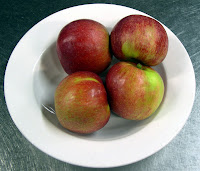
September 1: McIntosh. The Mac is an old stand by and a pretty solid general purpose apple, medium sized and red with the telltale Mac green spot or stripe. You can see these characteristics carry through in the Tydeman's Red and Paula Red above. The Mac is pleasantly sweet and tart with moderately firm flesh and a moderately thick skin. I would like a touch more firmness to the flesh and a thinner skin, but all in all, it's a damn fine eating apple and a solid cooking apple.
September 11: Northern Spy. As you can see, this is a big green, oddly shaped apple with red highlights where the sun has hit it. Northern Spy (also spelled Spie) is a very firm tart apple with greenish flesh and a thin skin. I like it a lot for cider, pies, and for sauce.
September 12: Jonagold. If you couldn't guess from the name, Jonagold is a cross between the Jonathan (see above) and the Golden Delicious (see below). I like Jonathan as an early eating apple while the Golden Delicious is just OK for cooking in that it holds its shape well. Jonagold is just OK for eating out of hand, wanting to go a little soft with age, while it cooks about as well as the Golden Delicious. As you can see, it's a large apple that goes red over green.
September 18: Golden Delicious. What to say about this medium to large yellowish apple with the classic shape that so many people desire? It's fairly crunchy, holds its shape when cooked, and is sweet. Despite its popularity, I find it very one note and sweetly boring.
September 19: Empire. I always smile when I see Empires in the market because they are my eldest daughter's favorites and for good reason. Although they are small red apples with yellow green blushing, they are big on crunch and tartness balanced with sweetness. I like this small apple a lot for eating out of hand, which is not surprising because it is the result of a cross of the McIntosh, a great eating apple, with the Red Delicious.
September 22: Grimes Golden. Discovered in what is now West Virginia around the turn of the 19th century, this oddly-shaped green apple with russet blotching has good green apple flavor, but the texture could be crisper. The skin is a bit tough. It is one of the probable parents of the Golden Delicious.
September 29: Stayman. This good looking red apple often sports vertical streaks and is sweet-tart and very crisp. I enjoy eating it about as much as the Empire, which is a lot. It's often called Stayman Winesap or Stayman's Winesap, but that moniker begs confusion with the Winesap, a much later apple.
October 2: Red Delicious. While there are a lot of Red Delicious grown here for the canning industry, quantity does not make it a good apple. This thick-skinned yellow-fleshed apple tastes very sweet with almost no apple flavor. In its commercial form, it is just not very good, although I have tasted some earlier unimproved Reds that are a lot better than the beautiful tasteless junk that we grow today.
October 2: Cortland. I'm not a fan of this white-fleshed apple with just so-so flavor, especially in light of its thick skin and soft, mealy texture. If you look at the coloration of the apple hanging off the rim of the bowl, you can see the resemblance in this highly colored apple to its McIntosh parent (McIntosh x Ben Davis). In the less highly colored apples, you can see the common vertical striping.
October 10: York. You can recognize this large red apple easily from its roughly trapezoidal cross section. I really like eating and cooking with this all purpose apple. It has good crunch, good sugar, and good acid and probably best of all, it is a great keeping apple and the one that we resort to in March, April, and May while we are waiting for the new crop of Transparents in June. So named because it was discovered in nearby York, PA, this apple holds its shape in cooking well and is a great canner. One of my must have apples.
October 10: Fuji. Fuji is a big seller in Japan where it was developed as a cross between the Red Delicious and the Ralls Genet, an old French apple brought right here to Virginia by Thomas Jefferson. Appeal in the Japanese market stems from its round uniformity and its crunchy sweetness. That said, this apple doesn't interest me much at all. Although I like the crunch, the flavor could use a lot more tartness to be more useful in my kitchen.
October 24: Golden Russet. I wait very patiently all year for the Golden Russets to appear and then I take almost all the production in our local market. Oink. Oink. Some say they're not the prettiest apples with all that russeting, but I find them attractive. This old apple, from the 17th century most likely, is not even all that good to eat out of hand, being fairly mealy with a thick skin. But what it has is an excellent acid and sweetness balance that makes it great for cider and juice. This is one of my go-to cooking apples.
It's really pretty sad that in the nearly 20 years that I have lived here, I have seen orchards succumb to subdivisions and to overseas competition. And because of our idiotic labor laws, I've seen fruit hanging in orchards because we can't get enough labor to pick the apples. The system for bringing in legal migrant labor (mostly from Haiti, it would seem) cannot adjust to real-time needs of a crop that can be unpredictable.
But I guess what irritates me most is that our friends and neighbors labor all year to grow and harvest wonderful local apples and yet our grocery stores stock nothing but apples imported from elsewhere. That, and far too many people are unwilling to seek out the local apples at farmers markets and farm stands.
Are you one of those people who would go to the Mega-Mart and buy a Chinese apple? I'm asking you to reconsider that and support our local growers.
In 2009, I decided to keep a record of when which apples arrived in the local market. This is mainly for my amusement, but it will also better help me plan my menus in the future. These dates are approximate because apples do not always arrive in the market as soon as they are picked. And we grow other varieties such as Macoun, Spitzenburg, and Black Twig that did not make it into the market: 2009 was a bad year for a lot of apples.
June 26: Yellow Transparent. Despite the name, this is a really small light green apple and the earliest of all that we grow around here. It has the classic Golden Delicious shape with the faintest red blush on the top when fully ripe. Because of its burst of green apple malic acid, it's not a great apple for eating out of hand, while for cooking applications, it is very soft, so it is best used for sauce. Its primary distinction is that is early. And that's a good thing, because all our storage apples have been exhausted for a month.
July 14: Lodi. Lodi, as you can see, looks similar to the Yellow Transparent and it seems to be just a bit larger, firmer, and sweeter than the super tart Transparent. Lodi was developed to be a replacement for the Transparent, and even though it is slightly later than the Transparent, it is still a very early apple. I like it a lot better than the Transparent. It is best for pies and sauces and is not a great out of hand eating apple.
July 21: Tydeman's Red. Also known as Tydeman's Early, this apple looks a good bit like its McIntosh parent (x Worcester Pearmain). It's a medium-sized apple, larger than the small Transparent and Lodi, with a good crisp bite. Tydeman's is an OK early apple for eating out of hand, but I'm not crazy for it.
July 25: Summer Rambo. You might think that the name Rambo has something to do with the large size of this apple, but it's just a corruption of the name of this French apple, Rambour or Rombour. So far, it's the tastiest of the early apples. It's a fairly flat and often lopsided apple. As a green apple it is fairly crisp and is OK for eating out of hand. As it ripens, it softens and gets very juicy.
August 7: Ginger Gold. Ginger Gold is a Virginia apple, having been found as a sport in Nelson County after the devastation caused by Hurricane Camille in 1969. It looks a bit like its Golden Delicious parent (a probable cross with Albemarle Pippin and an unknown third apple). While it is well known around here as the best early eating apple and a yellow summer apple that tastes like a fall apple, Ginger Gold is primarily an early commercial canning apple. This is the first apple of the season that I will go out of my way to eat, being crisp, sweet, and tart. It also resists oxidizing fairly well, so is well suited to the restaurant kitchen where we have to worry about browning.
August 11: Paula Red. A mutation of the venerable MacIntosh, the Paula Red looks like the Mac and favors the Tydeman's Red, which also descends from the Mac. I like the flavor, but the texture is a bit soft for eating out of hand, so I like it better for sauce. Still, Paula's a solid summer apple with good acidity and sweetness, leaning to the tart side like a good fall apple. This apple doesn't keep all that well. It gets softer as it ages, so eat up.
August 15: Gala. Gala is a really small apple that is very firm and crisp and pretty distinctive in the market because of its yellow-orange cast. Sadly, it tastes only sweet and doesn't have that good acid necessary for balance, so I find it tiring to eat. If we could cross the firm texture of the Gala with the great acidity of the Paula Red, we'd have a fantastic summer apple!
August 15: Golden Supreme. This big apple looks like a Golden Delicious, but the flavor is not as good, though the texture is better. I find the very thick skins obnoxious for eating out of hand. This apple works very well, however, for cooking. The flavor is nothing special so it's best relegated to an early season pie and cooking apple.
August 25: Jonathan. Related to Esopus Spitzenburg, the Jonathan is a commonly grown apple in Virginia, being one of the first good red apples to market. Sweeter than it is tart, the Jonathan appeals less to me than the McIntosh, but it's a solid week earlier to market than the Mac. Jonathan is round and red with a fairly thin skin and it eats well out of hand, as I am demonstrating as I type. Also a good cooking apple.
September 1: McIntosh. The Mac is an old stand by and a pretty solid general purpose apple, medium sized and red with the telltale Mac green spot or stripe. You can see these characteristics carry through in the Tydeman's Red and Paula Red above. The Mac is pleasantly sweet and tart with moderately firm flesh and a moderately thick skin. I would like a touch more firmness to the flesh and a thinner skin, but all in all, it's a damn fine eating apple and a solid cooking apple.
September 11: Northern Spy. As you can see, this is a big green, oddly shaped apple with red highlights where the sun has hit it. Northern Spy (also spelled Spie) is a very firm tart apple with greenish flesh and a thin skin. I like it a lot for cider, pies, and for sauce.
September 12: Jonagold. If you couldn't guess from the name, Jonagold is a cross between the Jonathan (see above) and the Golden Delicious (see below). I like Jonathan as an early eating apple while the Golden Delicious is just OK for cooking in that it holds its shape well. Jonagold is just OK for eating out of hand, wanting to go a little soft with age, while it cooks about as well as the Golden Delicious. As you can see, it's a large apple that goes red over green.
September 18: Golden Delicious. What to say about this medium to large yellowish apple with the classic shape that so many people desire? It's fairly crunchy, holds its shape when cooked, and is sweet. Despite its popularity, I find it very one note and sweetly boring.
September 19: Empire. I always smile when I see Empires in the market because they are my eldest daughter's favorites and for good reason. Although they are small red apples with yellow green blushing, they are big on crunch and tartness balanced with sweetness. I like this small apple a lot for eating out of hand, which is not surprising because it is the result of a cross of the McIntosh, a great eating apple, with the Red Delicious.
September 22: Grimes Golden. Discovered in what is now West Virginia around the turn of the 19th century, this oddly-shaped green apple with russet blotching has good green apple flavor, but the texture could be crisper. The skin is a bit tough. It is one of the probable parents of the Golden Delicious.
September 29: Stayman. This good looking red apple often sports vertical streaks and is sweet-tart and very crisp. I enjoy eating it about as much as the Empire, which is a lot. It's often called Stayman Winesap or Stayman's Winesap, but that moniker begs confusion with the Winesap, a much later apple.
October 2: Red Delicious. While there are a lot of Red Delicious grown here for the canning industry, quantity does not make it a good apple. This thick-skinned yellow-fleshed apple tastes very sweet with almost no apple flavor. In its commercial form, it is just not very good, although I have tasted some earlier unimproved Reds that are a lot better than the beautiful tasteless junk that we grow today.
October 2: Cortland. I'm not a fan of this white-fleshed apple with just so-so flavor, especially in light of its thick skin and soft, mealy texture. If you look at the coloration of the apple hanging off the rim of the bowl, you can see the resemblance in this highly colored apple to its McIntosh parent (McIntosh x Ben Davis). In the less highly colored apples, you can see the common vertical striping.
October 10: York. You can recognize this large red apple easily from its roughly trapezoidal cross section. I really like eating and cooking with this all purpose apple. It has good crunch, good sugar, and good acid and probably best of all, it is a great keeping apple and the one that we resort to in March, April, and May while we are waiting for the new crop of Transparents in June. So named because it was discovered in nearby York, PA, this apple holds its shape in cooking well and is a great canner. One of my must have apples.
October 10: Fuji. Fuji is a big seller in Japan where it was developed as a cross between the Red Delicious and the Ralls Genet, an old French apple brought right here to Virginia by Thomas Jefferson. Appeal in the Japanese market stems from its round uniformity and its crunchy sweetness. That said, this apple doesn't interest me much at all. Although I like the crunch, the flavor could use a lot more tartness to be more useful in my kitchen.
October 24: Golden Russet. I wait very patiently all year for the Golden Russets to appear and then I take almost all the production in our local market. Oink. Oink. Some say they're not the prettiest apples with all that russeting, but I find them attractive. This old apple, from the 17th century most likely, is not even all that good to eat out of hand, being fairly mealy with a thick skin. But what it has is an excellent acid and sweetness balance that makes it great for cider and juice. This is one of my go-to cooking apples.
Friday, November 6, 2009
A Fall Chef's Tasting
I really love composing and cooking tasting menus for a lot of reasons. In building a cohesive menu from scratch, I have a strong sense of engagement and I enjoy and welcome the intellectual challenge. Also, I get out of the rut of cooking the same old crab cakes and filets mignons that pay our rent month in and month out. And I enjoy cooking for people who are willing to have their palates challenged. This frees me to not only show off the bounty of local ingredients with which we are blessed to work, but it also lets me serve delicious things that wouldn't sell well on the main menu, and it lets me experiment to a certain extent by taking some risks that I wouldn't under normal dinner circumstances. Did I also mention that this is how I like to eat? When I go out, I just want the chef to send out small bites every 20 minutes or so.
A lot of restaurants have tasting menus and many of them run a tasting menu for a fixed period of time, such as a week or a month or a season. Each tasting menu that we do is custom designed for a particular client. Even if we are doing tasting menus for multiple parties simultaneously, they will be having different menus. Admittedly it's a crazy way to run a restaurant, but then my sanity escaped to the ether some years back. But in this way, the cooking is very personal. I am cooking for a specific client and not just for anybody who walks in off the street and happens to order the tasting menu.
I don't post many of the Chef's Tastings that we do simply for lack of photographs. It's often too busy to photograph our work or because we're in a rush, photos for a certain course just do not turn out. Shooting macro shots by handholding in a busy kitchen on reflective stainless steel tables under really crappy fluorescent lighting is somewhat short of ideal, especially when I brace the camera against the table and someone down the line hip checks the table at the same time I'm shooting.
But the pace and karma Saturday night all aligned perfectly and I got some good shots, good enough for blogging, at least. Not great, but good enough considering the terrible lighting. They follow below.
I was pleased that the clients actually encouraged me to pair this menu with Virginia wines. Often I have to cajole some clients into letting me show off some of our local wines. The following is a highly seasonal menu, one that screams late fall, exactly what I was aiming for:
Crème Brûlée of Mapled Foie Gras. This dish started with a lobe of foie in the cooler that I needed to use and with the local Chrysalis Petit Manseng that I wanted to serve. Americans seem always to want the sweet wines at the end of dinner instead of as an aperitif, so I wanted to buck that by serving the sweet wine up front. I wanted to add some sweetness to the dish to work with the wine and initially I was thinking about brûléeing a slice of foie, and from there it wasn't a huge leap to crème brûlée. The maple syrup was almost an afterthought, mainly a liaison with the maple leaf garnish on the plate. To offset some of the richness, we just barely poached fresh cranberries in simple syrup. We served this warm out of the oven and I have to say that it was a brilliant dish.
Fan of Tataki of Opah and Local Daikon. I had a really clear piece of Opah that I wanted to feature and the first local daikon of the year just arrived in the farmer's market the morning of the tasting. I put a slight pickle on the daikon, for a salty and acidic counterpoint to the barely seared Opah. The flavor combination of the two and the texture contrast between the two were fine, but in the end, I'm not crazy about this dish or the presentation.
Stone Crab Claws. Stone crab season just opened so I wanted to celebrate that with this dish. I feel like I went out on a limb here a little putting stone crab claws on a parsnip purée. Garnishes are a vanilla beurre blanc and salad burnet. I felt the combination of the slightly sweet and herbal parsnip worked amazingly well with the vanilla and the crab. This dish is a winner and visually appealing too.
Veal and Rabbit Terrine. This is another one of my terrines; there's always one in the cooler. While I generally don't use liver in my terrines (because of knee-jerk customer reaction), I used the livers out of four rabbits along with a good splash of cream to bind this terrine. A touch of Cognac doesn't hurt either. Interior garnishes are black truffles, pistachios, dried cranberries, veal tongue, green peppercorns, and rabbit loin. Really a very tasty effort. I opted for the artsy photograph here so the interior garnish is tough to see; pity. In the foreground you see that our nasturtiums haven't given up the ghost yet and in the background you see the last of the local cucamelons, lightly pickled.
Local Lamb Ribs in the Style of Peking Duck. Selling ribs in a fine dining restaurant is an exercise in futility, a real pity because they are so good. We have to sell the ribs somehow, so they most often end up on tasting menus. I am a huge fan of braised dishes (slow-cooked with a little liquid) and especially of the style called red cooking from northern China. We rubbed the lamb ribs in garlic and five-spice powder and braised them with soy sauce, white wine, brown sugar, hoisin sauce, star anise, cinnamon, ginger, garlic, and green onions, then let the ribs stand in the braising liquid overnight. We pulled the rib meat and minced it, defatted the braising liquid and reduced it slightly (soy is very salty!), augmented the braising liquid with a little hoisin and sesame oil to make a sauce, then mixed the minced lamb with the sauce, bias-cut green onions, and white sesame seeds. We then brushed a crêpe with the sauce and stuffed it with the minced lamb. This is absolutely delicious and much more flavorful than duck done the same way.
Lightly Grilled Caribou Tenderloin. Caribou is a mild and delicious deer that under the best of circumstances is difficult to obtain, so I was happy to be able to get a little bit for this tasting. This dish is all about fall: lightly grilled caribou over a nest formed from local spigarello (a leaf broccoli) and filled with a sauté of just-dug Jerusalem artichokes and fresh matsutake mushrooms from Oregon. We finished this with a few dried blueberries and a demiglace augmented with local elderberry syrup and black truffles.
A Study in Local Apples. I'd be really remiss here in the heart of Virginia's apple country not to do a dessert of local apples. I had wanted to do a separate cheese course, but the menu was starting to get a little long so we combined the dessert and cheese courses into a single course. Cheese and apples, especially apple pie, is a natural combination at least in the school of traditional southern cooking in which I was raised. A big slice of sharp Cheddar (rat cheese as we called it) was a must with apple pie.
When I was at the farmers market on Tuesday last week, I was getting some green tomatoes for fried green tomatoes. In the next bin were some green apples causing me to flash on fried green apples. I did an instant market survey ("Hey, what do y'all think of fried green apples as a dessert course?") and the conclusion was that it couldn't be bad, so I came back to the restaurant where Chris and I started to experiment with apple thickness, coatings, and seasonings. After a half a dozen samples we got it right. You see fried green apple under the cheese and the crêpe in the photo above. We removed the core of the apple and plugged it with a piece of apple so that the whole would be edible.
On the plate from left to right you see apple compote (Golden Russet apples) cooked down with local honey and kaffir lime, topped with a blade of vanilla grass. Then the fried green apple with the cheese wedge. The crêpe holds wedges of Empire apples roasted with honey and cinnamon, along with grated cheese. The crepe was warmed in the oven to melt the cheese, then topped with a bit more cheese. Under the fried green tomato you see a syrup that we make by straining and reducing local cider until it is syrupy. On the far right, you see a small serving of apple granita, made from 8 varieties of apples and almost no sugar. I'm really happy with the flavors, but the presentation is a bit monochromatic.
Local Apple Cider-Calvados “Martini”. I didn't want another dessert wine with this menu (remember, we started with one) and I had a couple gallons of local cider on hand in the cooler, so I mixed up a cocktail of cider, Calvados, lemon juice, vanilla syrup, and some bitters. The glass is rimmed with cinnamon sugar. The apple slice is from a sweet Fuji; the cider is naturally sweet so a tart apple would have been unpleasantly mouth puckering.
A lot of restaurants have tasting menus and many of them run a tasting menu for a fixed period of time, such as a week or a month or a season. Each tasting menu that we do is custom designed for a particular client. Even if we are doing tasting menus for multiple parties simultaneously, they will be having different menus. Admittedly it's a crazy way to run a restaurant, but then my sanity escaped to the ether some years back. But in this way, the cooking is very personal. I am cooking for a specific client and not just for anybody who walks in off the street and happens to order the tasting menu.
I don't post many of the Chef's Tastings that we do simply for lack of photographs. It's often too busy to photograph our work or because we're in a rush, photos for a certain course just do not turn out. Shooting macro shots by handholding in a busy kitchen on reflective stainless steel tables under really crappy fluorescent lighting is somewhat short of ideal, especially when I brace the camera against the table and someone down the line hip checks the table at the same time I'm shooting.
But the pace and karma Saturday night all aligned perfectly and I got some good shots, good enough for blogging, at least. Not great, but good enough considering the terrible lighting. They follow below.
I was pleased that the clients actually encouraged me to pair this menu with Virginia wines. Often I have to cajole some clients into letting me show off some of our local wines. The following is a highly seasonal menu, one that screams late fall, exactly what I was aiming for:
Chef's Tasting
Saturday, October 31, 2009
Crème Brûlée of Mapled Foie Gras
poached cranberries, bread crisp
Chrysalis Petit Manseng Virginia 2007
------
Fan of Tataki of Opah and Local Daikon
lemon zest, fleur de sel
White Hall Viognier Virginia 2007
------
Stone Crab Claws
parsnip purée, vanilla bean beurre blanc, salad burnet
Glen Manor Sauvignon Blanc Virginia 2008
------
Veal and Rabbit Terrine
quick-pickled local cucamelons; whole grain honey mustard
Swedenburg Pinot Noir Virginia 2008
------
Local Lamb Ribs in the Style of Peking Duck
Fabbioli Chambourcin Virginia 2007
------
Lightly Grilled Caribou Tenderloin
duck fat-sautéed matsutake mushrooms and sunchokes; dried blueberries; elderberry and truffle demiglace; local organic spigarello
Linden Claret Virginia 2005
------
A Study in Local Apples
Cheesy apple crêpe, apple granita, apple-kaffir lime compote, fried green apple with apple cider reduction; Kerrygold Ivernia cheese
Local Apple Cider-Calvados “Martini”
Saturday, October 31, 2009
Crème Brûlée of Mapled Foie Gras
poached cranberries, bread crisp
Chrysalis Petit Manseng Virginia 2007
------
Fan of Tataki of Opah and Local Daikon
lemon zest, fleur de sel
White Hall Viognier Virginia 2007
------
Stone Crab Claws
parsnip purée, vanilla bean beurre blanc, salad burnet
Glen Manor Sauvignon Blanc Virginia 2008
------
Veal and Rabbit Terrine
quick-pickled local cucamelons; whole grain honey mustard
Swedenburg Pinot Noir Virginia 2008
------
Local Lamb Ribs in the Style of Peking Duck
Fabbioli Chambourcin Virginia 2007
------
Lightly Grilled Caribou Tenderloin
duck fat-sautéed matsutake mushrooms and sunchokes; dried blueberries; elderberry and truffle demiglace; local organic spigarello
Linden Claret Virginia 2005
------
A Study in Local Apples
Cheesy apple crêpe, apple granita, apple-kaffir lime compote, fried green apple with apple cider reduction; Kerrygold Ivernia cheese
Local Apple Cider-Calvados “Martini”
Crème Brûlée of Mapled Foie Gras. This dish started with a lobe of foie in the cooler that I needed to use and with the local Chrysalis Petit Manseng that I wanted to serve. Americans seem always to want the sweet wines at the end of dinner instead of as an aperitif, so I wanted to buck that by serving the sweet wine up front. I wanted to add some sweetness to the dish to work with the wine and initially I was thinking about brûléeing a slice of foie, and from there it wasn't a huge leap to crème brûlée. The maple syrup was almost an afterthought, mainly a liaison with the maple leaf garnish on the plate. To offset some of the richness, we just barely poached fresh cranberries in simple syrup. We served this warm out of the oven and I have to say that it was a brilliant dish.
Fan of Tataki of Opah and Local Daikon. I had a really clear piece of Opah that I wanted to feature and the first local daikon of the year just arrived in the farmer's market the morning of the tasting. I put a slight pickle on the daikon, for a salty and acidic counterpoint to the barely seared Opah. The flavor combination of the two and the texture contrast between the two were fine, but in the end, I'm not crazy about this dish or the presentation.
Stone Crab Claws. Stone crab season just opened so I wanted to celebrate that with this dish. I feel like I went out on a limb here a little putting stone crab claws on a parsnip purée. Garnishes are a vanilla beurre blanc and salad burnet. I felt the combination of the slightly sweet and herbal parsnip worked amazingly well with the vanilla and the crab. This dish is a winner and visually appealing too.
Veal and Rabbit Terrine. This is another one of my terrines; there's always one in the cooler. While I generally don't use liver in my terrines (because of knee-jerk customer reaction), I used the livers out of four rabbits along with a good splash of cream to bind this terrine. A touch of Cognac doesn't hurt either. Interior garnishes are black truffles, pistachios, dried cranberries, veal tongue, green peppercorns, and rabbit loin. Really a very tasty effort. I opted for the artsy photograph here so the interior garnish is tough to see; pity. In the foreground you see that our nasturtiums haven't given up the ghost yet and in the background you see the last of the local cucamelons, lightly pickled.
Local Lamb Ribs in the Style of Peking Duck. Selling ribs in a fine dining restaurant is an exercise in futility, a real pity because they are so good. We have to sell the ribs somehow, so they most often end up on tasting menus. I am a huge fan of braised dishes (slow-cooked with a little liquid) and especially of the style called red cooking from northern China. We rubbed the lamb ribs in garlic and five-spice powder and braised them with soy sauce, white wine, brown sugar, hoisin sauce, star anise, cinnamon, ginger, garlic, and green onions, then let the ribs stand in the braising liquid overnight. We pulled the rib meat and minced it, defatted the braising liquid and reduced it slightly (soy is very salty!), augmented the braising liquid with a little hoisin and sesame oil to make a sauce, then mixed the minced lamb with the sauce, bias-cut green onions, and white sesame seeds. We then brushed a crêpe with the sauce and stuffed it with the minced lamb. This is absolutely delicious and much more flavorful than duck done the same way.
Lightly Grilled Caribou Tenderloin. Caribou is a mild and delicious deer that under the best of circumstances is difficult to obtain, so I was happy to be able to get a little bit for this tasting. This dish is all about fall: lightly grilled caribou over a nest formed from local spigarello (a leaf broccoli) and filled with a sauté of just-dug Jerusalem artichokes and fresh matsutake mushrooms from Oregon. We finished this with a few dried blueberries and a demiglace augmented with local elderberry syrup and black truffles.
A Study in Local Apples. I'd be really remiss here in the heart of Virginia's apple country not to do a dessert of local apples. I had wanted to do a separate cheese course, but the menu was starting to get a little long so we combined the dessert and cheese courses into a single course. Cheese and apples, especially apple pie, is a natural combination at least in the school of traditional southern cooking in which I was raised. A big slice of sharp Cheddar (rat cheese as we called it) was a must with apple pie.When I was at the farmers market on Tuesday last week, I was getting some green tomatoes for fried green tomatoes. In the next bin were some green apples causing me to flash on fried green apples. I did an instant market survey ("Hey, what do y'all think of fried green apples as a dessert course?") and the conclusion was that it couldn't be bad, so I came back to the restaurant where Chris and I started to experiment with apple thickness, coatings, and seasonings. After a half a dozen samples we got it right. You see fried green apple under the cheese and the crêpe in the photo above. We removed the core of the apple and plugged it with a piece of apple so that the whole would be edible.
On the plate from left to right you see apple compote (Golden Russet apples) cooked down with local honey and kaffir lime, topped with a blade of vanilla grass. Then the fried green apple with the cheese wedge. The crêpe holds wedges of Empire apples roasted with honey and cinnamon, along with grated cheese. The crepe was warmed in the oven to melt the cheese, then topped with a bit more cheese. Under the fried green tomato you see a syrup that we make by straining and reducing local cider until it is syrupy. On the far right, you see a small serving of apple granita, made from 8 varieties of apples and almost no sugar. I'm really happy with the flavors, but the presentation is a bit monochromatic.
Local Apple Cider-Calvados “Martini”. I didn't want another dessert wine with this menu (remember, we started with one) and I had a couple gallons of local cider on hand in the cooler, so I mixed up a cocktail of cider, Calvados, lemon juice, vanilla syrup, and some bitters. The glass is rimmed with cinnamon sugar. The apple slice is from a sweet Fuji; the cider is naturally sweet so a tart apple would have been unpleasantly mouth puckering.
Friday, August 14, 2009
Cape Gooseberry
This week I ordered a bunch of mixed cherry tomatoes from my favorite local organic farm and as I was unpacking the crate of tomatoes, I spied a pint of husked groundcherries, looking for all the world like miniature golden tomatillos. I was pleasantly suprised because if I were growing groundcherries, I'd be telling all my chefs that I had them and not just throwing them in with mixed cherry tomatoes. I was also very surprised because I love the tasty little nickel-sized treats.Groundcherry is the generic name for most of the small fruits of the Physalis genus, excluding the larger ones such as tomatillos/tomates verdes (P. philadelphica). I wasn't sure which ones I had received, not really being well versed in Physalis taxonomy, but once I tasted the caramelized pineapple brûlée custard flavor, I was pretty certain that these little guys are the groundcherries known as Cape Gooseberries (P. peruviana).
These little fruits are extremely versatile. I use them in fruit salads, salsas, cobblers, flambéed over coconut sorbet, in mixed tomato dishes, in trifles, and in dozens of other applications, both sweet and savory.
As versatile as cape gooseberries are, these will no doubt be relegated to that most mundane of uses: the chef snack! Ah, sometimes it's good to be king!
Friday, August 7, 2009
A Peach is a Beautiful Thing
About 7 or 8 years ago, I started seeing these flat peaches for sale in the local area. Being the sort to adopt any stray produce with which I am not acquainted, I brought a bunch of these peaches home to try, after first inquiring what they were called. I was told that they are called Saturn peaches, after the rings of that particular planet. I've since learned that they are also called doughnut peaches, for obvious enough reasons.I can tell you from a vast amount of personal experimentation on the subject that a tree-ripened Saturn is an ambrosial, juicy delight. These may be the juiciest peaches I've ever had the pleasure of letting dribble down my chin! I've had them in both yellow and white flesh, the preponderance being white. They have very thin skins, making them difficult to transport, and almost no fuzz, making them a joy to eat out of hand without peeling. Of course, I've never let a little fuzz stand between me and any peach. And they are freestone to boot.
Thanks to our friends at Rutgers (anyone remember the old light pink to orange Rutgers tomatoes?), more and more Saturns are finding their way to market. The breeders at Rutgers developed a tree that is more cold tolerant than its Chinese parents, allowing peach growers in most areas of the US to grow this wonderful peach.
And wonderful it is. I really really love this peach and that is saying something because I really really love peaches and this one stands out head and shoulders above most of them. They are best tree ripened and those you find in the grocery store were picked green, of necessity, because of their thin skins. Look for Saturn peaches at a farmers market near you. You will thank me.
Subscribe to:
Posts (Atom)