
 |
| Sockeye, Squash, and Tomatoes |
Showing posts with label squash. Show all posts
Showing posts with label squash. Show all posts
Saturday, August 3, 2013
Sockeye, Squash, and Tomatoes


Friday, August 17, 2012
Vegetarian Wine Dinner
Each August, we hold our annual Harvest Dinner to celebrate the hard work of Beth and Gene Nowak at Mayfair Farm. Beth and Gene supply the vast majority of produce to the restaurant and this is our way of saying "Thank you!" for all that they do for us and for our community. The dinner is made, as much as is feasible, exclusively from products from their farm. And because they produce no meat, the dinner is vegetarian.
This year, our dinner was almost entirely vegan although that wasn't a criterion in designing the menu. It was an artifact of our taking a tour through Asia with our dishes. This was our seventh Harvest Dinner and after working with the same vegetables and fruits each August with the same American/Western European mindset, we needed to do something entirely different. And so we embarked on a tour of Asia.
Filipino Melon Soup with Lumpia. The soup is made from cantaloupe and cucumber and seasoned with a few aromatics and a touch of chile. The lumpia are filled with a mixture of red and green cabbage, onions, green onions, and carrots seasoned with soy sauce.
Vegetable Satay with Peanut Sauce. We marinated strips of eggplants, yellow squash, and green squash in soy sauce and garlic, then grilled them. When cool, we threaded them on skewers in the manner of satay. The plate is finished with a peanut sauce (natural peanut butter, hot water, soy sauce, garlic, ginger, sambal oelek, palm sugar, and a lot of lime juice to balance).
Grilled Eggplant Bánh Mì. We decided since we were doing tasting portions for a crowd to build our bánh mì on grilled focaccia for ease of handling. The large eggplants were sliced; marinated in a slurry of kaffir lime, Thai basil, cilantro, ginger, and garlic; then grilled. We have developed our own style of dressing bánh mì: we first brush the bread with the same slurry that we marinated the eggplant in and then we drizzle the bread with a sweet and spicy chile sauce that we make in house. The layers are pretty traditional: cucumbers, lots of cilantro, and carrots. We don't pickle our carrots in any way.
Soba. One of the beautiful things that we got from Beth was a haul of cheese pimientos, red peppers so called because pre-annato they were used to color orange cheese. Another was some really pretty broccoli. For some reason, they both triggered visions of soba in my head. So here we have buckwheat noodles, green onions, peanuts, broccoli, cheese pimientos, and white sesame seeds in a dressing of rice vinegar, soy sauce, ginger, garlic, and sesame oil.
Green Thai Curry. Curries are never beautiful dishes, but they are so fragrant and so delicious. We made a classic Thai fried rice by first frying a shallot-cilantro-Thai basil paste in oil and then frying the vegetables and rice. Then we added egg to the cool fried rice and made rice cakes from that, cakes that we subsequently re-fried. On top is a curry of a eggplant, squash, the broccoli stems from making the soba, yellow peppers, and cherry tomatoes. The curry paste we made very heavy on kaffir lime both for color and for fragrance. We finished the curry with huge handfuls of cilantro and Thai basil leaves. The tricky part of this dish, because it is vegetarian, was getting the flavor just right without the use of fish sauce.
Plum Clafoutis. This is another in a series of experiments in making gluten- and dairy-free desserts. To give our clafoutis an Asian feel, we made it with rice flour and coconut milk. Quite delicious if I do say so myself and really wonderful when paired with an Orvieto Amabile.
This year, our dinner was almost entirely vegan although that wasn't a criterion in designing the menu. It was an artifact of our taking a tour through Asia with our dishes. This was our seventh Harvest Dinner and after working with the same vegetables and fruits each August with the same American/Western European mindset, we needed to do something entirely different. And so we embarked on a tour of Asia.
 |
| Melon Soup with Lumpia |
 |
| Vegetable Satay with Peanut Sauce |
 |
| Building the Eggplant Bánh Mì |
 |
| Eggplant Bánh Mì |
 |
| Soba |
 |
| Green Vegetable Curry on Thai Fried Rice Cake |
 |
| Plum Clafoutis |
Saturday, June 9, 2012
Chef's Tasting
Here are photos from last night's Chef's Tasting. Appearing for the first time this year are cherries, summer squash, sockeye salmon, new potatoes, and red raspberries. This is likely the very last tasting of the year to feature strawberries and asparagus: only the weather knows for sure.
This dish is the happy coincidence of foie gras and duck eggs. You know, the late afternoon, between shifts conversation on the deck that goes like, "What happens if we mix foie gras into a deviled egg?" The result is so rich that it can only be eaten in tiny quantities. Notice the relative size of the cornichon fan to the egg-foie mousse. We kept adding more and more pickle brine to the mousse to balance the fat and the acid. The olive-looking critter in the center is a truffled pickled immature peach.
Over the years, I have done many takes on a dish of salmon and Thai curry and this is another. The sauce is a green Thai curry and the green dots are a curried avocado mousse. In the center of the plate are cubes of deep-fried salmon and avocado, topped with some tobiko for crunch and a little Thai basil.
Not much to say here except the salad is awesome. It's a mix of Beth's mesclun, bean sprouts, carrots, Thai basil, cilantro, and green onions tossed in a dressing of vinegar, sugar, lime juice, fish sauce, chile paste, and garlic. Very Vietnamese and very cooling and refreshing.
Gorgeous! The first new potatoes of the year down in a ring with grilled asparagus over and then topped with a sauté of peas, asparagus, and morels in a white wine and shallot butter sauce. A quail egg gilds the lily. These peas are so amazingly sweet that we probably ate more than half of what we shelled. They are addictive!
This is a quick taste of summer in an otherwise late spring menu. Because of our crazy spring, everything is running 2-3 weeks early, including these awesome pattypan squash that we sliced, grilled, and stacked with rounds of fried goat cheese. The goat cheese is an amazingly creamy product that was made locally on Wednesday (and served on Friday). We mixed it with roasted red pepper before forming it into rounds and breading it. A drizzle of pesto and some borage blossoms complete the garnishes.
We love cherry season! Sorry this photo is so dark. All hell was breaking loose in the kitchen at the time: the dining room was full and our ticket rail was overflowing onto the counter. We were in hyperdrive, which lends itself not at all to decent photography. On the left there is a pork cheek, braised, chilled, sliced, and crisped in a steel pan, topped with a cherry-celery salsa. Cherries and celery, sweet and bitter, yin and yang, awesome! In the center on top of the grits is a piece of our pork belly topped with the remains of our dried cherry olivada, a tapenade-like relish. On the right is a salad of microgreens and pork confit threads. We cure the pork confit and age it under duck fat. For this dish, we shredded it and deep fried it, then mixed it with greens and tossed it in a cherry vinaigrette. All our pork is certified Berkshire.
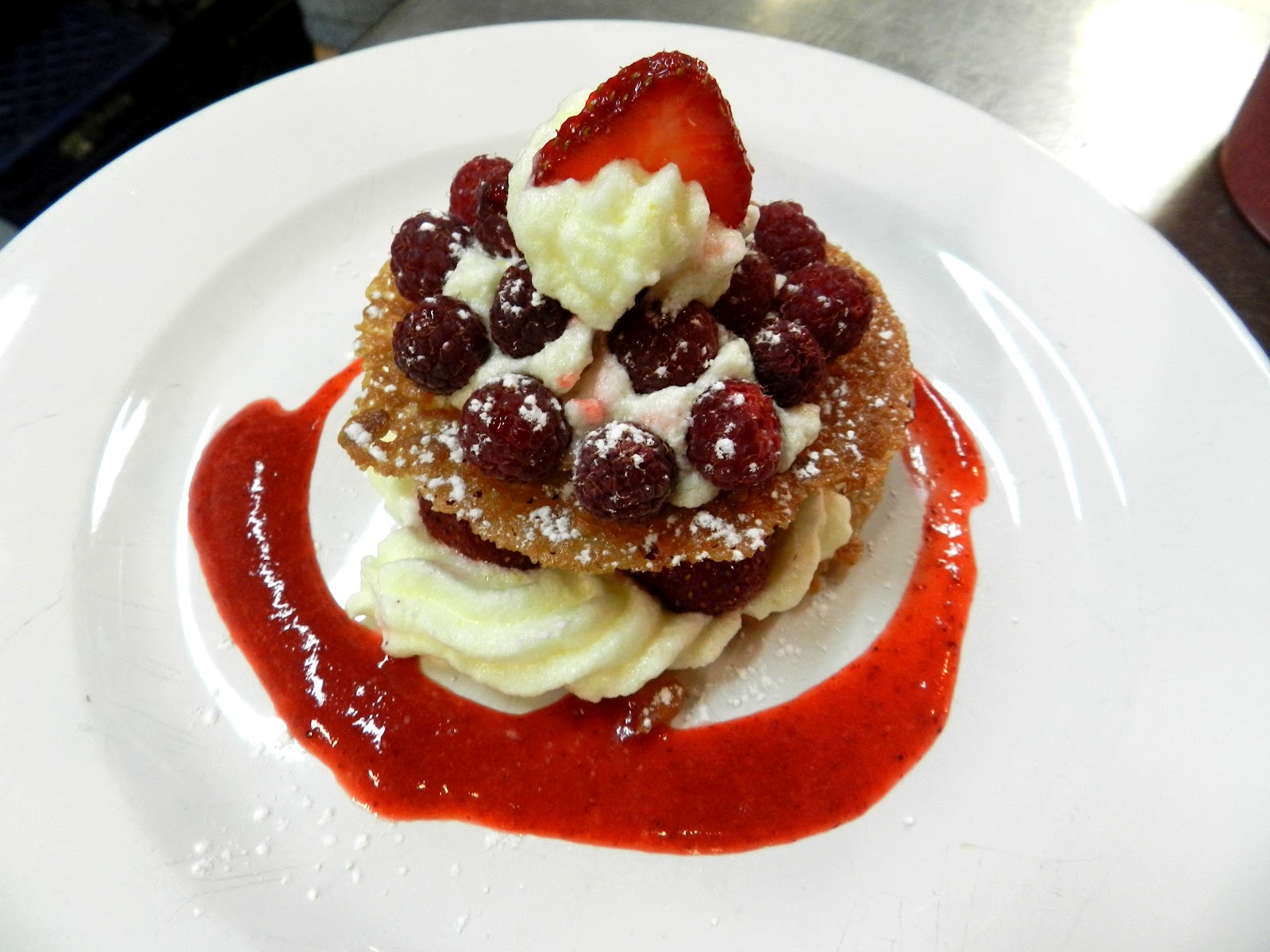
This is a fun and light way to celebrate the end of strawberries and the beginning of raspberries. Their seasons only ever overlap for a week or two. I baked some oatmeal tuiles and layered them with a lemon meringue and fresh berries. Simple, light, and a fitting ending to a late spring menu.
 |
| Deviled Egg |
 |
| Sockeye Salmon |
 |
| Soft Shell Crab |
 |
| June Salad |
 |
| Squash and Goat Cheese |
 |
| Pork and Cherries |
 |
| Berries |
Saturday, January 28, 2012
Vegetarian Chef's Tasting
This is a tale about letting go.
Last evening, we cooked a 5-course vegetarian tasting on a relatively slow Friday night, slow enough to let me take photos, something that I was unable to do all during the fall when we were so busy.
I was really happy to have this opportunity to do a vegetarian menu. Getting away from the meat-centric menu really frees my mind, removes constraints about how dishes are usually prepared, and gives me freedom to just do what I am feeling.
I loved each and every dish on this menu and I think we did a great job of putting the ingredients that we have now in dead winter on a plate in a creative and inviting and (most importantly) delicious manner.
While we were very pleased with the end result, the journey in getting there wasn't all that simple. Some menus just write themselves; this one did not. Over the past few years of designing menus, we have come to understand that simplicity is better than complexity, flavor trumps presentation, and if it doesn't feel right, it isn't. In short, we've learned to let go of pet ideas if they don't fit. There's always another day, another menu, another opportunity to try out that new idea.
A potato cake. This menu almost got derailed by a simple potato cake. For some reason, the Ecuadoran potato cake called the llapingacho insinuated itself into my conscious brain and wouldn't let go. From there, it was an easy enough leap to a full Ecuadoran menu. Over five or six days of brainstorming, we found ourselves putting dishes on the menu simply because they were Ecuadoran, not because they highlighted our local ingredients and not because we had a flavor profile that we were trying to express in a finished dish. This is not the way to design a successful menu. If a dish doesn't speak to you as a chef, discard it and move on.
I finally heeded the warning bells that were gently dinging in the back of my brain and punted the whole Ecuadoran menu save for the llapingachos that sent us off seeking the elusive red herring. At this point, we freed ourselves to get back to highlighting our local ingredients such as Jerusalem artichokes, rapini, and Fairy Tale squash.
As the menu started forming, all of us collectively said about the same time, "I'm not feeling the peanut sauce on the potato cakes." So we struck the traditional peanut sauce and that freed us to strike the rest of the Ecuadoran seasoning (achiote and cilantro) and just to retain that singular characteristic of the llapingacho that makes it stand out in the world's pantheon of potato cakes: the grated cheese in the cake itself.
And that is the lesson to take from this menu: learning to let go is hard but necessary. Don't force it. Keep it simple and distill it to its essence. Feel it and do it.
And now on to the photos.
 Jerusalem Artichoke Soup. We have a super abundance of Jerusalem artichokes in our cooler just now and they are a natural for soup. They bring an almost inimitable silky appealing texture to soup. The downside is that they can bring a dull and listless grey color to the party as well. To mask this, we added a tiny bit of roasted red pepper for an orange hue, but not enough to flavor the soup. Too much of a silky soup can really bore your tastebuds, so we had to bring some acid to the party, which we did in the form of a roasted red pepper and goat cheese mousse. The acidic goat cheese is just the thing to keep your palate refreshed. Paired with a lemony Spanish Albariño.
 Yukon Gold and Two Onion Potato Cakes. Here are the llapingachos that started this whole menu, made from local Yukon golds with a grated three-milk (goat, sheep, and cow) cheese, green onions, and caramelized onions. To reiterate the cheese, we have sauced these cakes with a warm cheese and beer sauce, using the same cheese as in the potato cakes and a very hoppy amber ale to give the cheese sauce a touch of hoppy bitterness to keep it from being cloying. The green sauce is a green onion cream that brings a cool acid bite to counterpose the rich cheese sauce. Paired with Chilean Pinot Noir. This could have easily paired with a white wine, but the customer's preference is red wine.
 French Onion Soup Bruschetta. Not really sure where this dish came from except that we were probably cold on the day that we brainstormed this and wanted soup to warm us up. This is an exercise in reimagining a classic soup. We took the soup and puréed it to become the sauce for the plate and put the onions on top of the croustade rather than under it. High cuisine? Not. Delicious? You bet. Paired with a medium-bodied, lower acidity Willamette Pinot from Yamhill-Carlton.
 Rapini "Wellington." Again, I don't remember the genesis of this dish. With three of us throwing ideas at the wall and seeing what sticks, creating dishes is a very crazy process. In any case, we decided to showcase our beautiful local rapini as a quasi-Wellington. I learned long ago that wrapping wet ingredients in puff pastry is a big fail, so we baked the puff separately and then topped it with the lightly bitter rapini, a duxelles of black trumpet mushrooms, and then a bit of herbed soft cheese to help marry the spicy earthiness of the mushrooms with the vegetal bitterness of the rapini. In the South, we always serve vinegar with our braised greens. The plate sauce of porcini stock and balsamic vinegar finished with a hint of cream (to round out the vinegar's tang) is a nod to that. Paired with a very high end Argentine Malbec.
 Fairy Tale Squash Flan. Eat your vegetables! There's probably no more sinful way to eat your squash than as a silky flan flavored with cinnamon and maple syrup, and garnished with gianduia, crème anglaise, maple syrup, gianduia powder, a chocolate cigarette, crispy salted phyllo, and a pumpkinseed brittle flavored with pimentón and sea salt. Paired with a 10-year old tawny Port.
Wednesday, November 23, 2011
Chef's Tasting
Here are photos from a series of recent tastings. These dishes pretty clearly reflect what is in the farmers market currently. I really like how we were able to incorporate root vegetables in so many dishes. It happened organically as a function of what we have on hand (and on the brain) now rather than as an exercise in making a menu around root vegetables. Organically formed menus tend to be the best and I really like this menu for that very reason.
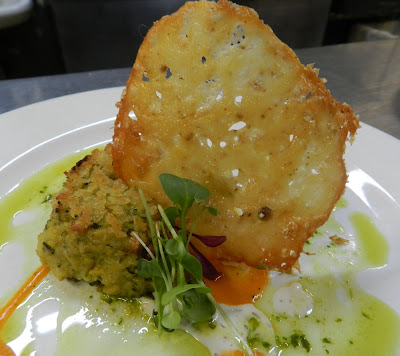 Squash Cake. Cake of grated yellow and green squashes long-cooked with cream and formed into cakes, garnished with tomato vinaigrette, tzatziki, pesto, and a pecorino tuile. I bought every last squash that Beth had about two weeks ago and we have been keeping them in the cooler and eking them out, trying desperately to hang on to a little bit of summer. We've never had summer squash this late into the year and it is really thanks to the crappy crop we had during the summer that Gene planted a second, late crop of which this is the very bitter end.
 Cauliflower Mushrooms with Guanciale and Broccoli. No brainer, really, in that Joe just sent us a 15-pound cauliflower mushroom. With its delightfully woodsy scent, this mushroom is a real crowd pleaser and its resemblance to egg noodles often influences how we prepare it: today, very simply with some Jowciale (smoked hog jowl from our friends at Edwards) and tiny broccoli florets.
 Napoleon of Seared Sea Scallops and Parsnip-Leek Latkes. This send up of scallop chowder features crispy sweet parsnip-leek latkes, a warm bacon-inflected leek and potato soup, cubes of roasted butternut squash, puffed wild rice (more addictive than crack) and mâche. After much experimentation, we have found that parsnip latkes benefit from 25% potato, to help them hold together and fry more crisply without burning.
 Pork & Grits. In our mission to convert the world to the Pork Belly Legion™, it seems that no tasting menu can omit at least one pork belly course. Here you see our house-cured pork belly fried to a crispy turn atop creamy Anson Mills grits coarse grits with a splash of local hickory bark syrup and a red grape “olivada.” The olivada is a condiment that we made for a big Italian-themed dinner back in October, a condiment that we liked so much that we keep on making it. It is son of the Cherry Tapenade that I created back in the spring and consists of red grapes, olives, capers, anchovies, lemon juice, oregano, and olive oil.
 More Pork. Seriously, what to follow pork belly but more pork? This dish was inspired by an incredibly beautiful savoy cabbage that I scored at the market and what you see is the answer to the question, "How shall we honor this beautiful cabbage?" What you see is a most non-traditional cabbage roll, stuffed with pulled pork shank and raw turnip julienne, then coated in Dijon mustard and rolled in panko and fried. It sits in a pool of pork gravy from braising the shanks and is garnished with a few chanterelles. I like to think of this as a very Western reimagining of a spring roll.
 Grilled Five-Spice Venison Loin. This dish screams late fall to me. You see a five spice-rubbed grilled loin of venison with butternut cream, a root vegetable hash, maple syrup, and a fresh fig compote made with the last of this year's figs. The star of this dish is not the venison but rather the humble hash, made from cubes of guanciale, parsnips, celery root, butternut squash, and fingerling potato along with dried cranberries and onions, all flambéed in bourbon. This hash is insanely good!
 Maple-Butternut Flan with Milk Chocolate Cremoso. What does a non-sweet eating chef use for dessert when there's precious little fruit about? Root veg, of course! Here you see a killer flan made of butternut purée, maple syrup, and cinnamon. The garnishes are a rich fudgy curl of milk chocolate cremoso (stolen shamelessly from pastry chef Hedy Goldsmith via Michael Schwartz, a chef whom I have never met, but who is clearly a fellow spirit), maple syrup, crème anglaise, gianduia (chocolate-hazelnut) powder, and a wicked good sunflower seed brittle that I made with sea salt and smoky pimentón.
 Squash Cake. Cake of grated yellow and green squashes long-cooked with cream and formed into cakes, garnished with tomato vinaigrette, tzatziki, pesto, and a pecorino tuile. I bought every last squash that Beth had about two weeks ago and we have been keeping them in the cooler and eking them out, trying desperately to hang on to a little bit of summer. We've never had summer squash this late into the year and it is really thanks to the crappy crop we had during the summer that Gene planted a second, late crop of which this is the very bitter end.
 Cauliflower Mushrooms with Guanciale and Broccoli. No brainer, really, in that Joe just sent us a 15-pound cauliflower mushroom. With its delightfully woodsy scent, this mushroom is a real crowd pleaser and its resemblance to egg noodles often influences how we prepare it: today, very simply with some Jowciale (smoked hog jowl from our friends at Edwards) and tiny broccoli florets.
 Napoleon of Seared Sea Scallops and Parsnip-Leek Latkes. This send up of scallop chowder features crispy sweet parsnip-leek latkes, a warm bacon-inflected leek and potato soup, cubes of roasted butternut squash, puffed wild rice (more addictive than crack) and mâche. After much experimentation, we have found that parsnip latkes benefit from 25% potato, to help them hold together and fry more crisply without burning.
 Pork & Grits. In our mission to convert the world to the Pork Belly Legion™, it seems that no tasting menu can omit at least one pork belly course. Here you see our house-cured pork belly fried to a crispy turn atop creamy Anson Mills grits coarse grits with a splash of local hickory bark syrup and a red grape “olivada.” The olivada is a condiment that we made for a big Italian-themed dinner back in October, a condiment that we liked so much that we keep on making it. It is son of the Cherry Tapenade that I created back in the spring and consists of red grapes, olives, capers, anchovies, lemon juice, oregano, and olive oil.
 More Pork. Seriously, what to follow pork belly but more pork? This dish was inspired by an incredibly beautiful savoy cabbage that I scored at the market and what you see is the answer to the question, "How shall we honor this beautiful cabbage?" What you see is a most non-traditional cabbage roll, stuffed with pulled pork shank and raw turnip julienne, then coated in Dijon mustard and rolled in panko and fried. It sits in a pool of pork gravy from braising the shanks and is garnished with a few chanterelles. I like to think of this as a very Western reimagining of a spring roll.
 Grilled Five-Spice Venison Loin. This dish screams late fall to me. You see a five spice-rubbed grilled loin of venison with butternut cream, a root vegetable hash, maple syrup, and a fresh fig compote made with the last of this year's figs. The star of this dish is not the venison but rather the humble hash, made from cubes of guanciale, parsnips, celery root, butternut squash, and fingerling potato along with dried cranberries and onions, all flambéed in bourbon. This hash is insanely good!
 Maple-Butternut Flan with Milk Chocolate Cremoso. What does a non-sweet eating chef use for dessert when there's precious little fruit about? Root veg, of course! Here you see a killer flan made of butternut purée, maple syrup, and cinnamon. The garnishes are a rich fudgy curl of milk chocolate cremoso (stolen shamelessly from pastry chef Hedy Goldsmith via Michael Schwartz, a chef whom I have never met, but who is clearly a fellow spirit), maple syrup, crème anglaise, gianduia (chocolate-hazelnut) powder, and a wicked good sunflower seed brittle that I made with sea salt and smoky pimentón.
Saturday, July 23, 2011
Chef's Table
Here are some photos from a Chef's Table dinner back in early July. This menu is a celebration of the new produce that arrived this week: beets, new potatoes, napa cabbage, cavolo nero, cauliflower, pluots, and peaches.

Chłodnik. It's hot, it's beet season, and there are some dill pickles from last season to be used. Time for this lovely Polish take on cold beet soup.

Early Summer Vegetable Plate. It was still too early for peppers, eggplants, and tomatoes—that glorious summer trio—when we did this dinner. So we made do with summer squash and green tomatoes. Here you see a miniature squash cake, a fried green tomato, and pesto goat cheese truffle, all garnished with various little bits from the plants on our deck.

Arctic Char. This dish isn't so much about the char as what the char is sitting on: a smoked bluefish new potato salad. This was an exercise in using the first new potatoes of the year. The char is notable really only for the way that it is cooked: skin side down on the grill until it reaches medium rare. The heat stays on the fatty skin side and yields a very delicate product.

Pork Confit on Kimchee. This dish is all about using the first napa cabbage of the year. I did a quick overnight kimchee pickle on it so that it was still fairly crunchy. We topped it with shreds of our latest batch of pork confit.

Grilled Lamb Loin and Cavolo Nero Packet. How fortunate for us that we got the first delivery of the season of cauliflower and cavolo nero on the same day that we received a new lamb. Here then is a piece of top loin (the New York strip if you will) wrapped in cavolo nero and grilled along with a cauliflower purée, red wine-lamb stock reduction, and chanterelle mushrooms.

Peach, Pluot, and French Toast Napoleon. Peaches and pluots just hit the market the week of this tasting and so it was a no-brainer that they were going to feature in dessert. The napoleon is sitting in a pool of cherry soup, made from the very last of the cherries from this season.
Friday, December 24, 2010
Chef's Table
For what will be most likely my final blog post of 2010, I wanted to post some photos of a recent Chef's Table. We hold these each Thursday at 6pm at the table in our back bar next to the kitchen. We only seat a maximum of 8 diners each week. Five to six courses paired with wines for $60: a deal no matter how you slice it and even more of a deal once you consider the labor.

Arancino of Porcini Risotto. Isn't this a gorgeous photo? First, thanks to Billie Clifton of Sunflower Cottage for all the beautiful herbs, greens, and flowers this winter. We made balls of wickedly good and creamy porcini risotto, rolled them in panko, and deep fried them for an addictively good amuse bouche. We made some extras for chef snackies. I loved the contrast between the crunchy crust and the sinfully creamy interior.

Fall Salad. This is a salad I came up with several years ago and it has featured on our late fall and early winter menus ever since, such a hit with customers it is. I don't like to repeat dishes that are on our dinner menu on our tasting menus, but this salad is so good that I want everyone to try it. This salad popped into my head at the farmers market one bleak Saturday when I needed a salad for that night's menu and nothing green was to be found. In classic Asian fashion, this salad has sweet and crunch from the Asian pears, salt and spice from the pecans, and earthy creaminess from the butternut squash. It's all bound with an apple cider reduction and topped with earthy Bull's Blood beets. I love this salad.

Winter Bounty. There may not be a vast selection of items at the farmers market in December, but we can do some cool things with what there is. This is a napoleon featuring three layers of parsnip latkes sandwiching layers of mustard greens and cavolo nero, standing in a pool of butternut squash cream. This dish is enough to make me turn vegetarian. All the flavors play together so well.

Cassoulet. This menu so far has been tamely vegetarian. Time to turn on the meat! This is pork and beans amped up with copious quantities of duck fat and house-cured duck confit. We made this cassoulet with Steuben Yellow Eye Beans, an heirloom variety that keeps it shape while becoming sinfully creamy inside. The French only wish they had this bean for their cassoulets. We make our cassoulet with amazing Virginia sausages and smoked slab bacon, keeping it as local as we can and keeping the local cardiologists in funds.

Pork, Pork, Pork. Did I mention that I could happily be a vegetarian except for one small problem? Pork products. Yep, I'd walk five miles for a taste of pork confit. This is a mini-homage to my friend the pig and one that hopped into my mind a couple of days ago while eyeing the pan of leftover ossobuco of pork from our company Christmas party. What if we debone the osso, reshape it into disks, wrap it in prosciutto, crisp it in a pan, and serve it in a bowl of smoky pork jus? What if indeed! This is one sexy pork dish, with its crown of sausage and duck fat-roasted brussels sprouts!

Apple Crumble. I'm not a dessert guy. Give me another glass of wine and a piece of cheese and some fruit after dinner and I'm really happy. So my desserts tend to be more savory, less sweet, and fruit-driven. And I guess 2010 has been the year of deconstructed, scattered desserts for me. If you look back at my dessert photos over the year, there seems to be a theme. Traditional apple crumble has been selling like hotcakes this fall and winter. This is a reworking in which the apples, the apple cider glaze, the crumble topping, and the vanilla bean gelato have all been pulled apart and reassembled. The crumble topping is in the form of a cookie, the result of another what-if. What if we bake the crumble topping too long? Sometimes good things come of curiosity!
Thursday, October 14, 2010
$50 Gift Certificate Photo Caption Contest

For all of you who follow the blog, but not our Facebook page, we're having a photo caption contest over on facebook.com/OneBlockWest for this photo. Keep it clean!
Monday, March 22, 2010
Prosciutto-Wrapped Loin of Rabbit

I like this dish so much that I wanted to share it with you. I love the late winter flavors and the presentation as well. What you see here is prosciutto-wrapped rabbit loin stuffed with Chinese broccoli leaves and goat cheese, sitting in a pool of Fairy Tale squash cream, surrounded by black trumpet mushrooms.
 Start by removing both loins from a rabbit (one rabbit serves one person) and cleaning them of silverskin and sinew. When you remove the loins, remove all the meat from the hip to the shoulder blades in a single piece. The best way that I have found to remove the silverskin is to start a small flap of the silverskin at the shoulder end (the pointed end), then flip the loin over, silverskin down on the cutting board, and skin it like you would a fish. Butterfly each loin about two thirds of the way from the hip end to the shoulder end as you see in this photo.
 Next, cover each butterflied loin with plastic wrap and gently pound the flesh until it is even in thickness all over. These I have pounded to about 3/8" or 1/2cm in thickness. Then lay a piece of plastic wrap on your board and on top of that lay out enough prosciutto to completely wrap the rabbit loin. Then lay two rabbit loins on top of the prosciutto as you see here, close to one edge of the prosciutto and so that the rabbit forms a long rectangle. Season the rabbit with salt and pepper.
 Meanwhile, for each rabbit loin, blanch about eight Chinese broccoli leaves. I'm sure if you're contemplating doing this recipe that you know you can substitute any leafy green in this recipe: chard, spinach, rapini, etc. After blanching the leaves, dry them well (important for the next step) and remove any central stem with a sharp knife.
 Lay the blanched and destemmed leaves on top of the rabbit. Fold the leaves as necessary to just cover the rabbit. Season the leaves with a little salt and pepper. Bring some fresh goat cheese to room temperature so that you can spread it. You can do this in the microwave, but you have to be really, really careful not to scorch the cheese. Stir a little salt and pepper (you could even use some herbs in the cheese were you so inclined) into the cheese. Then very gently spread the cheese on top of the broccoli leaves. It's probably best to drop small dollops of cheese in the center of the leaves and gently push it out to the edges with the back of a spoon. Go slowly and you'll get the hang of it in no time.
 Using the film as an aid, start rolling the roulade from the side where the rabbit is closest to the edge of the prosciutto. Gently tighten the roll with your fingers as you go. Once you have rolled the rabbit in the prosciutto, refrigerate for a couple of hours to solidify the cheese so that it is easier to handle when you cook it later. This roulade can be cooked entirely on the stove top. No oven time is necessary. If you do not have a flat top or a griddle pan that is big enough to hold the rabbit loin, you can heat a half sheet tray on two burners and use that. Sear the prosciutto all the way around; this will take six or seven minutes. Remove the loin from the heat and let stand for five minutes to finish cooking, to rest, and so that the cheese resolidifies a little bit. Slice and plate. I have best results with a sharp serrated knife, second best results with my ultrasharp prosciutto knife.
Friday, October 16, 2009
Market Shopping
I don't think it will surprise too many of my customers, especially the local ones who see me at the market, that I get the inspiration for a lot of dishes from seeing and feeling ingredients. Just last week, I was at the market when I spied some gorgeous tomatoes and very unique luffa squashes. I took them back to the restaurant with the vague idea that roasting tomatoes and luffa would be an interesting dish.
 Only one slight problem, I'd never worked with luffa (Luffa acutangula) before. Grown them to maturity and made sponges from them, yes; eaten the immature ones, never. But, it's another squash, albeit a firm one, and so I didn't think I could go too far wrong by treating as any other firm squash. These luffa were sold to me by their Mandarin name, si gua. This photo is from another batch and these luffa are a little worse for wear, still I wanted you to see the product that I am blessed to work with.
 Then later that afternoon, my fish delivery came in with some very pristine Atlantic Spanish mackerel, which happen to be migrating off the coast of Virginia right now. Mackerel is known as a dark, gamy, oily fish and undeservedly so. If you've ever eaten saba (pickled mackerel) at the sushi bar, you know that it is white-fleshed and although it has a strong fish flavor, it is delicious when extremely fresh. Mackerel do have a high oil content which makes them a delight to cook, for it is hard to dry them out. But the high oil content means that they go rancid quickly. Only buy from a trusted source. This little guy (2.5 pounds, 1.1 kg) was fat and pristine and yielded four nice filets. I don't skin mackerel; it has no scales and it is impossible to remove the skin anyway.
While I was breaking down the mackerel, the whole dish came to me. Why not roast the tomatoes and luffa and season them assertively arrabbiata-style, then roast the mackerel to order on top of the arrabbiata sauce? If mackerel can stand up well to pickling, certainly it will stand up to an assertive tomato sauce.
Roasted Spanish Mackerel with Luffa Arrabbiata
This feeds four people quite well with a green salad and a glass of red wine. You can substitute other squash for the luffa. If you use a soft squash such as zucchini, reduce the cook time to about 15 minutes. You can substitute any of the mackerels or bluefish in this recipe.
2 small luffa
4 large tomatoes
4 cloves garlic
1 anchovy
1/4 teaspoon crushed red pepper flakes or to taste
1/2 teaspoon salt
black pepper
1/4 cup extra virgin olive oil
4 mackerel filets
Preheat the oven to very hot, 450F. Slice the luffa into coins about 1/4" (1cm) thick. Peel, seed, and roughly chop the tomatoes. Mince the garlic. Remove the backbone from the anchovy and chop it finely. In a roasting pan, mix the squash, tomatoes, garlic, anchovy, red and black pepper, salt, and olive oil. Roast the vegetables until the squash is tender, stirring every now and again. It took me about 40 minutes. Rub the mackerel with extra virgin olive oil and season with salt and pepper. Place skin side down on top of the vegetables and return to the oven until the mackerel is just barely cooked, about 6 minutes.
For presentation, we put the sauce down in the well of a soup plate with the fish over. Then we spooned a tomato vinaigrette around the plate and a little on the fish and topped the fish with a small mound of local baby arugula dressed with lemon juice and extra virgin olive oil.
Friday, September 25, 2009
Craziness, Redux
I last posted about the semi-lunacy of taking in bushels and bushels of local produce and lots of local meats and in under 48 hours, concocting a menu using all those ingredients and serving it to 60+ people (see "Craziness"). It's not really as crazy an endeavor as it sounds: it is in larger scale what we do every day here at the restaurant—react to the fresh, local products coming in the door to create the dinner menu for the day.
Before I get started, I have to give a big thanks to the ladies from Preserve Frederick for all their help in coordinating logistics: amazing job! And both the front of the house crew and back of the house crew did fantastic jobs, letting me move from the kitchen to the dining room at will and greet and mingle with our guests. Great job everyone! Service was amazingly smooth!
To recap, last evening we held a sold-out farm-to-table dinner for the benefit of Preserve Frederick in conjunction with the Piedmont Environmental Council. The net proceeds will go to Preserve Frederick for the publication of next year's edition of the Buy Fresh-Buy Local guide, that connects local producers and consumers of agricultural products.
From the restaurant perspective, I've been leading the fresh-local parade for the past seven years and I am happy to have been able to help raise funds to publish a guide that might help our local producers connect with other restaurants and the general public. Who knows? Maybe we can convince other restaurants to keep their money here in our local economy.
After triaging all the food that came in the door, the cooks and I started sketching out ideas for using the products and dealing with issues such as feeding 60+ people with 7 pounds of pork. Here's the final menu that we ended up with after receiving the final donations at around 2:30pm before the dinner:
Gazpacho with Crispy Squash Cake. We made a fairly traditional tomato gazpacho with lots of diced vegetables for garnish, including yellow, red and green peppers, beets, and corn. If the beets are very young and sweet, you can use a lot; if they are very earthy, they will dominate. These were very earthy so we had to use restraint. We flavored the soup with lots of sherry vinegar and a healthy dose of Tabasco.
With the soup, we served one of our famous squash cakes: yellow squash grated and cooked for three hours in heavy cream with garlic and basil and bound with pecorino romano and bread crumbs, chilled, formed into cakes, and fried.
Gratin of Natural Chicken in Mustard Sauce. Needing to feed 60 people from 5 chickens (albeit huge ones), we had to take the chicken off the bone and stretch it. We poached the huge Corn Rock Cross chickens; poached a traditional mirepoix of leeks, carrots, and celery in the chicken stock to further flavor it; then reduced the stock with heavy cream and added a final liaison of Dijon mustard. After mixing the chicken, vegetables, and sauce, we baked it under an herbed breadcrumb crust. This is one of the key tricks of the professional kitchen: cook everything separately to the point where it is perfectly cooked and then combine all the ingredients. I wouldn't expect home cooks to do this (and dirty that many pans) but this is how we get our chicken perfectly tender and our vegetables just done.
Thai Beef Salad. What to do with chuck and sirloin steaks and how to stretch a small amount for a crowd? With chuck, you either have to cook it a little or a lot. We went for a little, first marinating the beef in a touch of the salad dressing, then grilling it to medium rare, chilling it, then slicing it and removing the nasty bits. This we mixed with a julienne of carrots, sliced green onions, mounds of Thai basil, cilantro, a few cherry tomatoes and lots of dressing. The dressing is lime juice, brown sugar, kaffir lime, fish sauce, and local first-pressing canola oil. We served this over some impeccable baby greens that were picked just before the dinner. Kaffir lime is not typical in this salad, but I have a lot on hand that I need to use.
Puerco con Mojo on Corn Cake with Tomato, Tomatillo, and Groundcherry Salsa. We had only 7 pounds of shoulder, bone-in at that, to feed a crowd, so we knew we were going to braise the pork and pull it. We braised the pork in a classic Cuban mojo of sour orange juice, cilantro, oregano, garlic, and cumin, then shredded it and mixed it with a Cuban-style arroz verde (green rice) and a salsa of cherry tomatoes, peppers, local tomatillos, and local groundcherries.
We shaved a lot of fresh corn, just picked in the afternoon, mixed it with local poblanos (these were way spicy!), garlic, and Virginia cornmeal from which we made delicious little pancakes on which to serve the pork.
Irish Stew with Butternut Squash Purée. I cubed four legs of lamb and stewed them in Petit Verdot from Jefferson Cellars as the base for this "stew." It was non-traditional in that while I did stew the lamb, I sautéed the accompanying carrots, celery, and onions, and roasted local Yukon Gold and Kennebec potatoes with rosemary. After straining and reducing the lamb stock, I bound it with a classic beurre manié, and mixed it into the meat and vegetables just before service.
For the butternut purée we peeled, cubed, and roasted the first butternut squash of the season. We then mashed them and seasoned with a touch of butter, nutmeg, salt, and white pepper. Roasting small cubes of squash to the point of slight caramelization yields a depth of flavor that you cannot get by other means.
White Chocolate, Pecan, and Roasted Apple Bread Pudding with Crème Anglaise. I think that everyone who ate this bread pudding will all agree that it was the best that I have ever made; it was pure money! The key is using premium products: our fantastic baguettes, local Jonagold and Empire apples roasted with cinnamon and local honey, white chocolate, toasted pecan halves, a little (about two gallons) 40+% heavy cream, a couple vanilla beans, and dozens of local Rhode Island Red eggs. Besides using the best quality ingredients possible, the other trick with bread pudding is knowing when to take it out of the oven. If you let it set up totally in the oven, it's overcooked, still good, but not money!
Thanks to the following farmers for their kind support of this event:
Echo Ridge Farm
Freight Station Farmers Market
Hardin Natural Chicken
Hedgebrook Farm
Linda's Mercantile
Marker-Miller Orchards
North Branch Farm
Richard's Fruit Market
Virginia Lamb
Before I get started, I have to give a big thanks to the ladies from Preserve Frederick for all their help in coordinating logistics: amazing job! And both the front of the house crew and back of the house crew did fantastic jobs, letting me move from the kitchen to the dining room at will and greet and mingle with our guests. Great job everyone! Service was amazingly smooth!
To recap, last evening we held a sold-out farm-to-table dinner for the benefit of Preserve Frederick in conjunction with the Piedmont Environmental Council. The net proceeds will go to Preserve Frederick for the publication of next year's edition of the Buy Fresh-Buy Local guide, that connects local producers and consumers of agricultural products.
From the restaurant perspective, I've been leading the fresh-local parade for the past seven years and I am happy to have been able to help raise funds to publish a guide that might help our local producers connect with other restaurants and the general public. Who knows? Maybe we can convince other restaurants to keep their money here in our local economy.
After triaging all the food that came in the door, the cooks and I started sketching out ideas for using the products and dealing with issues such as feeding 60+ people with 7 pounds of pork. Here's the final menu that we ended up with after receiving the final donations at around 2:30pm before the dinner:
Gazpacho with Crispy Squash Cake
Gratin of Natural Chicken in Mustard Sauce
Thai Beef Salad
Puerco con Mojo on Corn Cake with Tomato, Tomatillo, and Groundcherry Salsa
Irish Stew with Butternut Squash Purée
White Chocolate, Pecan, and Roasted Apple Bread Pudding with Crème Anglaise
Gratin of Natural Chicken in Mustard Sauce
Thai Beef Salad
Puerco con Mojo on Corn Cake with Tomato, Tomatillo, and Groundcherry Salsa
Irish Stew with Butternut Squash Purée
White Chocolate, Pecan, and Roasted Apple Bread Pudding with Crème Anglaise
Gazpacho with Crispy Squash Cake. We made a fairly traditional tomato gazpacho with lots of diced vegetables for garnish, including yellow, red and green peppers, beets, and corn. If the beets are very young and sweet, you can use a lot; if they are very earthy, they will dominate. These were very earthy so we had to use restraint. We flavored the soup with lots of sherry vinegar and a healthy dose of Tabasco.
With the soup, we served one of our famous squash cakes: yellow squash grated and cooked for three hours in heavy cream with garlic and basil and bound with pecorino romano and bread crumbs, chilled, formed into cakes, and fried.
Gratin of Natural Chicken in Mustard Sauce. Needing to feed 60 people from 5 chickens (albeit huge ones), we had to take the chicken off the bone and stretch it. We poached the huge Corn Rock Cross chickens; poached a traditional mirepoix of leeks, carrots, and celery in the chicken stock to further flavor it; then reduced the stock with heavy cream and added a final liaison of Dijon mustard. After mixing the chicken, vegetables, and sauce, we baked it under an herbed breadcrumb crust. This is one of the key tricks of the professional kitchen: cook everything separately to the point where it is perfectly cooked and then combine all the ingredients. I wouldn't expect home cooks to do this (and dirty that many pans) but this is how we get our chicken perfectly tender and our vegetables just done.
Thai Beef Salad. What to do with chuck and sirloin steaks and how to stretch a small amount for a crowd? With chuck, you either have to cook it a little or a lot. We went for a little, first marinating the beef in a touch of the salad dressing, then grilling it to medium rare, chilling it, then slicing it and removing the nasty bits. This we mixed with a julienne of carrots, sliced green onions, mounds of Thai basil, cilantro, a few cherry tomatoes and lots of dressing. The dressing is lime juice, brown sugar, kaffir lime, fish sauce, and local first-pressing canola oil. We served this over some impeccable baby greens that were picked just before the dinner. Kaffir lime is not typical in this salad, but I have a lot on hand that I need to use.
Puerco con Mojo on Corn Cake with Tomato, Tomatillo, and Groundcherry Salsa. We had only 7 pounds of shoulder, bone-in at that, to feed a crowd, so we knew we were going to braise the pork and pull it. We braised the pork in a classic Cuban mojo of sour orange juice, cilantro, oregano, garlic, and cumin, then shredded it and mixed it with a Cuban-style arroz verde (green rice) and a salsa of cherry tomatoes, peppers, local tomatillos, and local groundcherries.
We shaved a lot of fresh corn, just picked in the afternoon, mixed it with local poblanos (these were way spicy!), garlic, and Virginia cornmeal from which we made delicious little pancakes on which to serve the pork.
Irish Stew with Butternut Squash Purée. I cubed four legs of lamb and stewed them in Petit Verdot from Jefferson Cellars as the base for this "stew." It was non-traditional in that while I did stew the lamb, I sautéed the accompanying carrots, celery, and onions, and roasted local Yukon Gold and Kennebec potatoes with rosemary. After straining and reducing the lamb stock, I bound it with a classic beurre manié, and mixed it into the meat and vegetables just before service.
For the butternut purée we peeled, cubed, and roasted the first butternut squash of the season. We then mashed them and seasoned with a touch of butter, nutmeg, salt, and white pepper. Roasting small cubes of squash to the point of slight caramelization yields a depth of flavor that you cannot get by other means.
White Chocolate, Pecan, and Roasted Apple Bread Pudding with Crème Anglaise. I think that everyone who ate this bread pudding will all agree that it was the best that I have ever made; it was pure money! The key is using premium products: our fantastic baguettes, local Jonagold and Empire apples roasted with cinnamon and local honey, white chocolate, toasted pecan halves, a little (about two gallons) 40+% heavy cream, a couple vanilla beans, and dozens of local Rhode Island Red eggs. Besides using the best quality ingredients possible, the other trick with bread pudding is knowing when to take it out of the oven. If you let it set up totally in the oven, it's overcooked, still good, but not money!
Thanks to the following farmers for their kind support of this event:
Echo Ridge Farm
Freight Station Farmers Market
Hardin Natural Chicken
Hedgebrook Farm
Linda's Mercantile
Marker-Miller Orchards
North Branch Farm
Richard's Fruit Market
Virginia Lamb
Subscribe to:
Posts (Atom)

