Showing posts with label prosciutto. Show all posts

Tuesday, August 27, 2013

A Couple of August Dishes

Here are a couple of dishes from recent tastings: 
Steelhead and Tomato Tartare

This Steelhead Trout tartare is as simple as it looks and relies heavily on the freshness of its constituent ingredients. The tartare is cubed Steelhead belly, cubed tomato, capers, shallots, lemon juice, extra virgin olive oil, and a touch of shichimi togarashi. Garnishes are house-made crème fraîche, salmon roe, cilantro, and more shichimi togarashi.

Duck Prosciutto, Fig, and Onion Salad
And this is a bit of fun, showcasing our recent batch of duck breast prosciutto that is now 12 weeks of age and ready to eat. On the plate is a drizzle of saba, a syrup made by boiling down grape must. Then a caramelized onion jam, fresh figs, salad burnet, micro arugula, and very thin slices of our duck prosciutto. This dish is starting to show that our minds are moving into fall, here in late August.

Tuesday, March 26, 2013

Northern Italian Tasting

We're generally not in the habit of having customers dictate the direction of our tasting menus, preferring instead to take the best ingredients we have on hand at the time and shape them into a menu based on our own whims. But our customer for this dinner was insistent that we do a tasting of the foods from the provinces of Northern Italy. OK. I would have gone to a Northern Italian restaurant for this, but never mind, we can cook pretty much anything.

The hardest part of this whole exercise was deciding the order of the courses; for example, would the Piemontese course be primo, a secondo, a dolce? Once we got the ordering of the courses, progressing from first courses to seafood to meat to sweets, then it was easy enough to draw inspiration from each region to fill in the details.

Chicken Liver "Crostino"
Toscana: Chicken Liver Crostino. Chicken liver crostini are some of the best known appetizers in Tuscany and since we had chicken livers on hand, we decided to do a take on this well known primo, but reinvent the form. We cooked the livers in the traditional manner with onions, sage, rosemary, capers, anchovies, and Cognac. Then we formed the liver mousse into truffles and rolled them finely powdered crostini, cocoa powder, and espresso powder. The bitter cocoa and espresso worked with the liver very nicely.

Speck Knödel/Canederli Tirolese
Alto Adige: Speck Knödel/Canederli Tirolese. We went back and forth on a soup course, but the weather by turning cold and nasty made the decision easy for us. I have always loved the bread dumpling soups of Bavaria, Austria, and the Südtirol and wanted to reprise them for this menu, to show the Germanic influences in the cuisine of Alpine Italy. I made a classic brown stock from both pork and chicken necks and then poached quenelles of knödel batter in it. The batter is white bread soaked in milk, garlic chives, sage, minced speck, and eggs.

Gambero al Prosecco
Veneto: Gambero al Prosecco. I wouldn't argue if you wanted to call this Shrimp and Grits because that is basically what it is. This is our take on the classic Venetian dish of Schie con Polenta, tiny head-on shrimp in a garlic butter sauce over creamy polenta. Making the sauce with Prosecco is a nod to the famous sparking wine of the Veneto.

Trofie al Pesto
Liguria: Trofie al Pesto. You just can't think of Liguria and Genoa without thinking of basil and that most famous of sauces, pesto. What snaps immediately into my mind is a big plate of the local pasta, trofie, in pesto sauce. Plates of pasta just don't look all that pretty on tastings, so we mixed the trofie and pesto with some ricotta and eggs and baked them in little molds so serve as a base for mussels steamed with pesto.

Grilled Trout with Fennel, Chestnuts, and Lardo
Val d’Aosta: Grilled Trout with Fennel, Chestnuts, and Lardo. Moving right up next to France and Switzerland, the next course took its cues from regional products. This dish has no basis in classic Italian cooking: it is one of my own invention, but I daresay that it would feel at home in a modern restaurant in the Val d'Aosta. We grilled trout and then served it with a sauce made from caramelized fennel, shallots, and peeled chestnuts, splashed at the last second with a touch of anisette and bound with a splash of cream. On top is a very thin sliver of house-cured lardo. This dish is a keeper and I look forward to reprising it at some future time in the main dining room.

Radicchio, Wild Mushroom, and Sausage Strudel
Friuli/Venezia Giulia: Radicchio, Wild Mushroom, and Sausage Strudel. As a student of culinary history, I am always amazed at how cuisine pays no heed to political boundaries. For example, strudel, ignoring modern country borders, can be found all over the former Austro-Hungarian empire, including the far northeast corner of Italy. We made our strudel of radicchio, wild mushrooms, and a house-made sage sausage. Although it is very tasty, radicchio goes nearly black when cooked and does not necessarily make the prettiest strudel filling.

"Osso Buco" Milanese
Lombardia: "Osso Buco" Milanese. What is more representative of the cooking of Lombardia than osso buco milanese, succulent veal shank over saffron risotto? Nothing. How do you serve it for a nine-course tasting? We like the arrancino form.

Rabbit Bolognese
Emilia Romagna: Rabbit Bolognese. Emilia Romagna, among others, has two very famous exports: prosciutto di Parma and salsa bolognese from Bologna. We decided to marry a classic salsa bolognese made of rabbit with prosciutto, by wrapping the salsa in prosciutto, to give the salsa form on the plate. It is plated with saffron aïoli and a touch of sun-dried tomato pesto.

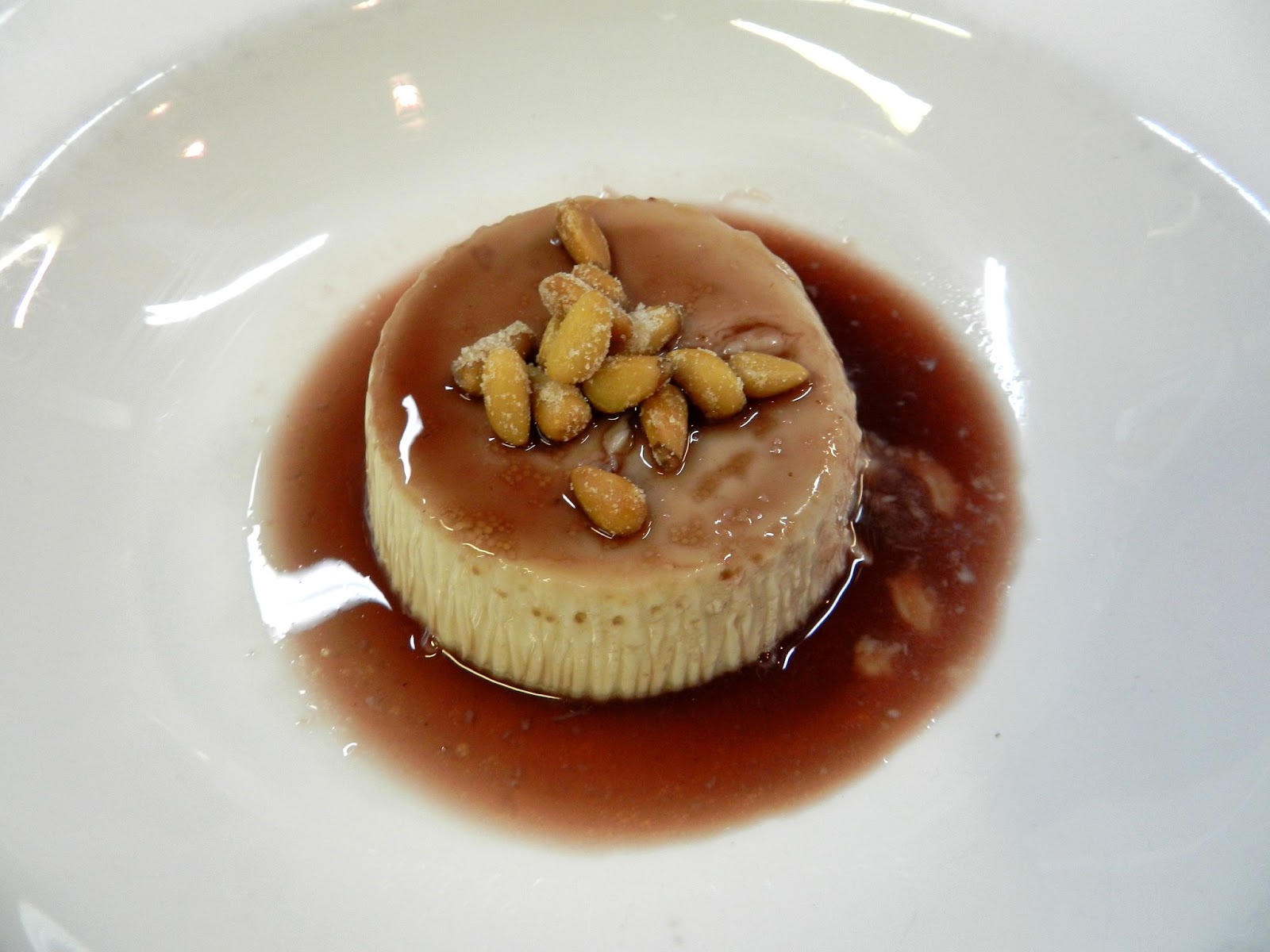
Chestnut and Red Wine Panna Cotta
Piemonte: Chestnut and Red Wine Panna Cotta. Panna cotta is a classic dish that I associate most closely with the Piemonte. This is a two-layer panna cotta of jellified Nebbiolo wine and a chestnut cream. I have gently reheated the panna cotta so that the red wine layer has just about melted, forming a sauce à la crème caramel. Topped with candied pine nuts.

Friday, September 7, 2012

Early Autumn Tasting

I know that it's not fall yet and won't be officially for another couple of weeks, but mentally, Tony and I are off creating fall menus already. As much as we love tomatoes, squash, squash blooms, and peppers, we are ready for the change to game, mushrooms, braised dishes, conserved pork products, and bacon, bacon, bacon.

Grilled Prosciutto-Wrapped Goat Cheese-Stuffed Figs

Grilled Prosciutto-Wrapped Goat Cheese-Stuffed Figs. This is not an earth shattering new dish, but it is wonderful nonetheless for having been made with local figs and local goat cheese. Next up, we're already scheming to make our own prosciutto when it gets cold enough. Served with a glass of prosecco, these are a great start to any meal.

Sausage and Eggs

Breakfast. Yet another in the long list of dishes that we have so titled, this one starts with a bed of chanterelle buttons cooked up with our bison and our venison sausages. On top is a spoonful of oeufs brouillés, duck eggs with chives and a splash of cream that have been whisked over a water bath until just set, more like a heavy sauce than traditional scrambled eggs and so, so much more sinful. Maple syrup around the edge adds a sweet note.

Truffled Steuben Yellow Eye Bean Soup; Potted Confit

Beans. Definitely my favorite dish of this whole tasting, and for being a soup, the most complex to make. My guests for this tasting are frequent diners and lovers of cassoulet, and so I worded the menu in such a way as to make them think that this course was going to be cassoulet. The beans are my favorites, Steuben Yellow Eyes, soaked overnight, drained, cooked to tender, and recooked with the juice that comes from roasting our pork belly (what we call "goodness"), mirepoix, smoked Surry sausage, garlic, thyme, bay, rosemary, and sage. It's all blitzed in the big Vita-Mix and passed through our finest chinois for an ultra-silky texture. Thinned, splashed with a touch of cream, seasoned, and lavished with a big spoonful of chopped black truffles, this is a soup for the culinary gods. Served with a croustade topped with potted confit. We finely chopped some of our duck confit and pork shoulder confit, then mixed it with softened butter, nutmeg, mace, and fresh thyme.

Braaied Skilpadjies

Skilpadjies. You South Africans might recognize the minature skilpadjies that we braaied on a skewer and served with geelrys. The rest of you see small tortoise-shaped patties of minced lamb and rabbit liver wrapped in caul fat, which have been grilled and served with a fragrant yellow rice and a green tomato ketchup. Somebody brought us a bunch of green cherry tomatoes from a field that needed to be tilled under for fall crops and so we made a big batch of spicy green tomato ketchup from them.

Corn Crème Caramel with Duck Breast

Duck. Here's another savory crème caramel. I just love the silky texture that it brings to a dish. This one is made from fresh corn flavored with thyme. You also see grilled Moulard duck breast, baby brussels sprouts, and a fresh fig. I made a jus (almost a consommé but I didn't technically clarify it) from more pork belly goodness, defatted Surry sausage jus, and star anise. This jus I spooned over so that its salty essence could marry with the caramel giving a delicious sweet-salty contrast with a haunting star anise note to bring out the spice in the accompanying Barossa Shiraz.

Pawpaw Panna Cotta

Pawpaw. We've been fortunate this year to have a local forager supply us wild pawpaws which have a banana-melon-mango flavor very similar to jackfruit. But pawpaws are a gigantic pain in the ass to prepare, unlike jackfruit. Here you see a plate with pawpaw purée, crème anglaise, and maple syrup on the plate, with miniature pawpaw panna cottas scattered about. Though it's hard tell, the large ball is a ball of coconut sorbet rolled in crushed black walnuts, with an oatmeal lace cookie sticking out of it.

Monday, February 9, 2009

Burning Questions: Meat

This whole series of "Burning Questions" posts originated as a somewhat amusing troll through the One Block West Restaurant web site server logs, to see what search phrases were bringing people to the web site. As I went through the logs, the search topics seemed to fall into several broad categories, each dealt with in a separate post in this series. This post deals with meats.

How to Cook Surry Sausage/What is Surry Sausage. First things first. Surry Sausage is a smoked pork sausage from Surry, Virginia-based S. Wallace Edwards & Sons. It's formed into small links and has a remarkable smoky flavor that some people mistake for country ham. Follow the link above for purchase and background information on this one of a kind sausage.

Cooking Surry Sausage is not much different from other smoked pork sausages. We dice it and add it to sautées; we grill it and slice it for appetizers and our popular Surry Sausage lunch salad. You should make sure that you cook the sausage to 165F/75C.

Non-Pork Substitute for Prosciutto. For those of you who cannot eat pork, I suggest that you use a similarly cured beef called Bresaola. A similar Swiss product is called Bünderfleisch. You may also see it labeled as beef prosciutto.

Andouille Sausage Substitute. Andouille as we think of it here in the US is a firm sausage stuffed with chunks of pork shoulder and seasoned with a good helping of cayenne pepper. You could substitute tasso or a firm city ham such as Hormel Cure 81 and some cayenne. Tasso or ham would have the closest texture to andouille. Or you could substitute another smoked pork sausage such as kielbasa and some cayenne. Kielbasa's texture will be wrong because it is made from a ground forcemeat. Me, I'd just go to Comeaux's web site and order the real andouille. I've been buying from Ray Comeaux since the early 1990's. The photo shows a link of Comeaux's andouille (top) and two links of Edwards' Surry Sausage (bottom).

Tasso vs Andouille. They're similar in flavor and yet they're dissimilar in appearance. Andouille is a sausage described just above. Tasso is made from pork shoulder too, only it is made from cross-grain chunks of shoulder that have been lightly cured, spiced, and smoked. Tasso will be a bit leaner than andouille, but they have the same basic flavor. For diced meat to add flavor to a jambalaya or gumbo, I use them interchangeably. If I want those nice andouille rounds, nothing else will do.

Spanish Word for Sausages. That would be chorizo, although specific sausages have their own names. There are basically two types of chorizo with which I am familiar: Spanish and Mexican. Spanish chorizo are small, firm (like pepperoni), cured sausages seasoned primarily with pimentón. Mexican chorizo, the kind I feasted on when I lived in Texas, tends to be a loose, fresh sausage seasoned with mild chile powder and a fair amount of vinegar. I have also seen it stuffed into casings.

What is Paleron? Funny you should ask, it's my favorite cut of beef and I wrote extensively on it in another post.

Wednesday, February 4, 2009

Burning Questions: Substitutes

This whole series of "Burning Questions" posts originated as a somewhat amusing troll through the One Block West Restaurant web site server logs, to see what search phrases were bringing people to the web site. As I went through the logs, the search topics seemed to fall into several broad categories, each dealt with in a separate post in this series. This post deals with substituting one ingredient for another.

Demi-Glace Substitute. Demi-glace is highly reduced stock, so you can substitute stock for it, but you're going to have to reduce the stock to thicken it. It's probably best to make a big pot of stock one weekend and reduce it to about a fourth of its volume, then freeze it in ice cube trays. You can put the frozen cubes in a seal-top bag in the freezer and have them at your disposal at any time. No need to thaw them, just drop the frozen cubes directly into the pan. You could thicken stock with a starch such as corn, potato, or arrowroot, but you're not going to get the depth of flavor that demi-glace brings to the table.

Andouille Sausage Substitute. Andouille as we think of it here in the US is a firm sausage stuffed with chunks of pork shoulder and seasoned with a good helping of cayenne pepper. You could substitute tasso or a firm city ham such as Hormel Cure 81 and some cayenne. Tasso or ham would have the closest texture to andouille. Or you could substitute another smoked pork sausage such as kielbasa and some cayenne. Kielbasa's texture will be wrong because it is made from a ground forcemeat. Me, I'd just go to Comeaux's web site and order the real andouille. I've been buying from Ray Comeaux since the early 1990's.

Can You Substitute Clam Juice for Oyster Sauce? Not exactly. Oyster sauce is a thick soy-based sauce. Clam juice is a thin stock akin to fish fumet or fish stock. I'm not sure why you would need to substitute for oyster sauce because it seems to be stocked in most groceries. You could thicken soy sauce with a little corn starch or substitute some other kind of soy product such as bean paste.

Fish Stock Substitute. Easy. Bottled clam juice or steam some mussels and save the liquid.

Can I Use Long Grain White Rice in a Risotto? No, I wouldn't recommend substituting long-grain rice for one of the Italian short-grain rices in risotto. You're going to end up with a soggy, non-creamy mess.

Differences Between Italian Parsley and Cilantro. Visually, you can see that cilantro on the left has rounder lobes than Italian parsley on the right with its more pointed lobes. Generally, you cannot substitute one for the other: they have vastly different flavors, but you should never need to because they're both available in most grocery stores. If you are confused about them at the market, crush a leaf of each and smell them.

Replacement/Substitute for Pasilla. If I don't have pasillas in the pantry, I would use guajillos. The important thing to remember is that the pasilla is a fairly mild red chile, so you should substitute another mild red chile for it. You could use anchos, but they have a much deeper, richer, more chocolatey flavor. You might want to view my Chile Primer.

Substitute for Pimentón. Pimentón is a paprika from Spain made from peppers that have been dried over oak fires, giving the resulting product a truly smoky flavor. There is no good substitute for pimentón. You could use any paprika in a pinch, but the smoky component would be lacking.

Poblano Chile Substitute/Replacement. I use poblanos as tasty substitutes for Bell peppers in almost all cooked applications. I suppose you could go the other way and use Bell pepper, but Bell peppers are very vegetal where poblanos have a nice round chile flavor. For most applications, I would probably go with a mild green chile such as an Anaheim.

Red Yellow Onions Interchangeable. Yes they are in most applications, unless color is a factor in the dish.

Can You Use White Wine Vinegar Instead of Sherry Vinegar? Yes, but you will miss a bit of nuttiness in the sherry vinegar. Technically, sherry vinegar, like Champagne vinegar, like Chardonnay vinegar, is a white wine vinegar.

Substitute for Corvina. Corvina is a mild, white, firm fish with small flakes in the Drum family. I serve it at the restaurant in preference to the similar Grouper which is overfished. Any of the larger drums would be fine substitutes: Black Drum, Red Drum, etc. as well as all of the groupers. Striped Bass which we call Rockfish is also a great substitute.

Non-Pork Substitute for Prosciutto. For those of you who cannot eat pork, I suggest that you use a similarly cured beef called Bresaola. A similar Swiss product is called Bündnerfleisch. You may also see it labeled as beef prosciutto.

Friday, June 27, 2008

June Wine Dinner: Linden Vineyards

Last night, we put on our monthly wine dinner, this month featuring the wines of Linden Vineyards, with special guests Jim Law and Shari Avenius. This is the fourth or fifth year in a row that Jim has been with us in June. I always look forward to this dinner because the wines are so great. I sincerely believe that Jim makes the best wines in Virginia and among the best in the country. It's always a pleasure to see if my food stands up to the test of his wines.

I'm very happy with the way that the dinner came off, the way the staff handled the dining room, the wine and food pairings, and especially the portion sizes. I think we finally managed to get them right. As chefs, we like to feed people and in multi-course dinners, we are sorely tempted to put way too much food on the plate. I would say that we put exactly enough food out last night and no more. It is always good to go away from a meal satisfied, but not bloated.

Here's the menu from the dinner. Discussion of how we arrived at the menu and notes on the individual dishes and wine pairings follow.

Grilled Prosciutto-Wrapped Hawaiian King Prawns
Lemon Balm Beurre Blanc
Sauvignon Blanc “Avenius” 2007

Caramelized Sea Scallop on Potato-Bacon Chowder
Chardonnay “Hardscrabble” 2005

Roulade of Lamb Tenderloin, Spinach, and Goat Cheese
Grilled Vegetable Hummus
Petit Verdot 2005

Grilled Bison Flat-Iron
White Corn Salad; Hardscrabble Red Demiglace
Red “Hardscrabble” 2005

Cherry-Chile Compote on Torched Pineapple
Late Harvest Vidal 2004


Menu Development
Some menus just fly off my pen and onto paper (yes, I write them out longhand), but this was not one of them. I started thinking about the menu some months ago, but nothing really came to me and so I put it off until Sunday, at which point I really couldn't put it off too much longer, to be able to order center of the plate proteins to arrive by Thursday.

I sketched out a very rough menu on Sunday, just trying to make some basic decisions about which proteins to order. At that point, I had some kind of ravioli with braised duck (either stuffed with duck or sauced with a duck Bolognese) paired with the Petit Verdot and veal brisket paired with the Hardscrabble red.

I wasn't happy with these because it put two braised dishes back to back in a summer menu and the pairing of veal and a big Bordeaux-style red would be a stretch. I could make it work, but the sauce I would have had to put with the veal would have obscured its delicate flavor.

Come Monday, I was so wrapped up in filming my forthcoming PBS shows that I forgot to call my meat and game broker to find out what he had on hand that might spark a creative idea for my menu.

Tuesday morning, because I had forgotten on Monday, I rushed to get an order in before the 9:30am cutoff for next day delivery. I managed to order the prawns and some rabbits and bison palerons for my weekend menus. At that point, I wasn't planning to serve bison for the wine dinner.

Tuesday afternoon, once we got the line set up for dinner service, it was do or die for this menu. Brandon and I went out on the deck and started sketching ideas out, but nothing was coming, so we went in and tasted the wines for the dinner. Back out on the deck, we started hashing out the menu again.

I decided while tasting to put the bison on with the Hardscrabble red and I knew that I wanted prawns to go with the Sauvignon Blanc. I drink a lot of the Hardscrabble Chardonnay, so I knew as far back as Sunday that I was going to do some kind of scallop chowder with it.

That left us to find a basic direction for the Petit Verdot course and the Late Harvest course. My initial idea of duck (or perhaps wild boar) was based on my tasting of the 2002 Petit Verdot, the last bottling prior to 2005. I am really happy that I tasted the 2005 rather than relying on my memory of the 2002, because the 2005 fairly screamed "lamb!" at me.

For the dessert course, Brandon thought cherries and I thought raspberries, mainly because I have a cooler full of raspberries. There was never any doubt that we would do fruit. I let him sway me to cherries and was intrigued by the possibilities of his idea of putting chiles in the cherries as a counterpoint to the residual sugar in the wine. I lobbied strongly for dried red chiles because I didn't want any vegetal character from a green chile coming through in the dessert. I pushed for some pineapple to bring the cherries back towards the tropical flavors in the wine. Then Brandon had the idea of torching the pineapple like a crème brûlée and we were about done. I tossed some candied pineapple into the mix. This is a good example of how dishes come together.

At this point, the hard work was over and all we needed to do was to figure out the cuts of meat, cooking methods, garnishes, and plate presentations. That really is the easy work and we knocked that out in about 10 minutes. Once the primary component of the dish is set, the rest is just tweaking the dish to work with the wine. Because Jim's wines are so good, I always want to let them take center stage. Keeping this in mind, we worked to keep the food very simple and the flavorings fairly muted.

Grilled Prosciutto-Wrapped Hawaiian King Prawns
This is a straightforward dish to go with the classically Sancerre-styled Avenius Sauvignon Blanc. Because this SB is very ripe with a full mid-palate, I wanted a bit more substance to the dish so we brought the saltiness of the ham into play. These prawns are naturally very sweet, so the salty ham is an excellent counterpoint. Shrimp, for all its virtues, has very little fat and the one thing that a high acid wine needs as a foil is some fat. So, we provided our own with a simple beurre blanc made from the very floral lemon balm growing in the planter just outside the front door.

Caramelized Sea Scallop on Potato-Bacon Chowder
This Chard could easily be a white Burgundy. It's got a lot of well integrated oak that gives it vanilla and caramel flavors, but it's also got enough acidity to stay pretty well balanced. If ever a wine screamed out for a cream sauce, this is it. I love the interplay of smoked foods with oaked Chardonnays, so with smoke and cream on the brain, a bacon-laced chowder came right to me. I reduced the cream in the chowder to a very thick sauce and plated the chowder right under the caramelized scallop. I toyed with smoking the scallop or putting the scallop in the chowder, but I wanted the drama of sitting the scallop on top of the chowder and I also wanted that lovely layer of caramel on the scallop to play with the caramel notes in the wine.

Roulade of Lamb Tenderloin, Spinach, and Goat Cheese
I did it again! I made myself say "Wow!" I hate it when I do that! This was an amazing dish and one that I need to remember to keep in the repertoire. Butterflying the tiny tenderloins and stuffing and rolling them was a bear, but it was so worth it.

Once I decided to put lamb with the Petit Verdot, we arrived quickly at a roulade of tenderloin. I love spinach and goat cheese with lamb, so that was a no-brainer for a stuffing: all three ingredients have an essential earthy character in common. This Petit Verdot, for the same reason that it wants lamb, wants grilled vegetables: the grill smoke and roasted flavors work well with the earthy, leathery, dark fruit. It was an instant leap from grilled vegetables to grilled vegetable hummus as a garnish. I'm not conscious of the thought process in this transition; I merely wrote "grilled vegetable hummus" on the menu next to the lamb and that was that.

The hummus was in itself outstanding. I grilled and finely diced yellow squash, green squash, and eggplant. Then I slowly cooked a lot of garlic in extra virgin olive oil and added that the vegetables. Next, I made three different batches of hummus in three different flavors and consistencies: a very smooth lemony one, a medium smooth pimentón one, and a chunky tapenade one. I mixed all three with the vegetables for a variety of flavors and textures.

Grilled Bison Flat-Iron
This was a really simple grilled meat dish designed as a foil for the delicious Hardscrabble Red Bordeaux-style blend. I seamed out the flat-iron steaks from the bison palerons (this was not a happy experience and is not something I am likely to ever do again!) and marinated them for 24 hours in extra virgin olive oil, garlic, black pepper, and soy sauce. Then we grilled them and served them over a fresh corn salad of grilled white corn, raw white corn, tomatoes, onions, and parsley.

I originally thought of putting the bison on polenta cakes, but because it was so warm out, we went with Brandon's idea of a cool and fresh corn salad. In hot weather, I find that a temperature contrast is always welcome.

Cherry-Chile Compote on Torched Pineapple
When pairing desserts with dessert wines such as the Linden Late Harvest Vidal, you must always keep the sweetness of the dessert less than that of the wine, or the wine will taste sour in comparison to the dessert. A great way to work with the fruitiness of dessert wines and avoid a lot of sugar is to use really ripe fruit with little or no added sugar.

For this dish, we sprinkled vanilla sugar (we store vanilla beans in fine sugar) over the pineapple, hit it with the torch à la crème brûlée for a glossy caramel layer, topped it with the compote of fresh cherries cooked down with arbol chiles, and put a few slivers of candied pineapple over the top.

The chiles added an interesting dimension to the dessert. The little bit of heat that they added to the cherries gave the cool, sweet wine a little fire to put out, making the wine seem all the more refreshing, an interesting trick if you ever need to pair food with sweet wine.

Hartley, you're right. A crisp cookie or tuile would have been appropriate here, but the humidity got the best of us. I made tuiles last week in similar humidity and they did not last an hour before they went soggy. I wanted to do a shortbread biscuit, but shortbread is impossible to do under humid conditions. So, I threw in the towel. In retrospect, I should have made some almond biscotti, but I had enough on my plate already in pulling off this dinner.

Enough. Off to break down the rabbits for tonight's menu....

Monday, May 12, 2008

Eggs One Block West

Yesterday was Mother's Day and each year, I make breakfast for my wife, usually with the help of my daughters; however, they were nowhere to be found this year. This year, I had no time to plan, so I brought home a couple of things from the restaurant to make Eggs One Block West.

Eggs OBW, in the fuzzy picture to the right (sorry, my Nikon battery died, so photo courtesy of my daughter and her little point-and-shoot), is my version of Eggs Benedict (which I don't really like at all). I used to run this as an elegant tapa or appetizer, but now I mainly do it for demonstrations. If we did brunch here, which we will never do, this dish would feature prominently.

Eggs OBW comprises a round of corn pancake flavored with finely minced Surry sausage, a crab cake, a round of prosciutto, a 3-minute poached egg, and pimentón sauce.

There's not too much I can give you in the way of recipes here because this is really a wing-it kind of dish, but I can give you some pointers.

For the pancake, mix 3/4 cup corn meal and 3/4 cup flour with a half teaspoon of salt, a teaspoon of baking powder, an egg, a minced Surry sausage, and enough milk to make a smooth batter. Tips for cooking pancakes: a batter that is a little more fluid will spread better in the pan; use moderate heat and give the pancakes enough time to cook in the center before flipping: you'll see the bubbles forming in the batter as it cooks.

Everyone has a crab cake recipe. Mine are a mix of lump and jumbo lump because without any other filler, I depend on the lump to take on the role of filler. Crab cakes made only of jumbo lump don't hold together well. I add celery, parsley, salt, white pepper, and eggs. I bind my crab cakes with mayonnaise* and the tiniest bit of panko (bread crumbs).
*I have tried many kinds of binder including egg whites, béchamel, sour cream, fish mousse, scallop mousse, crab mousse, etc. and I have yet to find a better binder than mayonnaise.

Sometimes I place the rounds of prosciutto between two sheets of parchment paper between two sheet pans and bake them in the oven to crisp them, but I am actually happier using raw prosciutto in Eggs OBW.

I poach eggs in gently shimmering water acidulated with a splash of vinegar (and a dash of salt for flavor). To my taste, three minutes is just the right cook time.

Finally, my pimentón sauce is a traditional mayonnaise flavored with bittersweet pimentón.