Showing posts with label trout. Show all posts

Tuesday, March 26, 2013

Northern Italian Tasting

We're generally not in the habit of having customers dictate the direction of our tasting menus, preferring instead to take the best ingredients we have on hand at the time and shape them into a menu based on our own whims. But our customer for this dinner was insistent that we do a tasting of the foods from the provinces of Northern Italy. OK. I would have gone to a Northern Italian restaurant for this, but never mind, we can cook pretty much anything.

The hardest part of this whole exercise was deciding the order of the courses; for example, would the Piemontese course be primo, a secondo, a dolce? Once we got the ordering of the courses, progressing from first courses to seafood to meat to sweets, then it was easy enough to draw inspiration from each region to fill in the details.

Chicken Liver "Crostino"
Toscana: Chicken Liver Crostino. Chicken liver crostini are some of the best known appetizers in Tuscany and since we had chicken livers on hand, we decided to do a take on this well known primo, but reinvent the form. We cooked the livers in the traditional manner with onions, sage, rosemary, capers, anchovies, and Cognac. Then we formed the liver mousse into truffles and rolled them finely powdered crostini, cocoa powder, and espresso powder. The bitter cocoa and espresso worked with the liver very nicely.

Speck Knödel/Canederli Tirolese
Alto Adige: Speck Knödel/Canederli Tirolese. We went back and forth on a soup course, but the weather by turning cold and nasty made the decision easy for us. I have always loved the bread dumpling soups of Bavaria, Austria, and the Südtirol and wanted to reprise them for this menu, to show the Germanic influences in the cuisine of Alpine Italy. I made a classic brown stock from both pork and chicken necks and then poached quenelles of knödel batter in it. The batter is white bread soaked in milk, garlic chives, sage, minced speck, and eggs.

Gambero al Prosecco
Veneto: Gambero al Prosecco. I wouldn't argue if you wanted to call this Shrimp and Grits because that is basically what it is. This is our take on the classic Venetian dish of Schie con Polenta, tiny head-on shrimp in a garlic butter sauce over creamy polenta. Making the sauce with Prosecco is a nod to the famous sparking wine of the Veneto.

Trofie al Pesto
Liguria: Trofie al Pesto. You just can't think of Liguria and Genoa without thinking of basil and that most famous of sauces, pesto. What snaps immediately into my mind is a big plate of the local pasta, trofie, in pesto sauce. Plates of pasta just don't look all that pretty on tastings, so we mixed the trofie and pesto with some ricotta and eggs and baked them in little molds so serve as a base for mussels steamed with pesto.

Grilled Trout with Fennel, Chestnuts, and Lardo
Val d’Aosta: Grilled Trout with Fennel, Chestnuts, and Lardo. Moving right up next to France and Switzerland, the next course took its cues from regional products. This dish has no basis in classic Italian cooking: it is one of my own invention, but I daresay that it would feel at home in a modern restaurant in the Val d'Aosta. We grilled trout and then served it with a sauce made from caramelized fennel, shallots, and peeled chestnuts, splashed at the last second with a touch of anisette and bound with a splash of cream. On top is a very thin sliver of house-cured lardo. This dish is a keeper and I look forward to reprising it at some future time in the main dining room.

Radicchio, Wild Mushroom, and Sausage Strudel
Friuli/Venezia Giulia: Radicchio, Wild Mushroom, and Sausage Strudel. As a student of culinary history, I am always amazed at how cuisine pays no heed to political boundaries. For example, strudel, ignoring modern country borders, can be found all over the former Austro-Hungarian empire, including the far northeast corner of Italy. We made our strudel of radicchio, wild mushrooms, and a house-made sage sausage. Although it is very tasty, radicchio goes nearly black when cooked and does not necessarily make the prettiest strudel filling.

"Osso Buco" Milanese
Lombardia: "Osso Buco" Milanese. What is more representative of the cooking of Lombardia than osso buco milanese, succulent veal shank over saffron risotto? Nothing. How do you serve it for a nine-course tasting? We like the arrancino form.

Rabbit Bolognese
Emilia Romagna: Rabbit Bolognese. Emilia Romagna, among others, has two very famous exports: prosciutto di Parma and salsa bolognese from Bologna. We decided to marry a classic salsa bolognese made of rabbit with prosciutto, by wrapping the salsa in prosciutto, to give the salsa form on the plate. It is plated with saffron aïoli and a touch of sun-dried tomato pesto.

Chestnut and Red Wine Panna Cotta
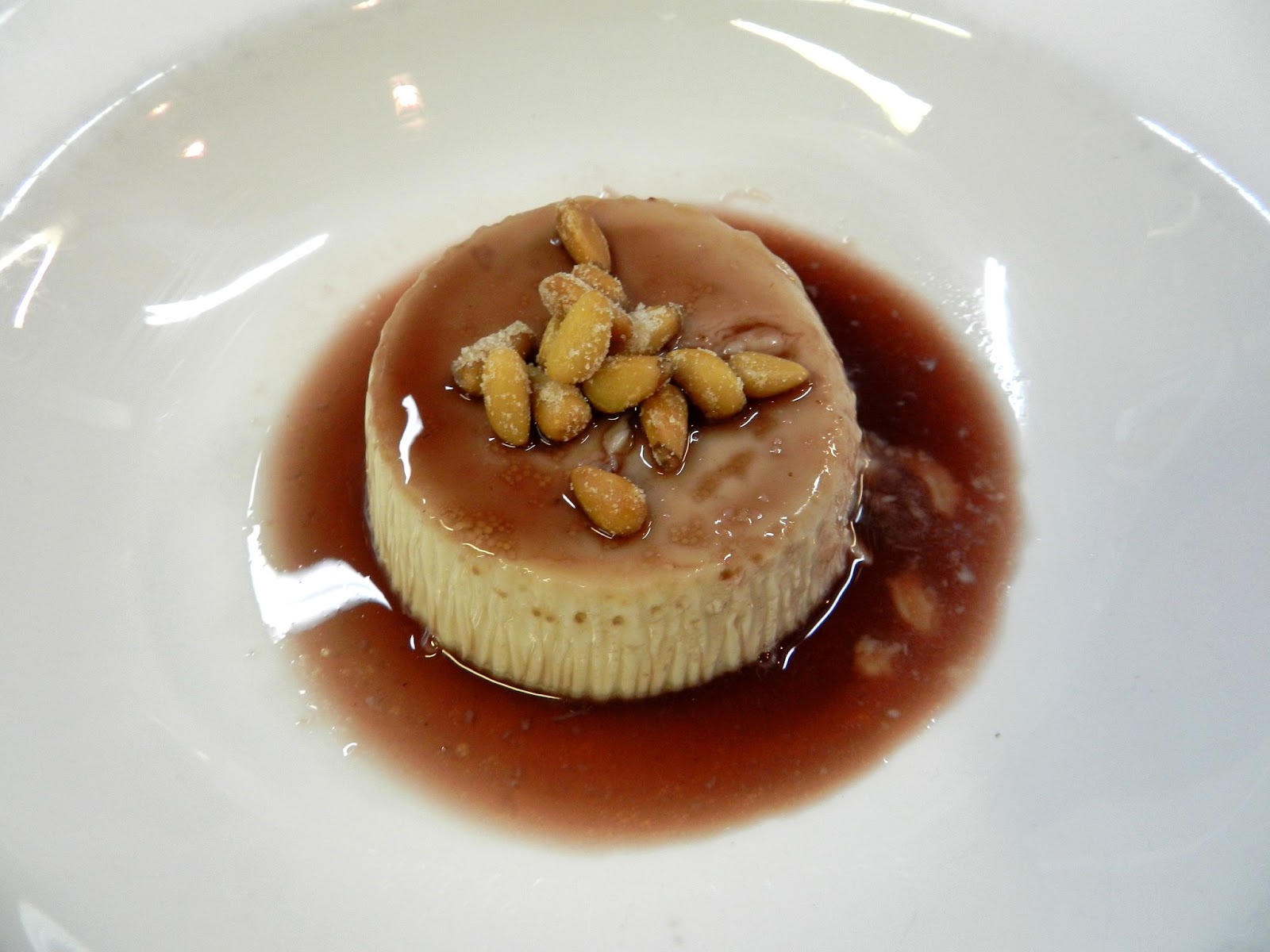
Piemonte: Chestnut and Red Wine Panna Cotta. Panna cotta is a classic dish that I associate most closely with the Piemonte. This is a two-layer panna cotta of jellified Nebbiolo wine and a chestnut cream. I have gently reheated the panna cotta so that the red wine layer has just about melted, forming a sauce à la crème caramel. Topped with candied pine nuts.

Saturday, April 21, 2012

"Spring"—A Chef's Tasting

We just did a Chef's Tasting on Thursday night with the theme of Spring. We decided to let the menu be informed by not only the ingredients that are available now in the spring but by the ideas and memories evoked by the season.

I am really pleased with this menu and think that it clearly states who I am as a chef right now and speaks to the food that appeals to me: simple, fresh, direct, highly flavorful, yet still a bit whimsical and playful, not too serious for its own good. I like this menu because the dishes are largely pared to their essence—not too many ingredients on the plate, but just enough. It is very difficult as a chef to pare dishes to their core: it forces excellence in the thought behind a dish, the ingredients themselves, and of course, in technique.

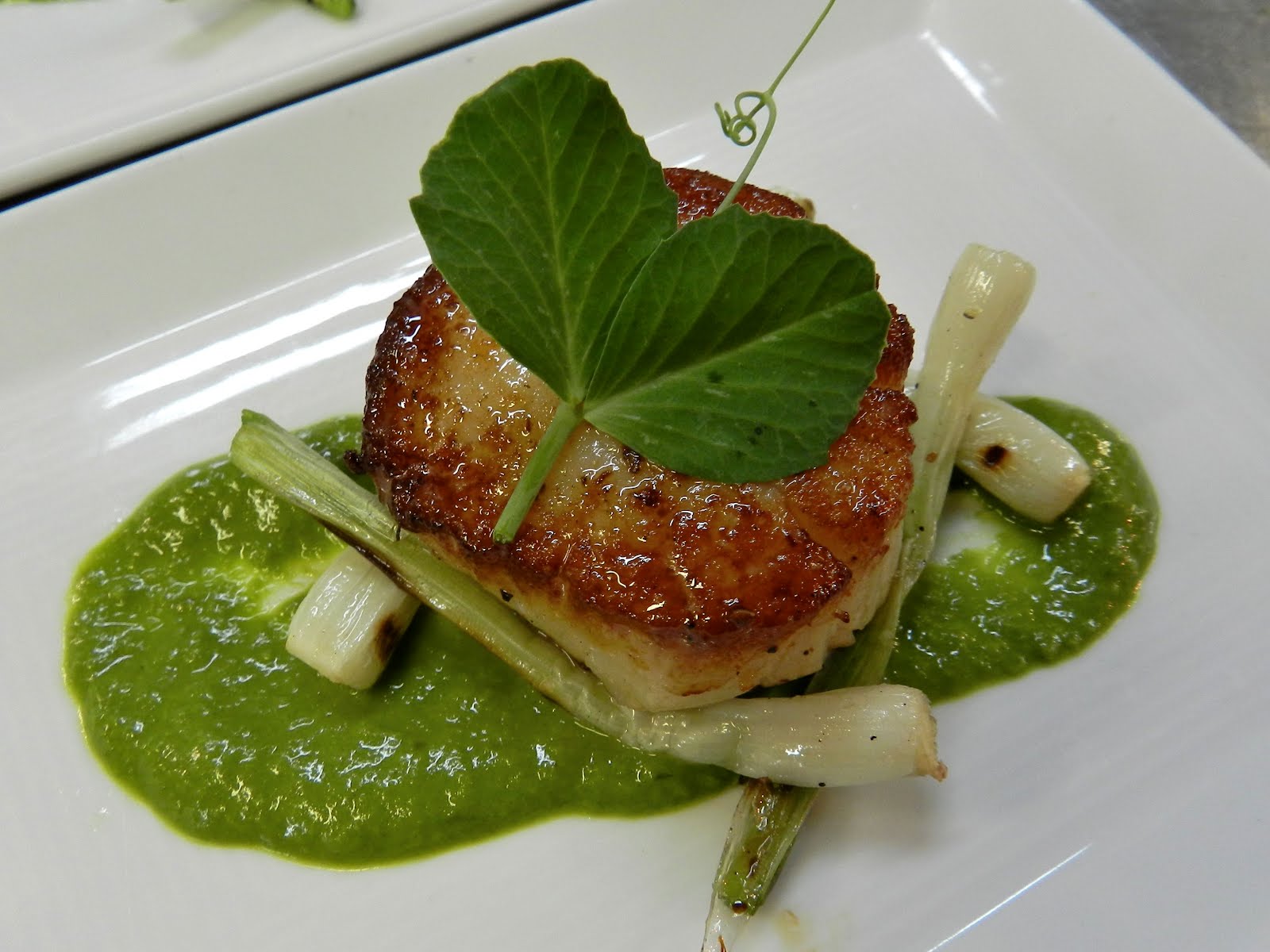
Sea Scallop. Spring always brings great scallops as new grounds are opened. I wanted to highlight our beautiful scallops against some of our local spring greens. The scallop is sitting on a purée of ramp greens and grilled baby spring onions and topped with a sugar snap tendril from my garden. The ramp bulbs have long since vanished into sopa de ajo.


Arctic Char. Spring always has me looking forward to salmon as it begins its spawning run up the rivers. It's just a little too early yet for salmon, but we do have two nice salmonids in house right now, arctic char and steelhead trout. Last week, we put up a batch of cured steelhead trout, so-called gravlax of steelhead trout, and we had a bunch of trimmings to work with.

On this plate, you see a mousse of roasted steelhead gravlax, fennel fronds from my garden, very lightly pickled hothouse cucumbers, seared arctic char, and a wonton containing gravlax, chives, and sour cream. The wonton came from wanting some crunchy element on the dish. And in the end, we decided to take the traditional bagel toppings and put them inside a crispy wonton as a somewhat cheesy (pun intended) nod to the God-awful crab rangoon served in ersatz Chinese restaurants. A little humor never hurt a dish as far I can tell.


Eggs, Bacon, and Toast. Now that spring has sprung and the days are getting longer, Sarah's ducks are cranking out far more eggs that we can possibly use to make our pastries. [Oh by the way, wondering why our pastries are so good? Blame the duck eggs!] So this dish was born of a need to consume duck eggs and of course also to showcase our awesome house-cured Berkshire pork belly.

Down on the plate, you see grilled and buttered focaccia topped with maple syrup-braised pork belly and a poached duck egg. We went through a dozen different plate presentations and finally in the spirit of consuming as many duck eggs as possible, decided to benedictify it with a lemon zest-augmented hollandaise. This sublime stack of wanton sinfulness is bejeweled with a crown of cilantro flowers from my garden.


Risotto. This dish didn't start as a risotto at all. For the longest time, it was just a list of ingredients: asparagus, morels, and duck confit. Our guests were very lucky that the first asparagus and the first morels of the year arrived in our kitchen simultaneously, lucky because they are ingredients that marry in the best kind of way. Morels, the king of mushrooms (you bolete fans are all wrong), deserve, no, they cry out for cured pork products. And what is better than cured pork? Our house-cured duck confit all poached in its unctuous duck fat bath!

So we had three awesome flavors that needed a neutral base to carry them and hence the risotto entered the picture, the rice marrying the ingredients and serving as a base for the garnishes: grilled asparagus, chive blossoms from my garden, and a morel dipped in cornstarch and crisped in hot oil. Ambrosial!


Picnic. I don't know what spring has on your mind, but a picnic is definitely on my mind. This dish is our homage to classic American picnic food: fried chicken, deviled eggs, and potato salad. Our fried chicken is an herb-marinated and grilled quail. Our deviled eggs are naturally quail eggs. And our potato salad, well, it is better than most potato salad you will ever eat, is instantly recognizable as potato salad, and yet, contains zero potatoes.

The potato salad is down on the plate letting us stand the boned-out quail up against it with the deviled egg halves nestled against it. Just under the quail and spilling out to the side of the eggs is an outstanding amarena cherry mosto cotto, cherry juice and grape must cooked down to almost a balsamic vinegar like syrup. To complete the cherry metaphor is a bit of dried cherry and celery salsa. Not only is it a great palate cleanser with the sweet-tart cherry working against the bitter crunchy celery, it is a reminder that cherries, that most delicious and first stone fruit of the new year, are just around the corner.

Oh, the potato salad. It's celery root, red onion, green onion, Surry sausage (our local Virginia smoked pork sausage), and parsley, all bound with mayonnaise.


Spring Lamb. No protein could be more spring in my mind than spring lamb and this one just arrived from the slaughterhouse. This lamb is so good that it really didn't need us to do much with it. I made a pesto from the tons of fresh mint growing in the boxes out in front of the restaurant and after boning out the lamb saddle, marinated the deboned loins in the pesto. In the vein of not doing very much with the lamb, I decided to serve it very classically, with pommes duchesse, mashed potatoes augmented with [duck] egg yolks and baked. Although you can't see it, the lamb is napped with a glace d'agneau, a highly concentrated lamb stock that we made from all the bones from the last lamb we received. It is so concentrated that it remains jellied at room temperature. We reheated it with a little white truffle juice.

The herbs I picked from my backyard in the morning. The lower herb in the photo is sheep sorrel which I included because lemony sorrel and lamb is a classic pairing, but also because I found it amusing to pair sheep with lamb! Corny, but true. The yellow blossom and the leaf above it is from a wild mustard plant. Lamb and mustard is a delicious combo. I often will drain the pan juices into a sauce pan after roasting a leg of lamb, add a little red wine, a little lamb glace, and then after straining it, will add Dijon mustard as a liaison to thicken the sauce. That, for me, is what the mustard greens on this plate evoke.


Rhubarb. Before there is any fruit in the spring, there is rhubarb, very much a vegetable, but one that we treat as a fruit. The only question here was how to provide a delicious foil for the sweet-tart rhubarb compote (rhubarb, cranberry juice, and sugar). Spring leads me to light desserts and light always leads me to Greek yogurt panna cotta, this one flavored with lemon zest and poppy seeds. For garnishes, you see a poppy seed tuile and lemon balm from my garden. The surprising element here is the black locust blossoms which had just opened for the very first time the morning of the dinner. I picked these from the backyard and just before serving them, tossed them in a dressing of honey, lemon juice, and lemon zest. The locust blossoms have a flavor at sweet pea crossed with honeysuckle nectar. They are delicious.

Saturday, February 19, 2011

Chef's Tasting

We just did a tasting for Phil and Deirdre Armstrong of Harvest Thyme Herb Farm in Staunton, VA, suppliers of herbs and vegetables to fine restaurants in the Staunton and Charlottesville area, as well as fellow bloggers. We wish we lived closer together so that we could work together.


Gravlax of Brook Trout. I'm a sucker for all kinds of cured and smoked fish, so when I got a delivery of way too many brookies, I decided to do a traditional salmon cure on some of them, hence the appropriation of the term gravlax. Garnishes are caperberries, dilled sour cream, red ribbon (aka blood) sorrel from the flats growing in our kitchen, and chervil which overwintered outside on the deck. I especially like the deep red color that the overwintered chervil takes on.

The crispy brown bits are parsnip crisps, something that we arrived at serendipitously. I love to serve smoked fish with latkes and we have been doing a lot of parnsip latkes lately. The night before the tasting, one of the cooks made a latke that was too big to fit onto the komatsuna garnish that I had already laid out on a plate, so I had him cut the latke down with a round cutter. That left all the crispy edge bits on the cutting board for chef snackies. The crispy edge bits were so good that we decided to do all crispy bits for the tasting.


Guinea Breast. We had a couple of guinea breasts laying around with no other use in mind, so we did a little ghetto sous vide on them and served them in a bowl of Surry sausage jus, with blanched Kentucky Wonder bean sprouts. Who knew you could eat baby bean plants? I sure as hell didn't think of it until Billie Clifton of Sunflower Cottage, our local microgreen supplier, brought some in a couple weeks back. To answer your question, they taste just like green beans. Go figure.


Porcini Carolina Gold Risotto with Wild Mushrooms, Guanciale, and Sage. We just had to do a wild mushroom course because we have wild mushrooms coming out of our ears now. It's been a great winter season for both black trumpets and hedgehogs. This is a really simple risotto of Anson Mills Carolina Gold rice, dried porcini, fresh sage from my home garden, and spectacular guanciale from La Quercia in Iowa. This is the last of my supply from La Quercia but even as good as it is, I'm looking forward to trying the guanciale from the home team in Manakin, VA, Olli Salumeria Americana. How cool is it to have two great suppliers of guanciale?

Garnishes are black trumpet mushrooms, hedgehog mushrooms, prosciutto crsips, fresh sage, and a cheese crisp made from porcini powder and pecorino Sardo. What you don't see in the photo is the barely poached quail egg beneath the robe of risotto. I love this trick. The egg yolk really enriches the risotto.


Pork Confit with Polenta Poblano Spoonbread and Salsa Verde. Ordinarily we don't do tomatillos out of season, but they were already in house from a very specific tasting that we did last weekend. I like to think of this dish as something you would get if your Southern grandma were of Mexican descent. It combines Southern classics spoonbread and fried green tomatoes with poblanos and salsa verde. And the crispy pork confit evokes carnitas, but the flavor is different because we used some orange zest and cognac in seasoning the pork before we cured it.

So what you see on the plate from left to right is a swoosh of salsa verde (poblanos, onions, tomatillos, cilantro, garlic), a fried green tomatillo, crispy pork confit threads, pimentón sauce (the orange sauce), and a cube of pork confit sitting on top of the spoonbread (leftover polenta, roasted poblano purée, cream, and eggs).


Bestilla of Border Springs Lamb. We get lambs in on a regular basis and tend to use the primary cuts (racks, loin chops, and legs) first. Then we end up with a lot of tiny foreshanks and necks in freezer after several months. That's when I get to braising, because braising is my favorite cooking technique and the neck and shank meat is the best meat on the lamb. This time, Craig's wonderful lamb ended up in a classic Moroccan tagine, a stew redolent of spices. I have made hundreds of tagines in my career and this was one of the best; I'm really honing in on just about the perfect spicing to showcase the lamb without overwhelming it. After braising, the lamb gets separated from the vegetables and the sauce. The lamb gets pulled and mixed back with the vegetables and the defatted and reduced sauce.

I wanted to showcase this beautiful pulled lamb, so I came pretty quickly to a classic bestilla. Rather than scramble eggs into the filling in the classic manner, I packed the pastries with lamb and buried a raw quail egg in the center, which then baked into a solid egg in the oven. We generally accompany our lamb tagine with chizu, a spicy carrot slaw. I wanted to use the chizu as a sauce and so we made a vinaigrette of it like we do with kimchee à la David Chang of Momofuku. Because of the high water content in the carrots, we had to use a touch of xanthan to bind the water and keep the vinaigrette from bleeding. The other sauce is a mixture of ras al hanout (an Arab spice mix) and Greek yogurt.

The salad garnish we called a winter salad. It consists of everything green that we could find, dressed with a preserved lemon vinaigrette. From what I remember, the salad contains brussels sprouts petals, tiny broccoli leaves, micro arugula, micro bulls blood beets, and chervil.


White Chocolate Goat Cheese Cheesecake with Sweet Potato, Almond, and Cranberry Florentine. I wanted to use sweet potatoes in the dessert course and it struck me to substitute them for the candied orange peel in a classic florentine, a crunchy cookie containing nuts and candied fruit glued together with honey, cream, and sugar. Florentines are often coated or drizzled with chocolate. We coated ours entirely with white chocolate and then used the Florentine as a crust for a white chocolate and goat cheese cheesecake. I've made hundreds if not thousands of cheesecakes in my life, but never with goat cheese, although that seems a pretty obvious thing to do. I enjoyed the goat cheese flavor; it reminded me of a panna cotta made with yogurt in which the acidity of the cheese/yogurt plays off the sugar to give a well balanced end result. Garnish is a drizzle of blueberry crème anglaise.