Showing posts with label grits. Show all posts

Thursday, April 11, 2013

Chef's Tasting

Friends came by recently for a tasting and here is what they ate. Although it wasn't intentional, there's a bit of an egg theme going on here, with quail, duck, and goose eggs featured. It's just a good thing that the birds are laying again!

Salmon Three Ways
Salmon Three Ways. We were just looking for something bright and fresh to start the meal with and we just happen to have some beautiful salmon on hand now. I made a quasi tartare sauce with cornichons, capers, dill, and finely minced gravlax that I topped with a nice piece of fatty belly and then that with a brined, pepper-crusted, and smoked piece of salmon.

Duck and Maitake Mushroom Frittata
Duck and Maitake Mushroom Frittata. We made a simple frittata of duck confit, maitake mushrooms, and duck eggs and then paired it with a daikon and cucumber kimchee, to have something bright to offset the richness of the frittata. This dish sounded fine on paper, but it seems an incomplete thought to me.

Breakfast
Breakfast. There have been many breakfast variations on our tasting menus over the years, because it is just such a damned good dish. This version was designed to show off my latest sausage: ground pork shoulder, Mangalitsa pork belly, and prune purée. The maple syrup is now local from Gene Nowak at Mayfair Farm.


Rabbit Loin with Fennel-Chestnut Sauce

Rabbit Loin. This dish doesn't look all that bright, but I guarantee it was the best dish of the meal. The loin is rolled in fennel pollen before seeing the grill for just long enough to mark it up. Rabbit and fennel is a sublime combination and this sauce that I created last week with caramelized fennel and chestnuts is simply amazing. Note the rabbit loin cooked only to medium; that's how you have to do it.

Lamb Sausage, Moroccan Carrot Slaw, Chickpea Cake
Lamb Sausage. I like the vibrant spices and flavors from northern Africa and tried to bring them together here on a plate. The herbaceous and garlicky lamb sausage is mixed with a carrot slaw made from a fiery harissa and julienned carrots. I made this harissa rather heavier with caraway and fennel than I usually do. The chickpea cake is flavored with sun-dried tomatoes, olives, and some of the preserved lemons that we put up last fall.

"Duck à l'Orange"
Duck à l'Orange. When we break down ducks, legs for confit and breasts for grilling or roasting, we collect the so-called breast tenders, the little muscle that sits atop the breast bone beneath the breast itself. These we pounded out and schnitzled in a crust of panko and five-spice powder. Garnished with orange brown butter, orange suprêmes, and a little salad of micro arugula and tiny mint leaves from our bed outside the restaurant.

Chocolate Peanut Cake, Cayenne Peanut Brittle, Goose Egg Anglaise
Chocolate-Peanut Cake. This is merely chocolate ganache, peanut butter, and goose eggs baked in a water bath until somewhat set, then gently rewarmed so that the center is very gooey and nearly runny. Garnishes are a goose egg crème anglaise, cassis jam, and a peanut brittle that I have made with a lot of salt (salty caramel, yum!) and cayenne pepper. Surprise!

Friday, February 22, 2013

Chef's Tasting

And now post-Valentine's Day, we start a whole series of tastings. Winter is seriously the most challenging time to do tastings as the showy summer fruits and vegetables are absent. We had fun with this menu making do with what we had on hand.

Smoked Salmon "Latke"
Smoked Salmon "Latke". Tony came up with the idea of inverting the smoked salmon and the potato, putting whipped potatoes on top of a thin pancake of shredded smoked salmon, capers, and dill. A twist on your mom's salmon croquettes.

Potted Rabbit
Potted Rabbit. We're blessed to have plenty of rabbits on hand and sometimes when we have too many, we conserve the rabbit by curing it and slow-poaching it in duck fat, then shredding the meat, seasoning it, and mixing it with the highly reduced braising liquid and more fat, then sealing it in a container under a layer of fat. Sound like rillettes? It is.

Hedgehog Mushrooms on Goat Grits
Hedgehog Mushrooms on Goat Grits. Recently, I've been on a kick of enriching my grits with goat cheese, especially to serve with a high acid red wine. On top is a mix of hedgehog mushrooms, roasted sweet potatoes, and spinach.


Sweetbreads
Sweetbreads. There may be no finer meat to eat than sweetbreads, these from our friends Bill and Holly at Martin's Angus Beef, our regular beef supplier. After poaching in court bouillon, being pressed overnight, and then cleaned, these labor-intensive nuggets have been hard-seared in pancetta oil after being tossed in Wondra and then finished with a splash each of heavy cream and veal glace. Did I mention a bit of black truffles as well? The green is cavolo nero.

Pork Pâté en Croûte
Pork Pâté en Croûte. I made a freaking awesome pork terrine earlier this week from pork shoulder, pork belly, and pork liver and I wanted to serve it for my tastings this week. But I didn't want to do the cold first course kind of thing with it because it has been so cold this week. Tony came up with the idea of wrapping the slices in pastry and then at some later point, we had made this awesome tart apricot chutney that was just hanging out waiting to be used, and so it went inside as well. Served with a whole-grain mustard vinaigrette to help tame the unctuousness of the terrine and the pastry.

Wild Boar Bobotie
Wild Boar Bobotie. I'm just going to say it right here and right now: feral wild boar is wild for a reason; it's barely worth eating. Domestic pork is so, so, so much tastier, fatter, and easier to work with. These big feral bastards from Texas are lean, stringy, chewy, and taste much more like beef than pork. Your idea of a good time? Not mine. So what can you do with it? Mostly, we grind it and add a hell of a lot of fat. And then we try to figure out what to do with pounds and pounds of ground boar. And bobotie, the unofficial national dish of South Africa, is a great way to use ground meat. More commonly made from lamb and/or beef, bobotie is an Indian-spiced mince pie topped with an egg custard. This one contains golden raisins, diced apricots, and diced apple.

Lime Curd Parfait
Lime Curd Parfait. With most of our dessert wines, something light and citrusy is called for, if we are not doing a savory profile dessert. Lime whip, lime curd, crème anglaise, and shortbread crumbles make this a tart and light finish to a heavy winter menu.

Thursday, November 29, 2012

Chef's Tasting

We've done a lot of tastings recently, but I haven't posted many pictures mostly because the dishes don't have striking color this time of year like they do in the summer. Long gone are the gorgeous reds of ripe tomatoes and peppers, the bright green of peas and snow peas, and the delicate yellows of squash blooms and corn. In now are the browns, rusts, tans, beiges, and whites of our winter vegetables and while they are not as photogenic as their summer cousins, they are equally delicious.

Without further ado then, one of our most recent tastings:

Charcuterie Trio
Charcuterie Trio. In the foreground you see a veal tongue terrine set in aspic with a lot of fresh parsley à la the French classic jambon persillé. In the middle is a swirl of rabbit liver mousse flavored with Cognac and on the far end, a terrine of ground Berkshire pork shoulder flavored with all kinds of delicious bits.

Cauliflower, Maitake Mushrooms, and Leeks
Cauliflower and Leeks. These are two vegetables that many people pass over without a second thought but which are incredibly fun for us chefs to work with. The cauliflower has been roasted to the point of caramelization and then made into the silkiest of sauces: it is really something you just want to wallow in! The leeks have been creamed and then wrapped in phyllo for presentation purposes, and these little triangles are decadently delicious. Crispy maitake mushrooms and dots of truffle-infused balsamic vinegar complete the plate, the earthy mushroomy flavors playing off the rich creamy cauliflower and leeks, and the vinegar delivering the acid that keeps this dish from being cloying.

Scallop, Pork Belly, Sweet Potatoes, and Black Truffles
Scallop and Pork Belly. Not too much original here, but this is a damn fine course that I would be happy to be served at a restaurant. Scallop on top of house-cured pork belly on top of a silky sweet potato purée, all napped with a tart black truffle beurre blanc.

People always ask me how to make pork belly, thinking that they are going to make it at home, but then start wincing about the time I get to the third of the fourth cookings! We cure it for a length of time dependent on the thickness of the belly, then brown/damn near char it in a very hot oven, then braise it, then refrigerate it, then confit it under duck fat, then refrigerate it under duck fat for a long period, then slice it, and pan fry it. Sure, you can do it at home but why would you want to? You can achieve 90 percent of the results with a much simpler process and that it good enough for home. The extra pain that we go through to make it the very best pork belly you've ever eaten, you should leave to us.

Duck, Rabbit, Spätzle, and Brussels Sprouts
Duck and Rabbit. It's winter and for some reason, the cute little brussels sprouts keep making us think of schnitzel. Here, we have taken a tenderloin off of a rabbit and the so-called tenderloin off a duck breast (the little tender piece on the under side of the breast) and pounded them side-by-side, slightly overlapped, so that they form a single piece of schnitzel from two very different meats. They're breaded in a five-spice panko and served with sweet and sour sprout hash and orange spätzle. I thinly sliced the sprouts, some shallots, and some of my house-cured pancetta. After caramelizing the pancetta and shallots, I added the sprouts and cooked them until bright green, just a few seconds. Then into the pan with a tiny bit of butter, a pinch of sugar, and a taste of white balsamic vinegar. Done and delicious! Even so-called sprout haters love them this way!

Pork Cheek, Grits, Gremolata, and Pork Jus
Pork and Grits. We serve a lot of pork and grits in various guises, mostly because how insanely good is the combination of any kind of pork with corn? This is a slow-cooked Berkshire pork cheek, crisped in a black steel pan, on grits, topped with gremolata, and napped with what we call "pork goodness," the juices left in the bottom of the pan after cooking our pork belly.

Venison, Flower Sprouts, Blueberry Salad, and Tasmanian Pepper
Venison. It's venison season once again and we are working our way through a few rear haunches. I seam out the legs into individual muscles and then break those down into steaks which I marinate for a couple of days. Then I grill them, very, very rare. Here you see the grilled and sliced venison plated with a dried blueberry and celery salad, and the first so-called "flower sprouts" that I have ever seen. These are a new (and according to the farmer that grew these, not very stable) cross between brussels sprouts and kale. The resulting plant has a long central stalk like a brussels sprout plant, but instead of miniature cabbages, it has little broccoli-like whorls of leaves without any sign of a bloom. These were deep purple before blanching and now they are very deep forest green. Despite their novelty and interesting appearance, I have already told the grower that they are not worth growing again: the flavor is not as good as either of the parents. She said, "good to know; they are a pain to harvest." And so it goes.

Chocolate and Cranberries
Chocolate and Cranberries. Being just after Thanksgiving, we have lots of cranberries in the cooler, looking for ways to get on plates. I made a bunch of them into a delicious whole berry jelly (or jam, if you are so inclined to call it that). This dessert starts with a simple disk of flourless chocolate torte, then a layer of orange cream cheese, a layer of jelly, and finally a swirl of cream cheese. This rich but not very sweet dessert I designed to go with a glass of Malbec. I liked the pairing a lot.

Friday, September 14, 2012

Another Tasting

And the fall dishes keep coming. This tasting is all about two things: comfort and flavor. No boundary pushing, no fancy food, just pure flavors, simple presentations, and awesomeness of ingredients.

Chowder/Lentil Shoots/Scallop/Black Truffle Beurre Blanc

Duck Confit Pupusa/Orange Salad

Crispy Cavolo Nero/Grits/Quail Stuffed with Cannellini, Smoked Sausage, and Sage/Cacciatore Sauce

Corn-Thyme Crème Caramel/Pickled Figs/Duck Breast/Tiny Green Beans/Tasmanian Pepper Syrup

Orange Polenta Upside Down Cake/Coconut Sorbet/Crème Anglaise

Saturday, June 9, 2012

Chef's Tasting

Here are photos from last night's Chef's Tasting. Appearing for the first time this year are cherries, summer squash, sockeye salmon, new potatoes, and red raspberries. This is likely the very last tasting of the year to feature strawberries and asparagus: only the weather knows for sure.

Deviled Egg
This dish is the happy coincidence of foie gras and duck eggs. You know, the late afternoon, between shifts conversation on the deck that goes like, "What happens if we mix foie gras into a deviled egg?" The result is so rich that it can only be eaten in tiny quantities. Notice the relative size of the cornichon fan to the egg-foie mousse. We kept adding more and more pickle brine to the mousse to balance the fat and the acid. The olive-looking critter in the center is a truffled pickled immature peach.

Sockeye Salmon
Over the years, I have done many takes on a dish of salmon and Thai curry and this is another. The sauce is a green Thai curry and the green dots are a curried avocado mousse. In the center of the plate are cubes of deep-fried salmon and avocado, topped with some tobiko for crunch and a little Thai basil.

Soft Shell Crab
Not much to say here except the salad is awesome. It's a mix of Beth's mesclun, bean sprouts, carrots, Thai basil, cilantro, and green onions tossed in a dressing of vinegar, sugar, lime juice, fish sauce, chile paste, and garlic. Very Vietnamese and very cooling and refreshing.

June Salad
Gorgeous! The first new potatoes of the year down in a ring with grilled asparagus over and then topped with a sauté of peas, asparagus, and morels in a white wine and shallot butter sauce. A quail egg gilds the lily. These peas are so amazingly sweet that we probably ate more than half of what we shelled. They are addictive!

Squash and Goat Cheese
This is a quick taste of summer in an otherwise late spring menu. Because of our crazy spring, everything is running 2-3 weeks early, including these awesome pattypan squash that we sliced, grilled, and stacked with rounds of fried goat cheese. The goat cheese is an amazingly creamy product that was made locally on Wednesday (and served on Friday). We mixed it with roasted red pepper before forming it into rounds and breading it. A drizzle of pesto and some borage blossoms complete the garnishes.

Pork and Cherries
We love cherry season! Sorry this photo is so dark. All hell was breaking loose in the kitchen at the time: the dining room was full and our ticket rail was overflowing onto the counter. We were in hyperdrive, which lends itself not at all to decent photography. On the left there is a pork cheek, braised, chilled, sliced, and crisped in a steel pan, topped with a cherry-celery salsa. Cherries and celery, sweet and bitter, yin and yang, awesome! In the center on top of the grits is a piece of our pork belly topped with the remains of our dried cherry olivada, a tapenade-like relish. On the right is a salad of microgreens and pork confit threads. We cure the pork confit and age it under duck fat. For this dish, we shredded it and deep fried it, then mixed it with greens and tossed it in a cherry vinaigrette. All our pork is certified Berkshire.

Berries
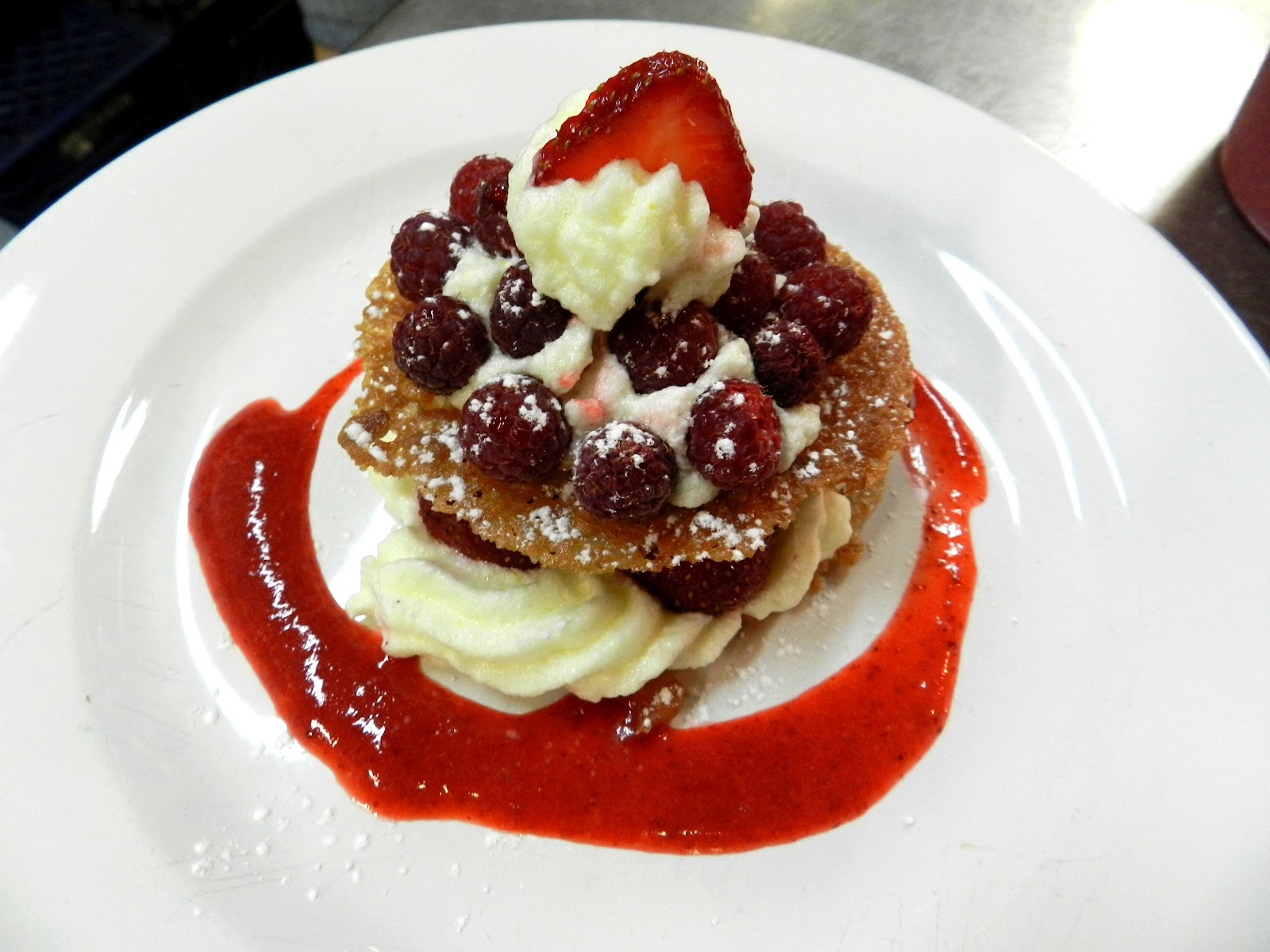
This is a fun and light way to celebrate the end of strawberries and the beginning of raspberries. Their seasons only ever overlap for a week or two. I baked some oatmeal tuiles and layered them with a lemon meringue and fresh berries. Simple, light, and a fitting ending to a late spring menu.

Wednesday, November 23, 2011

Chef's Tasting

Here are photos from a series of recent tastings. These dishes pretty clearly reflect what is in the farmers market currently. I really like how we were able to incorporate root vegetables in so many dishes. It happened organically as a function of what we have on hand (and on the brain) now rather than as an exercise in making a menu around root vegetables. Organically formed menus tend to be the best and I really like this menu for that very reason.

Squash Cake. Cake of grated yellow and green squashes long-cooked with cream and formed into cakes, garnished with tomato vinaigrette, tzatziki, pesto, and a pecorino tuile. I bought every last squash that Beth had about two weeks ago and we have been keeping them in the cooler and eking them out, trying desperately to hang on to a little bit of summer. We've never had summer squash this late into the year and it is really thanks to the crappy crop we had during the summer that Gene planted a second, late crop of which this is the very bitter end.

Cauliflower Mushrooms with Guanciale and Broccoli. No brainer, really, in that Joe just sent us a 15-pound cauliflower mushroom. With its delightfully woodsy scent, this mushroom is a real crowd pleaser and its resemblance to egg noodles often influences how we prepare it: today, very simply with some Jowciale (smoked hog jowl from our friends at Edwards) and tiny broccoli florets.

Napoleon of Seared Sea Scallops and Parsnip-Leek Latkes. This send up of scallop chowder features crispy sweet parsnip-leek latkes, a warm bacon-inflected leek and potato soup, cubes of roasted butternut squash, puffed wild rice (more addictive than crack) and mâche. After much experimentation, we have found that parsnip latkes benefit from 25% potato, to help them hold together and fry more crisply without burning.

Pork & Grits. In our mission to convert the world to the Pork Belly Legion™, it seems that no tasting menu can omit at least one pork belly course. Here you see our house-cured pork belly fried to a crispy turn atop creamy Anson Mills grits coarse grits with a splash of local hickory bark syrup and a red grape “olivada.” The olivada is a condiment that we made for a big Italian-themed dinner back in October, a condiment that we liked so much that we keep on making it. It is son of the Cherry Tapenade that I created back in the spring and consists of red grapes, olives, capers, anchovies, lemon juice, oregano, and olive oil.

More Pork. Seriously, what to follow pork belly but more pork? This dish was inspired by an incredibly beautiful savoy cabbage that I scored at the market and what you see is the answer to the question, "How shall we honor this beautiful cabbage?" What you see is a most non-traditional cabbage roll, stuffed with pulled pork shank and raw turnip julienne, then coated in Dijon mustard and rolled in panko and fried. It sits in a pool of pork gravy from braising the shanks and is garnished with a few chanterelles. I like to think of this as a very Western reimagining of a spring roll.

Grilled Five-Spice Venison Loin. This dish screams late fall to me. You see a five spice-rubbed grilled loin of venison with butternut cream, a root vegetable hash, maple syrup, and a fresh fig compote made with the last of this year's figs. The star of this dish is not the venison but rather the humble hash, made from cubes of guanciale, parsnips, celery root, butternut squash, and fingerling potato along with dried cranberries and onions, all flambéed in bourbon. This hash is insanely good!

Maple-Butternut Flan with Milk Chocolate Cremoso. What does a non-sweet eating chef use for dessert when there's precious little fruit about? Root veg, of course! Here you see a killer flan made of butternut purée, maple syrup, and cinnamon. The garnishes are a rich fudgy curl of milk chocolate cremoso (stolen shamelessly from pastry chef Hedy Goldsmith via Michael Schwartz, a chef whom I have never met, but who is clearly a fellow spirit), maple syrup, crème anglaise, gianduia (chocolate-hazelnut) powder, and a wicked good sunflower seed brittle that I made with sea salt and smoky pimentón.

Friday, January 21, 2011

Seafood and Root Vegetables

Root Vegetables. They're just not that cool, but that's pretty much what is in our cooler right now, it being the middle of winter. And when a couple from Warrenton engaged us to do a tasting menu for them last week, that is all we had in house to work with. They also requested no meat for their menu, but they love all manner of seafood, so we used that as our starting point for their custom menu.

While planning their menu, I had this slightly whack idea: why not pair a different seafood with a different winter root vegetable for each course, except for dessert? So we randomly paired each of six seafoods with six winter root vegetables used this as the basis for our menu. Doing the menu this way proved to be a great intellectual challenge: pairing seafood with root vegetables is rarely ever done. Here are the results of our brainstorming.


Scallops and Parsnips. We took our cue for this dish from brandade de morue from the south of France. The modern interpretation of brandade is a silky paste of salt cod, potatoes, olive oil, and garlic. We decided to try it with salted scallops and parsnips instead. And topped with a seared scallop, it worked extremely well. We're very pleased with this dish.


Crab and Sweet Potatoes. This is a complexly flavored sweet potato bisque seasoned with kaffir lime, green curry paste, Thai basil, and coconut milk. I no longer remember the genesis of this soup, but I think we have done similar sauces in the past. The bisque is topped with crabmeat marinated in a kaffir lime vinaigrette. We liked this so much that it went directly on to our nightly menu as an appetizer.


Oysters and Celery Root. We've done a lot of celery root purées this winter already and were looking for different ways to showcase this delicious vegetable, especially for a way to highlight it in its raw form. Immediately springing to mind was a celery root rémoulade that I had at Tujague's in New Orleans about 20 years ago. From here, it was an easy leap to an oyster Po Boy topped with celery rémoulade. The celery root fries were a last minute addition and the answer to the question to my cooks, "Does celery root make good fries?" Indeed, it does not. It makes outstanding fries. Live and learn.


Lobster and Leeks. This is what happens when we take our shrimp and grits from the lunch menu and amp it up with lobster, leeks, and truffles. The grits are Anson Mills as usual, but amended with a lot of creamed leeks. Truly decadent grits. The lobster is just along for the ride when compared to these grits.


Mussels and Red Onions. I confess that I went really overboard here. I am the one chef that you can generally count on not to mess with the form of an ingredient and here I go making mussels into a musselwurst. I have done every form of fried, stuffed, baked, and steamed mussel imaginable over the years and for some reason, I decided to just go crazy. So we have a mussel and caramelized red onion sausage on a bun with caramelized red onion mustard, caramelized red onions, and pickled red onions. It was a damned good seafood sausage if I say so myself, but my bun, to be polite, sucked.


Fish and Daikon. And finally, we deal with daikon. There's a ton of daikon at the farmers market now and I've been using a lot of it. Daikon led me to free associate with sablefish because sablefish is very highly prized in Japan. The natural application for daikon is raw and done in an Asian theme, so I wanted to stay away from that. I kept saying to the cooks, "Let's do something classic and French." We tried a bunch of things from grilled daikon, OK, to red wine-braised daikon, horrible, when Chris said, "Daikon Pommes Anna!" So we have seared sablefish on a daikon "pommes Anna" with wild mushrooms and a beurre rouge. The daikon pommes Anna was very tricky to pull off; daikon does not have the starch that potatoes do, so getting the cake to hold together was a problem. Once the technical issue was resolved, the result is a beautiful and classically European take on ingredients that are typically treated in an Asian style. Mission accomplished!

Saturday, November 22, 2008

Shrimp and Grits

If ever there were a dish that screamed "Charleston!", Shrimp and Grits would be it. The following recipe records what I made in my latest cooking class on Low Country cuisine.

I've tasted many dozens of versions of this dish and they're all good. I guarantee that my version, informed by my sensibilities and the ingredients available to me in my locale, is different from what your ancestors might have made, but it suits me to a T. That is to say that I am treading on some sacred ground here: I'm not a native Sandlapper and I know already that your grandmother makes the world's best version of Shrimp and Grits. People have started small land wars over the "correct" version of Shrimp and Grits, for goodness sake.

I don't want any part of your little wars. Just remember that while this isn't grandma's shrimp and grits, you might actually find you like it, if you can bring yourself to make it.

The first thing to talk about is grits. I have told you all I need to tell you in my recent posted entitled Grits 101. In that post, I introduce a couple of new tricks that you old dogs should probably read. If your grits suck and you didn't read my post, don't blame me. And, if you did read my post and your grits still suck, don't blame me either: I didn't cook them!

The next thing to talk about is shrimp. What you want is very fresh, small, head on shrimp right out of your own net. But, if you're like me, that's not happening in your neighborhood until Hell freezes over. If you've got some, by all means, bring them down to the restaurant and I will personally make the Shrimp and Grits for you. All the fat in the head of the shrimp will make this dish mind-blowingly good. Sadly, I'm using 16-20 count peeled and deveined Gulf brown shrimp, available at a supermarket near you.

My version of Shrimp and Grits has a lemony butter sauce redolent of thyme and smoky from Surry sausage. The following recipe serves four.

Shrimp and Grits

1 tablespoon vegetable oil
4 shallots, thinly sliced vertically
4 Surry sausages, diced
1 pound shrimp, peeled and deveined
1 teaspoon minced garlic
1 bunch green onions, bias cut into 3/4-inch segments
1 tablespoon fresh thyme leaves
1 tablespoon minced fresh Italian parsley
pinch of crushed red pepper flakes
2 lemons
1/4 cup dry white wine
3 tablespoons cold sweet butter, diced
salt and pepper to taste

In a sauté pan, heat the vegetable oil on medium high heat. Add the shallots and Surry sausages and cook until the shallots start to brown. Then add the shrimp and cook about half way. Add the garlic, green onions, thyme, parsley, and red pepper flakes. Stir well and add the juice of two lemons and the white wine to the pan. Let the liquid reduce by three fourths as the shrimp finish cooking. Off the heat, swirl in the butter to thicken the sauce and season to taste. Serve immediately.

Thursday, November 20, 2008

Grits 101

The grits that we made during my Low Country cooking class were without a doubt the hit of the class. Before I can get into the recipe that I promised for Shrimp and Grits, we must first talk grits. And I'm not talking about that pablum that Quaker tries to pawn off on the world.

I'm talking about real deal grits, fresh, extremely coarse, long cooking grits. With something as simple as grits, the devil is in the details, so you better buy the best grits you can. I know none finer than the Antebellum Coarse Grits from Anson Mills in Columbia, SC. and I speak from over 40 years of experience. Grits are one of my favorite foods.

These coarse grits take a minimum of 90 minutes to cook and two hours is better. But, you don't have to stand at the stove and stir all day. Here are two grits tips that will help you a lot; just don't tell your grandmother or she will have a fit, because it's surely not the way she did it.

First you're going to preheat your oven to 250F. That's right folks, the oven. And, you're going to find a very heavy ovenproof pan with a tight fitting lid. I use my large cast iron Le Creuset oval cocotte.

Next you're not going to sprinkle your grits slowly into boiling water following the conventional wisdom. You are going to put your grits and an equivalent volume of cold water into the pan and you're going to stir to form a lumpless slurry, adding a little more water if necessary. See how easy that is? Then you're going to add two more volumes of water and one of heavy cream to the pan and put it on the stove on a high flame.

Then while stirring often enough to keep the grits off the bottom of the pan, you're going to let the grits come to almost a boil and thicken, which usually happens just about the same time. At this point, add a bit of salt, cover and place in the oven. Stir every 20-30 minutes. If the grits are too thick, thin with heavy cream. (Who are we kidding? This recipe is about awesome grits, not diet grits!) You don't really want the grits to boil, so adjust the oven temperature accordingly.

Continue cooking in this manner until the grits are done to your liking, then stir in some sweet butter and salt to taste.

To recap, most grits take about four parts liquid to one part solids by volume. For my recipe, I start with one part grits, three parts water, and one part cream. Over the course of the two-hour cooking period, I probably add another part of cream. If you soak the grits overnight (a really good idea, but if you plan ahead like I do, it will never happen), you'll need significantly less liquid, probably only 3 parts in total.

Monday, November 17, 2008

Low Country Cooking Class

Recently I posted about how much I like to cook Cajun and Creole food. For my latest cooking class/dinner/party, I decided to tackle Cajun's cousin Low Country food, cuisine that's indigenous to the South Carolina coastal plain from Pawley's Island in the north, down to Savannah in the south. I haven't spent much time in this area, but as a Southerner, I have an innate feel for the basics of the cuisine.

Our menu was:


To keep this post from becoming book length, I'm going to give an overview here and deal with each dish on its own in subsequent posts. You can follow the links in the menu above to the article on each dish. And see the post entitled Grits 101 for the basics on grits.

The first thing to know about these dishes and recipes is that they are my own. I've tasted many versions of each of these dishes and these are my versions, informed by my sensibilities and the ingredients available to me in my locale. That is to say that I am treading on some sacred ground here: I'm not a native Sandlapper and I know that your grandmother makes the best version of each of these dishes. People have started small land wars over the "correct" version of shrimp and grits, for goodness sake. I have no wish to be involved in your little wars, so I make no claims about these dishes other than you will enjoy each and every one of them.

My shrimp and grits is made with very coarse grits from Anson Mills in Columbia SC. The all critical sauce for the grits is made from shrimp, shallots, green onions, Surry sausage, garlic, salt, pepper, red pepper flakes, loads of fresh thyme, fresh parsley, lemon juice, white wine, and sweet butter. Sure, this is not how your grandmother makes it, but I love it.

I make my pilau in quasi-risotto style; well, maybe I should stop beating around the bush. I make it jambalaya style. I start with a mirepoix of onions, celery, and poblano peppers sautéed with Surry sausage, garlic, fresh thyme, and crushed red pepper flakes. To this I add Carolina Gold rice, tomatoes, salt, pepper, and chicken stock, stirring and adding more stock until the rice is done. I know others insist on having separate grains of rice; that's just not for me. Here's Randy chopping onions for the pilau.

Smothered Quail is what we would call in my family Fried Quail. This is my favorite way of eating both rabbit and pork chops. I dredge the quail in seasoned flour and brown all sides, then remove the quail from the pan, and make a light brown roux from the drippings and additional oil as necessary. Then I add water to make a gravy and put the quail back in and simmer until tender, about 20-30 minutes. Onions and pork products always help the gravy; yesterday we used Surry sausage. I seasoned with salt, pepper, crushed red pepper, and fresh thyme.

I can't eat anything cooked in gravy like this without rice (hence the pilau) and a big pile of greens. My preference is turnip greens (which we call turnip salad), but in the market on Saturday, we had nothing but collards, which also suit me fine. At the restaurant, we chiffonade collards, blanch them, and sauté them quickly in olive oil and garlic. But that just won't do for a good Southern dinner which requires long slow cooking of the greens with smoked pork products.

We ended the meal with a glorious bread pudding, puffed up to almost four inches in height. Here you can see Tim whisking the custard before we added the stale bread to soak. Into the mix went caramel, white chocolate, pecans, and the guts of a vanilla bean. Quipped one of the jokers in attendance, "A vanilla bean is what we use when we run out of vanilla extract!"

You've seen the photos of some of the husbands in the class at work, but none of the wives. And what were the ladies doing during our class? What they do best: playing the role of technical advisor from the back row! It wasn't really so, but I managed to catch them chatting while the guys were whacking and stirring things.

Wednesday, September 24, 2008

Hominy

Tonight, we ran Rack of Venison on the menu with a Hominy-Poblano Gratin and Mole Sauce. As we were plating the venison, I really started thinking about how much I love hominy and I ran to my office to grab my camera to record the plate presentation for posterity. Too bad the pictures looked like hell, all underexposed. Sigh, I still have way too much to learn about photography.

I wonder, is mine the only gringo restaurant to serve hominy?

As a kid, one of my very favorite foods was hominy and it remains so today. Until recently, I have not featured it on the menu at the restaurant because I hadn’t been able to find a good supply. That has changed as our local Latino community expands by leaps and bounds.

Growing up, I thought that hominy was a product of our local Scots-Irish Appalachian culture: it was rare, but not unheard of, to see a lye hopper outside a mountain cabin. Hominy is dried corn kernels soaked in a basic solution such as lye until the hard outer hull and germ come off the kernels. The kernels are rinsed thoroughly and cooked until soft. It was a do-it-yourself, poor man’s Appalachian foodstuff, or so I thought until I moved to Texas in my early 20s.

Once in Texas, partly because I was flat broke and partly because I love simple food, I discovered as many back-alley taquerias and bodegas as possible. Many was the morning that I would start my day at the local taqueria where Abuelita Gomez would always make sure that there were an extra two or three tortillas in my docena (dozen). Sometimes, when I had the money, I would eat dinner at one of these joints, sitting among the Mexican laborers and listening to, but not comprehending, their chatter. It was there that I discovered both menudo and posole, two of my favorite foods to this day. Subsequent trips to Sandia National Labs (don't ask; I can't tell) in Albuquerque showed me yet another form of posole, one that we celebrated in a past beer dinner.

Menudo is tripe soup, the traditional Northern Mexican hangover food. Although hominy in menudo is optional, it is the sine qua non of posole, a pork, red chile, and hominy stew of Sonoran origin. Posole is sometimes spelled pozole. Eating these two dishes caused me to realize that perhaps hominy was a lot more widespread than I grew up understanding.

As I started to research corn and corn products in Mexico, one resource was a very wonderful set of regional cookbooks put out by the Mexican government and written by very well-educated authors. Occasionally I would come across the phrase maíz nixtamalado. You recognize the tamal root, especially in its plural form tamales. Because I don’t speak Spanish, it took me a long time to understand that they were talking about hominy, which if dried and ground fine enough makes the masa dough from which we make both tortillas and tamales. I finally clued in that nixtamal means hominy.

The word nixtamal is clearly not of Spanish origin. Rather, it’s an indigenous term, telling me that hominy is an ancient food. And in fact, it is. Researchers have determined that peoples in Mesoamerica have been making hominy for around 10,000 years. Back to our Appalachian settlers: they learned about corn and how to make hominy from the local peoples: hominy is an Algonquin word.

Now I come to find out that we have also assimilated the word nixtamal into English: nixtamalization is the process of making hominy from dried corn kernels. (Who knew there were cereal scientists that studied such things?) While our early settlers used lye (sodium hydroxide), derived from soaking wood ashes in water, Mexicans used lime-water (calcium hydroxide) to the same effect. This process also converts some of the B vitamins in corn to a form that can be more readily absorbed by the body. So, not only is hominy more flavorful and easier to eat than dried corn, it’s healthier too.

Once the husk and the germ of the corn kernel are gone, the remainder is cooked until tender. The grains of hominy fluff out a bit, reminding me of solid popcorn. Of course, hominy can be white, blue, yellow, or pinkish, depending on the color of corn used. Once soft, hominy is canned or dried. Dried hominy, often called posole in the Sonoran desert (part of both the US and Mexico: cuisine knows no political boundaries), can either be cooked to soften it or ground. Ground hominy is called, in increasing levels of fineness, coarse grits, grits, and masa harina (or corn flour).

Finding hominy at retail has been challenging until recently. In the mercados and bodegas, the challenge is language. I would wager that the majority of Latinos have never heard of hominy by any name. Those that have call it variously: posole, mote (as in mote blanco), maíz en estilo mexicano, and by other names. Some American grocery stores carry American brands such as Bush’s (acceptable) and Manning’s (not so good) and sometimes the pan-Latino Goya brand (good but expensive). Now, Wal-Mart has started carrying the excellent Juanita’s brand in their Latino section (in the aisle labeled, ignorantly, Mexican). It even comes in restaurant-sized #10 cans (108 oz.), which makes me happy. And, now my specialty goods supplier sells me cases (six cans) of #10 cans, which makes me happier still.

The simplest way to cook hominy is to sauté it in bacon grease, with salt and liberal quantities of black pepper. This to me is outstanding breakfast food, but we use it in the restaurant as a base for ossobuco of pork as well. I also love to use hominy in a mix I’ve started calling sofrito: poblanos, onions, plátanos or hominy, cumin, garlic, green onions, tomatoes, cilantro, all fried in achiote oil, with some chiffonaded collards thrown in at the last minute. This makes an outstanding accompaniment to pan-Caribbean cooking, and it wasn’t terrible when we served sliced, grilled bison ribeye over it recently, as many customers will attest. And of course, hominy is de rigueur in any pork-based, red chile stew.

Tuesday, May 13, 2008

Veal Brisket and Grits

Here's another recipe using veal brisket, a cut that's unfamiliar to customers and chefs alike. My inspiration for this recipe is grillades and grits, amazing comfort food from New Orleans and environs. I generally make this dish with beef paleron steaks, while high dollar New Orleans restaurants tend to use more expensive cuts of veal, such as butt tenders or eye rounds. I've got to tell you that veal brisket makes outstanding grillades.

This is a recipe for chefs; you'll want to scale this down for home use and no doubt, you'll need to substitute beef brisket for veal, unless you have a really good butcher shop. Also, the cook and reheat technique is for restaurants: you can either mimic that or not as you see fit.

Veal Brisket and Grits

For 20-24 portions:
4 Le Québécois veal point end briskets (about 16 pounds)
vegetable oil
1-1/2 cups duck fat*, oil, or other fat
1-1/2 cups all purpose flour
4 poblano* chiles, diced
2 large yellow onions, diced
1 bunch green onions, sliced
6 stalks celery, diced
6 tablespoons garlic, minced
4 T Cajun spice mix*
1/2 #10 can diced tomatoes with juice
water
salt and pepper to taste

Method
1. Heat a braising pan over high flame, film with vegetable oil, and sear hard both sides of each brisket, being careful not to burn the fond.

2. Remove briskets from pan.

3. Add the oil, duck fat, or bacon grease and bring to temperature.

4. Add the flour and stir frequently to form a medium brown roux.

5. Add the vegetables to the pan to stop the roux from cooking and stir well for a couple of minutes.

6. Add the garlic and spice mix and cook for another minute.

7. Add the tomatoes and mix well, then the briskets, and enough water to come about half way up the briskets.

7. Cover and braise until tender, 4-6 hours.

8. Remove meat to a hotel pan and chill.

9. Defat the gravy and season to taste. Reserve gravy for service.

Garnish
grits*

Assembly
1. Slice a portion of veal (three slices about 3/8" thick, about 8 ounces) across the grain.

2. Reheat 4 ounces of reserved gravy and the veal in a sauté pan.

3. Finish in a hot oven, turning the veal once, until everything is hot.

Plate Up
1. Mound grits in the well of large soup plate.

2. Place veal and gravy over.

3. Garnish as desired.

Chef's Notes
*Roux in Cajun home cooking is made from whatever fat happens to be on hand. If you process as much duck at your restaurant as we do here, you have buckets of duck fat on hand at any time. Duck fat gives the roux great depth of flavor.

*Poblano chiles are not traditional in Cajun and Creole cooking; Bell peppers are. To me, Bell peppers have an assertive vegetal flavor that I don't really care for and I find that they bring out the absolute worst qualities in a wine. I'm also convinced that if the Acadians had had Poblanos, they would have used them in preference to Bell peppers.

*Cajun spice mix is ubiquitous any more: you can find it anywhere. Years ago, I used to make a unique blend for each specific dish, but now as a time saver, we make 5-pound batches of a blend that I've been tweaking for 10 years. Use whatever you feel like.

*We use Anson Mills grits, the long cook 90-minute kind. Use the best grits you can find.