Showing posts with label desserts. Show all posts

Friday, April 26, 2013

Spring Tasting

Finally, after a long, long winter, we finally have some spring ingredients to feature in a tasting! This tasting features mint, ramps, green garlic, and asparagus.

Tilefish Mojito Seviche

Tilefile Mojito Seviche. Finally we have some fresh mint to work with and this is an experiment in making it work in a savory application. The seviche contains diced tilefish, brunoise of red onion and jalapeño, green onions, grape tomato, cilantro, mint, lime zest, red pepper flakes, and lime juice. The glass, we rimmed in Hawaiian black sea salt, and the garnishes are lime, mint, and a scoop of mojito sorbet (lime, mint, simple syrup).

Smoked Bluefish
Smoked Bluefish. Bluefish, like most oily fish, takes to brine and smoke, well, like a fish takes to water. And smoky fish loves mild, creamy cheeses. So it didn't take too much to put together a crostino topped with lemon-black pepper goat cheese, ramp pesto, and smoked blue fish. And then pair it with a napoleon of cucumber and smoked bluefish-cream cheese mousse. A little lemon oil brings some citrus brightness to the plate.

Rabbit, Asparagus, and Green Garlic
Rabbit, Asparagus, and Green Garlic. I love green garlic in risotto, ditto asparagus. Here the risotto has both green garlic and asparagus stems. The asparagus tips are grilled for a smoky char that will help the dish pair with a Pinot Noir. On top is a bit of our pulled rabbit wrapped in prosciutto.

Pork and Ramps
Pork and Ramps. I bet you didn't know that I stood there and cleaned ramps for three $%#^&! hours the other day. The tops I made into a classic sopa de ajo (roasted garlic soup with bread, pimentón, and a splash of cream) and the greens Tony made into a classic cream of greens soup. These two soups are yin-yanged on the plate and garnished with grilled ramps and chorizo oil. I made some pork scraps into an awesome chorizo and this is what is in the beggars purse.

Carrots and Ginger
Carrots and Ginger. We still don't have any fruit to work with for desserts so we are still playing games with winter storage vegetables. This is a carrot and ginger upside down cake. The cake is made with polenta to give it some tooth. Crème anglaise, lemon cream cheese, crystallized ginger, and maple syrup-candied carrot comprise the garnishes.

Friday, March 15, 2013

Chef's Tasting

Here's a quick synopsis of a menu that we had fun with.

Three Citrus Shrimp Seviche with Chipotle-Lime Cancha
Three Citrus Shrimp Seviche with Chipotle-Lime Cancha. With this dish, we are trying to will spring here. Unfortunately, it's still cold and not quite seviche weather, but a guy can dream, right? Shrimp, three colors of sweet peppers, celery, red onions, green onions, and cilantro, spiced with chipotle, garlic, and cumin, along with the zest and juice of Meyer lemons, blood oranges, and limes. The blood oranges and Meyer lemons don't have enough acidity to make me happy, so we ended up with about three times as much lime juice to get the acidity where it needs to be. The cancha is a toasted dried corn from Peru tossed in a chipotle-lime zest butter; it supplies great texture to the seviche.

Bánh Mì, Our Favorite Sandwich
Bánh Mì. I'm not kidding when I say we love these sandwiches. Thank you Vietnam for one of our most favorite chef snacks of all time! We most often make bánh mì when I have lots of meat scraps from butchering and I get in the mood to make some sausage. This sausage I made from pork belly, pork rack trimmings and cap, rabbit hearts, and rabbit livers. The seasonings are kaffir lime, fish sauce, black pepper, lots of garlic, and red chile flakes. Garnishes are a tangy slaw, nước chắm, slabs of pickling cucumber, carrot threads, and cilantro.

Allspice-Smoked Pork Terrine; "Pickle and Mustard"
Allspice-Smoked Pork Terrine; "Pickle and Mustard". Let me just say up front that I don't like this presentation at all, but we had 60 seconds to get it on the plate, photographed, and on its way to the dining room. There are two cubes of pork terrine that we skewered and smoked over allspice berries, just to see what the hell would happen. We knew the terrine would really take the smoke because it is high in pork liver content and the fat in the liver really binds the smoke. The flavor of the smoke starts a bit herbaceous (infer from that what you will) and finishes a touch floral. There was definitely a hint of je n'sais quoi. The "pickle and mustard" is a bit of a pun in that we almost always serve charcuterie with whole grain mustard and cornichons, but this time, with a pickled mustard plant.

Balsamic-Braised Merino Lamb Spareribs; Risotto Milanese; Fave
Balsamic-Braised Merino Lamb Spareribs; Risotto Milanese; Fave. We're playing with a new high altitude (above the cloud line) Merino lamb from New Zealand and putting it through the paces to see what it is best suited for. Here the spareribs are braised with balsamic vinegar, chilled, and grilled and plated atop a risotto milanese and topped with fresh fava beans. This new lamb is very silky in texture, very fine grained, and very mild.

Carrot-Ginger-Polenta Tatin with Sambuca Crème Anglaise
Carrot-Ginger-Polenta Tatin with Sambuca Crème Anglaise. Dessert is not something that a bunch of line cooks really thinks about, gives a damn about, or even, really wants to eat. So, we end up with more savory desserts without a whole lot of sugar. Somehow, Tarte Tatin popped up during menu discussions only to be followed by "we don't have any fruit" and my reminding the guys that there are lots of vegetables we can treat as fruits for this purpose. Carrots popped up, and then ginger to bring a freshness to the cake, then polenta to give it some mouthfeel, and finally Sambuca as a complementary flavor. The result: customers and cooks alike loved it.

Friday, February 22, 2013

Chef's Tasting

And now post-Valentine's Day, we start a whole series of tastings. Winter is seriously the most challenging time to do tastings as the showy summer fruits and vegetables are absent. We had fun with this menu making do with what we had on hand.

Smoked Salmon "Latke"
Smoked Salmon "Latke". Tony came up with the idea of inverting the smoked salmon and the potato, putting whipped potatoes on top of a thin pancake of shredded smoked salmon, capers, and dill. A twist on your mom's salmon croquettes.

Potted Rabbit
Potted Rabbit. We're blessed to have plenty of rabbits on hand and sometimes when we have too many, we conserve the rabbit by curing it and slow-poaching it in duck fat, then shredding the meat, seasoning it, and mixing it with the highly reduced braising liquid and more fat, then sealing it in a container under a layer of fat. Sound like rillettes? It is.

Hedgehog Mushrooms on Goat Grits
Hedgehog Mushrooms on Goat Grits. Recently, I've been on a kick of enriching my grits with goat cheese, especially to serve with a high acid red wine. On top is a mix of hedgehog mushrooms, roasted sweet potatoes, and spinach.


Sweetbreads
Sweetbreads. There may be no finer meat to eat than sweetbreads, these from our friends Bill and Holly at Martin's Angus Beef, our regular beef supplier. After poaching in court bouillon, being pressed overnight, and then cleaned, these labor-intensive nuggets have been hard-seared in pancetta oil after being tossed in Wondra and then finished with a splash each of heavy cream and veal glace. Did I mention a bit of black truffles as well? The green is cavolo nero.

Pork Pâté en Croûte
Pork Pâté en Croûte. I made a freaking awesome pork terrine earlier this week from pork shoulder, pork belly, and pork liver and I wanted to serve it for my tastings this week. But I didn't want to do the cold first course kind of thing with it because it has been so cold this week. Tony came up with the idea of wrapping the slices in pastry and then at some later point, we had made this awesome tart apricot chutney that was just hanging out waiting to be used, and so it went inside as well. Served with a whole-grain mustard vinaigrette to help tame the unctuousness of the terrine and the pastry.

Wild Boar Bobotie
Wild Boar Bobotie. I'm just going to say it right here and right now: feral wild boar is wild for a reason; it's barely worth eating. Domestic pork is so, so, so much tastier, fatter, and easier to work with. These big feral bastards from Texas are lean, stringy, chewy, and taste much more like beef than pork. Your idea of a good time? Not mine. So what can you do with it? Mostly, we grind it and add a hell of a lot of fat. And then we try to figure out what to do with pounds and pounds of ground boar. And bobotie, the unofficial national dish of South Africa, is a great way to use ground meat. More commonly made from lamb and/or beef, bobotie is an Indian-spiced mince pie topped with an egg custard. This one contains golden raisins, diced apricots, and diced apple.

Lime Curd Parfait
Lime Curd Parfait. With most of our dessert wines, something light and citrusy is called for, if we are not doing a savory profile dessert. Lime whip, lime curd, crème anglaise, and shortbread crumbles make this a tart and light finish to a heavy winter menu.

Thursday, November 29, 2012

Chef's Tasting

We've done a lot of tastings recently, but I haven't posted many pictures mostly because the dishes don't have striking color this time of year like they do in the summer. Long gone are the gorgeous reds of ripe tomatoes and peppers, the bright green of peas and snow peas, and the delicate yellows of squash blooms and corn. In now are the browns, rusts, tans, beiges, and whites of our winter vegetables and while they are not as photogenic as their summer cousins, they are equally delicious.

Without further ado then, one of our most recent tastings:

Charcuterie Trio
Charcuterie Trio. In the foreground you see a veal tongue terrine set in aspic with a lot of fresh parsley à la the French classic jambon persillé. In the middle is a swirl of rabbit liver mousse flavored with Cognac and on the far end, a terrine of ground Berkshire pork shoulder flavored with all kinds of delicious bits.

Cauliflower, Maitake Mushrooms, and Leeks
Cauliflower and Leeks. These are two vegetables that many people pass over without a second thought but which are incredibly fun for us chefs to work with. The cauliflower has been roasted to the point of caramelization and then made into the silkiest of sauces: it is really something you just want to wallow in! The leeks have been creamed and then wrapped in phyllo for presentation purposes, and these little triangles are decadently delicious. Crispy maitake mushrooms and dots of truffle-infused balsamic vinegar complete the plate, the earthy mushroomy flavors playing off the rich creamy cauliflower and leeks, and the vinegar delivering the acid that keeps this dish from being cloying.

Scallop, Pork Belly, Sweet Potatoes, and Black Truffles
Scallop and Pork Belly. Not too much original here, but this is a damn fine course that I would be happy to be served at a restaurant. Scallop on top of house-cured pork belly on top of a silky sweet potato purée, all napped with a tart black truffle beurre blanc.

People always ask me how to make pork belly, thinking that they are going to make it at home, but then start wincing about the time I get to the third of the fourth cookings! We cure it for a length of time dependent on the thickness of the belly, then brown/damn near char it in a very hot oven, then braise it, then refrigerate it, then confit it under duck fat, then refrigerate it under duck fat for a long period, then slice it, and pan fry it. Sure, you can do it at home but why would you want to? You can achieve 90 percent of the results with a much simpler process and that it good enough for home. The extra pain that we go through to make it the very best pork belly you've ever eaten, you should leave to us.

Duck, Rabbit, Spätzle, and Brussels Sprouts
Duck and Rabbit. It's winter and for some reason, the cute little brussels sprouts keep making us think of schnitzel. Here, we have taken a tenderloin off of a rabbit and the so-called tenderloin off a duck breast (the little tender piece on the under side of the breast) and pounded them side-by-side, slightly overlapped, so that they form a single piece of schnitzel from two very different meats. They're breaded in a five-spice panko and served with sweet and sour sprout hash and orange spätzle. I thinly sliced the sprouts, some shallots, and some of my house-cured pancetta. After caramelizing the pancetta and shallots, I added the sprouts and cooked them until bright green, just a few seconds. Then into the pan with a tiny bit of butter, a pinch of sugar, and a taste of white balsamic vinegar. Done and delicious! Even so-called sprout haters love them this way!

Pork Cheek, Grits, Gremolata, and Pork Jus
Pork and Grits. We serve a lot of pork and grits in various guises, mostly because how insanely good is the combination of any kind of pork with corn? This is a slow-cooked Berkshire pork cheek, crisped in a black steel pan, on grits, topped with gremolata, and napped with what we call "pork goodness," the juices left in the bottom of the pan after cooking our pork belly.

Venison, Flower Sprouts, Blueberry Salad, and Tasmanian Pepper
Venison. It's venison season once again and we are working our way through a few rear haunches. I seam out the legs into individual muscles and then break those down into steaks which I marinate for a couple of days. Then I grill them, very, very rare. Here you see the grilled and sliced venison plated with a dried blueberry and celery salad, and the first so-called "flower sprouts" that I have ever seen. These are a new (and according to the farmer that grew these, not very stable) cross between brussels sprouts and kale. The resulting plant has a long central stalk like a brussels sprout plant, but instead of miniature cabbages, it has little broccoli-like whorls of leaves without any sign of a bloom. These were deep purple before blanching and now they are very deep forest green. Despite their novelty and interesting appearance, I have already told the grower that they are not worth growing again: the flavor is not as good as either of the parents. She said, "good to know; they are a pain to harvest." And so it goes.

Chocolate and Cranberries
Chocolate and Cranberries. Being just after Thanksgiving, we have lots of cranberries in the cooler, looking for ways to get on plates. I made a bunch of them into a delicious whole berry jelly (or jam, if you are so inclined to call it that). This dessert starts with a simple disk of flourless chocolate torte, then a layer of orange cream cheese, a layer of jelly, and finally a swirl of cream cheese. This rich but not very sweet dessert I designed to go with a glass of Malbec. I liked the pairing a lot.

Friday, July 13, 2012

Chef's Tasting

Here are new photos from a recent tasting.

Shrimp and Mango Seviche; Shrimp and Mango Skewer
Shrimp and Mango. We're planning to do shrimp and mango seviche for a big crowd next week, so this was a test run to get the flavorings down. Served with a shrimp and mango skewer sitting on a bit of mango vinaigrette.

Grilled Opah, Okinawa Sweet Potato, Curry Sauce
Opah. This is opah grilled to about medium sitting on a piece of broccoli and some Okinawa sweet potatoes that we cooked in coconut milk. The now-purple coconut milk was fortified with red curry paste, fish sauce, and lime juice. Topped with a little grilled pineapple salsa.

Lumaconi Stuffed with Pulled Rabbit
Rabbit. The local rabbits are really rolling in now forcing us to get creative in finding ways to serve them. Here we braised them and pulled them off the bones, then created a sauce by reducing the braising liquid and finishing with a little cream and Dijon mustard. The meat and the sauce were combined with sautéed local carrots, leeks, and brussels sprouts, chilled, and stuffed into lumaconi (large snails). We topped the pasta with a touch of béchamel and browned that, then spooned over fresh local peas just barely warmed in butter.

Hummus, Lamb Chops, Phyllo, Olives, Preserved Lemons, Fresh Chickpeas
Hummus with Garnishes. This started as a way to showcase the fresh green chickpeas that a local farmer grows for us. In the center of the plate you see some hummus that we flavored with chile, garlic, and lemon. Sticking out of this is a phyllo crisp that has salt and ras el hanout (a North African spice mix) between the layers. The lamb chops are local and marinated with garlic, more ras el hanout, and ground sumac. Other garnishes are the aforementioned green chickpeas, winy Niçoise olives, and some of our house-cured preserved lemons. Over all is sprinkled a chiffonade of mint from the flowerbed out in front of the restaurant.

Panna Cotta with Black Berries and Anise Hyssop
Panna Cotta. Down on the plate you see a ribbon of three flavors of panna cotta: blackberry, apricot, and blueberry, three of the most abundant fruits right now. The plate is garnished with a little quick blueberry jam, apricot coulis, oat and sunflower seed granola, crème anglaise, honey-lime blackberries, and anise hyssop.

Saturday, June 2, 2012

Chef's Table

Each Thursday night we host up to 8 people at a communal table in our back bar for the Chef's Table. It's fun for us because unlike formal tastings where clients give us their likes and dislikes and we build a menu around that, for the Chef's Table we cook what we feel. More than that, we are experimenting with dishes, ingredients, and techniques. It's great way for us to start working on a concept for a new dish and get some immediate feedback. Some dishes work well, some need improvement, and well, some will never grace our table again.

Borage Granita, Sockeye Tartare, Cold Pea Soup with Riesling
What does one do with a surfeit of borage? Granita came to mind for us and we really liked its cucumber flavor as an amuse bouche.
Warm Rabbit "Terrine", Dijon Vichyssoise
Local purple potatoes and garlic chives on the bottom, local rabbit in a Dijon cream in the middle, local snow peas on top, warm cream of leek and potato soup flavored with a hint of Dijon mustard around. Pain in the rear to plate.
Duck, Duck, Goose
On the plate is a slab of sourdough bread French toast made with a goose egg custard and fried in foie gras fat. On top of this is what we call duck bacon, breast tenders that we cure in salt, sugar, and pink salt and then smoke. The next layer is scrambled goose egg with chives, done in the classic French preparation oeufs brouillés, whisked over a water bath until creamy and custardy. On top are threads of house-cured duck confit that we have shredded and deep fried. Maple syrup completes this delicious, over-the-top dish. The duck bacon was killer.
Sockeye Two Ways
Sockeye belly flaps (the really good stuff) confited in duck fat on a salad of tomatoes, Niçoise olives, fresh basil, and sliced caperberries; seared sockeye filet on lentils with bacon. Not much novel here; just letting the first sockeye of the year shine.
Île Flottante; Horchata Crème Anglaise
Playing games with chufa (aka tiger nuts) from Spain, we decided to make a classic horchata and convert that to a crème anglaise. What to do with crème anglaise? Float an almond meringue in it, old school style and top it with some fresh strawberries and a poppyseed tuile. The novelty for us here is that we cooked the meringue in the microwave, just to see if it could be done. Yep, easy enough.

Saturday, April 21, 2012

"Spring"—A Chef's Tasting

We just did a Chef's Tasting on Thursday night with the theme of Spring. We decided to let the menu be informed by not only the ingredients that are available now in the spring but by the ideas and memories evoked by the season.

I am really pleased with this menu and think that it clearly states who I am as a chef right now and speaks to the food that appeals to me: simple, fresh, direct, highly flavorful, yet still a bit whimsical and playful, not too serious for its own good. I like this menu because the dishes are largely pared to their essence—not too many ingredients on the plate, but just enough. It is very difficult as a chef to pare dishes to their core: it forces excellence in the thought behind a dish, the ingredients themselves, and of course, in technique.

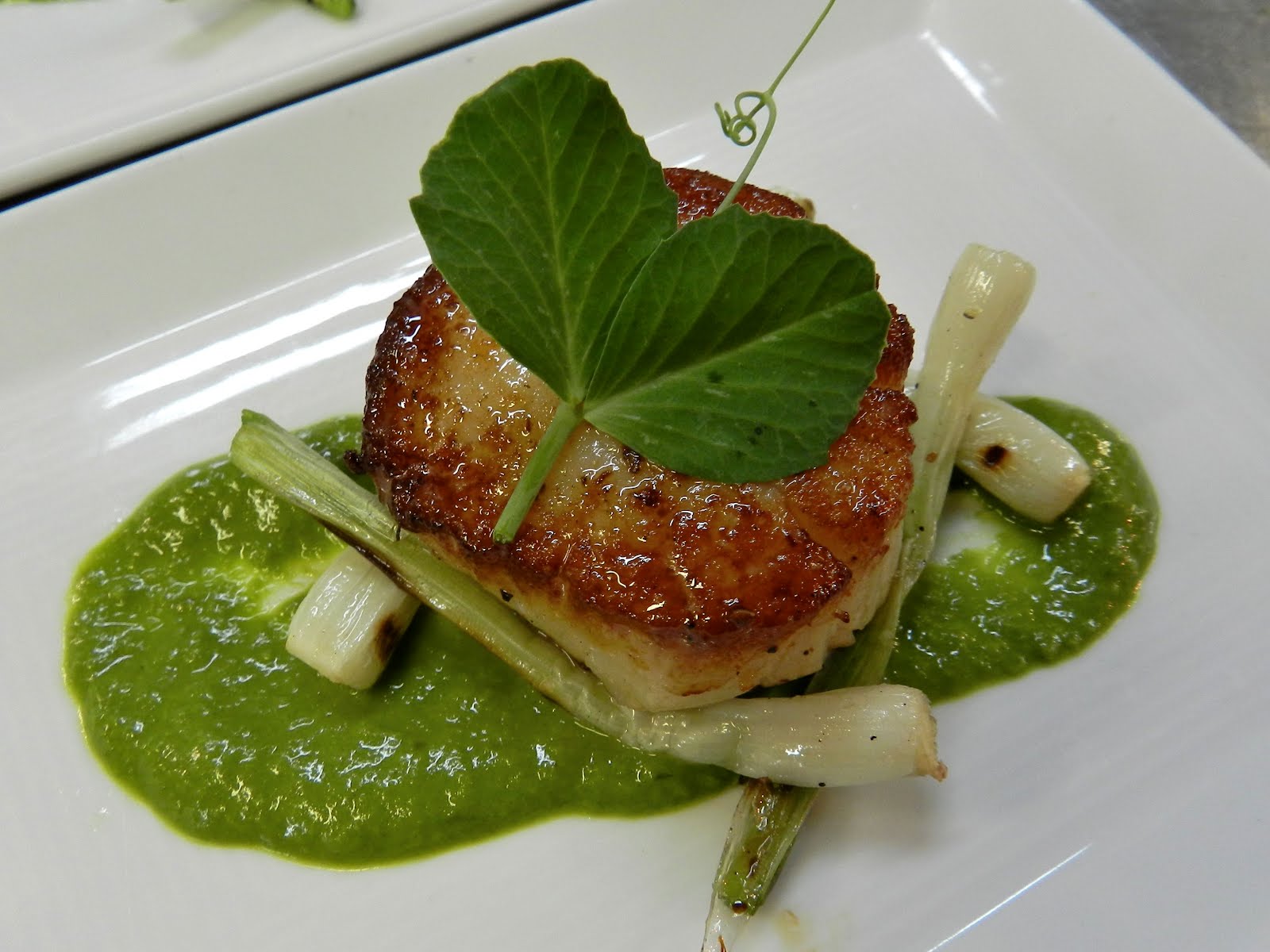
Sea Scallop. Spring always brings great scallops as new grounds are opened. I wanted to highlight our beautiful scallops against some of our local spring greens. The scallop is sitting on a purée of ramp greens and grilled baby spring onions and topped with a sugar snap tendril from my garden. The ramp bulbs have long since vanished into sopa de ajo.


Arctic Char. Spring always has me looking forward to salmon as it begins its spawning run up the rivers. It's just a little too early yet for salmon, but we do have two nice salmonids in house right now, arctic char and steelhead trout. Last week, we put up a batch of cured steelhead trout, so-called gravlax of steelhead trout, and we had a bunch of trimmings to work with.

On this plate, you see a mousse of roasted steelhead gravlax, fennel fronds from my garden, very lightly pickled hothouse cucumbers, seared arctic char, and a wonton containing gravlax, chives, and sour cream. The wonton came from wanting some crunchy element on the dish. And in the end, we decided to take the traditional bagel toppings and put them inside a crispy wonton as a somewhat cheesy (pun intended) nod to the God-awful crab rangoon served in ersatz Chinese restaurants. A little humor never hurt a dish as far I can tell.


Eggs, Bacon, and Toast. Now that spring has sprung and the days are getting longer, Sarah's ducks are cranking out far more eggs that we can possibly use to make our pastries. [Oh by the way, wondering why our pastries are so good? Blame the duck eggs!] So this dish was born of a need to consume duck eggs and of course also to showcase our awesome house-cured Berkshire pork belly.

Down on the plate, you see grilled and buttered focaccia topped with maple syrup-braised pork belly and a poached duck egg. We went through a dozen different plate presentations and finally in the spirit of consuming as many duck eggs as possible, decided to benedictify it with a lemon zest-augmented hollandaise. This sublime stack of wanton sinfulness is bejeweled with a crown of cilantro flowers from my garden.


Risotto. This dish didn't start as a risotto at all. For the longest time, it was just a list of ingredients: asparagus, morels, and duck confit. Our guests were very lucky that the first asparagus and the first morels of the year arrived in our kitchen simultaneously, lucky because they are ingredients that marry in the best kind of way. Morels, the king of mushrooms (you bolete fans are all wrong), deserve, no, they cry out for cured pork products. And what is better than cured pork? Our house-cured duck confit all poached in its unctuous duck fat bath!

So we had three awesome flavors that needed a neutral base to carry them and hence the risotto entered the picture, the rice marrying the ingredients and serving as a base for the garnishes: grilled asparagus, chive blossoms from my garden, and a morel dipped in cornstarch and crisped in hot oil. Ambrosial!


Picnic. I don't know what spring has on your mind, but a picnic is definitely on my mind. This dish is our homage to classic American picnic food: fried chicken, deviled eggs, and potato salad. Our fried chicken is an herb-marinated and grilled quail. Our deviled eggs are naturally quail eggs. And our potato salad, well, it is better than most potato salad you will ever eat, is instantly recognizable as potato salad, and yet, contains zero potatoes.

The potato salad is down on the plate letting us stand the boned-out quail up against it with the deviled egg halves nestled against it. Just under the quail and spilling out to the side of the eggs is an outstanding amarena cherry mosto cotto, cherry juice and grape must cooked down to almost a balsamic vinegar like syrup. To complete the cherry metaphor is a bit of dried cherry and celery salsa. Not only is it a great palate cleanser with the sweet-tart cherry working against the bitter crunchy celery, it is a reminder that cherries, that most delicious and first stone fruit of the new year, are just around the corner.

Oh, the potato salad. It's celery root, red onion, green onion, Surry sausage (our local Virginia smoked pork sausage), and parsley, all bound with mayonnaise.


Spring Lamb. No protein could be more spring in my mind than spring lamb and this one just arrived from the slaughterhouse. This lamb is so good that it really didn't need us to do much with it. I made a pesto from the tons of fresh mint growing in the boxes out in front of the restaurant and after boning out the lamb saddle, marinated the deboned loins in the pesto. In the vein of not doing very much with the lamb, I decided to serve it very classically, with pommes duchesse, mashed potatoes augmented with [duck] egg yolks and baked. Although you can't see it, the lamb is napped with a glace d'agneau, a highly concentrated lamb stock that we made from all the bones from the last lamb we received. It is so concentrated that it remains jellied at room temperature. We reheated it with a little white truffle juice.

The herbs I picked from my backyard in the morning. The lower herb in the photo is sheep sorrel which I included because lemony sorrel and lamb is a classic pairing, but also because I found it amusing to pair sheep with lamb! Corny, but true. The yellow blossom and the leaf above it is from a wild mustard plant. Lamb and mustard is a delicious combo. I often will drain the pan juices into a sauce pan after roasting a leg of lamb, add a little red wine, a little lamb glace, and then after straining it, will add Dijon mustard as a liaison to thicken the sauce. That, for me, is what the mustard greens on this plate evoke.


Rhubarb. Before there is any fruit in the spring, there is rhubarb, very much a vegetable, but one that we treat as a fruit. The only question here was how to provide a delicious foil for the sweet-tart rhubarb compote (rhubarb, cranberry juice, and sugar). Spring leads me to light desserts and light always leads me to Greek yogurt panna cotta, this one flavored with lemon zest and poppy seeds. For garnishes, you see a poppy seed tuile and lemon balm from my garden. The surprising element here is the black locust blossoms which had just opened for the very first time the morning of the dinner. I picked these from the backyard and just before serving them, tossed them in a dressing of honey, lemon juice, and lemon zest. The locust blossoms have a flavor at sweet pea crossed with honeysuckle nectar. They are delicious.

Friday, March 16, 2012

Guajes and Smoked Octopus

We keep on playing games with food here and some things work and are worth repeating and others get relegated to the it-was-interesting-but-not-that-interesting file. Here are photos from our latest Chef's Table, our regular 6pm 6-course tasting that we hold every Thursday evening.

California Roll Salad. We decided to deconstruct a California roll and present it as a salad. Honestly, though I am sure that the flavors are all fine, I'm underwhelmed by the result in the sense that it is probably not as good as a straight up California roll. I think there is too much going on here, something that I am not often guilty of: avocado, sesame seeds, wasabi, guaje seeds, yellow tomato, puffed wild rice, crab marinated in yuzu vinaigrette, tobiko, and slivers of nori. All fine ingredients but fails to adhere to less-is-more and I'm not wild about the presentation either. Minor fail.


Skate Cheeks. Everyone who eats seafood should try skate cheeks at least once. They are such wonderful morsels of pillowy goodness. You see them here in a sautée of artichokes hearts and pancetta, finished with white wine, herbs, and butter. Life is very good after you eat this dish.


Rosemary-Smoked Octopus. For me, this was the highlight of the dinner. I have never had smoked octopus before and not sure what prompted me to smoke it this time, but I am hooked. This is a really good dish. We poached the octopus in court bouillon until it was tender and chilled it overnight, then I cold smoked it lightly over cherry wood and fresh rosemary. At service, I tossed the octopus in unfiltered extra virgin olive oil and fleur de sel and warmed it on the grill. You see it sitting on an orzo, feta, and oregano custard. The dish is garnished with more olive oil, a squeeze of lemon juice, and the tiniest of sprigs of oregano that are just now popping up outside the restaurant. This dish is a winner, hands down: well conceived, well executed, nicely presented, and outstandingly delicious.


Grilled Brined Pork Tenderloin. We had some leftover trimmings from a pork tenderloin entrée, so we decided to brine and grill them to show off our dried cherry olivada and amarena cherry mosto cotto. The brine is salt, brown sugar, allspice, and pepper. The "olivada" is a tapenade-like condiment consisting of dried cherries, olives, anchovies, capers, garlic, thyme, oregano, lemon juice, and extra virgin olive oil. We colored a parsnip purée with spinach for contrast on the plate. Very tasty.


Local Lamb Rack Roulade. I removed every other bone from a large lamb rack and then butterflied and stuffed the rib-eye with a mixture of brunoise of sunchoke (Jerusalem artichoke), rosemary, Dijon mustard, panko, and goat cheese. Then I rolled the rib-eye back up, tied, seared, and roasted it. Here you see it with a wild watercress pesto and a glazed lozenge of celery root.


Baked Alaska. How often do you see Baked Alaska at a restaurant? When made correctly, it's a light and whimsical ending to a meal. On a base of sliced pineapple, we mounded our jackfruit and Meyer lemon granita and then piped on a layer of coconut Italian meringue made from the whites of all the local duck eggs that go into our pastries.
Saturday, January 28, 2012

Vegetarian Chef's Tasting

This is a tale about letting go.

Last evening, we cooked a 5-course vegetarian tasting on a relatively slow Friday night, slow enough to let me take photos, something that I was unable to do all during the fall when we were so busy.

I was really happy to have this opportunity to do a vegetarian menu. Getting away from the meat-centric menu really frees my mind, removes constraints about how dishes are usually prepared, and gives me freedom to just do what I am feeling.

I loved each and every dish on this menu and I think we did a great job of putting the ingredients that we have now in dead winter on a plate in a creative and inviting and (most importantly) delicious manner.

While we were very pleased with the end result, the journey in getting there wasn't all that simple. Some menus just write themselves; this one did not. Over the past few years of designing menus, we have come to understand that simplicity is better than complexity, flavor trumps presentation, and if it doesn't feel right, it isn't. In short, we've learned to let go of pet ideas if they don't fit. There's always another day, another menu, another opportunity to try out that new idea.

A potato cake. This menu almost got derailed by a simple potato cake. For some reason, the Ecuadoran potato cake called the llapingacho insinuated itself into my conscious brain and wouldn't let go. From there, it was an easy enough leap to a full Ecuadoran menu. Over five or six days of brainstorming, we found ourselves putting dishes on the menu simply because they were Ecuadoran, not because they highlighted our local ingredients and not because we had a flavor profile that we were trying to express in a finished dish. This is not the way to design a successful menu. If a dish doesn't speak to you as a chef, discard it and move on.

I finally heeded the warning bells that were gently dinging in the back of my brain and punted the whole Ecuadoran menu save for the llapingachos that sent us off seeking the elusive red herring. At this point, we freed ourselves to get back to highlighting our local ingredients such as Jerusalem artichokes, rapini, and Fairy Tale squash.

As the menu started forming, all of us collectively said about the same time, "I'm not feeling the peanut sauce on the potato cakes." So we struck the traditional peanut sauce and that freed us to strike the rest of the Ecuadoran seasoning (achiote and cilantro) and just to retain that singular characteristic of the llapingacho that makes it stand out in the world's pantheon of potato cakes: the grated cheese in the cake itself.

And that is the lesson to take from this menu: learning to let go is hard but necessary. Don't force it. Keep it simple and distill it to its essence. Feel it and do it.

And now on to the photos.

Jerusalem Artichoke Soup. We have a super abundance of Jerusalem artichokes in our cooler just now and they are a natural for soup. They bring an almost inimitable silky appealing texture to soup. The downside is that they can bring a dull and listless grey color to the party as well. To mask this, we added a tiny bit of roasted red pepper for an orange hue, but not enough to flavor the soup. Too much of a silky soup can really bore your tastebuds, so we had to bring some acid to the party, which we did in the form of a roasted red pepper and goat cheese mousse. The acidic goat cheese is just the thing to keep your palate refreshed. Paired with a lemony Spanish Albariño.

Yukon Gold and Two Onion Potato Cakes. Here are the llapingachos that started this whole menu, made from local Yukon golds with a grated three-milk (goat, sheep, and cow) cheese, green onions, and caramelized onions. To reiterate the cheese, we have sauced these cakes with a warm cheese and beer sauce, using the same cheese as in the potato cakes and a very hoppy amber ale to give the cheese sauce a touch of hoppy bitterness to keep it from being cloying. The green sauce is a green onion cream that brings a cool acid bite to counterpose the rich cheese sauce. Paired with Chilean Pinot Noir. This could have easily paired with a white wine, but the customer's preference is red wine.

French Onion Soup Bruschetta. Not really sure where this dish came from except that we were probably cold on the day that we brainstormed this and wanted soup to warm us up. This is an exercise in reimagining a classic soup. We took the soup and puréed it to become the sauce for the plate and put the onions on top of the croustade rather than under it. High cuisine? Not. Delicious? You bet. Paired with a medium-bodied, lower acidity Willamette Pinot from Yamhill-Carlton.

Rapini "Wellington." Again, I don't remember the genesis of this dish. With three of us throwing ideas at the wall and seeing what sticks, creating dishes is a very crazy process. In any case, we decided to showcase our beautiful local rapini as a quasi-Wellington. I learned long ago that wrapping wet ingredients in puff pastry is a big fail, so we baked the puff separately and then topped it with the lightly bitter rapini, a duxelles of black trumpet mushrooms, and then a bit of herbed soft cheese to help marry the spicy earthiness of the mushrooms with the vegetal bitterness of the rapini. In the South, we always serve vinegar with our braised greens. The plate sauce of porcini stock and balsamic vinegar finished with a hint of cream (to round out the vinegar's tang) is a nod to that. Paired with a very high end Argentine Malbec.

Fairy Tale Squash Flan. Eat your vegetables! There's probably no more sinful way to eat your squash than as a silky flan flavored with cinnamon and maple syrup, and garnished with gianduia, crème anglaise, maple syrup, gianduia powder, a chocolate cigarette, crispy salted phyllo, and a pumpkinseed brittle flavored with pimentón and sea salt. Paired with a 10-year old tawny Port.