Chris and I did a tasting last night that was incredibly ingredients-driven (as opposed to thematically driven or technique-driven). We literally threw this tasting together in the course of a couple of hours as most of the proteins were arriving late into the afternoon.
 Tuna Flower—Sashimi of Hawaiian Pink Tombo
. It's not often that I luck into a piece of 1+ Tombo (Albacore), especially the pink-fleshed kind. It was obvious on looking at the loin that we were going to do sashimi with it; to cook it would have been to dishonor the fish from which it came. We had a ball eating all the trimmings for lunch. The flower petal arrangement of Tombo is topped with lemon zest, green onions, and
fleur de sel. And the center of the flower is a quick salad of orange and
cucamelon, topped with a micro red Russian kale leaf. I didn't serve any soy with this because I didn't want to mask the fish and I didn't want the soy to fight with the Alsatian Pinot Blanc that I paired with the dish.
 Truffled Day Boat Scallop in its Own Shell
. Our FedEx driver delivered a huge sack of just harvested scallops from Massachusetts late in the afternoon. I like fresh scallops as sashimi, but I wanted a transition in this course from the raw first course to the cooked third course, so I seared the scallop on one side only and topped it quickly with a little black truffle butter refreshed with a couple drops of lemon juice. I paired this with a local Chardonnay that is amazingly Burgundian in style, high in lemony acidity with a round mid-palate.
 Chesapeake Bay Sea Squab Meunière
. I was fortunate enough to get some
Northern Puffer (
Sphoeroides maculatus) which I grew up calling Sea Squab from a dealer down on the Chesapeake Bay. These fish have always been regarded as trash fish on the Bay, but as a kid, I always enjoyed eating them. They have tenderly sweet white meat that is high in gelatin and they're definitely finger food. Whenever I see a batch of cleaned puffers, they remind me so of frog's legs that it always strikes me to cook them in my favorite manner as frog's legs:
à la meunière, dredged in flour, sautéed in butter, finished with lemon and parsley. No, your eyes are not deceiving you. There are two whole fish in that tiny crème brûlée dish. I paired the lemony sauce with a lemony and crisp Albariño from Rias Baixas.
 Terrine of Foie Gras with Calvados and Truffles
. The one thing that the customer requested for this tasting was foie and what better way to do it than as a terrine? The great and frightening thing about a terrine is that there is no place to hide: it's all about the quality of the foie. Not a problem: I have the best supplier in North America. Five ingredients make up this terrine: foie, Kosher salt, white pepper, Calvados, and black truffles, all mixed and jammed into a terrine and slowly cooked in a just barely warm oven, then weighted and refrigerated. Terribly old school and amazingly delicious! Here is the terrine on a slice of savory
pain perdu (French toast); cropped out of the photo is a dab of our Asian pear-Kaffir lime confit. I confess to handling the quality control of this terrine personally (and I saw Chris doing likewise). As a chef, I have to ensure that everything going to the table is fit to serve, no? Earlier in the menu, I would have paired this with a sweet wine; here at mid-menu, I treated it as the first meat course and so paired it with a local Pinot Noir, high on acid to work against the fat and smoky to complement the liver.
 Veal Cheek en Diable
. This dish was an exercise in finding a protein to pair with our amazing local
bird egg beans and organic cavolo nero (lacinato, black Tuscan kale). I cooked the huge bird eggs until just tender, then started trying some pancetta in a sauté pan, to which I added the bird eggs and some of their juice. Once this started to come down, I added a bit more juice and a lot of chiffonaded cavolo nero. Once the kale had wilted, I swirled in a touch of butter to mount the sauce and seasoned the beans. On top of this, I plated a veal cheek, the most unctuous and best part of the cow. We braised the veal cheeks in white wine, leeks, and celery root until tender, then firmed them up in the cooler overnight. "En diable" refers to mustard: we rolled the cheeks in Dijon mustard and then in panko and browned them all over, then finished heating them through in the oven. I paired this ensemble with a deliciously fruity local Chambourcin.
 Wild Boar Chop
. The last few boar that we have got in from Texas have been really tiny, so we have a bunch of small racks on hand. I lollipopped a couple of nice chops and grilled them. They're plated with some peach butter that we made out of self defense when we were given a couple of bushels of local and not terribly ripe peaches, a swirl of celery root purée stiffened with a little local gold potato, chanterelle mushrooms, and some veal demiglace that we augmented with pounded black truffle, local elderberry syrup, white pepper, and lemon juice. I really like Syrah and Nebbiolo with wild boar. I would buy a bottle of Hermitage or Barolo if I were dining out, but to keep costs under control, I found a reasonably priced Australian Shiraz that lets the Syrah shine through, Rhône-style.
 Apple Pie-Calvados Martini
. The customers for whom we created this tasting have a very strong preference for fruit desserts and now being prime apple season, we have about a dozen varieties on hand in the cooler. This is a simple granita of apples that we cooked down with the barest touch of sugar and a cinnamon stick, then passed through a
chinois. The trick to this very simple dish, as for the terrine de foie, is quality of the apples. The bulk are Empires for their tartness along with Grimes Golden for body and a couple of Staymans for flavor. We rimmed the martini glasses with cinnamon sugar, then filmed them with Calvados, added the granita, and drizzled over a bit of highly reduced local apple cider syrup. The remaining garnishes are a cinnamon stick and apple slices. Served with a double espresso and
cantucci (tiny almond biscotti).

 Salmon Sashimi with Pickled Daikon. Just a quick 24-hour pickle on the local daikon; thickened house-made ponzu on the plate. We let our ponzu brew for 48 hours before taking out the kombu and the hana-katsuo. We decided to use limes for the ponzu rather than bottled yuzu: fresh fruit tastes better, though limes taste different than yuzu.
 Mushroom Mini Pizzas. The customer, having just returned from two weeks in Japan, says that mini pizzas are all the rage right now. We wouldn't know, but we do know how to make pizzas. You see hon-shimeji mushrooms (actually a mix of brown and white beech and pioppini) sautéed with a touch of garlic and ginger and finished with a splash of tamari. The sauce is soft tofu blended with ponzu. We thought it was a delicious touch bringing both creaminess and acid to the pizzette.
 Yakitori. You see both chicken thighs and hearts skewered here, brushed with our house-made taré. We put the chicken in a soy- and ginger-based marinade for 48 hours. The taré sauce, based on chicken bones, took 48 hours to make and it has such a rich meaty sweetness. I couldn't find any cockscombs on such short notice; that would have been really cool as part of this dish. As it was, most of the guests didn't touch the hearts, which we happily snacked in the kitchen. The hearts are definitely the best part of this dish.
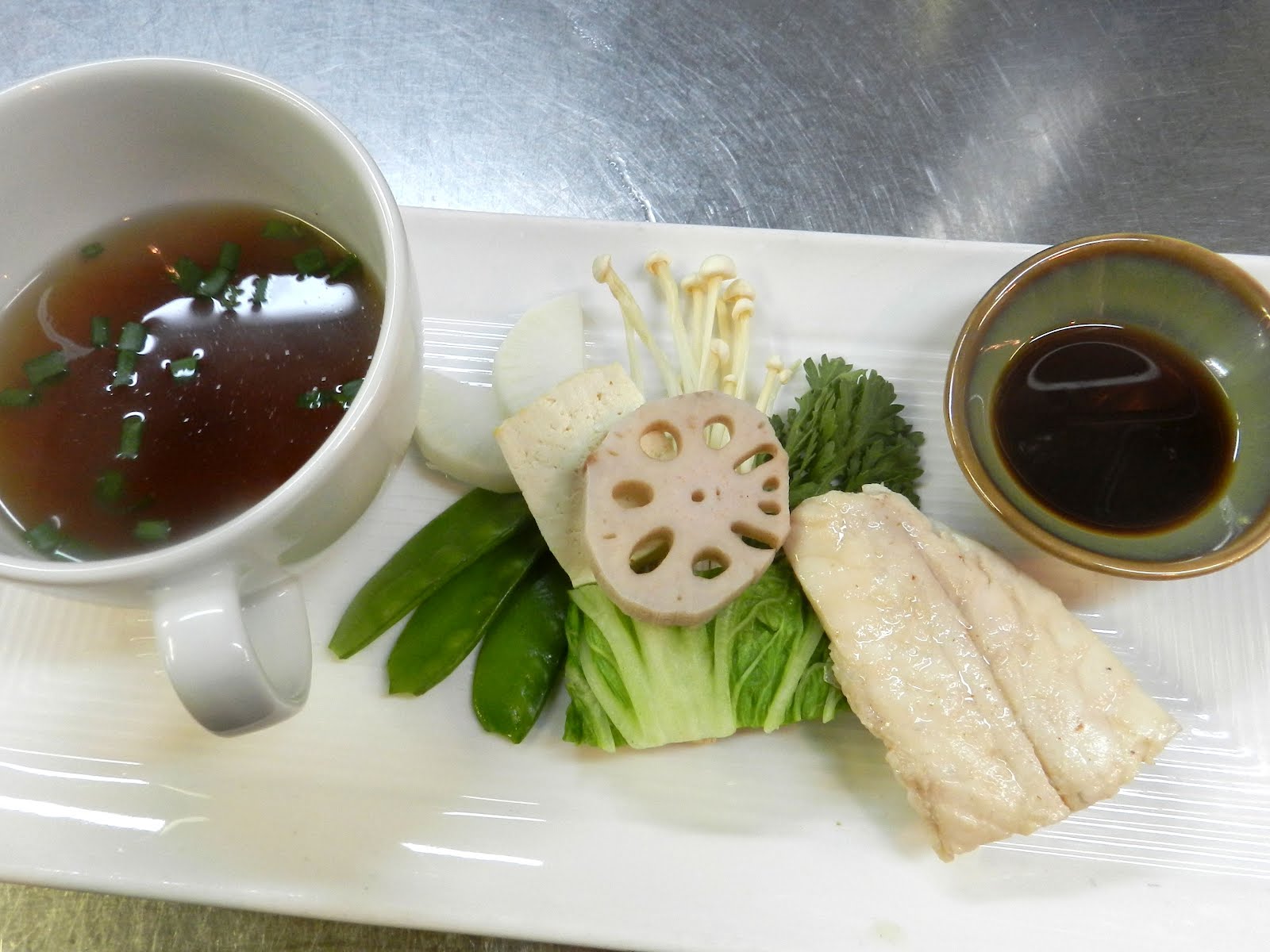 "Chirinabe". How do I tell a customer who is in love with a menu that we are not equipped to do a traditional nabe? I don't and I wing it, hence the quotation marks around chirinabe (fish hot pot). We just don't have the equipment to put communal hot pots on the tables (and the American customers would have freaked out at a communal pot anyway), so we blanched the vegetables and poached the black sea bass before plating them with a cup of boiling stock and small dish of ponzu for dipping. The garnishes, clockwise from the snow peas, are snow peas, daikon, enokitake, shungiku, sea bass, napa, tofu, and lotus root.
 Purple Yam Custard. I wanted to finish with rice and then some fresh fruit. Customer wanted a dessert. So here is a pan-Asian dessert: a brûléed custard of Okinawa sweet potato, sesame seed brittle, and some fresh jackfruit in simple syrup. At least I managed to keep the dish non-sweet and sneak some fruit in too. The white flecks are sesame oil powder.


