Showing posts with label veal. Show all posts

Tuesday, March 26, 2013

Northern Italian Tasting

We're generally not in the habit of having customers dictate the direction of our tasting menus, preferring instead to take the best ingredients we have on hand at the time and shape them into a menu based on our own whims. But our customer for this dinner was insistent that we do a tasting of the foods from the provinces of Northern Italy. OK. I would have gone to a Northern Italian restaurant for this, but never mind, we can cook pretty much anything.

The hardest part of this whole exercise was deciding the order of the courses; for example, would the Piemontese course be primo, a secondo, a dolce? Once we got the ordering of the courses, progressing from first courses to seafood to meat to sweets, then it was easy enough to draw inspiration from each region to fill in the details.

Chicken Liver "Crostino"
Toscana: Chicken Liver Crostino. Chicken liver crostini are some of the best known appetizers in Tuscany and since we had chicken livers on hand, we decided to do a take on this well known primo, but reinvent the form. We cooked the livers in the traditional manner with onions, sage, rosemary, capers, anchovies, and Cognac. Then we formed the liver mousse into truffles and rolled them finely powdered crostini, cocoa powder, and espresso powder. The bitter cocoa and espresso worked with the liver very nicely.

Speck Knödel/Canederli Tirolese
Alto Adige: Speck Knödel/Canederli Tirolese. We went back and forth on a soup course, but the weather by turning cold and nasty made the decision easy for us. I have always loved the bread dumpling soups of Bavaria, Austria, and the Südtirol and wanted to reprise them for this menu, to show the Germanic influences in the cuisine of Alpine Italy. I made a classic brown stock from both pork and chicken necks and then poached quenelles of knödel batter in it. The batter is white bread soaked in milk, garlic chives, sage, minced speck, and eggs.

Gambero al Prosecco
Veneto: Gambero al Prosecco. I wouldn't argue if you wanted to call this Shrimp and Grits because that is basically what it is. This is our take on the classic Venetian dish of Schie con Polenta, tiny head-on shrimp in a garlic butter sauce over creamy polenta. Making the sauce with Prosecco is a nod to the famous sparking wine of the Veneto.

Trofie al Pesto
Liguria: Trofie al Pesto. You just can't think of Liguria and Genoa without thinking of basil and that most famous of sauces, pesto. What snaps immediately into my mind is a big plate of the local pasta, trofie, in pesto sauce. Plates of pasta just don't look all that pretty on tastings, so we mixed the trofie and pesto with some ricotta and eggs and baked them in little molds so serve as a base for mussels steamed with pesto.

Grilled Trout with Fennel, Chestnuts, and Lardo
Val d’Aosta: Grilled Trout with Fennel, Chestnuts, and Lardo. Moving right up next to France and Switzerland, the next course took its cues from regional products. This dish has no basis in classic Italian cooking: it is one of my own invention, but I daresay that it would feel at home in a modern restaurant in the Val d'Aosta. We grilled trout and then served it with a sauce made from caramelized fennel, shallots, and peeled chestnuts, splashed at the last second with a touch of anisette and bound with a splash of cream. On top is a very thin sliver of house-cured lardo. This dish is a keeper and I look forward to reprising it at some future time in the main dining room.

Radicchio, Wild Mushroom, and Sausage Strudel
Friuli/Venezia Giulia: Radicchio, Wild Mushroom, and Sausage Strudel. As a student of culinary history, I am always amazed at how cuisine pays no heed to political boundaries. For example, strudel, ignoring modern country borders, can be found all over the former Austro-Hungarian empire, including the far northeast corner of Italy. We made our strudel of radicchio, wild mushrooms, and a house-made sage sausage. Although it is very tasty, radicchio goes nearly black when cooked and does not necessarily make the prettiest strudel filling.

"Osso Buco" Milanese
Lombardia: "Osso Buco" Milanese. What is more representative of the cooking of Lombardia than osso buco milanese, succulent veal shank over saffron risotto? Nothing. How do you serve it for a nine-course tasting? We like the arrancino form.

Rabbit Bolognese
Emilia Romagna: Rabbit Bolognese. Emilia Romagna, among others, has two very famous exports: prosciutto di Parma and salsa bolognese from Bologna. We decided to marry a classic salsa bolognese made of rabbit with prosciutto, by wrapping the salsa in prosciutto, to give the salsa form on the plate. It is plated with saffron aïoli and a touch of sun-dried tomato pesto.

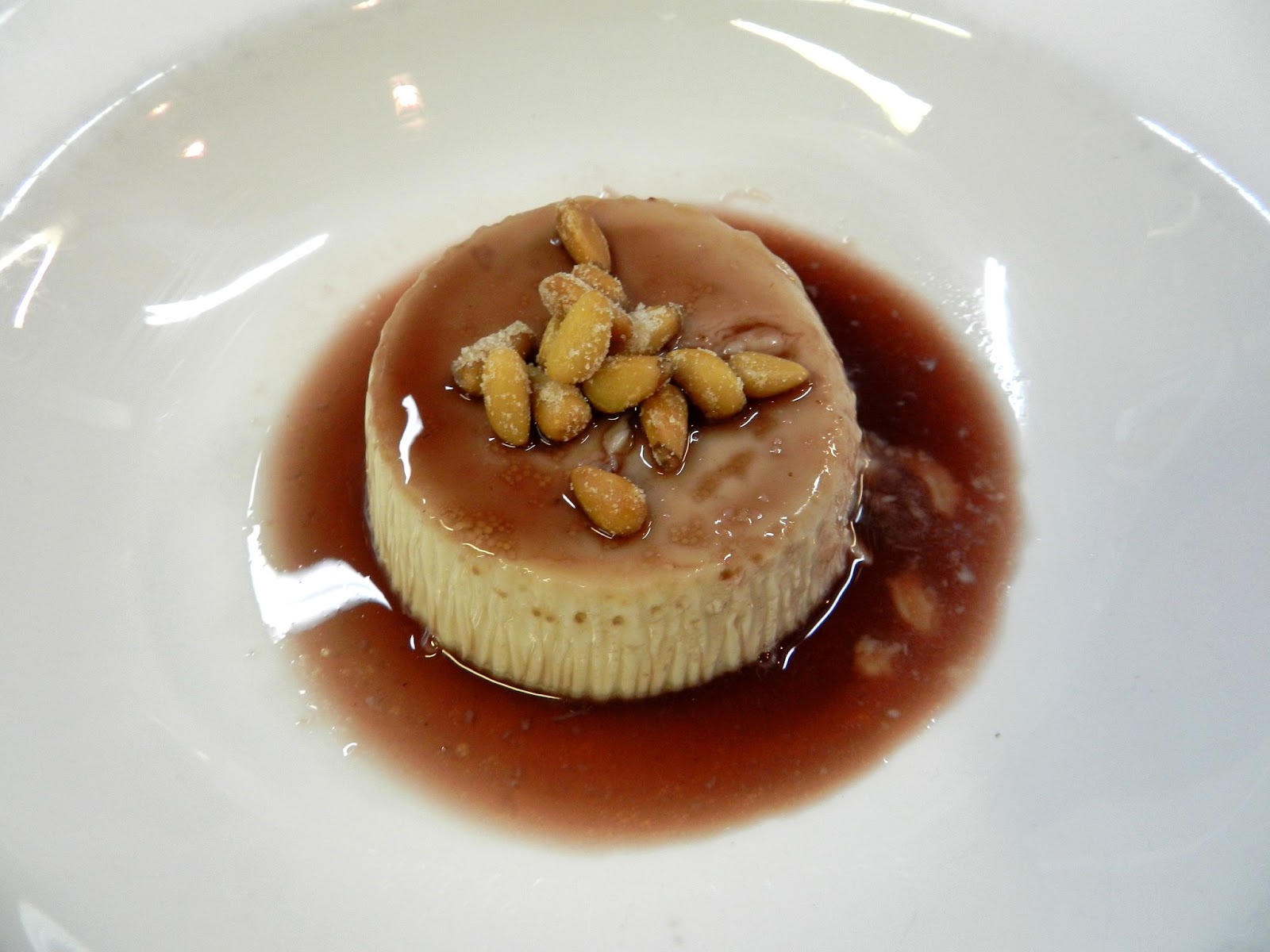
Chestnut and Red Wine Panna Cotta
Piemonte: Chestnut and Red Wine Panna Cotta. Panna cotta is a classic dish that I associate most closely with the Piemonte. This is a two-layer panna cotta of jellified Nebbiolo wine and a chestnut cream. I have gently reheated the panna cotta so that the red wine layer has just about melted, forming a sauce à la crème caramel. Topped with candied pine nuts.

Saturday, December 8, 2012

Another Tasting

Here are photos from another recent tasting. Couple of ideas that I would like to remember here, especially the mussel soup, the kale salad, and the rabbit Bourguignon in pastry.

Deconstructed Paella?
Mussel Soup. This dish started with a color, saffron, chorizo oil against a golden soup. From there it morphed into something of a deconstructed paella. The soup is salsify with saffron, mussel broth, and a little cream. The main garnish is a mussel salad: mussels, EVOO, Sherry vinegar, garlic, roasted red peppers, and diced tomatoes. The minor garnishes are chorizo oil, crispy chorizo, and socarrat—the crispy rice bits from the bottom of the paella pan.

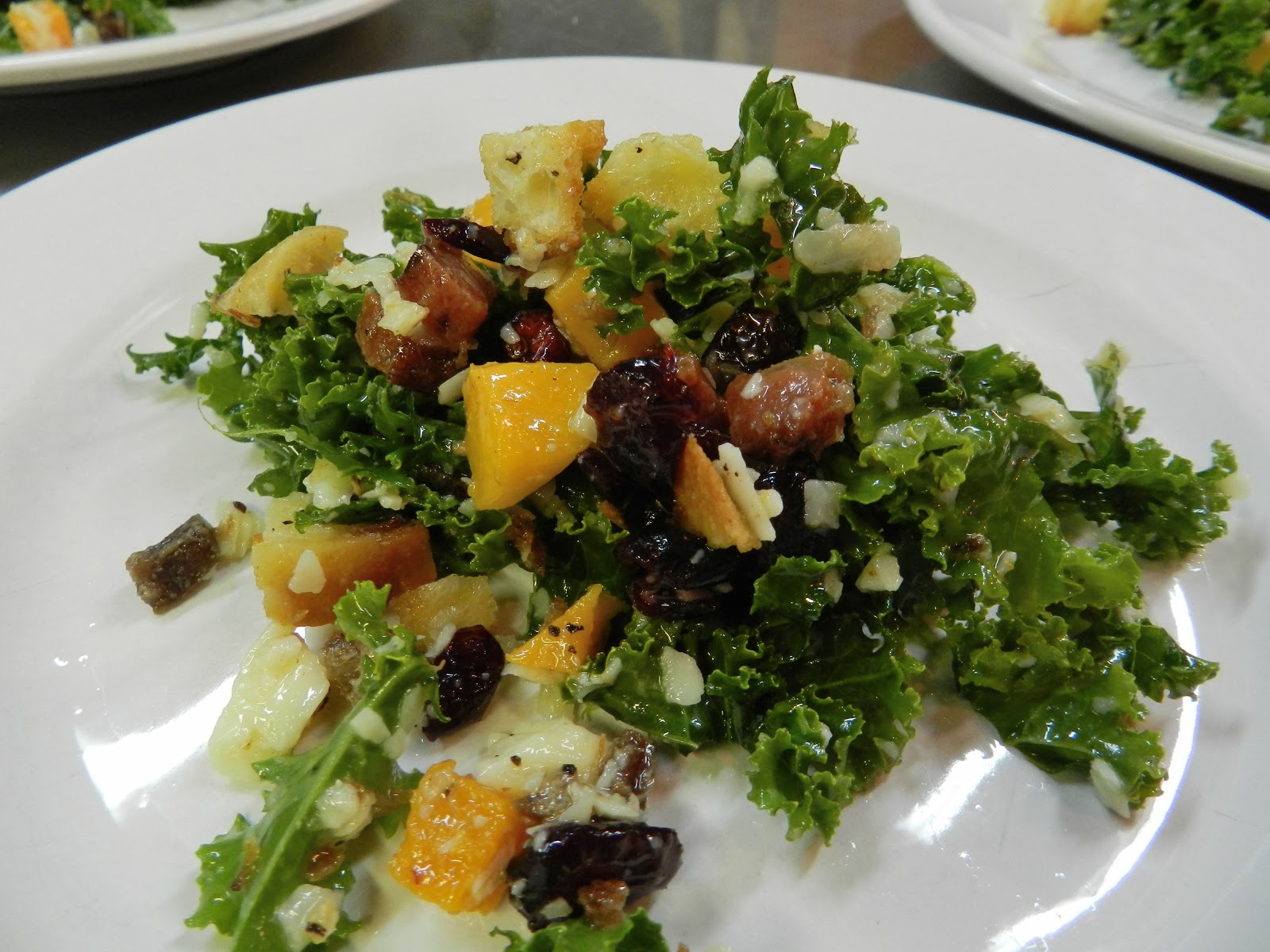
Kale Salad
Kale Salad. This is a blatant rip-off of a wonderful salad that Kelly White of Glen Manor Vineyards served me a few days ago. She's a great chef and this is a fantastic must-remember salad! It is tedious to pull off the tender, frilly edges of the kale, but after that, it is child's play. Garnishes for the salad include crispy pork belly bits, crispy bacon, grated pecorino, dried sweetened cranberries (Kelly used currants), roasted butternut squash, and croutons fried in bacon fat. To this I added some bacon fat, EVOO, lots of lemon juice, a touch of maple syrup, salt, pepper, and some minced garlic; and, surprise of surprises: I adjusted it to taste!

Rabbit Bourguignon
Rabbit Bourguignon. We are blessed with lots and lots of rabbits and so we struggle to find good ways to use them. And among the dozens of ways, we really do love this one. The trick, to sell rabbits in our market, is to take it off the bone, something that is anathema to Europeans who are used to rabbit on the bone. Once we take it off the bone, it is formless and we struggle, absent the bones, to give it form and definition on the plate. Wrapping the rabbit in pastry is a great and tasty way to present it. We have cooked the rabbit in the traditional Burgundian style with bacon, onions, mushrooms (cèpes or porcini), and Pinot Noir. A little of the reduced braising liquid serves as a sauce and some tiny Brussels sprouts serve as garnish.

Veal Shank Puttanesca; Black Barley Barlotto
Veal Shank. We lucked into some tiny veal shanks and so we did a take off on ossobuco, braising the veal in a puttanesca (spicy tomato with anchovies, capers, and olives) sauce. Rather than risotto milanese, we did a barlotto, black barley cooked in the style of risotto. Good hearty food, but culinarily unmemorable.

Pawpaw Parfait
Pawpaw Parfait. Back in the fall, we collected a lot of pawpaws and froze a lot of pawpaw pulp against the day when there wouldn't be a lot of local fruit with which to work. This parfait looked a lot nicer in person than it does here: you really cannot see the ruby red of the cranberry jelly layer that sits on top of the pawpaw panna cotta layer. On top of the cranberry layer is a layer of vanilla custard, a sprinkle of crunchy granola, and a whirl of whipped cream. Surprises: hidden in the middle of the panna cotta is a chocolate truffle and hidden in the vanilla custard is a swirl of orange cream cheese.

Thursday, November 29, 2012

Chef's Tasting

We've done a lot of tastings recently, but I haven't posted many pictures mostly because the dishes don't have striking color this time of year like they do in the summer. Long gone are the gorgeous reds of ripe tomatoes and peppers, the bright green of peas and snow peas, and the delicate yellows of squash blooms and corn. In now are the browns, rusts, tans, beiges, and whites of our winter vegetables and while they are not as photogenic as their summer cousins, they are equally delicious.

Without further ado then, one of our most recent tastings:

Charcuterie Trio
Charcuterie Trio. In the foreground you see a veal tongue terrine set in aspic with a lot of fresh parsley à la the French classic jambon persillé. In the middle is a swirl of rabbit liver mousse flavored with Cognac and on the far end, a terrine of ground Berkshire pork shoulder flavored with all kinds of delicious bits.

Cauliflower, Maitake Mushrooms, and Leeks
Cauliflower and Leeks. These are two vegetables that many people pass over without a second thought but which are incredibly fun for us chefs to work with. The cauliflower has been roasted to the point of caramelization and then made into the silkiest of sauces: it is really something you just want to wallow in! The leeks have been creamed and then wrapped in phyllo for presentation purposes, and these little triangles are decadently delicious. Crispy maitake mushrooms and dots of truffle-infused balsamic vinegar complete the plate, the earthy mushroomy flavors playing off the rich creamy cauliflower and leeks, and the vinegar delivering the acid that keeps this dish from being cloying.

Scallop, Pork Belly, Sweet Potatoes, and Black Truffles
Scallop and Pork Belly. Not too much original here, but this is a damn fine course that I would be happy to be served at a restaurant. Scallop on top of house-cured pork belly on top of a silky sweet potato purée, all napped with a tart black truffle beurre blanc.

People always ask me how to make pork belly, thinking that they are going to make it at home, but then start wincing about the time I get to the third of the fourth cookings! We cure it for a length of time dependent on the thickness of the belly, then brown/damn near char it in a very hot oven, then braise it, then refrigerate it, then confit it under duck fat, then refrigerate it under duck fat for a long period, then slice it, and pan fry it. Sure, you can do it at home but why would you want to? You can achieve 90 percent of the results with a much simpler process and that it good enough for home. The extra pain that we go through to make it the very best pork belly you've ever eaten, you should leave to us.

Duck, Rabbit, Spätzle, and Brussels Sprouts
Duck and Rabbit. It's winter and for some reason, the cute little brussels sprouts keep making us think of schnitzel. Here, we have taken a tenderloin off of a rabbit and the so-called tenderloin off a duck breast (the little tender piece on the under side of the breast) and pounded them side-by-side, slightly overlapped, so that they form a single piece of schnitzel from two very different meats. They're breaded in a five-spice panko and served with sweet and sour sprout hash and orange spätzle. I thinly sliced the sprouts, some shallots, and some of my house-cured pancetta. After caramelizing the pancetta and shallots, I added the sprouts and cooked them until bright green, just a few seconds. Then into the pan with a tiny bit of butter, a pinch of sugar, and a taste of white balsamic vinegar. Done and delicious! Even so-called sprout haters love them this way!

Pork Cheek, Grits, Gremolata, and Pork Jus
Pork and Grits. We serve a lot of pork and grits in various guises, mostly because how insanely good is the combination of any kind of pork with corn? This is a slow-cooked Berkshire pork cheek, crisped in a black steel pan, on grits, topped with gremolata, and napped with what we call "pork goodness," the juices left in the bottom of the pan after cooking our pork belly.

Venison, Flower Sprouts, Blueberry Salad, and Tasmanian Pepper
Venison. It's venison season once again and we are working our way through a few rear haunches. I seam out the legs into individual muscles and then break those down into steaks which I marinate for a couple of days. Then I grill them, very, very rare. Here you see the grilled and sliced venison plated with a dried blueberry and celery salad, and the first so-called "flower sprouts" that I have ever seen. These are a new (and according to the farmer that grew these, not very stable) cross between brussels sprouts and kale. The resulting plant has a long central stalk like a brussels sprout plant, but instead of miniature cabbages, it has little broccoli-like whorls of leaves without any sign of a bloom. These were deep purple before blanching and now they are very deep forest green. Despite their novelty and interesting appearance, I have already told the grower that they are not worth growing again: the flavor is not as good as either of the parents. She said, "good to know; they are a pain to harvest." And so it goes.

Chocolate and Cranberries
Chocolate and Cranberries. Being just after Thanksgiving, we have lots of cranberries in the cooler, looking for ways to get on plates. I made a bunch of them into a delicious whole berry jelly (or jam, if you are so inclined to call it that). This dessert starts with a simple disk of flourless chocolate torte, then a layer of orange cream cheese, a layer of jelly, and finally a swirl of cream cheese. This rich but not very sweet dessert I designed to go with a glass of Malbec. I liked the pairing a lot.

Friday, December 16, 2011

Chef's Tasting

Here are the photos from last night's Chef's Table. We used our customers as guinea pigs in a sense: we were auditioning new dishes for the main dinner menu. In most cases, this is the first time we've tried these dishes. Some may go on to feature on the main menu, some may get tweaked and tried again, and at least one will be relegated to the bit-bin here on the blog.

Dueling Pork Belly. You may have noticed a theme to recent Chef's Tasting menus: pork belly. In our quest to convert people to the Pork Belly Legion™, we seem to be serving it everywhere. Here, we have two quick one-biters for our amuse course.

The first (closest) is the way we have been featuring pork belly on the main dinner menu since we first started experimenting with this combination back in November for another tasting. Sitting on a mound of grits is the pork belly, which is drizzled with local hickory bark syrup, and topped with what we are calling a red grape "olivada" after the Italian condiment of the same name. It consists of red grapes, olives, capers, anchovies, lemon juice, oregano, and olive oil.

The second presentation (the farthest away) is a classic Vietnamese treatment of pork belly, but one we've never featured here at the restaurant. I braised the pork belly in a sauce that I made from caramel, fish sauce, black pepper, and shallots. You see the pork belly sitting on a mound of grits, topped with more of the braising caramel sauce, and topped with a cilantro leaf.

Seared Sea Scallop. This dish is the result of us having baby Shanghai bok choy, lop cheung (Chinese sausage), and pickled mustard greens in the cooler and trying to find a way to use them. Coupled with this, Matt just delivered us a huge bunch of chicken feet when he last brought us rabbits, so we had a big batch of super good chicken stock in the cooler as well. Soup was a natural thought given this bunch of ingredients, but we decided to change the form and do the old soup in the wonton trick. In the photo, you see a soup-filled wonton down and a quarter of a baby bok choy, cilantro leaves, pickled mustard greens, green onions, and lop cheung coins over, with a scallop topping the feast.

What you don't see is a tiny bit of the fish sauce caramel from the pork belly underneath the wonton. When the guest cuts into the wonton, the ginger-flavored chicken stock spews forth, mixes with the caramel, and fills the bowl with a delicious soup broth. It worked as intended, but the guests seemed non-plussed by the dish: they didn't seem to know how to eat it. Not knowing how I should eat something has never stopped me from trying, but then I am not most people, and that is why we test some of these dishes at the Chef's Table before launching them in the main dining room. This dish, as good as it looked and smelled and as fun as it appeared to us to be, will probably never make it to the dining room.

Wild Mushrooms on Celery Root Latke. There is nothing earth shattering here, just plain old-fashioned deliciousness. In recent weeks, we have really taken a liking to celery root paired with wild mushrooms and this is that pairing's latest incarnation. The chanterelle mushrooms (the last of the season before we switch to hedgehogs for the winter) are finished old-school, with veal demiglace and heavy cream. Classic French habits die hard in old chefs!

Roasted Red Drum. This is a test use of Tony's puttanesca-style lentils. I am a big fan of lentils with fish; the pairing just works for me. And pasta puttanesca, with it's bold seasonings, just may be my all-time favorite pasta dish. Here you see the lentils flavored with olives, capers, anchovies, garlic, basil, and crushed red pepper flakes under a piece of drum that has been rubbed with olive oil, salt, pepper, crushed red pepper flakes, and garlic, and then roasted. This is headed for the dinner menu this weekend. It will probably perplex customers, but I love the pairing and the plate presentation is clean and inviting.

Jerked Veal with Sweet Potato Spätzle. And now for something completely different and a dish that will never go any further than this. We've been serving a classic schnitzel with spätzle on the dinner menu this week. Tony had the idea of taking that dish and doing a Caribbean riff on it. The veal cutlets were rubbed and marinated with our house-made jerk paste then grilled, sliced, and stacked Lincoln Log-style. On top of this stack you see a cranberry salsa made from cranberries, lime, jerk paste, allspice, and cilantro. The salsa was pretty good and may be something we would try again. Next to this you see the sweet potato spätzle, browned with brunoise of sweet potato, and finished with a touch of grated ginger, lime zest, and allspice. I was unhappy with the presentation and the Caribbean flavors just didn't add anything to the dish; they weren't bad, but if they don't add anything, why are they there?

Caramel Apple Butterscotch Bread Pudding. What? This doesn't look like a bread pudding? Well, it is. These small local Blushing Golden apples are hollowed out and then baked with the bread pudding inside. Sauced with house-made dulce de leche, crème anglaise, and a touch of maple syrup, this dish was a fun way to finish dinner.

Saturday, July 23, 2011

Sweetbreads


Sweetbreads, pancetta, asparagus, lemon, capers, fresh parsley.

Friday, March 18, 2011

Bobotie

If South Africa has a national dish, it might well be bobotie, a ground (mince) meat pie, subtly flavored and topped with an egg custard as you see below.


Many diners at our South African wine dinner last evening requested the recipe for my bobotie and so here is the basic idea. Two things to remember: we made at least 10 times the following recipe and while I wrote a basic formula to cook by, in the end, we adjusted the seasoning to our liking by taste and not by formula. Of course, that is true for every dish we make and should be no surprise to anyone who cooks.

Bobotie

vegetable oil
1 medium red onion, diced
1 tablespoon garlic, minced
1 tablespoon ginger, minced
1/2 pound ground veal
1/2 pound ground lamb
1 tart apple (we used Yorks), peeled and diced
2 ounces hearty French bread in small pieces, soaked in heavy cream
2 tablespoons Madras-style curry powder
1 teaspoon coriander, ground
1 teaspoon cumin, ground
1 teaspoon salt
1/2 teaspoon black pepper, roughly ground
1/2 teaspoon allspice, ground
1/4 cup golden raisins (sultanas)
1/4 cup dried apricots, diced
1/4 cup slivered almonds, toasted
zest and juice of one lemon
1 egg
2 bay leaves

for topping:

1 cup heavy cream
2 eggs

Heat your oven to medium, about 350F. Meanwhile, heat a large skillet on high flame and film it with vegetable oil. Sauté the onions until just starting to brown around the edges, three to four minutes. Reserve the onions in a large mixing bowl. Next, sweat the garlic and ginger for a couple of minutes and reserve to the mixing bowl. Add the ground meats to the pan, breaking it up thoroughly. When browned, drain off the fat, and add the meat to the mixing bowl.

Squeeze any excess cream from the bread and add the bread along with the apple, spices, almonds, and dried fruit to the meat and onions. Taste for seasoning and adjust as necessary. Add the egg and mix very well.

Pack the meat mixture into a well oiled small casserole dish and tuck the bay leaves into the top of the meat. Bake until firm and set, about 40-45 minutes, then remove the bay. Mix the egg and heavy cream and pour on top of the meat mixture. You may need more egg and cream mixture to cover the meat depending on the size of your casserole. Return to the oven and bake until golden and puffed. Let cool for at least 45 minutes so that you can slice it for serving.

Friday, March 26, 2010

Chef's Tasting


"Cockles and Chorizo", Wine Pairing: Broadbent Vinho Verde 2008


"Shrimp Cocktail"—pickled shrimp, caperberry, baby cucumber with bloom, glass rimmed with cumin salt, cocktail: tomato juice, mussel broth, lime juice, cilantro juice, cumin, sherry vinegar, gold tequila


"Piquillos and White Beans"—parfait layers of brunoise of piquillo pepper and Tuscan "refried beans," green layer flavored with pesto, tan layer flavored with rosemary, Wine Pairing: La Slina Gavi di Gavi "Giorgio Cichero" 2008


"Morel Risotto"—onion and Carr Valley Shepherd's Blend cheese risotto napping a hidden poached quail egg (surprise!), crispy morel mushroom, Parmesan tuile, fresh thyme leaves, Wine Pairing: Clifton Springs Pinot Noir Sonoma Coast 2007


"Duck and Veal Ravioli"—raviolo stuffed with Moulard duck and local veal ragù, roasted romanesco, romanesco brown butter mousse (killer!), Wine Pairing: Cristom Syrah Willamette Valley 2005


"Oxtail Empanada"—chimichurri down on the plate, shredded oxtail, crispy polenta, radishes, pickled cipollini, pea shoots, johnny jump ups, Wine Pairing: Boxwood Winery "Boxwood" Virginia 2007


"New York-Style Cheesecake"—mini cheesecakes, poached dried apricots, almond brittle, Moscato d'Asti sabayon, crumbled amaretti, Wine Pairing: Vietti Moscato d'Asti "Cascinetta" 2008

Friday, February 26, 2010

Veal- and Bluberry-Stuffed Quail

Been busy in the kitchen dreaming up new dishes for my weekly Chef's Table (5-7 courses $60 prix fixe including wine, Thursdays at 6pm, by reservation only). From last night, here's a quail stuffed with local veal and dried blueberries on watermelon radishes and mixed microgreens dressed with apple cider reduction dressing.

Friday, November 6, 2009

A Fall Chef's Tasting

I really love composing and cooking tasting menus for a lot of reasons. In building a cohesive menu from scratch, I have a strong sense of engagement and I enjoy and welcome the intellectual challenge. Also, I get out of the rut of cooking the same old crab cakes and filets mignons that pay our rent month in and month out. And I enjoy cooking for people who are willing to have their palates challenged. This frees me to not only show off the bounty of local ingredients with which we are blessed to work, but it also lets me serve delicious things that wouldn't sell well on the main menu, and it lets me experiment to a certain extent by taking some risks that I wouldn't under normal dinner circumstances. Did I also mention that this is how I like to eat? When I go out, I just want the chef to send out small bites every 20 minutes or so.

A lot of restaurants have tasting menus and many of them run a tasting menu for a fixed period of time, such as a week or a month or a season. Each tasting menu that we do is custom designed for a particular client. Even if we are doing tasting menus for multiple parties simultaneously, they will be having different menus. Admittedly it's a crazy way to run a restaurant, but then my sanity escaped to the ether some years back. But in this way, the cooking is very personal. I am cooking for a specific client and not just for anybody who walks in off the street and happens to order the tasting menu.

I don't post many of the Chef's Tastings that we do simply for lack of photographs. It's often too busy to photograph our work or because we're in a rush, photos for a certain course just do not turn out. Shooting macro shots by handholding in a busy kitchen on reflective stainless steel tables under really crappy fluorescent lighting is somewhat short of ideal, especially when I brace the camera against the table and someone down the line hip checks the table at the same time I'm shooting.

But the pace and karma Saturday night all aligned perfectly and I got some good shots, good enough for blogging, at least. Not great, but good enough considering the terrible lighting. They follow below.

I was pleased that the clients actually encouraged me to pair this menu with Virginia wines. Often I have to cajole some clients into letting me show off some of our local wines. The following is a highly seasonal menu, one that screams late fall, exactly what I was aiming for:

Chef's Tasting
Saturday, October 31, 2009

Crème Brûlée of Mapled Foie Gras
poached cranberries, bread crisp

Chrysalis Petit Manseng Virginia 2007

------

Fan of Tataki of Opah and Local Daikon
lemon zest, fleur de sel

White Hall Viognier Virginia 2007

------

Stone Crab Claws
parsnip purée, vanilla bean beurre blanc, salad burnet

Glen Manor Sauvignon Blanc Virginia 2008

------

Veal and Rabbit Terrine
quick-pickled local cucamelons; whole grain honey mustard

Swedenburg Pinot Noir Virginia 2008

------

Local Lamb Ribs in the Style of Peking Duck

Fabbioli Chambourcin Virginia 2007

------

Lightly Grilled Caribou Tenderloin
duck fat-sautéed matsutake mushrooms and sunchokes; dried blueberries; elderberry and truffle demiglace; local organic spigarello

Linden Claret Virginia 2005

------

A Study in Local Apples
Cheesy apple crêpe, apple granita, apple-kaffir lime compote, fried green apple with apple cider reduction; Kerrygold Ivernia cheese

Local Apple Cider-Calvados “Martini”


Crème Brûlée of Mapled Foie Gras. This dish started with a lobe of foie in the cooler that I needed to use and with the local Chrysalis Petit Manseng that I wanted to serve. Americans seem always to want the sweet wines at the end of dinner instead of as an aperitif, so I wanted to buck that by serving the sweet wine up front. I wanted to add some sweetness to the dish to work with the wine and initially I was thinking about brûléeing a slice of foie, and from there it wasn't a huge leap to crème brûlée. The maple syrup was almost an afterthought, mainly a liaison with the maple leaf garnish on the plate. To offset some of the richness, we just barely poached fresh cranberries in simple syrup. We served this warm out of the oven and I have to say that it was a brilliant dish.

Fan of Tataki of Opah and Local Daikon. I had a really clear piece of Opah that I wanted to feature and the first local daikon of the year just arrived in the farmer's market the morning of the tasting. I put a slight pickle on the daikon, for a salty and acidic counterpoint to the barely seared Opah. The flavor combination of the two and the texture contrast between the two were fine, but in the end, I'm not crazy about this dish or the presentation.

Stone Crab Claws. Stone crab season just opened so I wanted to celebrate that with this dish. I feel like I went out on a limb here a little putting stone crab claws on a parsnip purée. Garnishes are a vanilla beurre blanc and salad burnet. I felt the combination of the slightly sweet and herbal parsnip worked amazingly well with the vanilla and the crab. This dish is a winner and visually appealing too.

Veal and Rabbit Terrine. This is another one of my terrines; there's always one in the cooler. While I generally don't use liver in my terrines (because of knee-jerk customer reaction), I used the livers out of four rabbits along with a good splash of cream to bind this terrine. A touch of Cognac doesn't hurt either. Interior garnishes are black truffles, pistachios, dried cranberries, veal tongue, green peppercorns, and rabbit loin. Really a very tasty effort. I opted for the artsy photograph here so the interior garnish is tough to see; pity. In the foreground you see that our nasturtiums haven't given up the ghost yet and in the background you see the last of the local cucamelons, lightly pickled.

Local Lamb Ribs in the Style of Peking Duck. Selling ribs in a fine dining restaurant is an exercise in futility, a real pity because they are so good. We have to sell the ribs somehow, so they most often end up on tasting menus. I am a huge fan of braised dishes (slow-cooked with a little liquid) and especially of the style called red cooking from northern China. We rubbed the lamb ribs in garlic and five-spice powder and braised them with soy sauce, white wine, brown sugar, hoisin sauce, star anise, cinnamon, ginger, garlic, and green onions, then let the ribs stand in the braising liquid overnight. We pulled the rib meat and minced it, defatted the braising liquid and reduced it slightly (soy is very salty!), augmented the braising liquid with a little hoisin and sesame oil to make a sauce, then mixed the minced lamb with the sauce, bias-cut green onions, and white sesame seeds. We then brushed a crêpe with the sauce and stuffed it with the minced lamb. This is absolutely delicious and much more flavorful than duck done the same way.

Lightly Grilled Caribou Tenderloin. Caribou is a mild and delicious deer that under the best of circumstances is difficult to obtain, so I was happy to be able to get a little bit for this tasting. This dish is all about fall: lightly grilled caribou over a nest formed from local spigarello (a leaf broccoli) and filled with a sauté of just-dug Jerusalem artichokes and fresh matsutake mushrooms from Oregon. We finished this with a few dried blueberries and a demiglace augmented with local elderberry syrup and black truffles.

A Study in Local Apples. I'd be really remiss here in the heart of Virginia's apple country not to do a dessert of local apples. I had wanted to do a separate cheese course, but the menu was starting to get a little long so we combined the dessert and cheese courses into a single course. Cheese and apples, especially apple pie, is a natural combination at least in the school of traditional southern cooking in which I was raised. A big slice of sharp Cheddar (rat cheese as we called it) was a must with apple pie.

When I was at the farmers market on Tuesday last week, I was getting some green tomatoes for fried green tomatoes. In the next bin were some green apples causing me to flash on fried green apples. I did an instant market survey ("Hey, what do y'all think of fried green apples as a dessert course?") and the conclusion was that it couldn't be bad, so I came back to the restaurant where Chris and I started to experiment with apple thickness, coatings, and seasonings. After a half a dozen samples we got it right. You see fried green apple under the cheese and the crêpe in the photo above. We removed the core of the apple and plugged it with a piece of apple so that the whole would be edible.

On the plate from left to right you see apple compote (Golden Russet apples) cooked down with local honey and kaffir lime, topped with a blade of vanilla grass. Then the fried green apple with the cheese wedge. The crêpe holds wedges of Empire apples roasted with honey and cinnamon, along with grated cheese. The crepe was warmed in the oven to melt the cheese, then topped with a bit more cheese. Under the fried green tomato you see a syrup that we make by straining and reducing local cider until it is syrupy. On the far right, you see a small serving of apple granita, made from 8 varieties of apples and almost no sugar. I'm really happy with the flavors, but the presentation is a bit monochromatic.

Local Apple Cider-Calvados “Martini”. I didn't want another dessert wine with this menu (remember, we started with one) and I had a couple gallons of local cider on hand in the cooler, so I mixed up a cocktail of cider, Calvados, lemon juice, vanilla syrup, and some bitters. The glass is rimmed with cinnamon sugar. The apple slice is from a sweet Fuji; the cider is naturally sweet so a tart apple would have been unpleasantly mouth puckering.

Thursday, October 15, 2009

Chef's Tasting, October 2009

Chris and I did a tasting last night that was incredibly ingredients-driven (as opposed to thematically driven or technique-driven). We literally threw this tasting together in the course of a couple of hours as most of the proteins were arriving late into the afternoon.

Tuna Flower—Sashimi of Hawaiian Pink Tombo. It's not often that I luck into a piece of 1+ Tombo (Albacore), especially the pink-fleshed kind. It was obvious on looking at the loin that we were going to do sashimi with it; to cook it would have been to dishonor the fish from which it came. We had a ball eating all the trimmings for lunch. The flower petal arrangement of Tombo is topped with lemon zest, green onions, and fleur de sel. And the center of the flower is a quick salad of orange and cucamelon, topped with a micro red Russian kale leaf. I didn't serve any soy with this because I didn't want to mask the fish and I didn't want the soy to fight with the Alsatian Pinot Blanc that I paired with the dish.

Truffled Day Boat Scallop in its Own Shell. Our FedEx driver delivered a huge sack of just harvested scallops from Massachusetts late in the afternoon. I like fresh scallops as sashimi, but I wanted a transition in this course from the raw first course to the cooked third course, so I seared the scallop on one side only and topped it quickly with a little black truffle butter refreshed with a couple drops of lemon juice. I paired this with a local Chardonnay that is amazingly Burgundian in style, high in lemony acidity with a round mid-palate.

Chesapeake Bay Sea Squab Meunière. I was fortunate enough to get some Northern Puffer (Sphoeroides maculatus) which I grew up calling Sea Squab from a dealer down on the Chesapeake Bay. These fish have always been regarded as trash fish on the Bay, but as a kid, I always enjoyed eating them. They have tenderly sweet white meat that is high in gelatin and they're definitely finger food. Whenever I see a batch of cleaned puffers, they remind me so of frog's legs that it always strikes me to cook them in my favorite manner as frog's legs: à la meunière, dredged in flour, sautéed in butter, finished with lemon and parsley. No, your eyes are not deceiving you. There are two whole fish in that tiny crème brûlée dish. I paired the lemony sauce with a lemony and crisp Albariño from Rias Baixas.

Terrine of Foie Gras with Calvados and Truffles. The one thing that the customer requested for this tasting was foie and what better way to do it than as a terrine? The great and frightening thing about a terrine is that there is no place to hide: it's all about the quality of the foie. Not a problem: I have the best supplier in North America. Five ingredients make up this terrine: foie, Kosher salt, white pepper, Calvados, and black truffles, all mixed and jammed into a terrine and slowly cooked in a just barely warm oven, then weighted and refrigerated. Terribly old school and amazingly delicious! Here is the terrine on a slice of savory pain perdu (French toast); cropped out of the photo is a dab of our Asian pear-Kaffir lime confit. I confess to handling the quality control of this terrine personally (and I saw Chris doing likewise). As a chef, I have to ensure that everything going to the table is fit to serve, no? Earlier in the menu, I would have paired this with a sweet wine; here at mid-menu, I treated it as the first meat course and so paired it with a local Pinot Noir, high on acid to work against the fat and smoky to complement the liver.

Veal Cheek en Diable. This dish was an exercise in finding a protein to pair with our amazing local bird egg beans and organic cavolo nero (lacinato, black Tuscan kale). I cooked the huge bird eggs until just tender, then started trying some pancetta in a sauté pan, to which I added the bird eggs and some of their juice. Once this started to come down, I added a bit more juice and a lot of chiffonaded cavolo nero. Once the kale had wilted, I swirled in a touch of butter to mount the sauce and seasoned the beans. On top of this, I plated a veal cheek, the most unctuous and best part of the cow. We braised the veal cheeks in white wine, leeks, and celery root until tender, then firmed them up in the cooler overnight. "En diable" refers to mustard: we rolled the cheeks in Dijon mustard and then in panko and browned them all over, then finished heating them through in the oven. I paired this ensemble with a deliciously fruity local Chambourcin.

Wild Boar Chop. The last few boar that we have got in from Texas have been really tiny, so we have a bunch of small racks on hand. I lollipopped a couple of nice chops and grilled them. They're plated with some peach butter that we made out of self defense when we were given a couple of bushels of local and not terribly ripe peaches, a swirl of celery root purée stiffened with a little local gold potato, chanterelle mushrooms, and some veal demiglace that we augmented with pounded black truffle, local elderberry syrup, white pepper, and lemon juice. I really like Syrah and Nebbiolo with wild boar. I would buy a bottle of Hermitage or Barolo if I were dining out, but to keep costs under control, I found a reasonably priced Australian Shiraz that lets the Syrah shine through, Rhône-style.

Apple Pie-Calvados Martini. The customers for whom we created this tasting have a very strong preference for fruit desserts and now being prime apple season, we have about a dozen varieties on hand in the cooler. This is a simple granita of apples that we cooked down with the barest touch of sugar and a cinnamon stick, then passed through a chinois. The trick to this very simple dish, as for the terrine de foie, is quality of the apples. The bulk are Empires for their tartness along with Grimes Golden for body and a couple of Staymans for flavor. We rimmed the martini glasses with cinnamon sugar, then filmed them with Calvados, added the granita, and drizzled over a bit of highly reduced local apple cider syrup. The remaining garnishes are a cinnamon stick and apple slices. Served with a double espresso and cantucci (tiny almond biscotti).