Saturday, April 21, 2012

"Spring"—A Chef's Tasting

We just did a Chef's Tasting on Thursday night with the theme of Spring. We decided to let the menu be informed by not only the ingredients that are available now in the spring but by the ideas and memories evoked by the season.

I am really pleased with this menu and think that it clearly states who I am as a chef right now and speaks to the food that appeals to me: simple, fresh, direct, highly flavorful, yet still a bit whimsical and playful, not too serious for its own good. I like this menu because the dishes are largely pared to their essence—not too many ingredients on the plate, but just enough. It is very difficult as a chef to pare dishes to their core: it forces excellence in the thought behind a dish, the ingredients themselves, and of course, in technique.

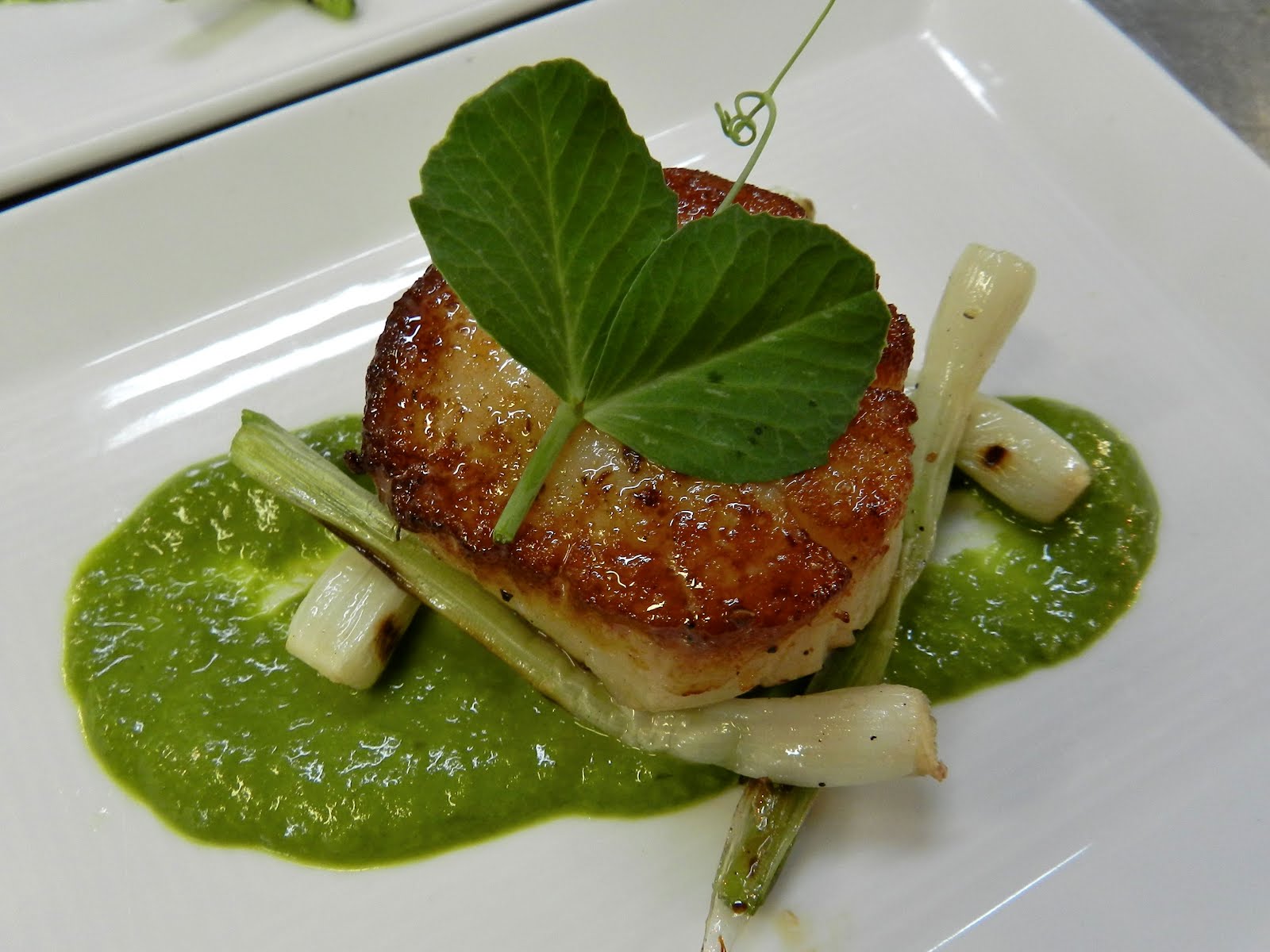
Sea Scallop. Spring always brings great scallops as new grounds are opened. I wanted to highlight our beautiful scallops against some of our local spring greens. The scallop is sitting on a purée of ramp greens and grilled baby spring onions and topped with a sugar snap tendril from my garden. The ramp bulbs have long since vanished into sopa de ajo.

Arctic Char. Spring always has me looking forward to salmon as it begins its spawning run up the rivers. It's just a little too early yet for salmon, but we do have two nice salmonids in house right now, arctic char and steelhead trout. Last week, we put up a batch of cured steelhead trout, so-called gravlax of steelhead trout, and we had a bunch of trimmings to work with.

On this plate, you see a mousse of roasted steelhead gravlax, fennel fronds from my garden, very lightly pickled hothouse cucumbers, seared arctic char, and a wonton containing gravlax, chives, and sour cream. The wonton came from wanting some crunchy element on the dish. And in the end, we decided to take the traditional bagel toppings and put them inside a crispy wonton as a somewhat cheesy (pun intended) nod to the God-awful crab rangoon served in ersatz Chinese restaurants. A little humor never hurt a dish as far I can tell.


Eggs, Bacon, and Toast. Now that spring has sprung and the days are getting longer, Sarah's ducks are cranking out far more eggs that we can possibly use to make our pastries. [Oh by the way, wondering why our pastries are so good? Blame the duck eggs!] So this dish was born of a need to consume duck eggs and of course also to showcase our awesome house-cured Berkshire pork belly.

Down on the plate, you see grilled and buttered focaccia topped with maple syrup-braised pork belly and a poached duck egg. We went through a dozen different plate presentations and finally in the spirit of consuming as many duck eggs as possible, decided to benedictify it with a lemon zest-augmented hollandaise. This sublime stack of wanton sinfulness is bejeweled with a crown of cilantro flowers from my garden.


Risotto. This dish didn't start as a risotto at all. For the longest time, it was just a list of ingredients: asparagus, morels, and duck confit. Our guests were very lucky that the first asparagus and the first morels of the year arrived in our kitchen simultaneously, lucky because they are ingredients that marry in the best kind of way. Morels, the king of mushrooms (you bolete fans are all wrong), deserve, no, they cry out for cured pork products. And what is better than cured pork? Our house-cured duck confit all poached in its unctuous duck fat bath!

So we had three awesome flavors that needed a neutral base to carry them and hence the risotto entered the picture, the rice marrying the ingredients and serving as a base for the garnishes: grilled asparagus, chive blossoms from my garden, and a morel dipped in cornstarch and crisped in hot oil. Ambrosial!


Picnic. I don't know what spring has on your mind, but a picnic is definitely on my mind. This dish is our homage to classic American picnic food: fried chicken, deviled eggs, and potato salad. Our fried chicken is an herb-marinated and grilled quail. Our deviled eggs are naturally quail eggs. And our potato salad, well, it is better than most potato salad you will ever eat, is instantly recognizable as potato salad, and yet, contains zero potatoes.

The potato salad is down on the plate letting us stand the boned-out quail up against it with the deviled egg halves nestled against it. Just under the quail and spilling out to the side of the eggs is an outstanding amarena cherry mosto cotto, cherry juice and grape must cooked down to almost a balsamic vinegar like syrup. To complete the cherry metaphor is a bit of dried cherry and celery salsa. Not only is it a great palate cleanser with the sweet-tart cherry working against the bitter crunchy celery, it is a reminder that cherries, that most delicious and first stone fruit of the new year, are just around the corner.

Oh, the potato salad. It's celery root, red onion, green onion, Surry sausage (our local Virginia smoked pork sausage), and parsley, all bound with mayonnaise.


Spring Lamb. No protein could be more spring in my mind than spring lamb and this one just arrived from the slaughterhouse. This lamb is so good that it really didn't need us to do much with it. I made a pesto from the tons of fresh mint growing in the boxes out in front of the restaurant and after boning out the lamb saddle, marinated the deboned loins in the pesto. In the vein of not doing very much with the lamb, I decided to serve it very classically, with pommes duchesse, mashed potatoes augmented with [duck] egg yolks and baked. Although you can't see it, the lamb is napped with a glace d'agneau, a highly concentrated lamb stock that we made from all the bones from the last lamb we received. It is so concentrated that it remains jellied at room temperature. We reheated it with a little white truffle juice.

The herbs I picked from my backyard in the morning. The lower herb in the photo is sheep sorrel which I included because lemony sorrel and lamb is a classic pairing, but also because I found it amusing to pair sheep with lamb! Corny, but true. The yellow blossom and the leaf above it is from a wild mustard plant. Lamb and mustard is a delicious combo. I often will drain the pan juices into a sauce pan after roasting a leg of lamb, add a little red wine, a little lamb glace, and then after straining it, will add Dijon mustard as a liaison to thicken the sauce. That, for me, is what the mustard greens on this plate evoke.


Rhubarb. Before there is any fruit in the spring, there is rhubarb, very much a vegetable, but one that we treat as a fruit. The only question here was how to provide a delicious foil for the sweet-tart rhubarb compote (rhubarb, cranberry juice, and sugar). Spring leads me to light desserts and light always leads me to Greek yogurt panna cotta, this one flavored with lemon zest and poppy seeds. For garnishes, you see a poppy seed tuile and lemon balm from my garden. The surprising element here is the black locust blossoms which had just opened for the very first time the morning of the dinner. I picked these from the backyard and just before serving them, tossed them in a dressing of honey, lemon juice, and lemon zest. The locust blossoms have a flavor at sweet pea crossed with honeysuckle nectar. They are delicious.

Saturday, April 14, 2012

Alien Ingredient #26: Khao Thong


On another quick trip to the market to grab a couple of things for the restaurant, I saw a new addition to the line up of Asian herbs. At first, I mistook this herb for sweet potato vines, which I have worked with many times in the past. But on closer inspection, it clearly wasn't sweet potatoes and it was labelled Kha Thong. Google didn't help, which led me to believe that there was a typo in the name somewhere.

It took me a few minutes of puzzling to figure that this was some kind of bastardized Thai name, but fortunately before I could spend too much time digging into the name or running it across the street to the Thai restaurant, a customer put me on the right track. [Tran Huong-Thu, thank you!]

I now see that I was looking for khao thong, or more properly, phak khao thong, aka Houttuynia cordata. English names are heartleaf and fishwort. It was described thus: "The shoots and young leaves of khao thong have a strong fish-like smell with a hint of lemon. They are eaten raw with jeo or laap, giving a slightly bitter flavour." And, "has an unusual taste that is often described as fishy (earning it the nickname "fish mint"), so it is not enjoyed as universally as basil, mint, or other more commonly used herbs."

Yeah, well Tony and I hadn't read this before we chowed down on a leaf and spit it out immediately. We have decided that there is a more fitting name for this plant: Ass Plant.

Vote: Ass Plant says it all. We have already been there and you have been warned. No need to go there yourself.

Alien Ingredient #25: Ngò om/Rice Paddy Herb


Here's another Vietnamese herb about which I have read much but never worked with before, the so-called rice paddy herb, a name that fittingly describes its preference for hot and wet growing conditions.

On tasting it, it presents a bright lemony, sweet, somewhat cumin-like flavor. In fact, it very much reminds me of shiso/perilla and I would use it in situations where I would use shiso. Which is a sneaky way of saying I wouldn't use it at all, not being a big fan of shiso. [When I say I'm not a fan, I'm not saying I won't eat it, because I will eat just about anything, but I am saying that there is no compelling reason for me to ever seek it out again.]

Vote: If you like shiso, you'll like ngò om. Me, I could do without shiso and I can do without rice paddy herb.

Friday, March 23, 2012

Alien Ingredient #24: Kinh Giới


This is a fun herb that I have never heard of before. At first, I mistook it for Lemon Balm, an herb that we grow here at the restaurant for its wonderful lemon flavor. With its square hairy stems, this mint (Elsholtzia ciliata) differs only in very slight ways from lemon balm. Tasting it, the flavor is slightly different too. It reminds me more of lemon zest than lemon balm does. Lemon balm has a slightly more lemongrass/citronella flavor. Of all the lemon-flavored herbs, this Vietnamese Lemon Balm is the closest imitator of lemon zest. It really is quite good and I look forward to converting this to a sorbet or granita for our tasting menus this week.

Vote: An herbal dead ringer for lemon zest. Excellent!

Postscript April 14, 2012. Kinh Giới has found a place on our appetizer menu in our Shrimp, Lemon, and Vietnamese Lemon Balm Risotto. It is proving to be quite a useful herb.

Alien Ingredient #23: Rau Răm


After years of reading in my Vietnamese cookbooks about this magical herb called rau răm (Persicaria odorata), I finally stumbled across some at the market. Excitedly, I brought some of this herb that is also called Vietnamese Coriander back to the restaurant. You can tell from the Latin odorata and the common name coriander that this should be a fragrant herb à la cilantro or Thai basil. And according to my texts, rau răm is used as a fresh herb, often as a garnish, just as are cilantro and basil.

I have rarely been more underwhelmed by an herb in my entire life. I crushed a leaf and it smelled of nothing but crushed green leaf. I tasted it and it was totally blah, just like chickweed. Nothing but a vegetal chlorophyll flavor.

I'll try again if I ever see it again, but this was a total waste of time and money.

Vote: What is the point?

Friday, March 16, 2012

Guajes and Smoked Octopus

We keep on playing games with food here and some things work and are worth repeating and others get relegated to the it-was-interesting-but-not-that-interesting file. Here are photos from our latest Chef's Table, our regular 6pm 6-course tasting that we hold every Thursday evening.

California Roll Salad. We decided to deconstruct a California roll and present it as a salad. Honestly, though I am sure that the flavors are all fine, I'm underwhelmed by the result in the sense that it is probably not as good as a straight up California roll. I think there is too much going on here, something that I am not often guilty of: avocado, sesame seeds, wasabi, guaje seeds, yellow tomato, puffed wild rice, crab marinated in yuzu vinaigrette, tobiko, and slivers of nori. All fine ingredients but fails to adhere to less-is-more and I'm not wild about the presentation either. Minor fail.


Skate Cheeks. Everyone who eats seafood should try skate cheeks at least once. They are such wonderful morsels of pillowy goodness. You see them here in a sautée of artichokes hearts and pancetta, finished with white wine, herbs, and butter. Life is very good after you eat this dish.


Rosemary-Smoked Octopus. For me, this was the highlight of the dinner. I have never had smoked octopus before and not sure what prompted me to smoke it this time, but I am hooked. This is a really good dish. We poached the octopus in court bouillon until it was tender and chilled it overnight, then I cold smoked it lightly over cherry wood and fresh rosemary. At service, I tossed the octopus in unfiltered extra virgin olive oil and fleur de sel and warmed it on the grill. You see it sitting on an orzo, feta, and oregano custard. The dish is garnished with more olive oil, a squeeze of lemon juice, and the tiniest of sprigs of oregano that are just now popping up outside the restaurant. This dish is a winner, hands down: well conceived, well executed, nicely presented, and outstandingly delicious.


Grilled Brined Pork Tenderloin. We had some leftover trimmings from a pork tenderloin entrée, so we decided to brine and grill them to show off our dried cherry olivada and amarena cherry mosto cotto. The brine is salt, brown sugar, allspice, and pepper. The "olivada" is a tapenade-like condiment consisting of dried cherries, olives, anchovies, capers, garlic, thyme, oregano, lemon juice, and extra virgin olive oil. We colored a parsnip purée with spinach for contrast on the plate. Very tasty.


Local Lamb Rack Roulade. I removed every other bone from a large lamb rack and then butterflied and stuffed the rib-eye with a mixture of brunoise of sunchoke (Jerusalem artichoke), rosemary, Dijon mustard, panko, and goat cheese. Then I rolled the rib-eye back up, tied, seared, and roasted it. Here you see it with a wild watercress pesto and a glazed lozenge of celery root.


Baked Alaska. How often do you see Baked Alaska at a restaurant? When made correctly, it's a light and whimsical ending to a meal. On a base of sliced pineapple, we mounded our jackfruit and Meyer lemon granita and then piped on a layer of coconut Italian meringue made from the whites of all the local duck eggs that go into our pastries.

Alien Ingredient #22: Guaje

I was amused to see what looks like locust pods in a bundle on the shelf of the produce section at the store. And even more amused to see them on an episode of Chopped the very same evening that I bought them for this series. These guajes are the seed pods of a Mimosa-/Acacia-looking tree (Leucaena leucocephala) native to southern Mexico. No wonder they look like locust seed pods—the trees are cousins. These have a bronze tint; I have also seen bundles of green pods as well. I am led to believe that they taste identical regardless of pod color.

First things first. There is no way that this seed pod is edible: it is way too tough. That some of the contestants on Chopped would have not figured this out just goes to show what lack of talent that show features. So how to open them? First, they're green (in the sense of immature) so they don't split open as readily as dried bean or locust pods. I've shelled a bunch of beans in my life and these are tougher than some and easier than others. Rip one of the long strings off one of the edges and then starting at the tip, try to split the two sides of the pod apart. Once you get it started, the pods open fairly readily and the beans pop right out.
So what you have left when you shell out the guajes is some green pumpkin seed looking affairs without a hard seed coat. Into the mouth it goes and—drumroll please—it tastes green and vegetal with overtones of avocado and a pleasant undercurrent of garlic. Not too different from the green chickpeas we tried a few weeks ago. The first thing that comes screaming into my brain is guacamole. As soon as the bags of avocados on the counter ripen later this week, these guajes are definitely going into guacamole. Some tortillas are going into the fryer. And I am feasting.

Digging around on the web, I see that guaje seeds are frequently used in guacamole (great minds think alike), in green salsas, and in cooked sauces. I have no doubt that they would be wonderful in my next batch of pepián (a green mole).

Vote: Who would think something this awesome comes from a dry, stringy seed pod? I love these things and am having a hard time imagining guacamole without them ever again.